So, if you have any questions or comments, please do put them in the chat and I'll try and answer them. If you're doing this course online, you can put your question into the the question list and we'll get an individual response to you as soon as we can. Now, this I want to take a very practical approach to this.
So, here are some practical considerations. I should say the most tricky part of this and the most timeconuming is writing the actual case studies themselves and there are different ways of doing that. Um I'm going to give you a few to get you started.
So you've got that. Um you can use AI that's one way of doing it to to nuance it and differentiate it. There are collections of case studies you can use.
There are some published ones actual real life case studies but that's usually there's too much detail to use with a client. You don't want to give the client six or seven pages like Pedeski's famous um vlogger um where she breaks it down. It's very very interesting but you know there's still uh it's quite fragmented.
You need to have it all in the one place. So there are different ways of doing it but it is worth doing it and you can use it again and again of course but here are some things you need to bear in mind. First of all the client themselves might have reservations.
It might open up new issues of discharge. If you are uh using case studies with a client very often like I um have been doing in the past, you're using it towards the end just to check what the client has remembered, what the client is aware of, what the client's going to apply going forward, what's easily activatable by the client. Now what if they're asked about techniques for um getting something done and not procrastinating?
what pops into their head? Does anything pop into their head? But the thing is that if you only use it at discharge, it might raise brand new issues.
Now, it shouldn't. If you've worked with a client appropriately to get them to explore issues and and and feel on top of them, have a plan and know how they're going to look after themselves. But there is that risk.
The second is clients will sometimes struggle to make comments initially, and that's fine. And you can give them plenty of time, but it is a good uh reason to give them prompt questions, which I will show you to help them get started. And again, one of the techniques is to try and get the client to answer a question that you is printed on the sheet, but then saying, "What else would you like to say?
" You know, use that just as a warm-up really. And something which I've I've seen with clients a couple of times is they're really enthusiastic. they want to do well and they know they've got the techniques and I don't know maybe I'm talking to a client about uh aspects of their social anxiety and they've got all the exposure and response prevention they've all their rules um for for living they've got their awareness about unhelpful thinking styles they've got their mindful they've got a whole range of techniques and they mention those spontaneously but maybe they forget about something like visualization to visualize the uh social gathering you're going to and play around with that in your head and they feel cross that they didn't mention it cuz oh I use that all the time I can't believe I didn't mention it and that's fine but that can come up if clients set too high a bar when they're enthusiastic at discharge clients will make all kinds of comments I want to give you some examples of the comments that you might get and and really you know how to handle them so we'll go through this but obviously the first thing is to and the temptation to correct the client is probably not the main problem because you know that we wouldn't do that.
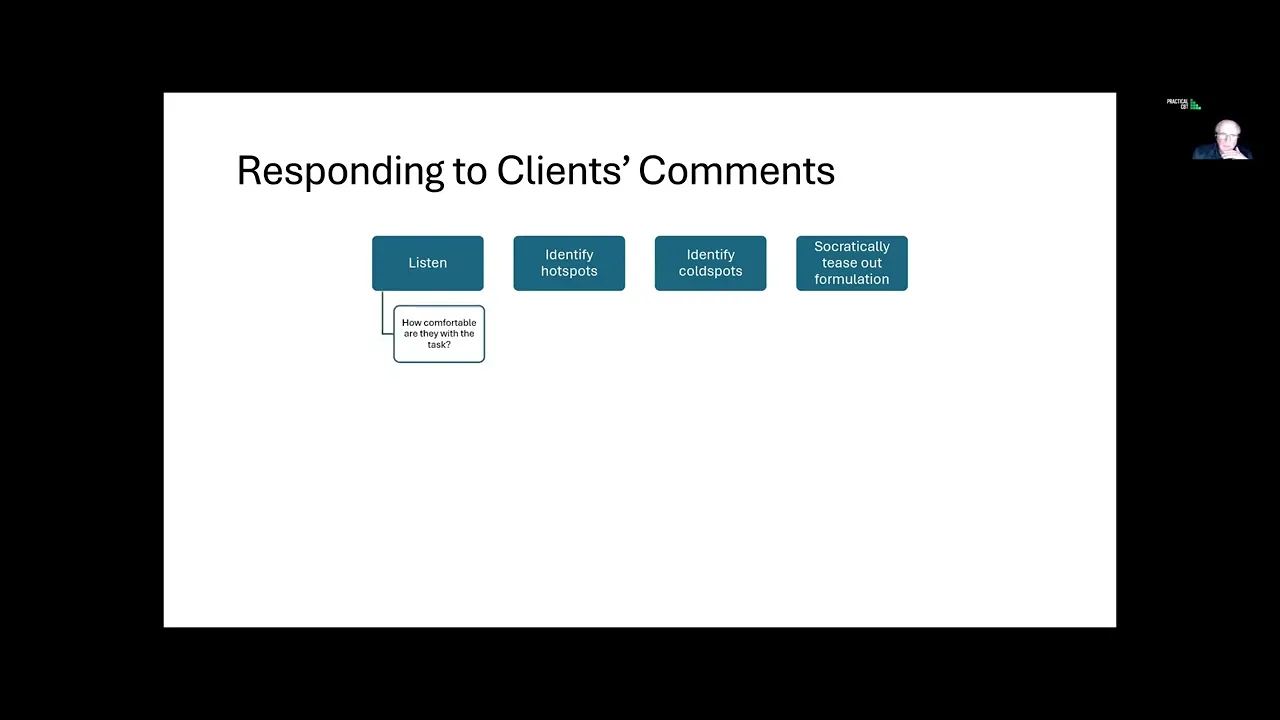
Um but it it's kind of too much to work with a client to get them to say more about what they're thinking immediately. It's really important at the beginning of this, particularly if it's the very first one, to give the client a chance just to talk and get their head around the idea of talking about a fictional third party. We want to identify the hot spots.
In other words, the the areas where the clients, and we're talking here about any case study at any point in therapy, not just at the end. If the client, you know, through the non-verbal behavior or through the answers they give or laughing or saying to you directly, "Wow, this really hits home. I can see now that that is something that I do and it's probably not helping me either or that's something I avoid and that's probably not helping me.
So that's a hot spot. You've hit you've hit paid dot there and you want to make you know want to build on that but you want to be patient and wait until the client said everything they want to say before you you move in. We also want to identify cold spots.
And this is something which you might have heard me talk about before which is that you know clients who let's say are suffering from health anxiety and they get the four famous dimensions of health anxiety. If the client has all the symptoms or all the the high ratings on the instruments apart from thinking that getting a disease would be very very bad. They just think there's a high probability of getting a a disease, but they just don't think it's be terrible.
That's quite atypical to you. You want to say, well, why isn't that there? Why isn't why is it the client's got all these other symptoms and all these other preoccupations about their health, but they're not preoccupied by the idea it could be debilitating?
And this is something you can build on. What is the client's way of thinking in that domain that seems to make them more balanced, more rational, more self-aware than in terms of the the vast vast overestimation about the probability they have of catching some very very rare tropical disease. You want to socially tease out the formulation.
So, you kind of want to make sure that the client neither limits themselves to saying, "Oh, yeah, you know, Tom's anxiety clearly is stopping him doing well at work. " And then just and that's it. I mean, that's good empathy, but it's not going to help the client.
And equally, uh, this is really much trickier, try not to cash in on the client, saying, "Tom's really got to pick himself up after that disappointment last year, not getting a promotion, and work really hard and put himself out there. " Now, you know, if the client gets to that point, there's a lot of stuff going very well there. But what you really want is the client to do the link.
You want the client to say something along the lines of, "Tom is going into his shell. He's avoiding people and developing negative um self assessments and that is stopping him from doing a good job. It's self handicapping.
He's he's not allowing himself to find out about the new techniques in the company. He's not meeting the new employees. He's not getting there to some of the leadership forums.
And that's that's something he's got to avoid. He's got to stop avoiding those things. You want the client to make that link about the consequences of action.
In any event, here are some spec specific things to bear in mind as the client talks. Just ask yourself, how comfortable are they with the task in general? Not because you're going to stop if they're a little bit anxious because they need a little bit of stretch for this.
How concrete are they? Are they vague? Are they talking in generalities?
Are they really getting into the concrete specifics of this case? You want a balance moving initially from broad to the concrete? But that's what you want.
Do they use CBT nom included? Not a problem if they don't, but it's good to sort of just track whether they're picking up on maybe some of the worksheets you've been giving them, some of the concepts you've been giving them, for example, on unhelpful thinking styles. If they pick that up and use it, that's really good.
Or negative automatic thoughts, that shows that they're picking up on some of the conversations you will have had with them or maybe some of the worksheets. But if they talk about people having biases or um knee-jerk reactions, then that's okay. But you might want to just check they are absorbing some of the concept because as I've said before the more the client and the therapist can establish a common vocabulary without excluding other things a common vocabulary it makes it easier to reference things further down the line for the client and for the therapist.
Do you want to identify hot spot? Things that must have been bad for them, things they want to address and cold spots, maybe something blatantly obvious potentially, arguably in the case study that's not mentioned by the client at all. That might be something they're avoiding or something they think's unproatic and doesn't need commentary.
Maybe something's been managed vaguely, something they talk about as being possibly an issue, possibly not. And to tease out the formulation, what are the emotions? try and get the client to identify the emotions the person is experiencing and how those emotions of course are driven by their beliefs but also how those emotions drive behavior.
That's really fundamental. We often talk about the ways in which the beliefs impact on emotions. He's out to get me so I'm scared but not so much on the impact of the emotions on behavior.
I'm scared I'm going to lock myself in the house for next weekend. So what thoughts are driving them? So these are the things we want to be alert to as the client is doing their written or spoken, preferably spoken analysis or commentary on the case study.
One of the key questions is how could it be different? To ask the client when they've been able to answer the little prompt questions, give their general commentary say well how could things be different? And even you know what one aspect of Tom's life if it was different would be much better for him.
Could could he change that? Could he do something to make that different? Exploring agency.
So I think agency comes into it very very directly here because we don't and you you'll see from the case studies I'm going to show you the ones I think are most powerful the ones that present the initial presentation of the client. I think it's got enough detail without driving it. You don't want the client to be told a story about John was depressed.
He did a lot of activities. He recognized he was um unduly pessimistic. He went back to his social network and he's fine now.
Stop drinking. He's fine now. But there's not a lot the client could do with that.
You want it to be kind of a cliffhanger, right? You want the client to be saying, "Oh gosh, what's going to happen next? Well, he could do that.
He could do this. If that was different, that would be great. It's going to be more engaging for the client self-evidently, but you want the client to have sufficient detail to engage, but not so much detail that they feel as though, well, it's obvious what's going to happen now.
It's done and dusted. I'm reading a this is all in retrospect.












![Gravitation' by Richard Feynman [1080p HD Video with clear audio]](https://img.youtube.com/vi/q_edsSpDzHg/maxresdefault.jpg)