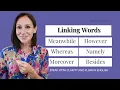
Have you ever felt that heart-stopping panic when someone says, What was that? I lost you or Say that again? I'm not following you.
It is stressful and frustrating when others can't follow our ideas. And yes, of course, it could be distracting background noise, making it difficult to hear, or perhaps someone is unfamiliar with a topic, but sometimes it's a lack of smooth transitions from one idea to the next. Let me show you what I mean.
Listen and read these examples. First, Helen walked to the store and bought groceries. She went to the bank to pay her bills.
She didn't go shopping. There wasn't enough time. Compare those sentences to Helen walked to the store and bought some groceries.
Then she went to the bank to pay her bills. However, she didn't go shopping since there wasn't enough time. What differences do you notice in those groups of sentences?
Is one easier to understand than the other or does one have more clarity, more flow? You may have noticed that I sprinkled in just a few extra words in that second example. I included the words then however, and since.
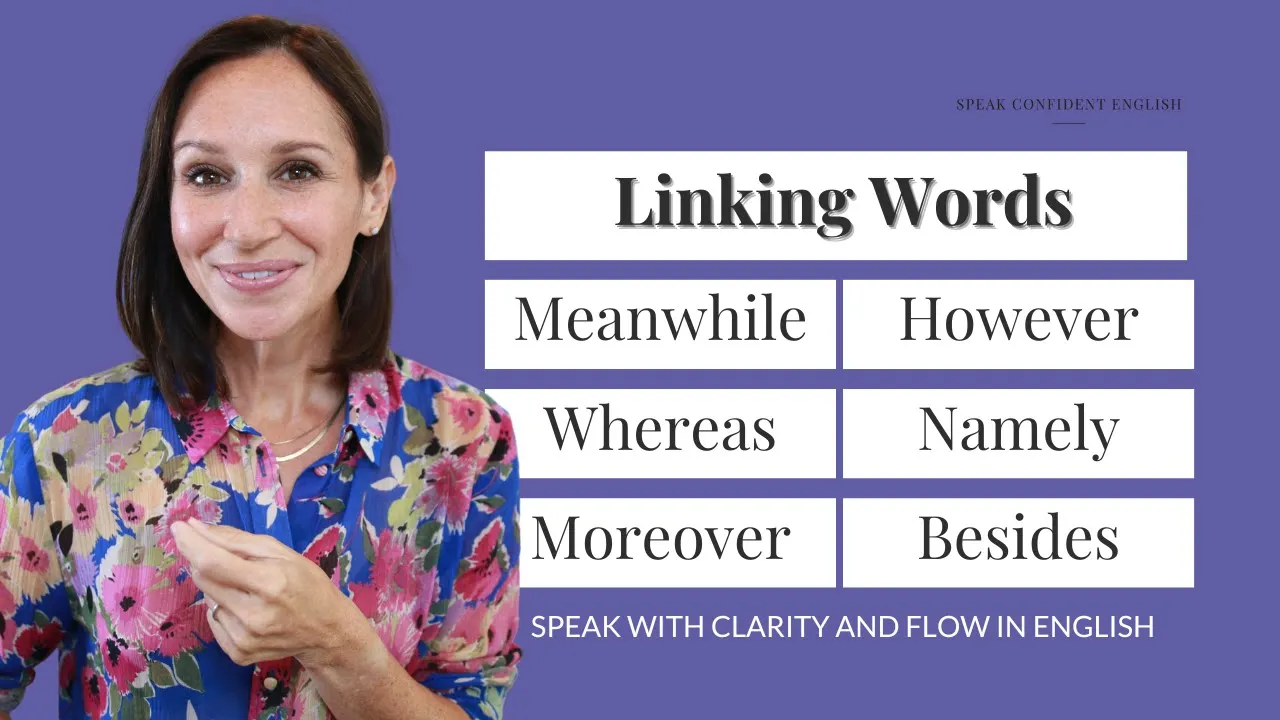
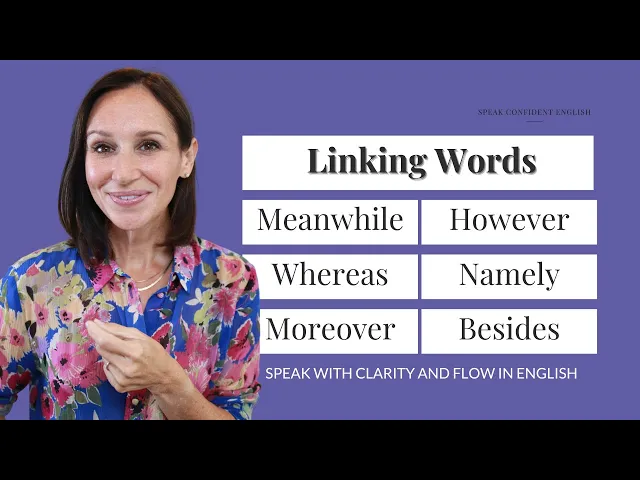
These small but mighty words are linking words, linking words, also known as sentence transitions or transition words, help your sentences to flow smoothly from one to another, allowing for improved clarity. When you speak in English, those linking words allow your listeners to easily follow you as you transition from one sentence to another and another. In other words, they don't get lost in this Confident English lesson.
Today, you're going to learn eight ways to use linking words and phrases for those smooth, clear transitions when you speak in English, and I'll give you multiple examples so you can use these sentence transitions with accuracy and confidence. Before we get started, if you don't already know, I'm Annemarie with Speak Confident English. Everything I do is designed to help you get the confidence you want for your life and work in English.
One way I do that is with my weekly Confident English lessons where I share my top fluency and confidence-building strategies as well as tips for how to communicate with clarity in English just like in this lesson today. So if you find this lesson helpful to you, make sure that you give it a thumbs up here on YouTube and subscribe to my Speak Confident English YouTube channel so you never miss one of my Confident English lessons. Before we get into our eight different ways to use linking words, I want to answer two important questions.
Number one, why are linking words so important and number two, where do you put them in the sentence? So first, why are they so important? Linking words create smooth transitions from one sentence to another.
In other words, they create a logical flow. For example, they help us indicate whether we are making a comparison or identifying similarities between two things. They help us show contrast or indicate that we're adding on a detail, linking words indicate a sequence and also create cohesion.
They can draw attention to specific words and bring emphasis to what we're saying, and when used regularly, they act as a map helping your listeners follow you as you speak. Not only is it important to use them, but we have to know where to put them in the sentence to ensure clarity and organization, so whether you're writing or speaking aloud, linking words can be placed at the beginning of a sentence in between a sentence or an idea, and at the start of every major point in an argument. For example, let's take a look at two sentences to highlight this.
At first, the book introduces the history of psychology. Later it shifts to contemporary studies and theories. In these two examples, we have linking words that come at the beginning of the sentence.
They also indicate the start of a new point. This helps your listeners follow the flow of ideas and make connections between them. With that in mind, let's get to our first use of linking words to reiterate or repeat.
From time to time, it may be necessary to repeat something that has already been said. We typically do this in an effort to clarify or draw attention to or bring emphasis to something that has been said previously. To indicate this, we have multiple linking words and phrases we can use, including as I already mentioned, as I've said, to repeat as Sarah said or like Sarah said, or simply again, let's look at how we might use these in an example sentence.
Imagine you're at a meeting discussing your company's social media strategy, and in that meeting, a coworker suggests a change in response, you say, As Linny said, we should wait for more data before making any major changes to our strategy. The second use of linking words and phrases is to create a sequence. A sequence helps us understand the order of events, and if you're communicating multiple ideas, it's important for others to understand the timing or the sequence.
Using linking words effectively not only allows for those smoother transitions, but it also allows your listeners to follow your train of thought and understand the timing or the sequence. Common linking words we use for this include first, second, third, last, before, beforehand, after, afterward, then, next, at the same time, meanwhile and many more, if you want to get additional examples of linking words you can use to indicate sequence, I recommend you visit this lesson at the Speak Confident English website where I've also included a written portion with more examples than what I've shared here and now. Let's consider another scenario so we can see how these would be used in a sentence.
Think about the last time you made a recipe perhaps for baking a cake or baking some cookies. In sharing that recipe, someone very likely used sequencing words to help you understand the order of steps. For example, first mix the butter and sugar together, then add the eggs one at a time.
Without those transitions, it's possible that recipe could go terribly wrong. Our third use of linking words is to express conditions. In other words, one thing may only be true or may only occur due to another.
For example, if you're discussing plans on starting a business, you might say to someone, I'm on track to starting my business next year so long as I continue saving money and we don't have a downturn in the economy, one thing will only happen so long as another thing occurs or doesn't occur. There's a condition. Other linking words and phrases we can use for this include as long as granted or provided that in the event that if and then that structure we typically use with conditional sentences and less and now use number four, we use linking words to provide support or to illustrate.
I'm quite sure you already use quite a few linking words that help you provide support. One very common one is, for example or such as these transitions allow you to share examples to expand on your ideas or provide support for your particular opinion or idea. Additional examples of this include, for instance, in other words, to put it differently, to put it another way, that is to say, and namely, if you want a few more examples, I recommend visiting this lesson at the Speak Comfort English website.
Once again, I've listed several more there in writing. As I mentioned earlier in this lesson, linking words allow us to indicate whether we're drawing comparisons or highlighting contrasts, and that is exactly what we're going to look at with use. Number five, we'll look at a series of linking words and phrases that help bring focus to a comparison or contrast.
If we want to highlight contrast, here are a few examples of linking words you can use in contrast on the contrary, on the one hand and on the other hand even so, or even though in spite of unlike, but however, and whereas, let's take a look at an example sentence and then we'll talk about linking words we use for comparisons. Let's go back to that scenario of being in a meeting where you're discussing your company's social media policy. Perhaps you're trying to convince your coworkers to make a change, and in doing so, you might say, On the one hand, there are benefits to waiting until we see the data, but on the other hand, the longer we wait, the more we risk losing our audience.
Now, when we want to address similarities or make comparisons, here are several examples of linking words you can use likewise, like similarly in comparison in the same manner or in the same way, and just as for example, let's say you and your partner are narrowing down your options for a property you'd like to purchase. In your conversation, you might say, Just as the first house we looked at is by the water and has great views, the last house has the same, It's just a bit cheaper. Our sixth use for linking words is to add on or to expand an idea, and once again, I'm quite sure you're using many of these linking words already.
This list includes in addition to additionally, furthermore, moreover, also plus and as well as imagine you're telling a friend all the reasons she should watch your favorite show and in order to convince her you want to add on multiple reasons. Here's how you might do that. This show focuses on real stories and retail's events in an exciting way, plus the actors are great.
Our seventh use on this list today is to emphasize or draw attention to something that is important to do that we use linking words and phrases such as it's important to realize indeed, in fact, of course, in truth, surely and besides. For example, let's say a coworker really needed some help, so you have decided to take on some of her workload, but oh, she's feeling kind of bad and guilty, so you want to reassure her. In doing that, you might say, Don't worry about any of this besides Kiko will be helping me as well, and now use number eight for linking words is to conclude or summarize.
When you shared multiple ideas, it's always useful to summarize the key points and highlight that final conclusion to help you do that effectively and tell your audience precisely what is happening. Let them know that you are now summarizing the key details or you're bringing them to the concluding point. You can use these linking words and phrases to summarize in brief, in short, in essence, overall and to sum up, these are all useful.
To help your audience understand that you are going to summarize or restate the key points. For example, let's say you're coming to the end of a long presentation and you want to reiterate the key points. You can do that by saying, in brief, we can cut carbon emissions by carpooling using renewable energy sources and upgrading our homes to be energy efficient.
After you've done that, you can go on to a clear conclusion and use linking words such as in conclusion, to conclude finally, thus, therefore, and as a result, if we were to continue those sentences where you summarized your presentation, your final sentence might be to conclude, cutting carbon emissions at home is an easy and small step we should all take. Take to finish this lesson on linking words and linking phrases that allow you to speak with clarity and have smooth transitions. Let's talk about how you can practice this.
I want you to first identify a topic that you feel particularly passionate about. It could be something related to politics. It could be a situation happening at work where you have a potential solution or an idea you'd like to share.
Spend a couple of minutes doing a mind map or writing down the key points to your argument or what you might want to share with someone to convince them that you have the right idea. Once you have those key points down, try to expand on them, add support. Maybe you've had a past experience or there's something you've read, heard, or some data that supports your position.
Write that information down as well. Then when you're ready, I want you to practice talking about it out loud. Share your thoughts on that political situation, Share your idea out loud, and most importantly, record it.
While you do that, try to sprinkle in some of these linking words to reiterate an important topic or to expand on an idea, to add an example or to summarize. Once you've done it, you can stop the recording and then go back and listen to it. Pay attention to the linking words that you used and also evaluate.
Are there opportunities where you could have used more? Following this process is one of the most effective ways you can improve your communication skills and make sure you're using those smooth transitions. If you found this lesson helpful to you today, I would love to know.
You can always give it a thumbs up here on YouTube and don't forget, subscribe to this channel as well so you never miss one of my Confident English lessons. Thank you so much for joining me, and I look forward to seeing you next time.
![How To Connect Ideas In English [with Linking Words]](https://img.youtube.com/vi/-JqAs_vdQb8/maxresdefault.jpg)








![English Phrases for Positive Communication [At Work and On Teams]](https://img.youtube.com/vi/5KnK5nOkITM/maxresdefault.jpg)