Egypt is one of the first and oldest civilizations in the world. Although it has come in dozens of different forms, the banks of the Nile River have hosted powerful civilizations for well over 5,000 years. Today the Arab Republic of Egypt, with its more than 100 million-strong population, is the 14th most populous country in the world [1], but most of that population is still generally limited to the banks of this one river, the river that made Egyptian civilization so successful, and yet could pose modern Egypt with a big problem.
[This video was sponsored by Squarespace. New sponsor! Also no this isn’t me claiming some sort of throne of Egypt, I do not want to claim responsibility for a country of 100 million people] So first, let’s set our bearings.
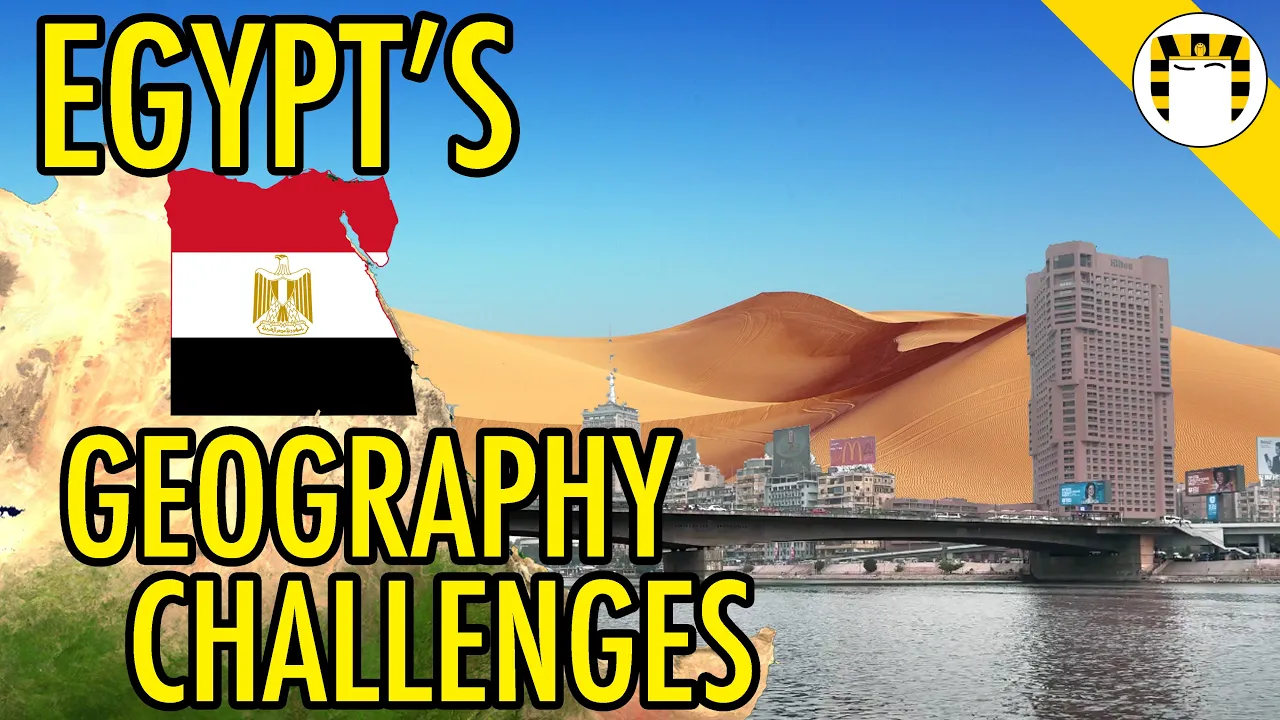
As I’m sure you already know, this is Egypt, a transcontinental country mostly in North Africa with the Sinai Peninsula in Western Asia. Politically Egypt is bordered to the west by Libya, to the south by Sudan, and to the northeast by Israel/Palestine (no we are not going into that debate here, I made this video to talk about Egypt, and I am going to talk about Egypt! ) Egypt is also bordered by the Mediterranean Sea to the north and the Red Sea to the east, but that’s just what surrounds Egypt’s borders.
In reality most of the country’s land area is essentially a buffer zone around its core. Looking geographically, Egypt’s historical success and modern challenges start to become clearer. Egypt’s core is of course the ever so fertile Nile River Valley, which is of course key to starting a civilization, as rivers provide freshwater for humans and crops, and a method of easy transport within the kingdom and to the outside world if it goes out to an ocean (don’t worry, I’ll get to the stuff you don’t already know, I’m just catching everyone up first).
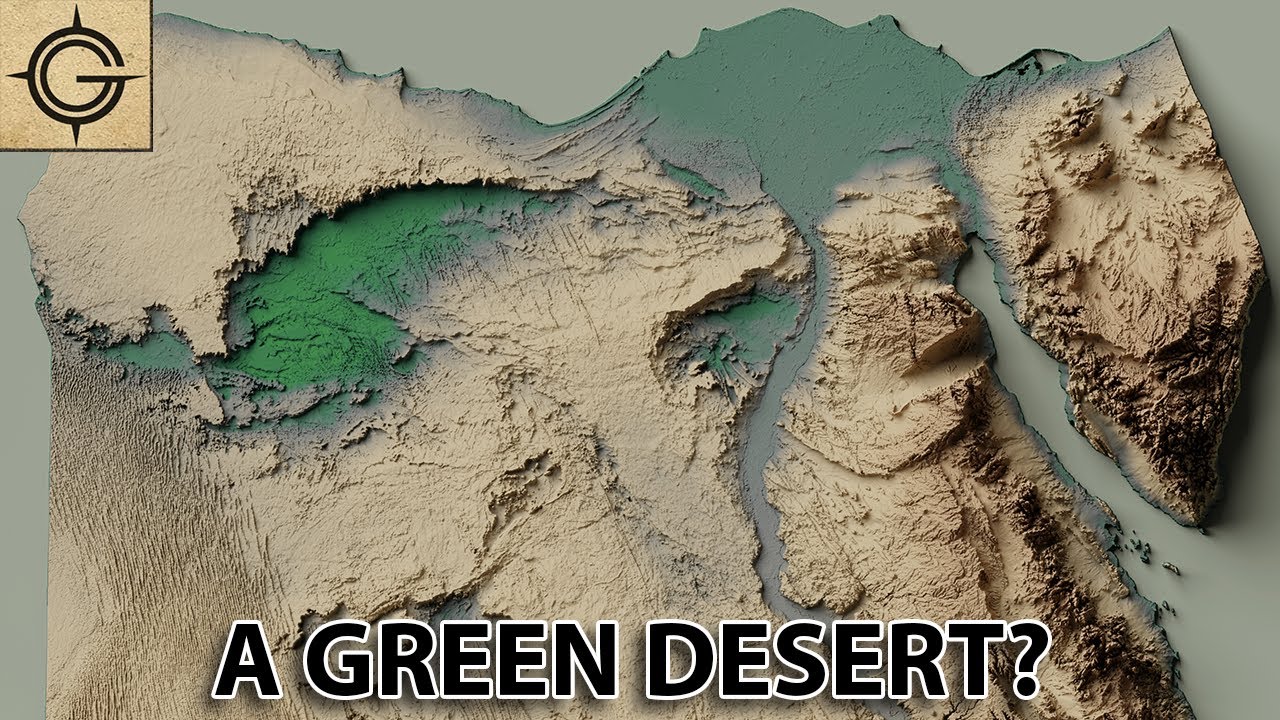
To better understand this country, Egypt’s geography can be broken up into four major pieces: the Western Desert, the Nile Valley, the Eastern Desert, and the Sinai Peninsula. Although almost the entirety of the Egyptian population lives along the Nile River Valley, one of Ancient Egypt’s greatest assets would have been the Eastern and Western Deserts surrounding it, precisely because of their inhospitable environments. Egypt had a large desert to the west and a sea to the east of some large desert mountains that were also to the east, and to the north was the Mediterranean Sea, providing both easy access to and easy protection from its northern neighbors.
Because hostile armies have a lot harder of a time going anywhere than friendly traders. Ancient Egypt was only successfully invaded a select few times from outside powers through one of two passageways, and even into the colonial era Egypt was almost always invaded either from the northeast or from the south. In fact, while Egypt has been invaded by the Nubians to the south and a whole crap-ton of empires to the northeast, many times-- particularly around the 15th century BC-- it was Egypt invading its neighbors through these corridors, as various Egyptian dynasties and kingdoms, from the New Kingdom to the Mamluk Sultanate, sought to expand their influence in this direction.
Between the Nile Delta and the Levant is the Sinai Peninsula, which despite its hostile climate and lack of oases-- and its mostly mountainous terrain-- is only around 200km long on the northern coast, meaning an army could travel through it in only about a week. This essentially provided an effective land corridor in and out of Egypt for the civilizations that arose in Western Asia, both for diplomats and for invading armies, with a series of fortresses also built during the New Kingdom to deter foreign armies [2]. Not that that always successful.
Now of course there’s quite a big drawback to being surrounded by empty desert wasteland no one can settle, you’re surrounded by empty desert wasteland no one can settle. Modern Egypt’s geographic challenges, while somewhat similar, are still very different from Ancient and Medieval Egypt. Egypt is located at what has become an important crossroads in the modern world, being the world’s largest Arab nation, partially in Africa and in Asia, and on the coast of the Mediterranean and Red Seas.
One of modern Egypt’s greatest assets, and where Egypt’s central position in the region becomes clear, is of course the Suez Canal, one of the two easy connections between the Atlantic and the Pacific and Indian Oceans. As one of the two canals connecting these oceans, and the only one that some of the world’s largest ships can fit through, the Suez Canal Authority made a reported US$5. 61 billion in 2020 [3].
This shortcut however has also become a chokepoint for international trade, as seen in the aftermath of the Six-Day War and just earlier this year when… when a… Egypt’s population has recently passed 100 million, compared to around 20 million as recently as the 1950’s [4]. Despite this, 95% of Egypt’s population still lives in the Nile River Valley, inhabiting 7. 7% of the country’s area [5].
To put this into perspective, imagine Spain times two, plus another 10 million people, and cram them all in an area the size of Czechia. Or in American terms, a place twice the size of California with the population three times that of California, but almost everyone lives in an area smaller than South Carolina. As I said in my How We Traveled in the Ancient World video (at least for those of you who actually watched it), Egypt doesn’t just depend on the Nile, Egypt *is* the Nile.
Its capital and largest city Cairo, although it didn’t even exist in ancient times, is now one of the largest cities in the world, with a metro area population of over 20 million. This all points to one of Egypt’s main domestic worries: overpopulation. The country is growing at a rate of 1.
8% per year [6] which could strain the country and the Nile’s resources. Now that the country has grown this significantly, and doesn’t generally have to worry about invasions, the deserts surrounding Egypt’s heartland now pose Egypt with a big handicap. The largest of Egypt’s 27 governorates is the New Valley or El Wadi El Gedid Governorate, with an area of 440,000 km2, around the size of Morocco or California, yet with a population of 245,000, smaller than Glendale, Arizona.
The governorate gets its name from the New Valley Project, which aims to irrigate the Western Desert and create a sort of new Nile valley. The New Valley Project is an ongoing project first undertaken in 1997, which aimed to irrigate the Western Desert by pumping water from Lake Nasser, itself created from the construction of the Aswan High Dam, which regulates the once unpredictable seasonal flooding of the Nile. This project however has thus far not been nearly as successful as hoped.
Envisioned by then president Hosni Mubarak, the project aimed to provide ample arable land with which to resettle up to 20% of Egypt’s population [7], but as of yet only 21,000 hectares of farmland-- 10% of the envisioned total-- and none of the cities or major infrastructure has been built. With the project dubbed by critics as “Mubarak‘s pyramid“. This however does not solve an existential threat to Egypt’s lifeline, and a prime source of already brewing geopolitical conflicts with its southern neighbors.
While Egypt relies almost wholly on the course of the Nile river, it only truly controls the last part of the river, with other countries controlling parts of the Nile further upriver. 3,000km upriver Ethiopia is building the $4. 5 billion Grand Ethiopian Renaissance Dam on the Blue Nile [8].
To Ethiopia this dam would help give electricity to Ethiopian homes and allow it to export this power to neighboring countries, however to Egypt this dam is seen as an existential threat. The dam obviously would not dry up the river entirely, but it would likely drastically cut the water Egypt receives from the river. Egypt argues that they are the historic masters of the river, especially as according to treaties from 1929 and 1959 granting it and Sudan 87% of the river’s flow [9].
Ethiopia, which never signed either of these treaties, argues that this would not affect Egypt’s water supply so severely, and that this is an imperative to provide power for Ethiopia’s also rapidly growing population. The real danger to Egypt though lies in how quickly the reservoir behind the dam will be filled, as blocking the river’s flow to fill it too quickly could result in droughts downriver. The Ethiopian government, already under pressure from citizens who have bought government bonds for the dam’s construction, hopes to fill it within 4 years, whereas Egypt argues for it to be filled in 12 years.
The two sides have sparred diplomatically over the issue for years, even to the point of threatening military action, but both sides must figure out a diplomatic solution before the dam is finished. With 40% of its population living in the Nile Delta region [10], this leaves much of the Egyptian heartland open to both external powers with dominance over the Mediterranean, and rising sea levels due to climate change, in addition to pollution and potential water shortages from upriver. Rising sea levels wouldn’t just inundate the low-lying farmlands, but would also bring saltwater into the delta.
Geopolitically, Egypt is a powerhouse in Africa, the Arab world, and the eastern Mediterranean-- culturally, militarily, and economically-- but in a sense, because they have to be. While they may only control the area within its borders, but ultimately it must look out for whatever happens further up the Nile, to impede trade through the Suez Canal, in the rest of the Arab world and Africa, and whoever’s the most powerful player in the Eastern Mediterranean. In the ancient world Egypt was given some of the best geography an early civilization could ask for, but now in the modern era, Egypt’s geography might have turned out too good for its own good.
[AD] Now I know the question you’re all asking, just how did I look so stylish this entire video? Well obviously it’s because I never go outside… without an ultra-fashionable Squarespace website! With a Squarespace website you can rock the world with your style, whether you’re starting a blog, creating member-only areas for your audience, or just linking all your social media pages to make a landing page… but in style!
With Squarespace it’s never been quicker or easier to build the website your business or project truly deserves. I actually made my website, khanubis. tv, long before Squarespace ever reached out to sponsor me, and it’s no joke actually been really easy to work with.
I mean it’s not slap-the-keyboard-and-get-a-beautiful-website easy, but it’s still easy to use and get the hang of. Even then though Squarespace has award-winning customer service should you ever need. Prove to the world your ideas are truly a force to be reckoned with by stunning them with a Squarespace website.
If you want to stun the market with your glamorous website, craft it to the look of your dreams on squarespace. com, and when you’re ready to pull the trigger go to squarespace. com/khanubis for 10% off your order with the code “khanubis”.
Your idea deserves a good website, your idea is a Squarespace idea (okay literally what does that even mean? We’re talking about websites not actual fashion here) (Yeah that’s the joke, you idiot!