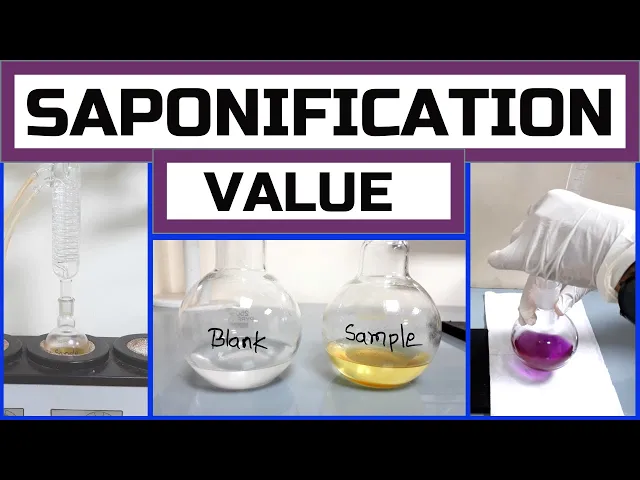
[Music] Hello viewers, before studying the main topic, we would like to give you a very good news for Micro Games Experiments family. Finally, we got the monetization, we are expressing our gratitude to you for supporting us and we hope that you will be with us for lifetime. So today we will learn a very important test procedure which is the determination of soponification value of an oil or fat sample.
The test involves five steps. Chemical preparation, sample and blank preparation, sophonification, titration and calculation. To carry out the whole test, we need a balance machine, bure withstand, reflex condenser, heating mantle, distillation unit, absolute ethanol, potassium hydroxide, phenopene, hydrochloric acid, and aluminium foil.
Let's start the analyszis. In this step, we will prepare chemicals and reagents. At first we will prepare 4% ethanolic potassium hydroxide solution [Music] with 1.
67 g potassium hydroxide pellets and take into a round bottom distillation flask. [Music] Now weight 1 g granulated aluminum foil. [Music] Transfer the aluminum foil into the same flask.
Now measure 200 ml absolute ethanol and pour into the same distillation flask. Attach [Music] a reflux condenser with the flask. Heat the flask and reflex the alcohol with potassium hydroxide and aluminum foil for 30 minutes.
[Music] After 30 minutes of reflex, remove the reflex condenser and set a distillation unit with the flask. [Music] Distill and collect 180 ml ethanol after discarding first 10 ml. [Music] Now turn off the heating of the distillation unit.
[Music] label the collected ethanol flask. [Music] Now gr some potassium hydroxide pellets using the motor and pastel to make powder. [Music] Take weight of 6 g ground potassium hydroxide pellets.
Transfer the pallets into a flask in which 4% ethanolic potassium hydroxide solution will be prepared. Now measure 150 ml ethanol we just collected from the distillation. [Music] Pour the ethanol into the flask containing potassium hydroxide pellets.
[Music] Mix and dissolve the potassium hydroxide in ethanol. Keeping the flask into cold water. 4% alcoholic potassium hydroxide solution is prepared successfully.
For the preparation of 0. 5 normal hydrochloric acid, dilute 4. 1 ml concentrated hydrochloric acid in distilled water to make the final volume of 100 ml.
Standardize the solution using a standard sodium hydroxide solution. For the preparation of phenopthylene indicated solution, dissolve 2 g phenopthylene powder into 100 ml ethanol and mix to dissolve. In this step, we will prepare our sample along with the blank.
Take two 250 ml flasks. [Music] Take approximately 5 g of oil or fat sample into the sample flask. Note the sample weight.
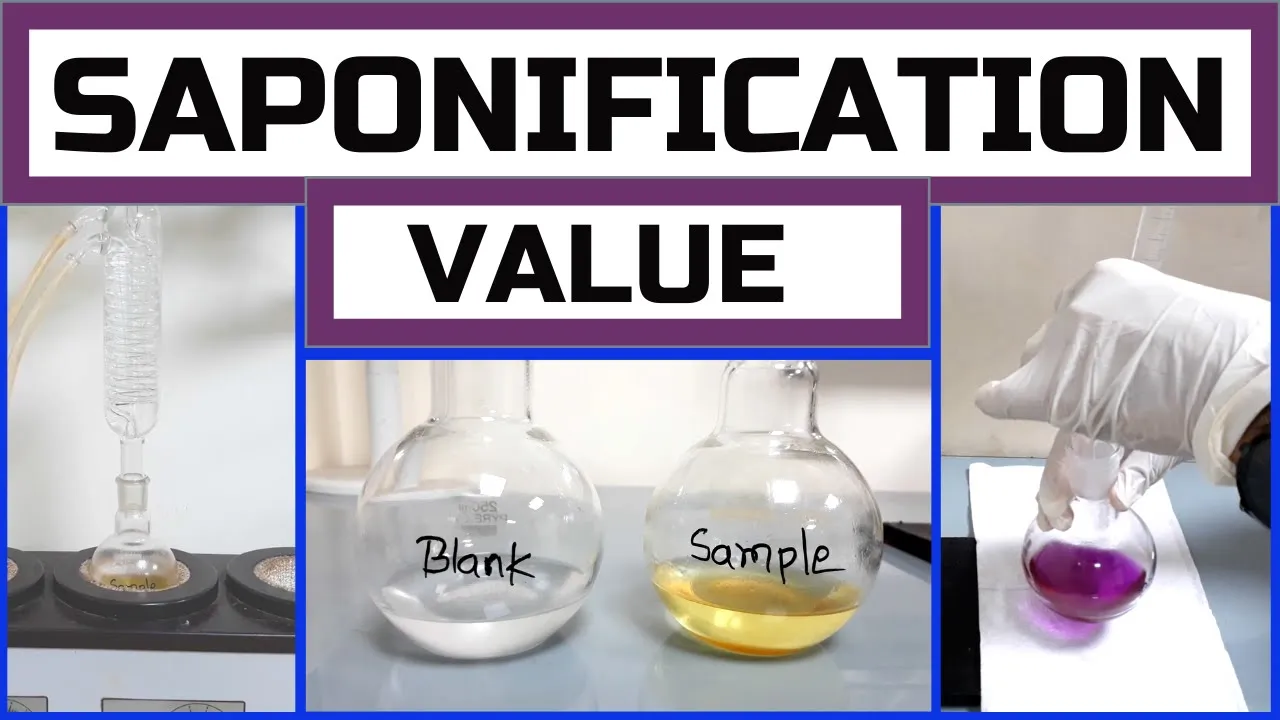
[Music] Now measure 50 ml of 4% ethanolic potassium hydroxide solution and pour into the sample flask. [Music] [Music] Now measure another 50 ml of 4% ethanolic potassium hydroxide solution and pour into the blank flask. [Music] Blank flask contains only potassium hydroxide solution.
No sample is taken in it. Sample and blank are prepared successfully and are ready to go to the next step. [Music] You can see a separate layer of the oil sample at the bottom of the flask.
[Music] For the sophonification, place the prepaid sample in a heating mantle. Attach a condenser with the sample flask. Heat the sample flask at the boiling point to reflex the content for 30 minutes.
Don't forget to turn on the cold water supply through the condenser before heating the flask. [Music] Soponification of the sample is started successfully. [Music] [Music] You can see the condensed ethanol is falling dropwise into the flask.
[Music] After 30 minutes, pull up the flask and check for the separate oil layer. In this test, no separate oil layer is seen and the mixture looks transparent and clear. Transparent mixture indicates the end of the soponification.
Now, cool the flask and remove the condenser. In the same way, boil and reflex the blank for 30 minutes. [Music] [Music] After 30 minutes, stop heating.
Cool the blank flask and remove the condenser. It's time for the titration. At first, we will try our saponified sample.
Check the sample flask for separated oil layer carefully. No separated oil layer indicates the complete soponification of the sample. If any separated oil is seen, continue the soponification for another 15 minutes.
In that case, blank should be reflexed for more 15 minutes as done for sample. After soponification, bring the cooled sample flask for titration. Add few drops of phenofthylene indicator solution into the flask and shake the flask for proper mixing.
Take 0. 5 normal hydrochloric acid solution in a bureet. Note the initial bureet reading for the sample titration.
Stir titration with vigorous agitation of the flask. [Music] Heat. Heat.
Disappearance [Music] of pink color indicates the end point of the titration. Shake the flask well and add few more drops of 0. 5 normal hydrochloric acid if needed.
[Music] Stop titration when the pink color is disappeared completely. Note the final bureet reading for the sample titration. Now we will titrate the blank.
Blank should be reflexed for the time which was needed to saponify the sample completely. [Music] Bring the cooled blank flask for titration. Add few drops of phenoscalene indicator solution into the flask.
Start titration after taking note of the initial beet reading. [Music] Hey, hey, hey, hey, hey, hey, We are using a bureet of 50 ml and we already used all of 50 ml of 0. 5 normal hydrochloric acid in this blank titration.
So hold the titration at this position and take the final bureet reading of this first session. Let's refill the bureet. [Music] resume the titration after taking the initial bureau reading of the second session.
[Music] Disappearance of pink color indicates the end point of the digration. [Music] note the final bure reading of this second session. Now we have to calculate to find the soponification value of our sample.
Let's put the known values first. Sample weights is 5. 27 g.
volume of 0. 5 normal hydrochloric acid needed for the sample titration vs is final bure reading minus initial reading which is 23. 3 ml in case of the blank titration we used total 58.
6 6 ml hydrochloric acid solution in two sessions. Now we will put these values in the equation given in the left side. [Music] By solving the equation we get the soponification value of our sample is 187.
88 mg of potassium hydroxide. This means 187. 88 88 mg potassium hydroxide is needed to soponify 1 gram of fat or oil sample.