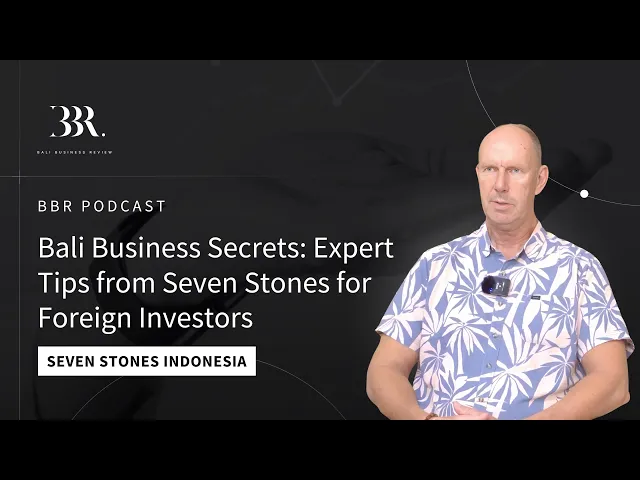
My name is Terje Nilsen. I'm originally from Norway, but I've lived most of my life here in Indonesia. We're going to talk a little bit about our latest company, which is called Seven Stones.
Seven Stones is a company that operates in what we call market entry service, which basically means that we take care of foreigners when they come up. They want a set of companies. They want to do their visas.
We do the accounting. We do taxes. Legal advice, transaction management.
We have offices in Jakarta and also in Bali. So that's our main activity. We set up PMA, or in English that would be similar to a Pty.
Ltd. From then on we do advice on how to structure that company, how to run the company, how you can be in compliance with different permits, with taxes and accounting. If you're investing in businesses, in real estate or hospitality, we also do legal advice, we do contracts.
If there is disputes and litigation, we can also help and service people with that. Also including different types of permits like building permits and operational permits and so on. The story behind Seven Stones is we actually came out of real estate.
We have been developing a lot of villas ourselves. We have also been doing marketing and sales of villas, which we still do, but not as much as before. The motivation was probably lack of consistency in legal advice.
So we started what we thought would be an in-house advisory to our clients looking to buy real estate. But I think because we've always been very active in the space of legal advice, talking about seminars and so on, people figured out, our client figured out that they could seek advice and use us for that aspect as well. So we quickly grew into that becoming our main business.
Maybe along that road we also then started working with a similar setup in Jakarta, which works a lot with the Nordic embassies because myself I'm from Norway, so we work with Norway, Sweden, Denmark and Finland. A little bit different from Bali. It's a bit more corporate.
While in Bali it's hospitality and real estate mainly. There are many good agencies in Bali. There are many, maybe not so good.
And I think there's a lot of misinformation, a lot of lack of valid information. In all fairness too, there's been a lot of changes recently with Omnibus Law, so there's a lot of confusion as to what is valid, what is not. But I think our main strong point is transparency.
We're very open with our clients so they can follow the process. They understand fully what is going on. And the reason for that is if there later is a legal dispute, ignorance is not an argument under any country's law, so also Indonesia.
We're very advanced in the understanding of regulations. We know what's coming. We have a very close relationship with the provincial government, but also the central government, so we can advise on changes that may come, whether that is taxes or bill permits or other aspects.
And I think for me as a person, being in Indonesia for more than 30 years, I think my brain wave maybe is half Indonesian, half expat, so I can maybe connect that energy level and that frequency and differences in the legal systems that sometimes becomes an issue for expats and foreigners when they invest in Indonesia. I think in Indonesia there is quite a lot of issues. I think maybe if we pull it down to the level of Bali then I think the misunderstanding and confusion as to how you can own and operate a villa operation.
A lot of people think as a tourist you can kind of walk off the street and lease a villa for 20, 30 years and then rent it out. That's actually not true. The regulation is very clear that you actually need a legal entity to be in full compliance.
That is one main issue. The other main issue that we see now maybe particularly since COVID and the opening up after that is that there is a massive number of developments and new villas being built and the understanding and implementation of permits seem to be almost missing in the sense that people believe that in Bali you don't need permits to start building while the regulation is quite strict and clear that you do have to have a proper permit. Collaborating with the government I think anyone can do but I think we are very active in communicating with the government to sort of find what we would call pain points in structures and regulations and give feedback but the main motivation for us to talk to the government actively and we actually do seminars with them is to actually show the market that Indonesian government officials and institutions are actually humans and very friendly and nice to work with.
So we kind of want to try to remove that stigma or narrative which is out there that the government is not cooperative or difficult to deal with. I think somewhere in between the government and the market, there is a lot of agents and misinformation that makes people confused but the government itself is very proactive to find solutions and encourage the right type of investments. I guess sometimes we probably try to do too much and we get a bit confused in what we are really good at.
I think we are really good at many things and maybe not so good in some other things. But in a business sense, sometimes you can have a legal decision that heavily impacts your taxes or the other way around. You can have something to do with your permit that will also impact your overall business plan and I think that you can find really good tax consultant, you can find really good legal advisors, you can find really good advisors on anything but that overall picture I think is our main strength and service so we can advise on an overall structure.
And I think that's where we kind of have the slogan partners in growth and we kind of mean that we grow together with our client, we want to see them develop their business and be successful and with that our services kind of comes along and grows with them as well. Yeah, I think there is many. I think we have set up probably thousands of PMAs so there's a lot of clients.
We were probably also one of the few agencies that refused to, during COVID, a lot of people set up PMAs just to hold visas so we never did that. But I think if you are consistent and you set up your company properly, you comply with your taxes and permits, most businesses that we have supported are successful. Whether this is an individual villa, a complex or sometimes bigger resource to develop.
Right now we work very closely with quite a few large Ukrainian developments and also Australia has found a new and fresh interest so there's a lot of investments and developments coming from Australia. These are mainly again into hospitality, into real estate and also a little bit not only Bali, They start looking at Lombok and Flores and other areas. We try to develop but we're not in a consultancy firm, we're not a hourly rate based agency so we don't use very much retainers.
Sometimes we do but- what we're trying to sell people on is a package so they come to us, they want to set up let's say a PMA, they want to fully understand that. Once that established and they may look at how to get visas, KITAS, dependent and so on. Then it evolves further into taxes and accounting, keep the company running, being in compliance.
So it's more an ongoing story where we have an ongoing relationship with the client. So it's not like a, I don't know, hit and run in the sense that we're done with the client, we don't see them again. We try to have a sustainable and a growth together.
So most clients stay with us for years and years and years. Insurance, I think, if we have done anything, I don't know, mistakes sometimes that happens. Maybe some examples during COVID, there was a lot of experts that had overstays and issues with that, with many different agencies.
We had one or two cases where we could discuss whether it was our fault of the client, but we actually took the responsibility and paid the overstay for the client. And I don't think any other agencies has ever done that. I think the biggest change in good and bad is that what we used to call a villa was normally like a 500 square meters to maybe a thousand square meters of land pool and, you know, a tropical living.
Today, that is down to maybe less than 100 square meters of land. Little plunged pools, maybe, and very cramped living. You see massive development on fairly small pieces of land.
That, I don't think is a good thing. I think it's challenging the infrastructure. I think it creates a lot of issues, not just traffic, but also on- In our sewer, electricity, all kinds of water issues that we see.
But Bali sort of keeps growing. And I think we'll find our way around those issues and deal with them step by step. Again, the government is very proactive and trying to find a sustainable and long-term solution.
Today, I think the main investment areas is Canggu and further west of that, now up to maybe Cemagi, Seseh, and even Tanah Lot and beyond, Kedungu and so on. Same with Bukit and Uluwatu. That's also almost exploded in developments.
Again, in good and bad, in the sense that someone are building in green belts and they may not be fully aware sometimes. And also Ubud has seen massive development. I think forward with infrastructure coming in, which I think will happen.
And I guess we need to wait for the new government to take place. But further development of roads and airports, I think Tabanan will be a very interesting area forward. And maybe also Karangasem and these areas will have a new second wind.
It used to be quite popular, faded away a bit, but it's now coming back. That most of our clients, we make them aware Again, maybe like a build permit and later on a activation permit, SLF. Also the different zonings, like you have green belt, you have farming land, you have residential, you have tourism, you have commercial.
All of those also dedicate what kind of business you can actually set up. What kind of permits you can get, like in the case of villas in the residential. As a PMA, you shouldn't really do short term, probably also not locals, even though that seemed to still be the case.
And then it depends on what kind of permits that you need from then on operational wise. Because Indonesia works with what we call a risk system. So from low, medium low, medium, then high risk, that determines what kind of additional permits and so on you need.
And because we tend to have a long term relationship with our clients and actively speak with them through the process We can quickly identify whether they have forgotten, let's say yearly tax compliance or there's changes within the immigration regulations or to have their investor KITAS or working KITAS. We can also update them and adjust the business to make sure they're in compliance. A few things, we probably get 85 to 90 percent of our clients from referrals, people that have dealt with us.
We're trying to change that. Not in a way that we don't want referrals, but we also want to get better at maybe online presence and marketing to grab people earlier so that we don't have too many issues and we can advise them early in the process of their setup. And what we do really well if you go to our web page or social media, we share a lot of information.
Anything from permits, we have specific groups that share legal regulations changes, all the way to geopolitical aspects, investment climate. Elections, what is Indonesia doing. I think people see that they can find a very complete overview of Indonesia as a country.
How it works, how it functions. Where it's heading, where it stands politically. Is it safe, is it not and so on and so on.
Well, I think right now, like the example of what you mentioned, the seminar about in Finns that was specifically to PBG, which is build permit, and SLF, which is the activation permit. And there's an awful lot of confusion, which we think is high risk for investors if they aren't aware and they don't follow that. So we tend to put forward topics that we think are important.
So other topics would be maybe from a taxation perspective. How important it is to comply with taxes and in Bali, unfortunately, there are some habits of sometimes underreporting and not even reporting at all when you're doing, let's say rent out or selling villas. Immigration is another hot topic, what's ongoing there and there's been a lot of changes with the new, our fairly new director Mr Silmi, who's done an awful lot of good work with a new, a lot of new types of visas and a lot more clarity into it.
So I guess those three topics, taxes, immigration and permits is the main topics, but we try to talk to the market, talk to our clients and sort of ask them to- What do you want to know more about, and where do you feel Maybe BKPM, the Ministry of Investment is another aspect. Integrity, Compliance, Understanding. In the sense that we make the client or our customers- Understanding really what they are doing and should do so they fully understand .
And can be part of the process and then they can make a choice whether there are aspects of that they do themselves or they use us or other agencies for parts of it.