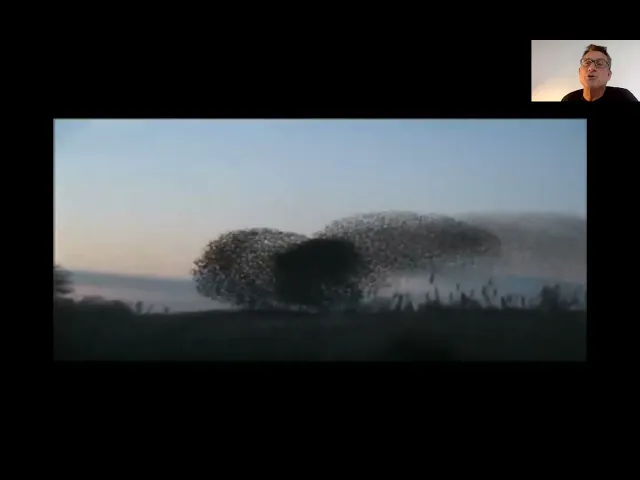
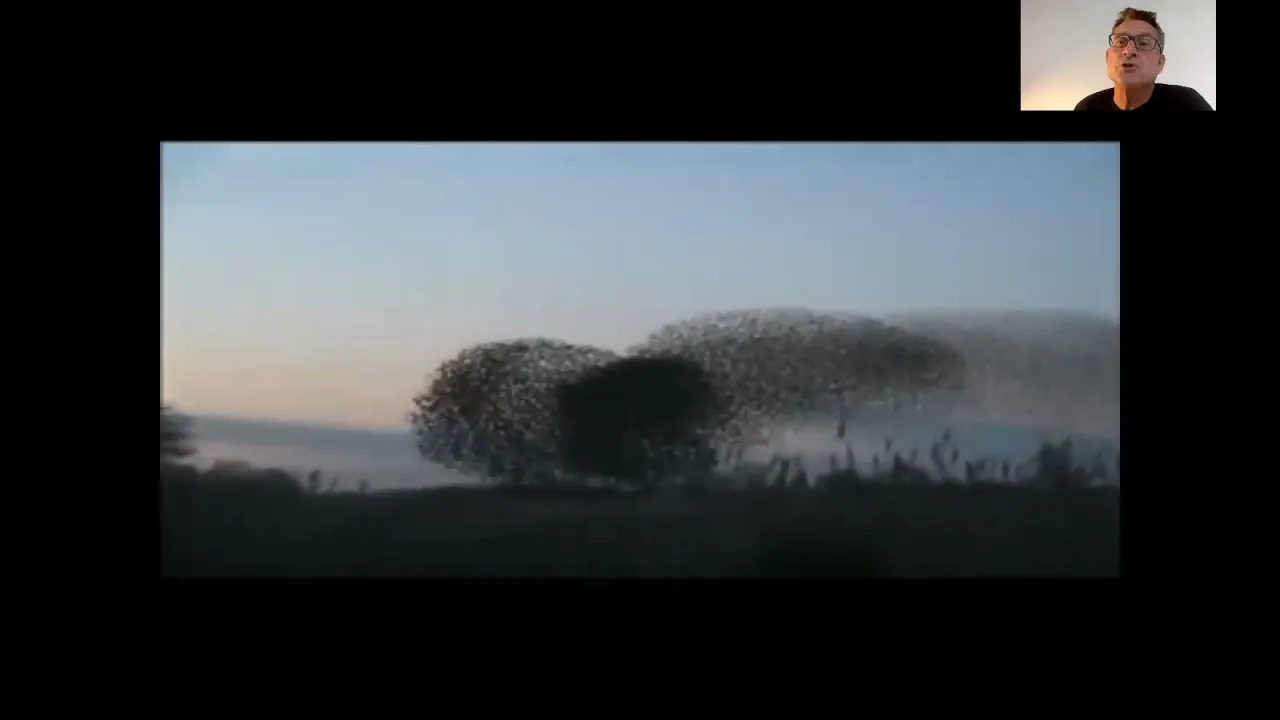
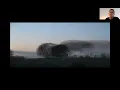
swarm intelligence how we to understand swarm intelligence we can see swarm intelligence at work in many aspects of nature we could see it at work in slime molds we could see it in work in flocks of birds we can see it at work in schools of fish the important point is the phenomenon remains the same no matter what the agents involved are this is of course a classic example of swarm intelligence the flocking behavior of birds as they come into roost at night especially starlings it looks of course exquisitely exquisite this aerial choreography but what
exactly is going on she pointed out first of all this is a form of bottom-up behavior it is not being controlled in a top-down way it is emerging it is emerging out of the aggregation the sum total of all the parts the whole in some senses is greater than the sum of the parts also it's important to recognize that the effect that is based on very simple rules each individual bird is following a very simple set of instructions keep a certain distance from the birds on either side keep a certain distance from the birds in
front but keep going in the same broad general direction at roughly the same outer individual variations have a a certain form of of differences it emerges and the flop takes on a life of its own importantly also we should be aware the birds themselves are unaware of this they have no idea of what is happening in the flock itself they are simply part of this this behavior initially it was thought that there were no there were no particular birds who were leading it there was no as it were captain wearing an armband like in the
soccer team who was who was leading the play it was thought initially that it was all based on on individual agents operating completely remotely but more recent research has been suggesting that there are a few individual birds that tend to be calling the tune in this flocking behavior we can see this throughout europe uh i used to teach at the university of brighton in sussex in the uk and this is a very common phenomenon that we would get almost every evening and when the starlings came into roost during the winter months we also saw it
a lot in in glasgow we could see it also in rome in italy um it's quite common less common perhaps in the united states but more common perhaps in the states you'd see the behavior of the schools of fish also uh flocking as it were sardines especially and here we can see a kind of sardine run whereby the sardines could make this formation as a form of self-defense safety in numbers but importantly also you could see it in the way that humans behave particularly in in more anonymous conditions such in subway stations where we tend
to act individually the discourse of swarm intelligence in terms of books started off with a book produced published in 1999 by three scientists from the santa fe institute in new mexico eric bonobo marco dorigo guitarales came together to write a book called swarm intelligence from natural to artificial systems this was a fantastic book in many ways but it was written in a very scientific matter it wasn't so it's not so easy to digest then stephen johnson a popular science writer came along and produced emergence the connected lives of ants brains citizen software this became a
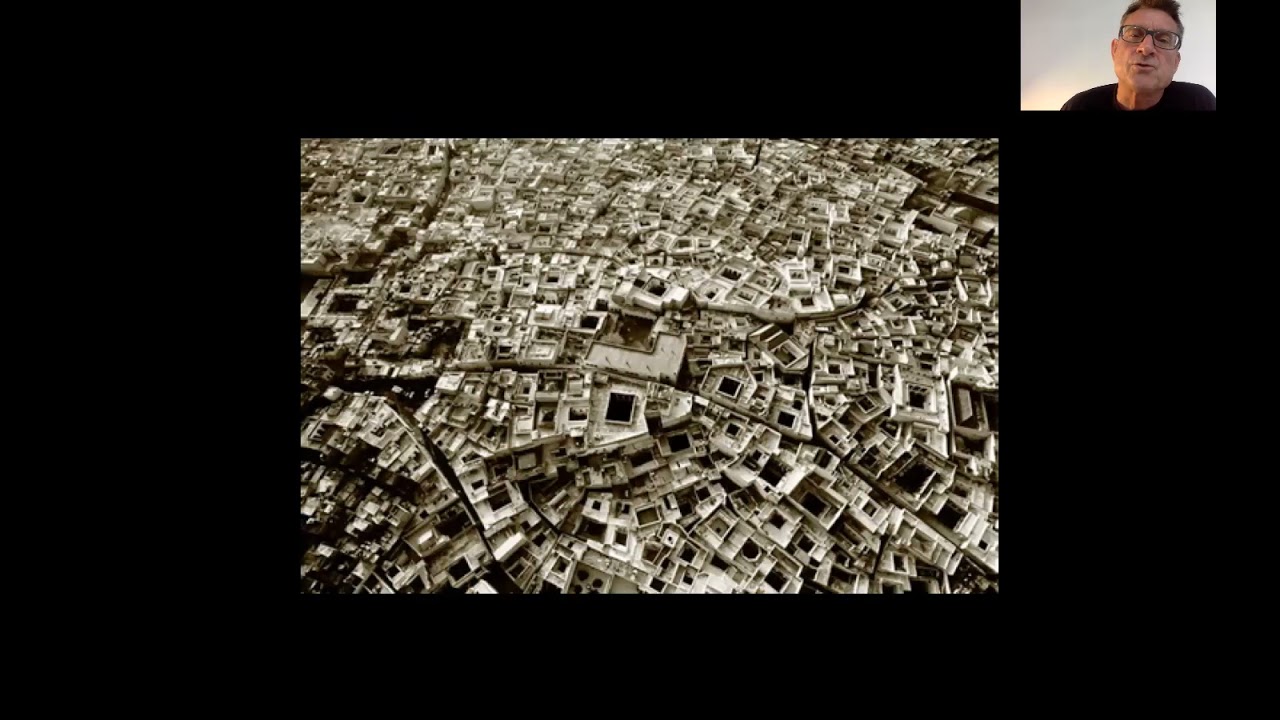
bestseller this was published in fact on the very day of 9 11 and stephen johnson himself lives in new york the important aspect of this book is not the title so much or the title is itself important the notion of emergence how certain behaviours emerge but the subtitle the connected lives of ants brains cities and software the point being that no matter how incommensurable the agents involved all of these are multi-agent systems ants behave in in a multi-agent system operation as do birds as do fish likewise brains are composed of neurons cities are composed of
people and software is likewise composed of neurons despite the differences in the individual agents involved the overall behavior is very similar the third book to be published was a book that i published with with edited with the oak river and snook that was published in 2017 swim intelligence architectures of multi-agent systems which is really look at the way in which this this logic of emergencies this logical swim intelligence of multi-agent system was informing progressive architectural design one of the interesting interesting aspects about swarm behavior is that the scientists it took a computer scientist to really
understand how this behavior happened ornithologists bird experts and naturalists had no real idea of what were the principles behind this but in order to model this computationally you had to be aware of the rules and craig reynolds as it were reversed engineered this process so as to kind of be able to to to be able to inform the world of of ornithologists and bird experts of how the shocking behavior happened in the context of ai of course uh we could see that the similar thing aspects can be considered similar approach can be taken we can
discover something about human intelligence by understanding artificial intelligence