This footage shows the core engineering bottleneck in property technology. Converting unstructured real world data like photos, blueprints, and addresses into structured bid ready quantities. Manual takeoff from digital PDFs takes hours of tedious clicking for a single property.
On the other end of the spectrum, heavy photoggramometry APIs provide high accuracy, but they are too expensive to run for high volume preliminary ballparking. To bypass this friction, many developers look to frontier generative 3D models like Meshi or TPO. But these systems offer a false promise for construction estimates exactly why generative 3D fails for engineering.
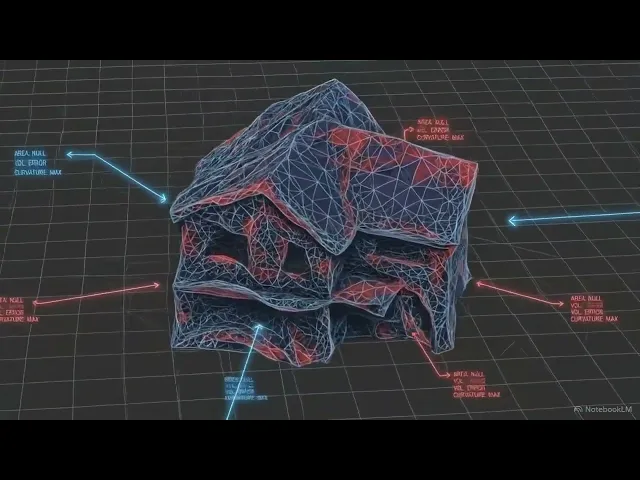
On the left is a generative AI building, a tangled chaotic polygon mesh built for visual appeal. On the right is a parametric building, clean rigid geometric planes mapped to an XYZ coordinate grid. The generative mesh lacks real world units, queryable boundaries, and BIM semantics, properties that define what an object is.
Because these models prioritize visual completeness, they invent hidden sides that don't exist. This hallucination renders accurate material quantity extraction impossible. Construct IQ operates on a strict thesis.
AI should not draw the building. Instead, AI's role is to extract the exact mathematical parameters. Deterministic code then uses those parameters to draw the building.
This separation of logic allows the system to rely on the building kernel. The building kernel is a single unified state machine that acts as the absolute quantitative source of truth for the property. Instead of requiring all data up front, the building kernel operates as a progressive pipeline.
The building kernel is designed to continuously upgrade its data confidence. The system processes information across three specific tiers of input, starting with an address, then smartphone photos, and finally detailed construction plans. This sequential data refinement funnel moves a project from probabilistic AI guesses towards strict deterministic physical facts.
Tier 1 initiates this funnel using a single text string, a street address. Submitting this address triggers parallel API data gathering across multiple public records. This data flow map shows how the system pulls information.
The address node branches out to the Atom API, retrieving text data like total square footage, stories, and exterior materials. Simultaneously, it queries over to maps to extract the geographic footprint as a top-down vector polygon. All of this unstructured text and vector geometry then feeds directly into a single note powered by the Gemini 2.
5 Pro large language model. The MLN's role here is heavily constrained. It uses those strict real world facts to deduce missing variables, outputting a structured JSON file that defines exact wall dimensions, window counts, and roof pitches.
What emerges from the LLM is not an image or a 3D mesh. It is clean lines of structured JSON code containing highly specific numerical parameters. Custom code then takes those JSON parameters and programmatically extrudes them into measurable 3JS geometry.
3. js PJS is a cross browser JavaScript library used to create and display 3D computer graphics. Because this geometry is inferred, the system tags these newly extruded surfaces with a red confidence value.
Red indicates a prior only a high probability AI guess that requires physical verification. This programmatic approach is highly efficient. It costs roughly 50 cents to execute and generates a complete baseline model in exactly 30 seconds.
By separating parameter extraction from geometry rendering, the system generates an instant queryable 3D baseline for the contractor before they visit the job site. To verify those red surfaces, the system transitions to tier 2. An integrated capture coach identifies the lowest confidence red surfaces from the tier 1 model and explicitly prompts the user to capture smartphone photos of those specific missing angles.
These photos run through an open-source vision pipeline. First, VGGT commercial generates instant depth maps. Then, Colemap performs precise camera pose extraction to understand exactly where the user was standing.
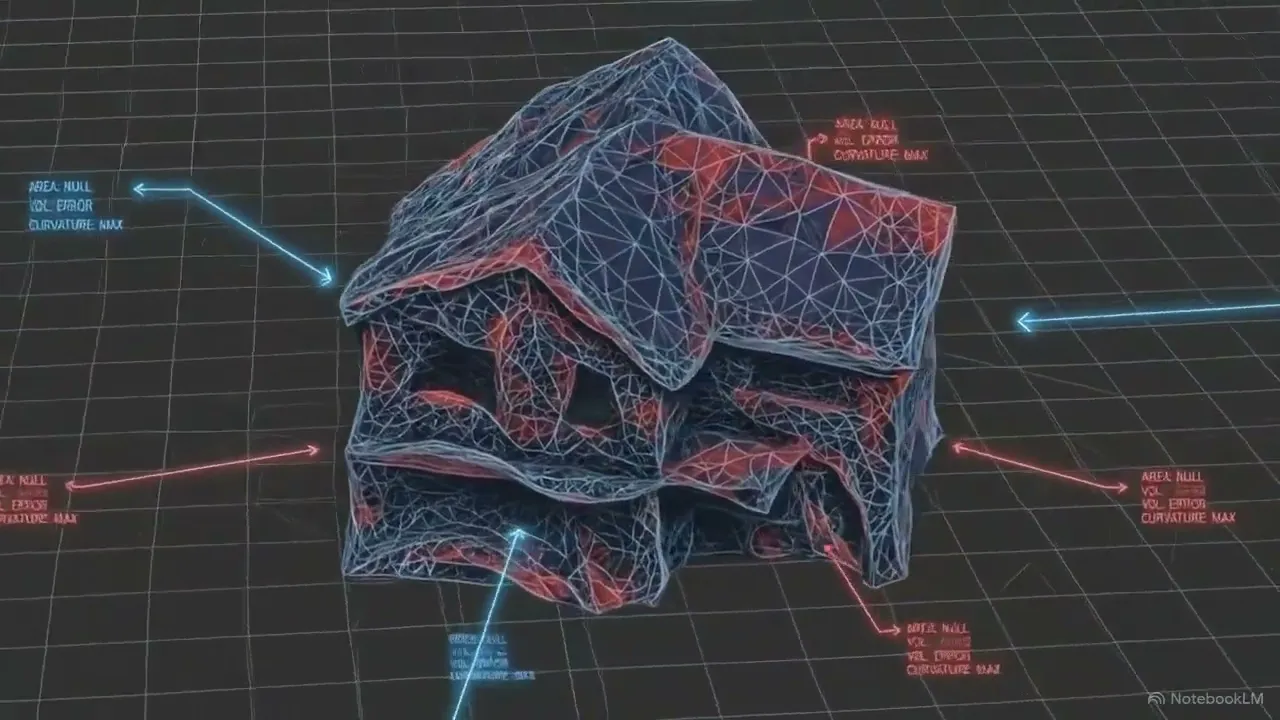
Next, Open 3D utilizes TSDF fusion to merge those sparse point clouds into a solid mesh. TSDF fusion is a 3D reconstruction technique that averages multiple depth maps to build a single continuous surface. This rotating view shows why raw photoggramometry fails.
The resulting surface mesh looks melted and mathematically imperfect, making it useless for precise construction quantities. To fix this, Construct IQ relies on its primary technical advantage, a custom module called the structural regularizer. This diagram demonstrates the regularizer's first function.
It uses ransack plane fitting, an algorithm that filters out visual noise to find mathematical consensus to forcefully snap those messy unaligned data points perfectly flat against an absolute vertical plane. It then executes secondary geometric corrections, forcing detected window openings into plausible rectangular aspect ratios and aligning features like gutters so they follow the established eve lines. With the geometry flattened, grounded SAM 2 performs semantic segmentation.
This vision model isolates and identifies specific building elements directly on the regularized surface. A state upgrade occurs. Measured regularized surfaces permanently overwrite the old red AI prior inside the building kernel.
Updated surfaces receive confidence markers. They are now painted yellow, meaning they were inferred from sparse views or green indicating they were directly measured from comprehensive photo coverage. While computer vision is required to capture reality, the custom regularizer is required to enforce uklitian geometry.
It is the necessary bridge between a raw photograph and a bid ready number to achieve a strict 3 to 5% margin of error. Probabilistic models are no longer sufficient. They must be overwritten by the ultimate ground truth deterministic 2D construction blueprints.
The system uses a Python library called PI PDFUM2 to parse exact mathematical paths directly from native vector PDFs, lifting the actual geometry off the page. For stand documents, a fallback neural network called PyTorch deep floor plan identifies walls and rooms directly from pixel data. This diagram illustrates the dimension harvesting process.
Optical character recognition scans the written dimension strings on the plans like the 12 ft seen here and cross references them with the drawn geometry instantly locking the underlying data variable to exactly 144 in. During final state integration these perfectly scaled 2D vectors are extruded upward punching perfectly through the existing 3D shell of the model. Every surface touched by this blueprint data receives the final confidence upgrade.
It is locked and marked as green. By layering exact 2D vectors over 3D visual prior, the system achieves bid ready accuracy without requiring a human to manually click a single line. This brings us to a critical problem of user psychology.
Construction professionals do not trust blackbox AI algorithms with their profit margins. Construct IQ solves this with the confidence review screen, a user interface that translates the building kernel's complex data into a simple, readable visual language. The interactive 3D model displays surfaces colorcoded by their underlying data source.
Red for the AI prior, yellow for photoggramometry, and green for exact plans. This animation shows the true nature of the building kernel. It functions as an evidence ledger.
When a green roof plane is selected, it spawns a connecting line to a data card containing stylized source data, photographs, and blueprint sections. If a user rejects a red dimension, they can manually type a new number, and the estimate updates instantly. Spatial depth is the future.
AI pioneer FE Lee founded World Labs to build navigable environments. This transition to structured spatial data suggests a future where high-level vision models feed directly into the quantitative estimation ledgers contractors use daily. Construct IQ contrasts with competing tools which hide their math behind a single unverifiable output number.
By rendering AI's uncertainty visible, Construct IQ converts construction estimation from a leap of faith into a verifiable mathematical proof.