in 1887 German physicist Hinrich Herz was conducting experiments to prove James clerk Maxwell's equations of electromagnetism when he noticed something peculiar Herz had placed two electrodes at a distance from each other to generate electric Sparks between them so he could detect an electromagnetic field to get a better look at the spark he placed the receiver in a dark case but an unintended effect happened as a result of this the maximum spark length in the receiver was smaller than it was outside of the dark box and after taking apart the case piece by piece he found
that the side of the box that separated the transmitter from the receiver was the determining factor in the phenomenon upon noticing this Herz tried different materials to test the effects on the receiver he found that using a glass box shielded the spark but using a box made of quartz allowed the spark to transmit he used this information to then use a quartz prism to break up the light coming from the transmitter and from this he found that the wavelength of light responsible for more powerful Sparks came from the ultraviolet Herz didn't do more research on
this strange phenomenon after he discovered it however so more advancements came from other Minds in the coming years such as vilhelm holax Philip Leonard and JJ Thompson this phenomenon came to later be known as the photoelectric effect and would be described as light at or above a certain frequency hitting electrons and causing them to fly off the material they previously existed on and send them through the air Philip Leonard was arguably the biggest Pioneer in experimentally demonstrating this effect using cathode rays to show that it was purely determined by the light's frequency and not by
its intensity but the reason this effect was so intriguing is because it contradicted the classical laws of physics established by Newton hook and hens centuries earlier previous experiments such as the famous double slit experiment in 1801 had led scientists to believe that the light was purely a wave and therefore should always act as such through classical wave theory however the photoelectric effect was a direct experimental contradiction to this theory in two key ways the first was that according to classical wave theory the energy from a light wave is uniformly distributed and dependent solely on its
intens it meaning that the kinetic energy of these so-called photo electrons should increase as the intensity of light also increases however Leonard showed that the kinetic energy varies based on the frequency of light and not on its intensity and thus we have our first contradiction the second was that according to classical wave theory any frequency of light should be capable of ejecting photo electrons Herz and Leonard showed however that there was a certain fre frequency of light that caused these ejections and that it existed in the ultraviolet and anything below the ultraviolet would not cause
this effect and thus we have our second contradiction Leonard won the Nobel Prize in physics in 1905 for his work with cathode rays that led to these advancements in the photoelectric effect that same year a new upand cominging scientist Albert Einstein published a paper in which he proposed a new revolutionary idea that would fundamentally re WR the nature of light and explain the confounding photoelectric effect Einstein's explanation for this phenomenon was that light does not just exist as a wave but also as a particle or a discrete energy packet with its energy depending solely on
its frequency Einstein used an equation derived by Max plunk in 1900 to describe this he made a bold move by endorsing plunk turbulent new theories to describe black body radiation but it was a move that would surely pay off in the coming years to explain the photo electric effect with light as a particle Einstein postulated that so-called photons collide with photo electrons and transfer energy to them in two forms the first form of energy is that which is required to eject the electron from the atoms they exist in which he called the work function the
rest of the energy transferred is in the form of the kinetic energy of the photo electron as it travels freely through the air using this relationship for energy along with plunk previously established relationship for energy Einstein was able to do two key things the first was establish a theoretical value for the threshold frequency denoted experimentally previously by Leonard and Define it as equivalent to the work function of the atom the second key factor in Einstein's explanation was determining the maximum kinetic energy a photo electron can achieve during a mission using his previously established relationship for
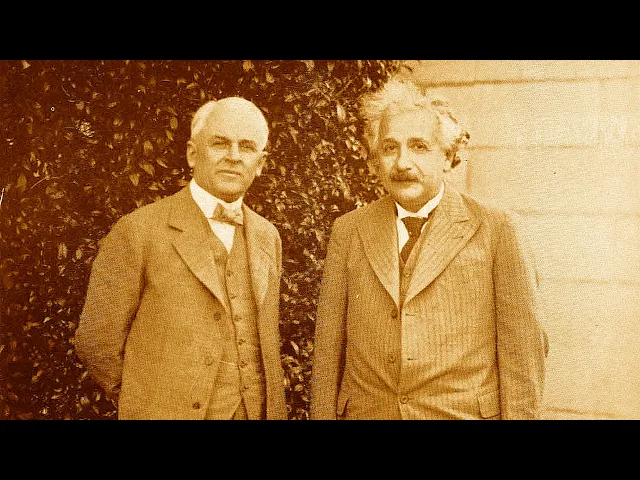
the work function he reached a relationship between the maximum kinetic energy of a photo electron and the photon's frequency incorporating plunk constant and thus explaining the effect with quantum physics these equations formulated by Einstein in 1905 turn out to be a great way to experimentally calculate the value of plunk constant and such was done with extreme Precision later in 1916 by Robert milikin Milligan ironically was motivated by proving Einstein wrong in his particle theory of light and believed that the only reason the photoelectric effect was happening was due to the Apparently flawed experimental setups previously
done by Leonard and others milikin in his quest unexpectedly proved Einstein and others further correct through his ingenious setup which involved a rotating plane of three different Metals in a near-perfect vacuum chamber a blade would constantly clean the metals as they rotated and the metals would take turns being exposed to UV light upon seeing that the photoelectric effect still occurred in his setup he used a previously established relationship by Leonard Einstein's equations and his previously calculated charge of the electron to solve for plunk constant his calculations were so precise in fact that his calculated value
for the constant is still within 0.7% of today's currently accepted value even after all this experimental evidence however milikin stood firm in his beliefs swearing that Einstein was still incorrect but through means that they did not yet understand Milan's thoughts can be summarized through one of his quotes Einstein's photoelectric equation cannot in any judgment be looked upon at present as resting upon any sort of satisfactory theoretical Foundation even though it actually represents very accurately the behavior of the photoelectric effect three Nobel prizes were handed out throughout the course of the photo El electric effect Saga
Leonard in 1905 for his experimental contributions Einstein in 1921 for his theoretical explanation and milant in 1923 for his experimental validation of Einstein's theories alongside black body radiation the photoelectric effect was thought to be one of the final mysteries of physics during the turn of the 20th century but upon the discoveries made by these brilliant scientists in both topics and entirely new world was opened up and The Quest For Truth continued into the depths of the quantum realm if you enjoy this video please consider liking and subscribing click here if you want to see more
scientific progress made during this time period thank you for watching and I will see you in the next video