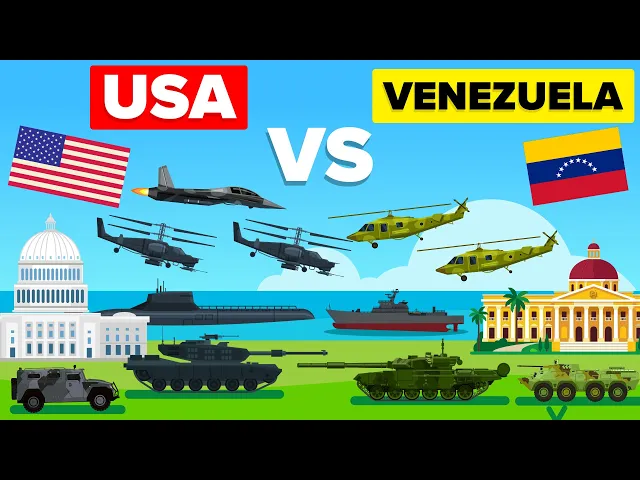
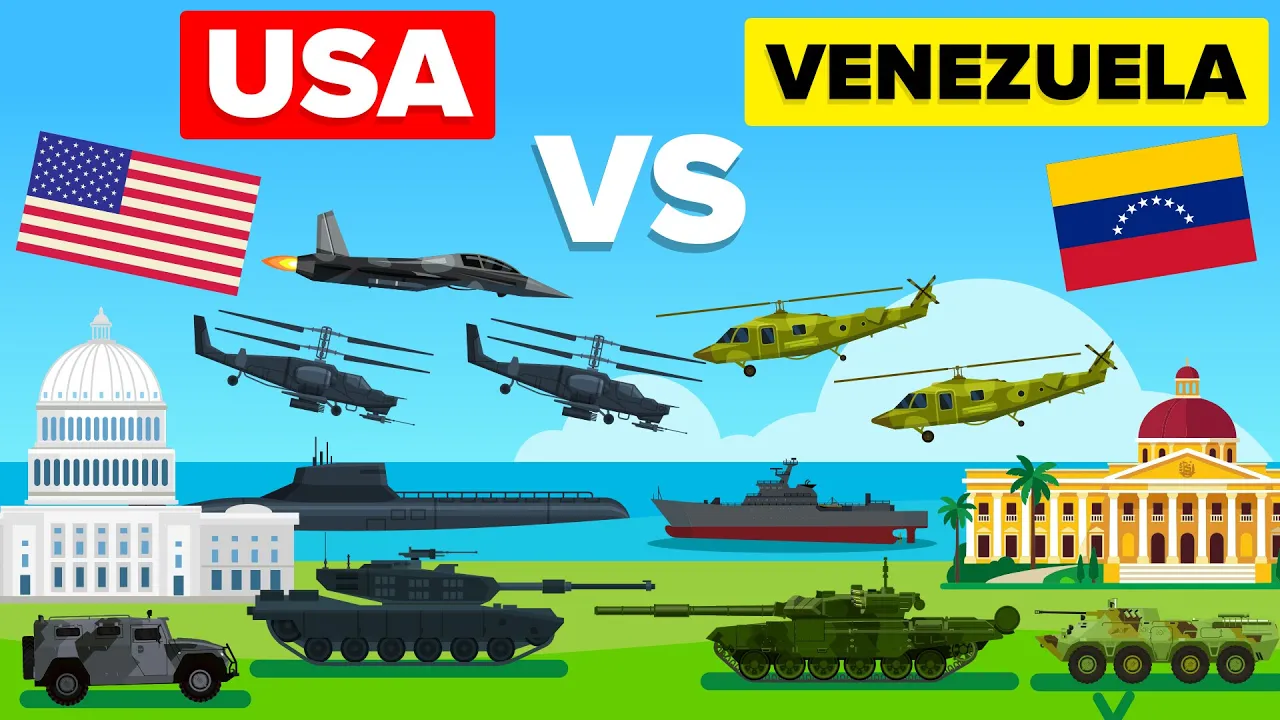
With a possible U. S. ground intervention in Venezuela on the horizon, the military balance looks overwhelmingly one-sided.
So how do the U. S. and Venezuela compare?
On raw manpower alone, the gap looks enormous - but that’s only the surface. The U. S.
has an active duty military personnel of about 1. 3 million, with some significant shortfalls in key areas due to ongoing recruiting problems. Infantry and information technology roles are suffering the most, with a growing pilot shortage also undermining U.
S. readiness. Venezuela, meanwhile, plays a very different numbers game - one that favors boots on the ground.
Venezuela's active duty military numbers just over 100,000, with an overwhelming emphasis on ground combat. That means they would likely outnumber US forces on the ground by a significant margin. However, the U.
S brings numerous force multipliers to bear and has historically defeated much larger forces with relative ease. And this difference in force structure will matter later - because the kind of war Venezuela can force isn’t the kind the U. S.
is optimized to fight. In reserve, the US maintains about 800,000 personnel ready to be called up in case of an emergency - giving it the depth to absorb casualties while maintaining a high pace of combat operations. Venezuela on the other hand has a paltry number of reserves, at around 8,000 and lacks the training depth needed to keep them combat-ready.
That depth advantage looks decisive now - but it becomes far less meaningful once the fighting shifts away from conventional battlefields. And Venezuela has two distinct advantages. The first has nothing to do with Venezuela’s strength - and everything to do with America’s limits.
The U. S. is unable to bring all, or even a significant amount of its combat power to just one place in the world.
Security commitments prevent it from concentrating forces for a single conflict in anything but the most extreme circumstances. With a potential conflict with China looming, the U. S.
is unlikely to commit more than a token force to any operation in Venezuela. And that limitation sets the stage for Venezuela’s real strategy - one that only works if the U. S.
can’t bring overwhelming force. Venezuela's true military strength lies paramilitary forces, which number around 220,000. While not officially part of the armed forces, they are often state-sanctioned, receiving political backing and, at times, arms and funding from the government.
From this point on, the conflict stops looking like a traditional invasion - and starts looking like something much harder to end. The colectivos for instance are an assortment of pro-Maduro government militias which operate in large numbers across many cities. They act as enforcers of government policy, much like China's maritime militia which poses as civilian fishing fleets.
The colectivos do everything from maintaining public order to intimidating journalists and even attacking protesters. They are lightly armed but well suited for fighting an insurgency against US forces. And that’s only the smallest layer of Venezuela’s paramilitary forces.
The Milicia Bolivariana, or MB, is a massive nation-wide militia with numbers in the millions according to official sources. Though they technically include any civilian not on active duty, these forces are guided directly by the central government and are largely staffed by former soldiers and MB reserve volunteers - separate from Venezuela’s formal military reserves. Organized into militia detachments and battalions, these forces are meant to act as rapid response units for internal control and local defense.
In a war with the U. S. , they would almost certainly operate as an insurgency.
While official figures claim up to 4 million members, the real number of combatants is unknown - though a figure closer to 1 million is more realistic. And at that scale, the war stops being about winning - and starts being about endurance. And insurgencies don’t run themselves.
Someone has to coordinate them. Venezuela employs numerous special military units which have been accused of acting like death squads. They are under direct state control and small in number, but well trained and heavily armed.
With a focus on urban counterinsurgency, they would function as command hubs for a nationwide insurgency, turning U. S. peacekeeping missions into a far more complex fight.
Next are the Megabandas, huge hybrid criminal/government organizations which receive unofficial state support. They make the majority of their profits from drug trafficking and have huge amounts of wealth at their disposal. They use this to purchase large amounts of military-grade weaponry.
Their loyalty to the state however is in question, as they have often clashed with the state directly. This makes it unclear what role they would choose to play in an invasion. Venezuela could also call upon a whole host of foreign paramilitaries operating inside of its borders - it’s rumored there are as many as 50,000 Cuban personnel in the country.
These include groups such as Ejercito de Liberacion, which has vowed to fight US imperialism. With massive profits due to state-sanctioned drug running, the paramilitary groups are very well armed. A more serious concern is their experience and effectiveness as hardened jungle fighters.
And this is where the cost of escalation changes dramatically. No modern war is decided on land alone. In the air, the U.
S. has just over 13,000 aircraft, with the Navy by itself making up one of the world's largest air forces. Venezuela by comparison only operates 229 aircraft, most of these being transport or trainer aircraft.
The only combat aircraft of note are 3 F-16sA and a single F-16B - but the operation condition of these aircraft is unknown operational condition. There are also 24 Sukhoi Su-30s bought from Russia. However, it’s believed some of the Sukhois were destroyed by the U.
S. during Operation Absolute Resolve - the mission to capture Nicolas Maduro. Insiders claim that Venezuelan air force readiness is practically non-existent.
On the ground, the United States operates roughly 4,600 tanks compared to Venezuela's 172 - largely comprised of T-72s and French AMX-30s. Overall readiness is unclear, but in urban or jungle terrain, even outdated armor can still threaten U. S.
forces if used with discipline and numbers. Supporting their tanks, the U. S.
sports nearly 392,000 armored vehicles, versus Venezuela's 8,800. While the US mostly has modern Bradleys, Venezuela leans heavily on BMP-3s and BTRs - Russian made vehicles which have proven to be completely ineffective against American Bradleys in Ukraine. Fire support is where the imbalance becomes overwhelming.
When it comes to artillery, the U. S. is historically weak in this department due to its reliance on air power - but even here, it still overwhelmingly outmatches Venezuela.
The US has 671 self-propelled artillery, using GPS guided rounds which would be devastating against Venezuelan forces. Venezuela meanwhile operates 48 self-propelled artillery pieces. In towed artillery, the U.
S. brings the thunder with over 1,200 pieces against Venezuela's 100. The US also brings 641 Multiple Launch Rocket Systems (MLRS) designed to overwhelm enemy positions with rocket strikes before they can seek cover.
Venezuela operates Russian-made Smerch and Grad rocket launchers, along with a limited number of Israeli LAR-160 systems. While the LAR-160 uses a smaller 160mm warhead, it is significantly more modern and capable. At sea, Venezuela’s fleet of just 34 vessels would face off against the U.
S. Navy’s roughly 440. The United States fields 11 supercarriers and nine amphibious assault carriers, while Venezuela has no seaborne aviation capability at all.
The U. S. has 70 nuclear powered submarines, while Venezuela has a single German-made Type 209 - currently undergoing refits and out of action.
The U. S. Navy operates 81 destroyers, compared to just one major surface combatant in Venezuela’s fleet - an Italian-made Lupo-class frigate of uncertain operational readiness.
So what do all these numbers actually mean? The military balance favors the United States, but victory wouldn’t be easy. The fight on the ground would be far more complicated.
Any intervention in Venezuela would likely turn into a prolonged and costly struggle. How did it get this way? Check out What Actually Went Wrong With Venezuela.
Or click on this video instead.