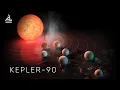
With all the diversity of space objects in space it might come as a bit of a shock if one were told that it’s actually our Solar System that is one of the most unusual places in the cosmos. Besides, it is the only place in the universe more or less explored by us which is home to developed life forms. Our home galaxy is also a stellar system with the biggest number of planets.
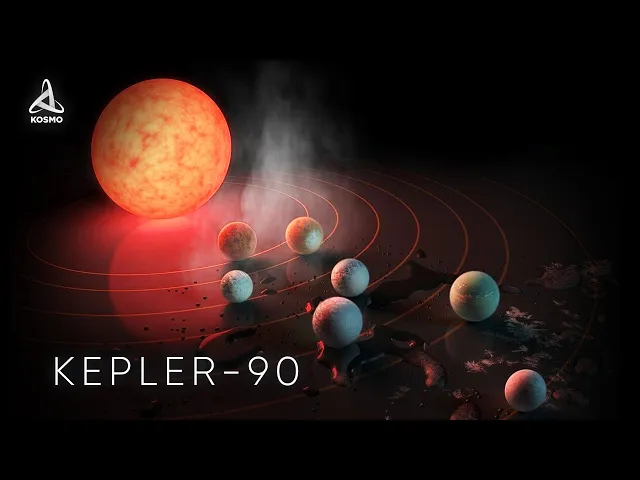
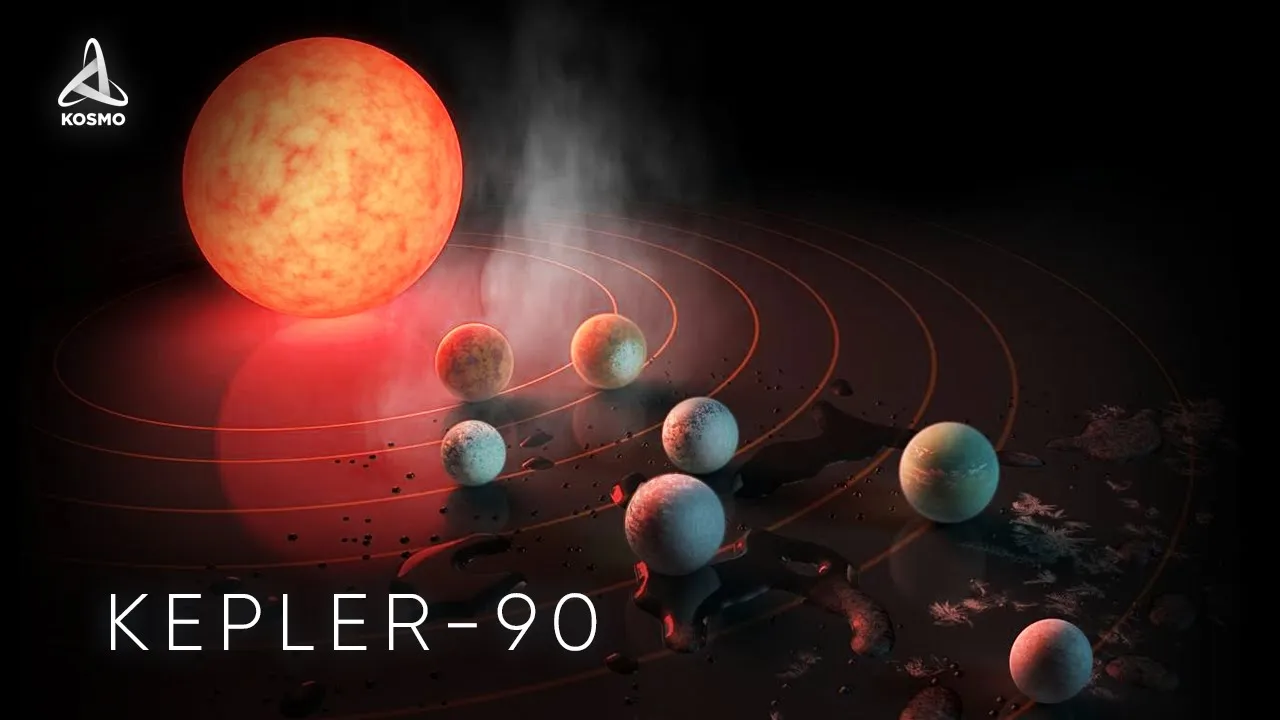
Can there be any other star out there with the same number of planets as our Sun? Observations show that there is! It is the star Kepler-90 with 8 planets orbiting it already detected.
The discovery of this object was made with the Kepler space telescope whose mission was to look for exoplanets. The Kepler star system became the 90th object spotted by the telescope. That is where the catchy nickname Kepler-90 comes from.
Let’s take a closer look at it. Kepler-90 is a yellow dwarf of spectral class G0 V. Both its mass and radius are approximately 1.
2 times those of the Sun. As for the surface temperature, it equals 6,080 K, or 5,800 °С. The estimated age of the star is 2 bln years.
This makes it 2 times younger than our Sun which formed about 4. 6 bln years ago. It was possible to gauge the star’s age by analysing its spectrum, which helps establish the stage of the star’s evolution.
Another method instrumental for the purpose is observing stars lying closest to the object under scrutiny. Incidentally, Kepler-90 is too dim to be seen with the naked eye. Its luminosity, meanwhile, is more than one and a half times as intense as that of the Sun.
Located in the Drco constellation, it is approximately 2,840 light years away from our system. Incidentally, the object is hardly notable for its properties. It is quite an ordinary main sequence star without any particularly exciting features.
It’s the number of stars discovered in its system so far that makes it really stand out. The only other system where we could observe as many as 8 planets had been only our Solar System. Before Kepler-90 had been spotted, the Sun held the first place in terms of the number of planets, with the following champions as the runners-up: the systems TRAPPIST-1, HD 10180 and HR 8832.
Each of them has 7 detected planets. At first glance Kepler-90 might probably look like our Solar System in miniature. However, on closer inspection the following principal differences will change the observer’s mind about it.
For a start, the smaller planets are closer to the star, with the bigger planets lying further and following bigger orbits. As we know, it’s quite the other way round in the Solar System, with the giants close to the star and the smaller planets located further away. Admittedly, it is too early to claim this with absolute certainty, and the number of planets we know of in the Kepler-90 system may increase as scientists make progress in their observations.
Another principal difference from our system shows in the planets’ mutual proximity. The Earth and the other planets in our system, on the other hand, are further away from each other. And also all the 8 known planets in the Kepler-90 system orbit their star within just 1 astronomical unit.
Another important difference is the fact that 6 internal planets in the Kepler-90 system are either super-Earths or mini-Neptunes in size, while its 2 outer planets are gas giants. The two planets in the system lying closest to their host star dubbed Kepler-90 b and Kepler-90 c may probably be called our Earth’s analogues. However, their temperatures are considerably higher than on Mercury or Venus, that is, the two planets closest to their host star in our Solar System.
This is the case on account of their proximity to their system’s centre. Kepler-90 g and Kepler-90 h are the objects lying furthest from their parent star. Both of these bodies are gas giants.
Their dimensions must be comparable to those of Jupiter. The system leaves the general impression of being extremely compact. Even Kepler-90 h, the remotest planet in the system, lies approximately as far as the Earth does from the Sun.
Also, as I’ve already mentioned, this remotest planet is also the largest in the system, and a year on it is almost as long as a year on our Earth – 331 days, to be more exact. All these planets were discovered not so long ago, with the latest of them, Kepler-90 i, spotted as recently as in 2017. It was possible to detect it with the transit method – that is, by observing sharp changes in the host star’s luminosity when one or several planets pass across its disc and block a certain portion of its rays normally visible to us.
This method is quite productive for large celestial objects lying close to a star. However, if a planet is remote from it, fluctuations in the star’s luminosity and other incidental factors interfere with observations. These problems may be dealt with in two ways – namely, by prolonging observation periods and by sorting data with the help of statistical algorithms and artificial intelligence systems.
In fact, the latter helped the team of scientists studying Kepler-90 in discovering the eighth planet in the system. A specially trained neural network was instrumental in pinpointing one more planet in the Kepler-90 system and defining its parametres. The newly spotted object was given the temporary designation Kepler-90 i.
Located between Kepler-90 c and d, this celestial object orbits its star within less than 15 days, and its radius is 1. 32 that of the Earth. Kepler-90 i is three times closer to its star than Mercury is to the Sun, that is why its surface temperature is rather high – approximately 427 °C.
Just to compare – this value is quite close to the surface temperature of Venus, which is 477 °C. Kepler-90 i resembles our Earth very much in terms of its chemical composition, size and mass. Its orbital period is 14.
4 earth days. As the planet lies too close to its parent star, it cannot realistically support life. The discovery of this celestial object prompted a lot of questions on the part of the scientific community – it still remains to be found out how such a large and complex planetary system managed to remain so compact and stable at the same time.
Also, astronomers assume there might be more planets out there orbiting Kepler-90 which still remain to be discovered. The search for other bodies in this system is still on. As for the other known planets in the system, the parametres of each are unique in their own way.
The radius of the one nearest to its parent star, Kepler-90 b, measures about 1. 3 times that of the Earth, and its orbital period lasts for 7 days. Just like all the other objects in this system except Kepler-90 i, it was detected back in 2013.
The planet coming next orbiting its parent star slightly further away than Kepler-90 b is Kepler-90 c. Its radius is slightly smaller, measuring 1. 19 times that of the Earth, and as for its orbital period, it is 8.
7 days. The fourth known object in terms of its closeness to its star is Kepler-90 d. With its radius measuring 2.
87 times that of the Earth, it orbits Kepler-90 within a period of 59. 7 earth days. Kepler-90 e holds the fifth place.
Its radius is 2. 66 that of our planet and its orbital period may reach 91. 9 days.
Kepler-90 f comes next. Its radius is 2. 88 times that of the Earth and its orbital period is 124.
9 earth days. After Kepler-90 f comes Kepler-90 g with a radius measuring 8. 1 times that of the Earth.
Its orbital period is 210. 5 days and its mass is approximately 0. 8 times that of Jupiter.
Last but not least, but definitely the remotest from its star at this point, Kepler-90 h has a radius measuring 11. 3 times that of the Earth. Its orbital period is 331.
6 earth days and its mass is about 1. 2 times that of Jupiter. As this object’s orbit lies approximately as far from its star as that of the Earth from the Sun, assumptions may prove to be true about hypothetical moons in its environs.
If there are any located close to Kepler-90 h that are similar to Titan or Ganymede in their parametres, conditions on these moons may be realistically suitable for life. These hypothetical celestial objects might have some really incredible features. As their planet lies in the habitable zone of its star, some of these moons may well resemble our Earth.
For all we know, just as you are watching this video on the Kosmo channel, a new life may be dawning on a moon of the faraway gas giant Kepler-90 h.