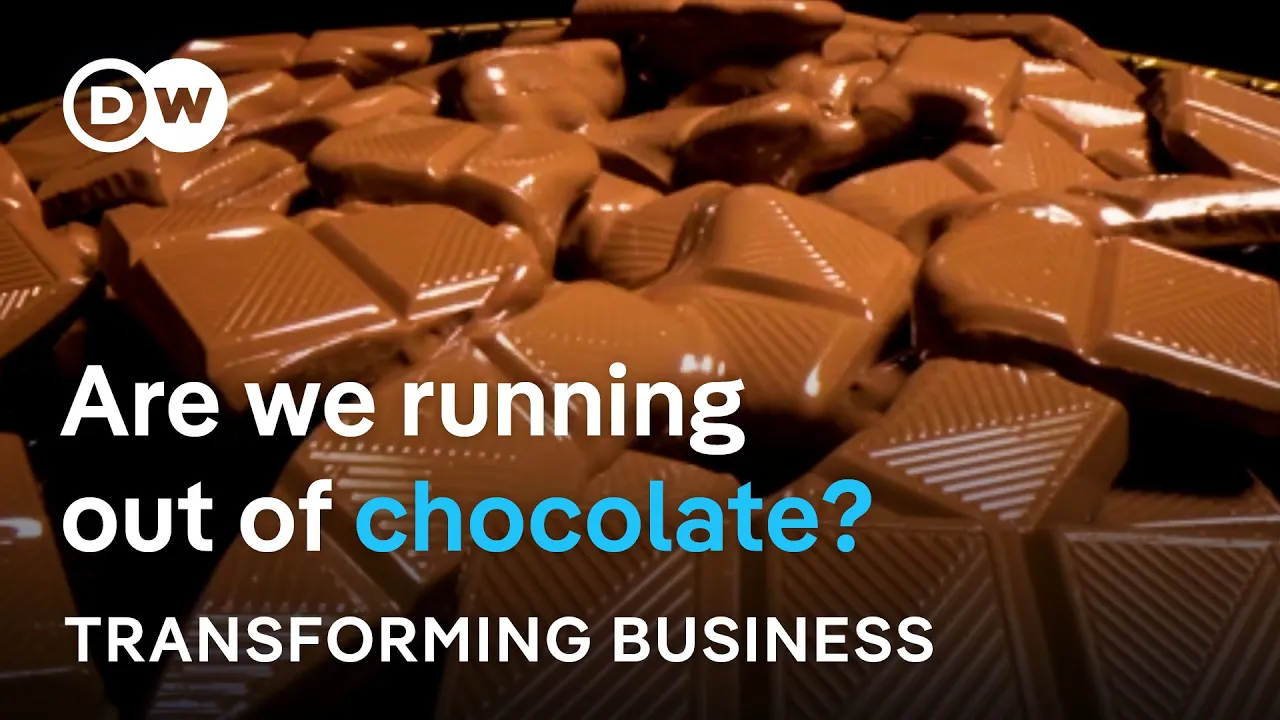
why is the cocoa industry in crisis the price of chocolate is going up cocoa prices surged to all-time highs this week the price of cocoa beans is soared to record highs as harvests collapse and prices skyrocket do we need an alternative first things first this has been the price of cocoa in recent years since 2020 and in just a few months it's literally gone through the roof quadrupling to over $10,000 per metric ton a new record the background to the to this unprecedented rally that we've seen in prices or rise that we've seen in prices
is really driven by a collapse in production in West Africa this is Jonathan Parkman head of the cocoa section at commodity broker Marx in London he looks at the international cocoa trade global production as a result is now running well below global demand last year production in Ghana and the Ivory Coast fell by 22 and 27% respectively this is being felt worldwide around 70% of the world's cocoa is grown in West Africa this is followed by Latin America with just over 20% and a small proportion comes from Asia the two main producing countries are Ivory
Coast and Ghana and in there they're there neighboring countries and they're both suffering from a similar disease the disease is known as cocoa swollen shoot but the disease is only part of the problem the way cow cow production has expanded in many parts of the world is extremely unsustainable this is Sophia Cordinudo geographer from the University of Victoria Canada she has been researching the cocoa industry for years she says players in the cocoa sector need to take some more responsibility for the state of the industry for almost 90% of the cocoa from West Africa rainforest
had to be cleared today cocoa is often grown on the land in monoculture the same tree on the same land year after year with farreaching consequences for the most part in a lot of places in in West Africa the way in which cow cow production has expanded is through varieties of the tree that are tolerant to the sun so it's a full sun system it might be more productive for the first few decades of of the the cowcow treere's life but it requires a lot of inputs a lot of chemical fertilizers a lot of pesticides
and so that leads to a lot of soil degradation over time crop failures and record high prices are already resulting in the reduction of profit margins as the Swiss food company Nestle announced in its annual report the group listed in the top five of the world's largest cocoa manufacturers also sees humaninduced climate change as a threat to further crop losses particularly in Brazil nestle was not available for an interview and it's not only the industry that's affected consumers are also feeling the pinch there is a lot of price increase being passed on to consumers and
whether that's in making smaller chocolate for the for the same price um that it was last year and you're just getting less product for the same price or sometimes the industry will use more fillers right um maybe not so much cowcow butter but more um substitutes like palm palm oil or palm kernel cocoa is grown in a few countries around the equator in the global south and mainly processed and consumed in the north west Europeans eat almost 40% of the world's cocoa followed by the USA and Eastern Europe and Russia for them the sweet treat
has become more expensive but those most affected are the cocoa farmers who are struggling with crop losses around 5 million small farmers produce 90% of the world's cocoa but despite cocoa products now costing more the farmers only get a fraction of the final price supermarkets and manufacturers take the largest share of the end product then they're followed by the processing industry farmers well they earn an average of just €6 cents per bar poor wages and even child labor are not uncommon in the cocoa business that is part of the problem because impoverished farmers generally don't
have the money to invest in improving soil health in fertilizers in more sustainable and stable cultivation methods or in rejuvenating plantations in Kotivo and Ghana farmers receive a fixed government price per kilo of cocoa it's different in Ecuador being the world's third largest producer with 420,000 tons of cocoa per year and a global market share of 10% this could reap rewards here farmers sell freely on the market or through production cooperatives according to the non-governmental organization Riculto after years of low prices the recent price rally here is hugely beneficial today farmers are paid $400 per
100 kilograms many more times than a few years ago jose Luis Qua says In both good and bad times the cost of cocoa on the world market sets the price here more efficient and resilient cultivation methods compared to West Africa are an additional location advantage explains quas according to him Ecuador takes the lead in productivity per hectare but here too forests are being cleared for cocoa so vulnerable ecosystems which might be sensitive to drought or lots of rainfall are a concern and production has also fallen in the past year but it was down within what
what is undoubtedly a an uptrend in production there's a there's a trend for higher and higher production in Ecuador we are at the testing laboratories of Planet A Foods in Planck near Munich in the south of Germany people think differently here planet A Foods doesn't want anything to do with low wages crop failures and deforestation but they do want to eat chocolate it has a good snap the young company has developed an alternative that is supposed to taste like real chocolate without the cocoa beans instead they use sunflower seeds this approach is supposed to be
more sustainable and avoids issues with cocoa supply chains the founders of the company claimed that a large proportion of cocoa flavors can be reproduced the result a chocolatey powder a holy EU product the special powder is then mixed with fat and under goes the same process as real chocolate made from cocoa steering rolling tempering planet Food says it's important that the process is identical so that potential customers mostly large confectionary manufacturers don't have to change their production only the ingredients the company does not sell its own chocolate bars but offers major brands the chance to
produce their confectionary using this alternative but does it really taste like chocolate um which one do you like I like this look this doesn't have chocolate at all but it tastes the same what began as a startup is now available in many supermarkets in Germany the alternative is not only confusingly similar to real cocoa but also has another advantage in the current price battle actually the the prices of sunflower seeds compared to cocoa are quite stable so they do don't rise as much and they don't in general develop or it's much more predictable how they
develop and that's what's make Shiva in the end yeah at least not more expensive than than chocolate um I mean we always say we are there where chocolate and cocoa prices were about yeah 2 years ago that's essentially three times cheaper than cocoa at the moment and potentially one reason why locos brands rely on the cocoa alternative regionally grown safer supply chains no deforestation according to the company Sunflower Cocoa produces 80% less CO2 planet A Foods is currently growing strongly and wants to tackle the US market in 2025 production is set to increase from 2,000
to 15,000 tons this year in order to position itself more dominantly on supermarket shelves fluctuating cocoa prices are normal but the collapse of harvests clearly show that the industry is in a vulnerable position despite the growth of planet A foods it's not expected to replace cocoa or gain huge chunks on global markets at least not in the short term with the producers model in Ecuador farmers there are probably best positioned for gains fairer wages for small farmers globally more efficient and sustainable farming methods adaptation to a warmer world and above all investment in the sector
will be crucial for fair cocoaore yields in the future we need to incentivize farmers sufficiently that they're able to afford input uh to use greater greater amount of inputs fertilizer that kind of thing and then we should increase yields and that will generally benefit the farmer and the chocolate eater eater as well but given that to date this has not worked yet what do you think