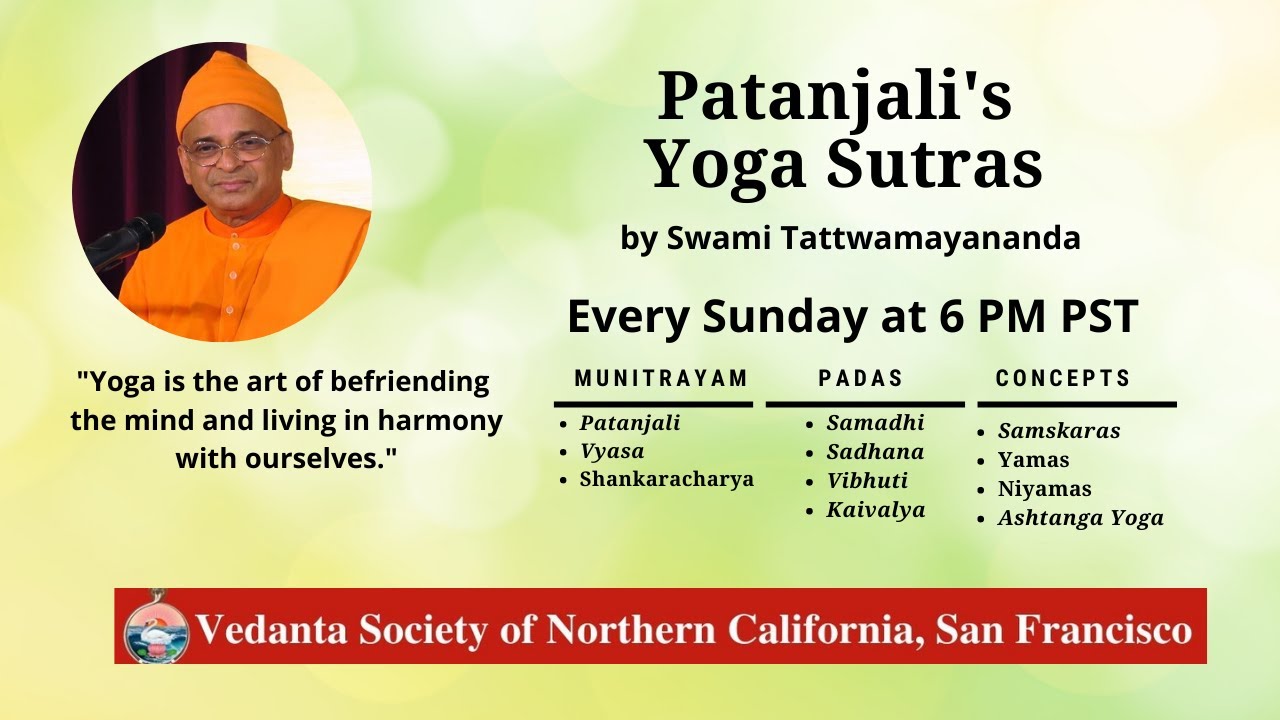
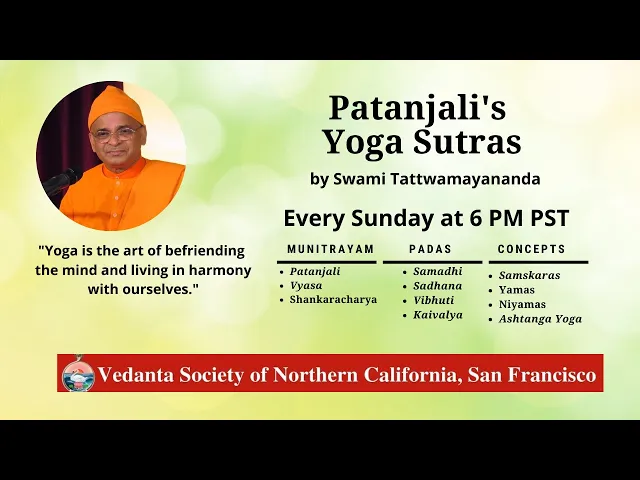
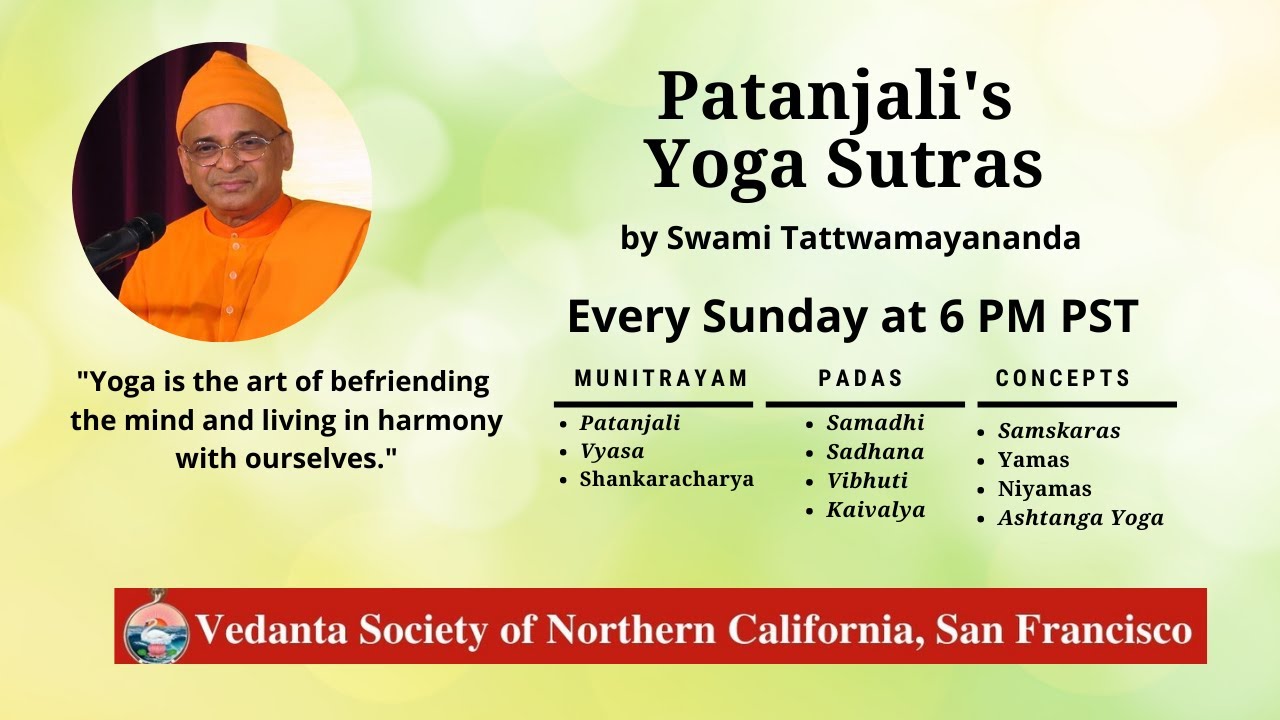
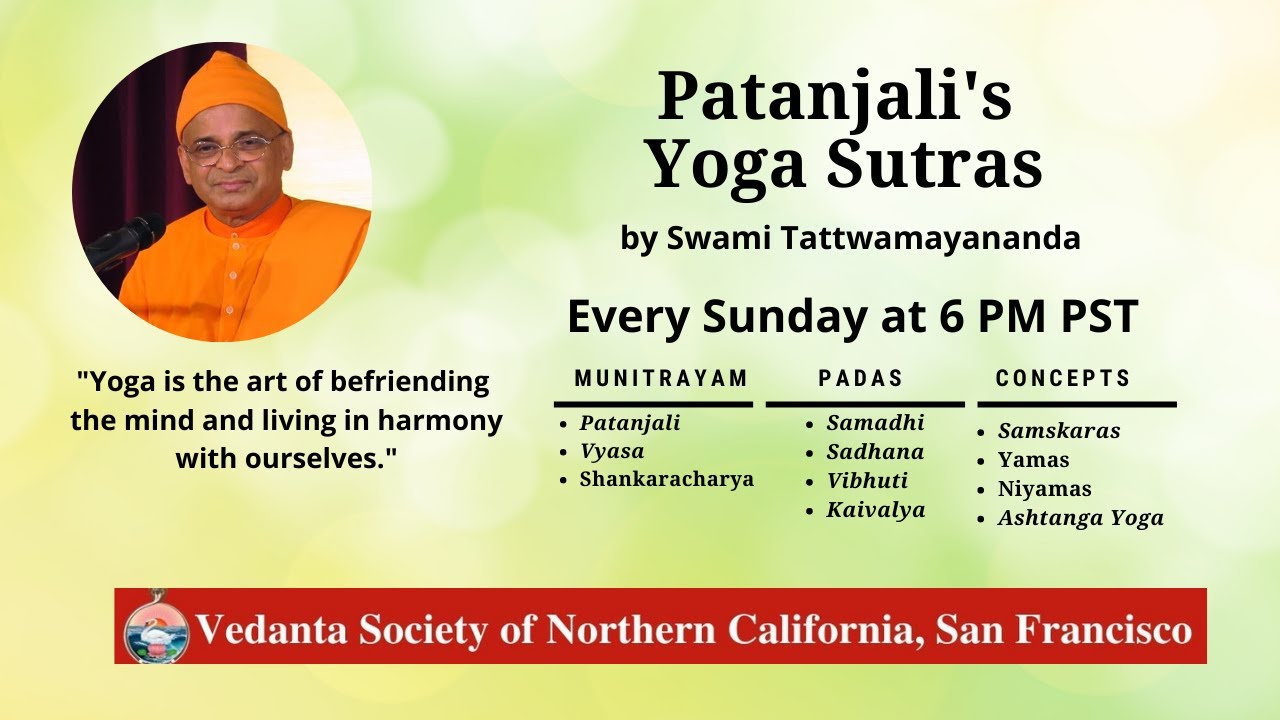
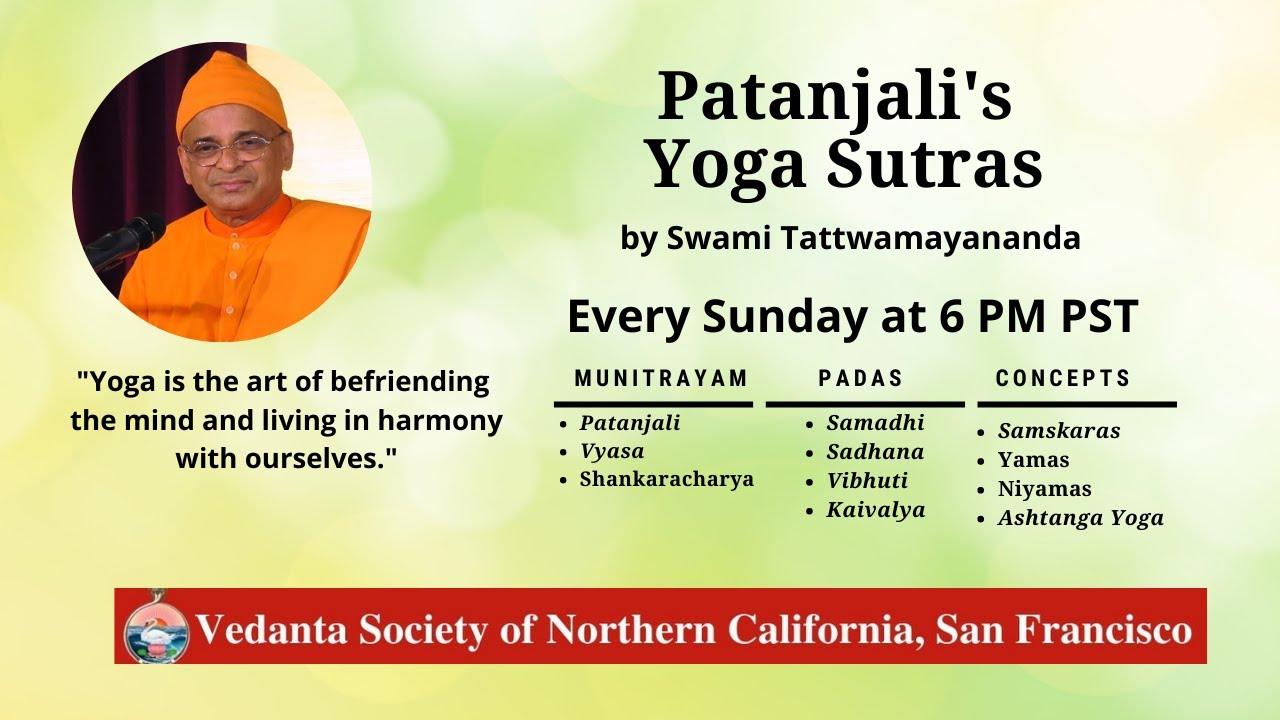
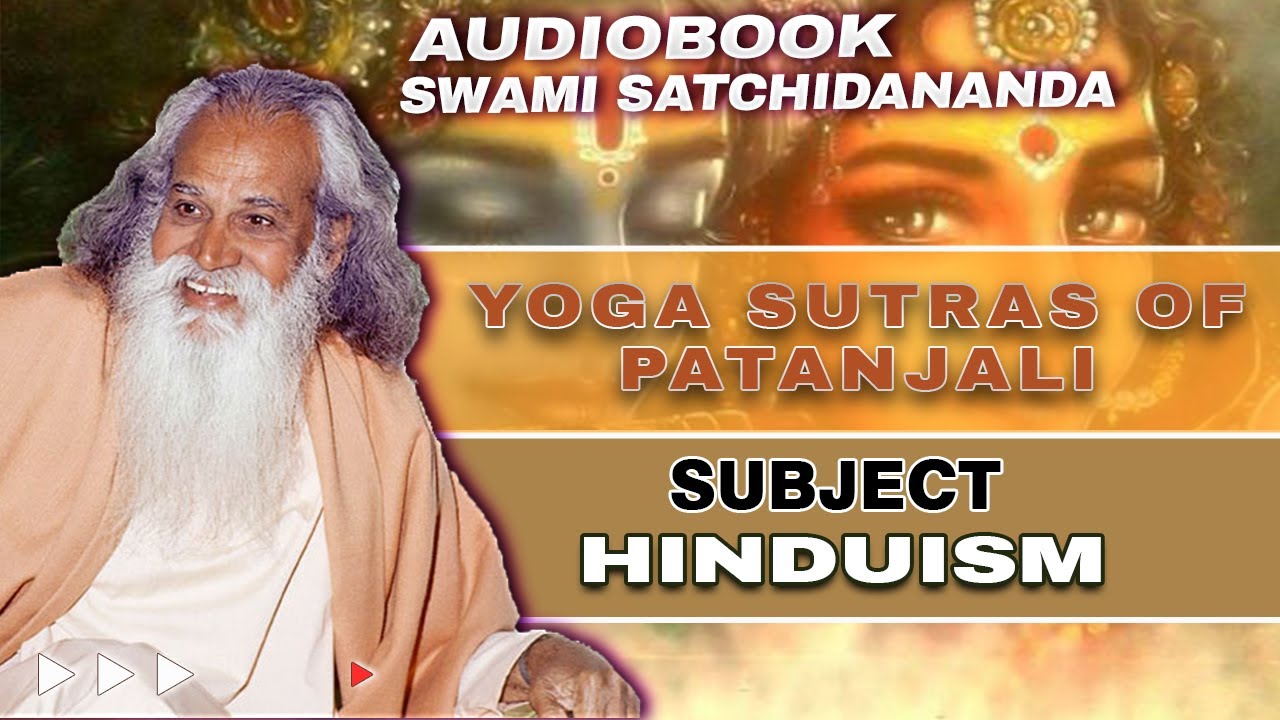
[Music] good evening so we'll begin the class these two verses of invocation i shall chant so we already discussed some of the early sutras so i want to remind you again because many of you will have this printed volumes printed books of yoga sutras and in this text the order of the chapters i mean the way the chapters are arranged is like this first samadhi then then so the four chapters but uh in terms of actual yoga practice from the standpoint of a spiritual evolution it's a bit different we begin with sadhana badass practices and
then the results consequences the powers what we derive what benefit will be derived from yoga practice that is and then samadhi pada concentration is the result of yoga practice and the last ultimate goal of yoga is kaivalya liberation so this is how it is normally arranged but i have slightly changed the pattern i will begin with so but it may not be appropriate to begin with the first sutras of south napa for the advantage of those who study the scripture we have to cover some of the earlier sutras of samadhi bada because they deal with
the definitions and explanations of yoga as a system some of the technical terms are defined and these definitions are very important for example what is virti what is chittham and what you mean by getting the ultimate result these conceptual definitions are included in the first few sutras of samadhi bada so we already discussed some of the sutras the first one ata yoga anusha asanam we already discussed now the word yoga itself has got different different connotations and different meanings in the yoga literature sometimes some others like vyasa and others define yoga itself as the last
the final goal of yoga practice is called niruta state now to understand that definition of yoga we should know what disney thus did so there five levels of human mind are exp explained that a ship them for example it means it is a when a mind is restlessly moving about without any inclination towards concentration and he cannot focus on anything higher that particular state is called kripta state in its advanced state it becomes a pathological state of human mind which is which belongs to the cat the realm of abdominal psychology but it's in ordinary situation
most of us or many of us we feel this restlessness it is not a pathological state a natural state of human mind moving restlessly without being able to concentrate on anything it is active but it's not able to focus on anything that is shifter state the next one is moda moda where you you are but be numbed where it a kind of sleepy state induced by tama inertia sleeplessness etc uh well uh to understand this uh it's a it is a very there's an interesting definition here you know there is a great uh there's a
great yoga teacher 19th century is one of the 10 orders monastic orders founded by shankaracharya so [Music] state as a state of human mind where mind is full of passion strong passions but you are not very active you are not very energetic mind is not very active he remains in a state of inertia in some kinds of mod patients suffering from depression you find this melancholia you find this so it's something very interesting if there are amongst you some who have specialized in psychiatry especially abdominal psychology will be struck by the the deep insights into
human mind including the abnormal mind that you find in the yoga sutra literature not pathetically directly but indeed in the commentaries on yoga for example this one it's actually a classical picture of a person suffering from melancholia these are two abnormal states the third state as i mentioned earlier the state now i am explaining this to understand what yoga actually implies we must keep all this in mind the third stage is vikshiptastic but again this great yoga teacher in his book [Music] sometimes you feel a great peace of mind sometimes it is gone i already
explained this in plain simple english in the last session you go to a prayer hall you go to a temple at church synagogue you attend a yoga sutra class you attend a wonderful music or maybe a recitation of quiet tree suddenly you feel a great absorption i've seen this really happening within the society sometimes you'll have big puja celebrations you know puja houma mantra so people sit with eyes closed in the prayer hall it may take sometimes uh two hours and then at the end of the day they will say oh swamiji we had a
wonderful time now even it's good to have a wonderful time but it also shows that it was not so very wonderful why because you are comparing your previous state which was not so very wonderful with the state that you have just now sorry viktor manaha mind was suddenly mind was observing some higher thoughts when you attended the puja and then mind has a tendency to go back to another state it is a classic example of bikshiptamana so that is why means once a while suddenly a little bit of mental peace and then it's gone now
this is natural this is the this the natural state of human mind that you find among spiritual seekers sincere seekers of course yoga sutra lays down a step-by-step path a a i mean a a ladder of ascending steps to us a state where the this peace of mind becomes a natural state that's a purpose of yoga when you are attending a puja and attending a prayer in the church or a synagogue or any place of worship you are happy you're peaceful you're contemplating how to keep that contemplative mind that peaceful state of human mind even
when you're working in the factory in the university in the workplace in the markets that is the purpose of yoga i am not accelerating swami vegan in 1900 when he visited san francisco he walked through the market streets and then he makes a statement standing right in the middle of market street in san francisco if you can keep your mind absorbed in peace and tranquility then you are a real yogi that is the purpose of vedanta that is something very interesting so that is what yoga seeks to help you to reach that is big shift
next two states according to the assad are higher states sometimes you will find this explained in the later the mental world takes the form of one single blissful bruti we feel inner conflict in the mind and we take to yoga when we feel these conflicts and these conflicts are due to the confrontational conflict between two opposing sets of brutis samskaras again we should remember what bhurti means bhuti is nothing but the residual effect of whatever we experience when you do something good something pleasant well something let us say spiritual after some time you feel your
mind has observed some spiritual ideas and [Music] mind feels a lot of inner peace and tranquility it's called chitta prasada and the language of the yoga sutras and if you do something wrong if somebody does something to you something wrong if you're experiencing it either from your own mind or from somebody outside then also that unhappy experience leaves behind a residual im impact residual effect that is also everything so vertices can be positive or negative for this samskaras sankalpas all these are interrelated impressions feelings memories all these are interrelated eventually you find they all constitute
the same mental phenomenon so there are good worthies bad worthies good memories bad memories good impressions bad impressions so they conflict they fight among themselves there is there is a kind of disharmony when this happens we are not able to enjoy peace of mind such a mind is called big shift but at the same time when after long spiritual practices your mind naturally feels this inner peace then the mind takes one single birthday blissful happy pleasant kriti that state is called a kaggramana that's a fourth state in the yoga sutra vocabulary sometimes it is called
samathi that you'll study later when you when you deal with samadhi father later kaiva levada this is discussed elaborately the fifth state is you know niruta state in fact that is what yoga actually implies according to the classical communities see yoga is not the physical exercise yoga is a state where you become naturally established in this blissful peaceful tranquil state of mind in the yoga tradition it may be called assam practice well even the last blissful worthy is gone you are completely able to transcend the entire mental world of impressions in samskaras in fact you
transcend your mind transcending our mind means going beyond our mind going beyond our mind means preaching yoga in his ultimate conclusion that is called yoga cheetah and yoga is defined and yoga is further elaborated so yoga here should be understood to reach i mean the reaching the state needed all goodies are transcended when you reach that state you are totally free from all conflicts or doubts or skepticism that that is what actually the implication of the second sutra yoga now we will we have already just discussed with the discuss the third sutra that is now
here there are certain terms used here i already gave a brief somewhat superficial interpretation of the sutra in plain modern language no i shall give the deeper implications according to the commentators the literal translation is simple when you reach that yoga state then means the seer his nominative seer the experiencer the witness thus two is sativa sixth case means the possessive case the rupa means the real natural state of senior experiencer when you reach that state of yoga you get established the seer gets established in his own real state which is totally free from the
interference over peace totally free from conflicts you become established in your own natural state it is the meaning here now drastica the business here means according to traditional scriptures means purusa so what is purusa we should understand for that we must know a little bit of the philosophical background of yoga so that will take us it away from the yoga sutras we must remember these two systems of indian philosophy that is sankhya philosophy and yoga philosophy both are interrelated yoga is the applied form of sankhya in other words sankhya is a theoretical aspect of yoga
now what is sankhya sanctuary philosophy can be roughly called the indian school of evolutionism in india's philosophical landscape if you make a brief analysis you find there are 12 distinct systems of philosophy of the innumerable i am just giving the broad generalization 12 distinct schools of philosophy of them six schools belong to theistic systems it's called asanas the traditional or the rock circles the other one is called nastiga darsnas astiga means the orthodox the conservative which uh the conservative schools of indian philosophy which accept the vedas as an important testimony as an important tool of
epistemology as a pramana as we call it those who accept vedas is accept the look upon vedas as an important as deep paramount uh testimony according to purum imam sadhu according to other four schools vedas are accepted it's called all the rocks schools of indian philosophy asked us the other sikhs are nasty darsinas the non-orthodox the heterodox the non-conservative that that that group includes the four schools of buddhism both belonging to uh i mean all the four belonging to mahayana and hinayana systems this the two schools of idealism sunnyvale and vikryanabada belonging to mahayana system
the two schools of realism belonging to hinayana system plus jaina philosophy and charvaka it's called indian materialism the first school of materialistic philosophy that world that the world is produced was in india in fact it is it is a very ancient system so it's called chava philosophy means a kind of it is it is a kind you can say epicureanism utilitarianism with the bohemian touch if you want a description in terms of western i mean corresponding western philosophical terms it is a kind of experience it keeps a peculiarism and a kind of ultra utilitarianism plus
a little bit of bohemian approach to life this is called charvata system so that the six systems of uh non-orthodox or heterodox systems of indian philosophy which do not accept vedas as a testimony as a tool for understanding the supreme reality of these 12 systems sanctioned yoga belong to the orthodox schools of indian philosophy sankhya system of philosophy is attributed to a great ancient thing called kapila and yoga philosophy as we know is attributed to patanjali of these two the sankhya system is more ancient it is attributed as i mentioned to its great stage called
kapila his sutras are not so easily available today but his system of philosophy was much more lucidly elaborated by a great thinker who came in the succession of sankhya thing sankey philosophers his name was israel krishna he wrote a valiant book called and according to this school there are two fundamental categories which are the eternal one is pragudi the other is purusa so that to understand to understand his full philosophical background we must know its connection with the sankhyan system of philosophy so in sankhya system of philosophy there are two fundamental categories one is pragradi
the other is purusa so it is a dualistic system it is division division means a system of philosophy which accept more than one fundamental ultimate category so and it is called indian school of evolutionism because according to this school the whole universe all the human beings the physical human beings with the physical aspect of human beings like our senses of perception senses of action our mind this empirical phenomenal world all these are evolution of prakriti and the prakrti of another name is unconscious by nature it is not conscious it is it's it is not efficient
it is called jada means it has no consciousness the other category is purusa it is consciousness itself consciousness is his natural characteristic so these are two fundamental categories which are eternal fundamental categories in sankhya philosophy purusha and pragati purusha is consciousness itself is of the nature of consciousness and it can be equated with soul atman and so on prague is unconsciousness it is called jeddah is called chaitanya the good say the name effulgence consciousness prague is unconscious it is jeddah it has no chain name out of this entire universe emerges so pradhanam first emerges you
know the cosmic intelligence the cosmic intellect is called buddhist is cosmic intellect from that individual the principle of individuation sort of individuation uh principle of category the ego category the self-identity and this it's called this ahamgara has got three dimensions three aspects my divorce and from the other side aspects the five senses of perception the five senses of action evolves and then from the tamasiga aspect of akhangira the subtle elements evolved they called the panchata matras five subtle elements for these five subtle elements five gross elements pancha mahabhutas so you find 23 evaluates of pragri
and regulates of 24. these 24 categories constitute 24 accord office 22 sorry 23 are sub-categories because there are evaluates of prakruti praguery is one out of this pragma these 23 categories evolve what are the 23 categories another name is bhuti cosmic intellect from that has got from these aspects of the five senses of perception five senses of action that is and five subtle elements is called tanmatras the technical language and the pancha mahabhutas the the five gross elements which constitute the empirical world emeralds in other words whatever we see around us this empirical world and
our senses of perception senses of action our mind intellect etc all these are evaluates of praguiti or partha which is eternal and but you it evolves it is eternal category but it evolves so 23 evaluates and prague constitute 24 plus purusa 25 now this is the philosophical landscape of sankhya system of philosophy now coming to yoga as i mentioned yoga borrows its philosophy from sankhya system but one difference in sankhya system ishwara the god idea has no place in the last class somebody raised a question in fact youtube came as a question but i saw
only after the class was over somebody raised a question about israel nithana what is means i would have i'd be happy to respond to this question again at the end of the class if things are not very clear so understand this we should know the slight difference between yoga and sankhya systems of philosophy in yoga system pragradi is accepted purusha is accepted so it is dualistic system and one extra category is accepted that is that is israel it's only says now actually this is responsible for uh for the karmas which cause our birth activities rebirth
for that israel this is riser rule now this israel is a purusa visayas i called he survived so you find patanjali yoga sutras themselves mentioned it is sort of like the issue is all-knowing omniscient so to speak you find he's a great teacher a guru nang guru he's a great teacher premier premier teacher and at isra he is designated by the word prana by the word symbol pranava and it is by his will and accordance to his desire that karmas activate human life and human beings go through these endless cycles of life and death and
rebirth and so on so this one important point remember we should know this so now we go go back to the sutra proper so uh our sutra we left behind each other now as i mentioned what does it mean according to yoga and sankhya philos both systems we forget our true nature we identify ourselves with the empirical world as we evolved from prague coming down to the five elements the empirical world phenomenon what really happens is we identify ourselves to be i am doing this i am suffering for this i am enjoying this i am
acting like this so we identify ourselves with every empirical phenomenon pain and pleasure anxieties worries and all this raga dressa and all this all this happens because we identify ourselves with these things and this identification happens because we forget our true nature and what is our nature true nature our true nature is that we are purusa so we de-identify with our true nature that is purusa and we hypnotize ourselves into believing that that we are the products of this so we identify ourselves with every passing experience if you forget your purusa identity then we identify
ourselves with every single bruti something unhappy happens immediately we get upset something pleasant happens we get overjoyed why because we identify ourselves with that means that our mind takes the form of that particular experience pleasant or unpleasant happy or unhappy when i see an object my chitta my mental world totally identifies with that visual object and then i forget my true nature this all happens because i forget the fact that i am purusa in reality so drastic means purusa means the fact that we are purusa that is forgotten and once you practice yoga you get
established in your purusa consciousness that is drastic here means a transition you should mean then the seer the experience gets established in his own true nature the true nature is the via the conscious purusa so the purpose of ashtanga yoga yamaneima asana pranayama our disciplines that we undertake to get back to our true nature when we get back to our true nature what happens then we don't identify with every passing experience when when something unhappy happens we won't be shocked we don't identify ourselves with that momentary impulse momentary experience happening in this world this hap
and this freedom from this momentary infatuation or momentary aversion happens when we identify ourselves with our purusa nature that is the real meaning of the third sutra surupy avasthanam and the fourth sutra is very clear i already mentioned here you know at other times we identify ourselves with whatever this happened whatever kurtis memories what it means is if we do not identify ourselves without true nature then we identify ourselves with our false nature but the false nature whenever something is a momentary unhappy experience happens we get shocked we lose our balance because we totally identify
with that we forget this is uh just we forget that this is this part of it passing changing momentary phenomena that we forget and we totally identify ourselves with every passing experience that's what happens that is now the fifth sutra is very important it's also very important what are these and how many virtues are there etc all mentioned here so these are fivefold some of of these are with places some of them are without lasers clay saw this place that places are defined in the sadhanapadha those of you who have got the text you can
see them but the sutra is simple this is the sutra you find here these are the five places now these are clay sauce remember so clay says and that's called krista virtis and guptis which are not classical these so those birthdays which are related to creations are called krishta and those virtues which are not related to klaysas are called actress implies negative so what are the places so you can if you if you go to southern you'll find anyway mentioned here ignorance egoism attachment aversion and clinging to life are the five places afflictions already mentioned
here that is sadhana now there are certain samskara samskaras impressions mental mentations called mental impressions which are related to these five clayshavartis avid diyas media etc means egoism ignorance aversion extreme liking for certain things extreme dislike for certain things and fear of certain things all these are different creations certain samskaras are related to this you can see that our prejudices our views our attitudes the way we look upon life the way we interpret our own experiences the way we differ world can be colored by our previous impressions that the mind has already accumulated in the
mental world and some of them could be in the form of raga means extreme liking infatuation for certain things very often it's they also some kind of obsessions of psychosis are related to this dog and does us that also especially delusions of persecution can be related to gracious impressions which are negative by nature and unknown relational fear and hatred and dislike for things so all these are there now here in this coming sutras um there is a description of samskara chakra here in this particular sutra the sixth sutra virtues in their most general form are
described they can be they they they can also cause these other these the glaciers that we already discussed earlier pramana we believe true knowledge means wrong knowledge conceptual knowledge i mean without any corresponding objective reality sleep nidra smurdy memory all of them can cause impressions can be protease protection this is something this is an interesting subject it is related to metaphysics as a whole not only yoga you know this is an important subject in indian philosophy uh the the the meaning of this particular sutra only means perception inference and testimony means texts scriptures important fundamental
texts that we look upon as as a source of knowledge from an epistemological point of view from the standpoint of theory of knowledge means direct perception what we see in front of us with the mind and the five senses of perception involved when i see an important things in front of when i hear when my mind is involved when mind and eyes come together i see certain things when mind and ears come together i hear things when mind and the sense of touch come together i see things by touching i understand the presence of things
by touching when mind and the sense of smell come together then i understand about the presence of incense stick in front of me and also the mind and sense of taste come together i understand certain things by taste so mind and the senses of perception together brings certain knowledge is called direct perception inferences of course you know inference is just you infer certain things but inference always has the background of direct perception sometime in the past the classical example that is applicable to aristotelian concept of inference also when you see you are seeing that sometime
in the past when there was smoke in the mountain and later when you investigated you came to know there is fire there so the fire and the smoke the connection is well resisted in our mind through direct perception sometime in the past now later on maybe after some years when you see his smoke coming from the top of a mountain immediately infill based on your previous direct perception that there should be fire because smoke is coming so this connection is called inference and then anumana sorry also agama organized by testimony well maybe for for abrahamic
religions you know this important reveal texts constitute the verbal testimony means the agamas for hindu vedantic tradition vedas of the supreme permanent testimony these are only three tools called pramana means epistemological tools three tools of theory of knowledge but you would remember of course this is passing reference though so we are interested in broader aspects of philosophy in hindu tradition there are actually 10 pramanas of which the indian material is materialism called chava philosophy except only one from a direct perception that's because they see only the matter in front of them some schools of buddhism
accept one some accept two that is direct perception and inference protection and mana they don't accept augmented testimony then certain schools of ritualists like prabhadra school of imams accept five that is and certain schools of indian powder schools and methodological schools they accept eight and also here i mean some legends beliefs or that and some schools of philosophers very very rare schools french schools of philosophies means external justice and uh the principle of kind of detection parish issue where you live outward all the other things and what is left out is dependable anyway so you
need not go further into this those who are interested in indian epistemology different schools of epistemology indeed systems those who can those who are interested can ask questions to the interaction he is not directly related to yoga sutras but to keep in mind uh indian schools of philosophy at different schools of philosophy accept different types of pramanas or epistemological tools the most extensive epistemology of any non-system of philosophy exists in indian philosophical systems equal 10 pramanas you know aristotle three sometimes four but maximum three mostly but indian indian philosophy he finds is an extensive uh
description of different tools of epistemology and theory of knowledge so to give in brief uh yoga philosophy accepts direct perception inference and website testimony the indian materialists charvakas accept one from only direct perception but this some of them accept two pramanas that is direct perception and inference and some of them accept only one pramana diary perception that is by bashlia uh views are dead and then among the meemam sagas the prabhagaramsa and so on so i'm not going further into details now we will describe this again and again so when you have a correct knowledge
something you're seeing through direct perception or through inference or by reading something you come to know certain things that will create everything an impression in the mental world that is one kind of root so we are now in the coming sutras we are going to discuss the five thieves mentioned in the sixth sutra that is wrong knowledge conceptual knowledge sleep and memory these are five rupees we already discussed the first one that is pramana pramana here means true knowledge what uh how do we get true knowledge it's a very empirical sense it is used to
not only we get through direct perception seeing certain things i see a certain object with my eyes and mind involved or inference or i infer i guess i do some guess work based on my previous experience and then again i may read about certain things in a book that is also one way of getting through knowledge this is the first one the second pramana that is mentioned here is vibhelia so pipelia viperia is false knowledge of something which does not correspond to its form so that also can be can create vertices you hear certain things
which may not be real or genuine which has no real foundation we may hear from somebody we may raise he read it read somewhere and that also can create a book in the mind so that is viper riya that is false knowledge again you know avidya also can be a cause of this or ignorance of certain things wrong understandings something that we eventually come to know is not real but we wrongly believe it is real before we are corrected before we get the correct knowledge we may sit and we may hear and read certain things
and we may think it is real so long as we believe that it's real it can create a very strong virtue in our mind and once we are corrected that bhurti is temporarily gone but davidi will not be completely obliterated fundamental system it remained that's why it is considered to be a source of it creates an impression so impressions are not necessarily created by something that is real real knowledge false knowledge also can create virtis when it is proved to be false devotee gets weakened but he will be there to give an example obsession with
washing hands you i think i don't know there are certain things because you're afraid of bacteria gems people taking dip so many bugs washing hands again and again checking whether the door is locked or not the switch is switched off or not all these fears in time in psychiatry many of the patients know they are totally rational but they cannot get out of it it's an example we were there in example sometimes so many of pathanjali's concepts and vidyasas descriptions vidyana bikshut descriptions surprisingly revealing in the light of modern psychiatry then vikalpa the third pramana
is the third clay rises from the word you hear certain things certain words but there is no objective reality corresponding to that particular word or expression may not be real but still it will create everything how mind works i mean the mysteries of human mind are all revealed by patanjali so we may hear certain words which may not have corresponding objective reality but still what we hear can create everything so now we will have interaction maybe for half an hour you are most welcome many of the concepts may be new to some of the listeners
and i'd be happy to throw further light and explain more on the subject thank you namaskar now we have interaction yeah swamiji uh there's a question from zomcon the question is swamiji nature has provided us for a purpose why is it not right to feel sad when something unpleasant happens and vice versa feeling joyful when you have a good experience why should we suppress feelings is it not going against nature will it not be too much pressure to suppress your natural yeah very very wonderful question you know yoga wants you to stream against the flow
of nature if you want to live as a creature of nature then you will be coming close to the animal kingdom what you eventually understand yoga wants to bring you back to your own real nature the real nature according to yoga psychology is purusa we are totally free ever free suppose you say every attempt to meditate or pray or practice karma yoga or practicing higher values is going against our nature then you have to underscore this nature nature in its most naked form is nothing worth going back to it we going back to the animal
world physically we are not very distinct from the animal world you know from purely physical perspective but human beings have got certain other aspects in their makeup in the build-up the mind is the the ability to think the way to discern to understand higher things and to practice higher values so swimming against nature going against our own biological impulses is the essence of yoga so in the coming sutras you'll find we are evolved from pragueti we have evo descended we have reached the bottom level of the ladder of evolution and yoga is trying to help
you climb up the steps reach the top level from where you have descended what's the top level you have to uh area to you know erica it is called uh reverse evolution you are evolving forward you are now come you have come backward we are actually going forward to where we started it's called reverse evolution is the word used in the coming in the yoga sutra literature you find which means we have traveled a long distance from our true nature that is we first we got detached from our purusa identity a purusa identity's consciousness and
then we identified ourselves and then we started descending with mind intellect then eventually ultimately the empirical world panchamaha buddhas the violence we have come down descended just descending we have come down to the to the top to the to the bottom layer of the ladder now we have to start our journey back to where we started and that is the essence of yoga so it is reverse evolution you call involution is called and actually arriving though has taken one small minute aspect of this so you find in aravindo's philosophy you know from life and finally
evolution to a superman we have to get out of the physical cage in which we limit ourself and then going beyond the physical the mental the intellectual eventually to pragrati and then finally we have to identify our true nature our true nature is purusha this is the scheme of reverse evaluation in yoga it's called pradeep prasad means we are moving back to where we started we have come down several steps below descending descending again and again now we have to ascend you have to start ascending the steps uh reaching the top layer from where we
descended so first you should begin your journey by understanding what's the external world that makes you infatuated towards this what creates this aversion extreme liking extreme dislike that's what makes me a slave of the external world i'm happy now and happy next moment so once we are realized that we understand that tanma trust the five circular elements then we identify the mind which is even behind all this then intellect and then pragmati and finally we identify ourselves with purusa so that's an important point remember yoga sutra yoga is an ancient technique of helping us to
become more civilized more cultured more refined that's a very simple common sense language and that's what we call becoming more spiritual so this idea behind [Music] you said uh yoga is the end result right it is the end point and not the process as we usually yeah use the term could you just comment more yeah yeah thank you thank you know when when patanjali defined yoga as yoga nirota then by yoga he means reaching the ultimate destination some practice according to some that is a highly advanced state of concentration so that's what we are going
to discuss in the coming sessions hopefully so uh that is the re that that nirupa state when we transcend all this when we become identified with our own our own true nature that is yoga but in a secondary sense yoga could mean all the practices that you that you that that that you have to do to reach the goal you know there's a particular metaphor in sanskrit language it's called you are cooking food you are you don't cook food what you get after cooking is called food it's not so you are baking bread you may
say you don't you don't you don't bake bread because bread is something that is the result of baking so again you know you you say i'm cooking food actually i don't cook food food is food is what the result of my cooking is follow the point so you find yoga could mean the process of gradually evolving towards the highest stage it also could mean the higher stage itself it's a problem of language okay there's a question on the youtube one yes so justin asks how should a beginner start the study yoga sutras along with attending
this lecture series yeah i would say it comes we will discuss this maybe maybe after uh two three weeks because when we take up the the sadhanapadha the first sutra comes you know kriya yoga uh when we discuss kriya yoga that is the first step is mentioned there so the first two sutra two three sutras of sadhana we are going to take up we'll discuss that i'm dealing with this uh early sutras of samadhipada now just to make clear what yoga is all about because many of the definitions occur in these sutras that's all so
how we step anyway to beginning itself do something good that is kriya yoga you know um our mind is uh constituted of vasana samskaras impressions attitudes etc now some of them may not be very friendly and some of them are very friendly so how to turn our mind into our best friend when you are in perfect harmony with your own mind then you feel a kind of inner joy and satisfaction and contentment to do that we must befriend the mind and we must give good food to the mind and we may feed the mind with
good food so to speak and the basic fundamental first step is to do something good any good action not physical action alone action here could mean word speaking good word listening to good words maybe thinking good thoughts having good ideas anything positive anything positive will give our mind some good food and mind enjoys that and mind will thank you for that how mind will slowly start cooperating with your good intentions your good samskaras your good feelings etc so that is the first step so for example if you can do anything if you can't go out
and do something good in this chronologist pandemic season then we can do we can create a good position scars in our mind by reading good things thinking good things and when these this thing lockdown is lifted you can you can attend these programs you can organize these programs and you can go to nearby temple or any place any public place do some karma yoga i've seen this really happening many devotees in our own conjugation who go on doing a lot of unselfish totally selfless activities totally free from any selfish motive the embodiments of karma yoga
idea absolutely unselfish selfless now why they do that i don't know why they do that because doing good things they derive a great joy in fact that's something very interesting and this is something which is so valuable for mental health so you find physical activities generate spiritual energy spiritual effect you find something very interesting any kind of good positive physical activity which we can do easily will generate spiritual energy so any kind of karma yoga any any positive activity is the first step in the practice of yoga that's why kriya yoga uh karma yoga bhakti
yoga all these are implied in the description of kriya yoga that's the first sutra of sadhana path i find that the stepping stone i mean the welcoming you tend to the path of yoga i took up these sutras just because i wanted to introduce some of the definitions of yoga we will come back to samadhi later after finishing sadhana bada and bibuti we won't complete samadhi father now only just a few more sutras then we'd go we straight away start with southern part swamiji um relating to samkhya i have a couple of very small questions
yeah one is uh you said santiago is a school of duality right so how is it different from say something like uh dwighta which is in uttara mamsa uh so why what is it that separates it from that is one question the second question is uh shri krishna talks about swankier so now first you know the the question number one you know sankhya system is called duida and not in the sense you call madura ramanuja system is due remember ramanuja systems emerged much later ramanuja was born in maybe in a 1080 around that time my
mother was born maybe some 80 90 years later so the sankhya system is much more ancient uh attributed to kabila uh belongs to the uh the third fourth century bc so it's so ancient israel krishna is the author of that we read today there is a foundational book of modern philosophy 11th and 12th century so there's a wide gap time period it is that is one thing in general means any system of philosophy which accepts more than one absolute fundamental category that is the meaning of dweda the doesn't mean two assets more than one so
any pluralistic or dualistic system can be called veda in the conventional sense second question is the second chapter of bhagavad-gita yoga means in the bhagavad-gita it means knowledge it is a part of yoga sankhya has got this name because that is the most widely accepted explanation the this name sung the the sanchez system got this name derived its name sankia because it is related to number sankhya means number in sanskrits sankhya means knowledge sankhya means number and because the kabila system or rishar krsna's sankhya philosophy speaks about 24 uh means you know 23 evaluates together
24. so it got this name sankhya philosophy something related to sankhya number but please remember this is very important remember uh the second chapter of the bhagavad gita is called sankhya yoga actually it means something by which you know the supreme reality so there is a white disappointment difference thank you for the questions becomes clear there's one more question from youtube asks explain the difference between kriya yoga and karma the first sutra is is an elaborate way of opening a new chapter in our life entering the path of yoga suddenly you know actually me it's
almost like uh starting a new different kind of evolution not darwinian evolution because there is no scope for further evolution at the biological level you know we cannot have another head or another hand it's not possible but there's a plenty of scope of further evolution in in the world of culture refinement values there is enormous scope or further evolution so actually uh this that kriya yoga mentioned in the in the first sutra of sadhana it refers to karma yoga [Music] mentioned so karma yoga is one elementary form of kriya yoga yeah good evening swamiji this
is mark yeah um i think i'm jumping ahead a little bit here but um this word keeps coming up for me and i i'd like you to just speak briefly about uh what a vicar is right yeah you know something that a word or idea that we may read that we may register in our mind without a corresponding objective reality to give an example of the classic example vedanta is very relevant here you mistake the rope for the snake and you till you bring light you are under the impression that you just snake the snake
is in the kelp actually and you mistake the same rope for a for a crack on the floor or maybe stick or curved stick perhaps all this cervical pass so vikalpa in transfer grammar because another possibility another option as meanings here but in this particular context because the the real implication of the kalpa can be understood uh from these examples i give just now the well-known analogy the rope snake analogy before you brought light when you were perhaps you as you were scared that there's a rope there's a there's a snake in the room you
mistook the rope for the snake finally you bring light i just disappeared so that is an example of big alpha now this example is only partially accurate why because this alpha will disappear the moment you bring light okay the fear of snake will go away but certain ideas certain concepts that we accumulate in the mental system they may not disappear immediately when they are corrupted the virti created by the force the kalpa will become weak but they may not always disappear i give the example i give the example you know certain cases of obsessions fears
due to some previous misunderstanding or anything can be examples of this vehicle pass how big is sometimes um distort my delusions are examples delusions delusions yeah they have no objective reality but still they have very powerful impressions in the mind now yoga sutra's genius is that it pins it pinpoints it's clearly uh tells you about these things and once we understand we will be able to throw the flashlight into our own mind and will we know oh this is how really works then that that's very helpful really speaking a counselor may not be able to
help you that way because there is so much of medicine so many other things and by the time you finish the treatment you are you become a mental wrack but here patanjali without disturbing your mind without encroaching upon your own mental world is simply giving your flashlight come on you you just use this flashlight and you can find you can enlighten the dark corners of your own mind that's something very interesting yeah can it also be uh considered like a fantasy something you think of that's it's not really yeah yeah but fantasies also may come
under the category so if you have more questions otherwise thank you for this and very very helpful questions very very interesting thank you now we will continue in the next session um be [Music]

![Patanjali Yoga Sutras Part1 - Swami Mukundananda [Patanjali, a divine multifaceted scholar]](https://img.youtube.com/vi/U84rbVi4dVU/maxresdefault.jpg)