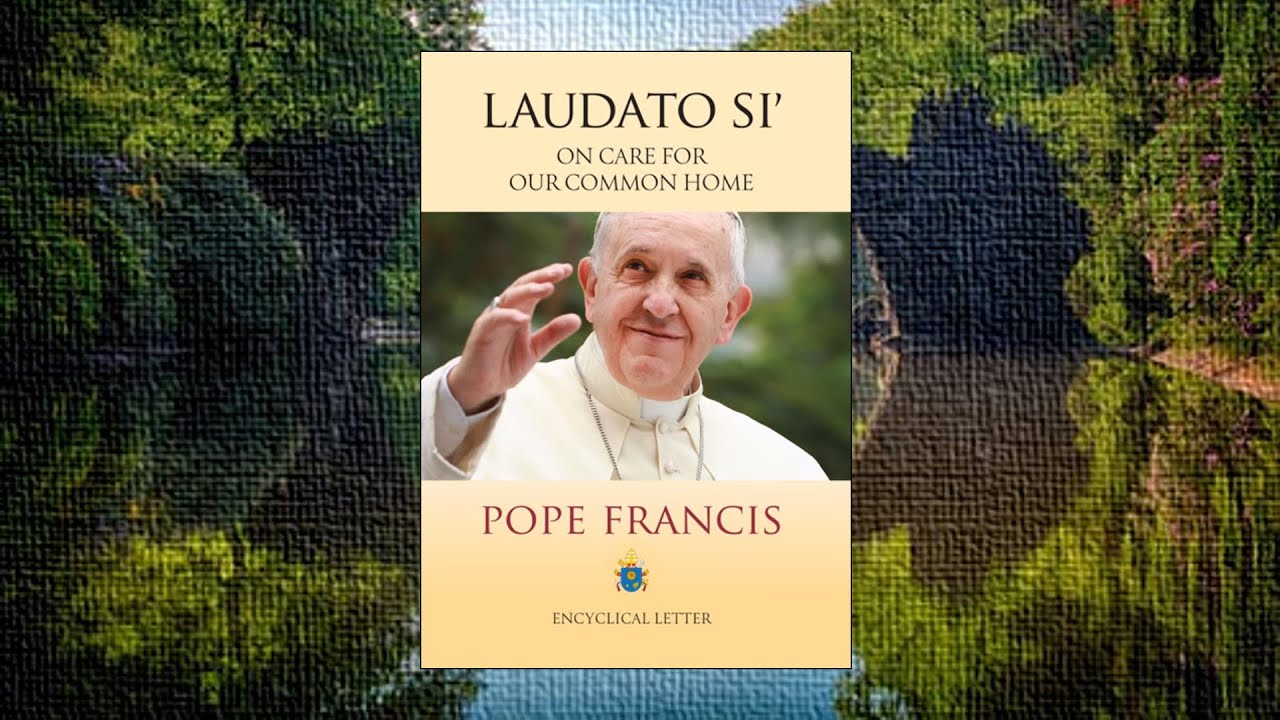
Five years ago, Pope Francis promulgated Laudato Si: On Care For Our Common Home, the first ever encyclical devoted to the environment, leaving many Christians with the same question: Why care about the environment? More importantly, why waste time on a document about the environment when human beings face far more important issues? For Francis, the answer is simple: we are all interconnected.
Exploiting God’s creation for short term profit doesn’t just hurt the trees or rivers—it hurts human life, particularly the poor and vulnerable. For this reason, Laudato Si is a landmark work of Church teaching that brings together science, theology, and social action to deal with much more than just the environment— it seeks to create an integral ecology in which all that is sacred is considered and cherished. What does this document say and why is it important for every person on earth?
This is Catholicism in Focus. For those whose Medieval Umbrian is a bit rusty, the title Laudato Si comes from the famous Canticle of the Creatures by St. Francis of Assisi, Laudato Si mi signore, “Praised be to you, my Lord.
” You really have to read the primary texts in their original languages… is something my professors used to say. This literary allusion gives insight into Pope Francis’ mindset: we must be like the saint who saw all of God’s creatures, not in regards to their utility, but as ends in themselves giving praise to God for their very existence. Personifying the earth as a sister, just as St.
Francis did, Pope Francis writes in his introduction: As a result, we as a human species have committed many sins against nature, against God, and against one another, greedily consuming more than we need, wasting precious resources meant for the good of all. In the opening chapter of the encyclical, he addresses many of them by name. To name just a few.
But of course, as Francis writes, “human beings too are creatures of this world,” and so widespread environmental degradation doesn’t just hurt natural resources, it hurts human life as well. Cities have grown unruly in many areas. They are inefficiently run, filled with pollution, and leave its citizens crowded in a world of cement and asphalt.
Those who have relied for generations on the fruits of the environment—people like fishers and farmers—are finding it more difficult to support themselves. In areas where precious metals or oil is found, locals are often exploited by multinational corporations, even expelled from their own land. The poor are forced to live where pollution is high and environmental disasters are frequent.
This is a far cry from what Pope Francis called the “Gospel of Creation. ” In Chapter 2 of his letter, he looks to the biblical accounts of creation, the Judeo-Christian approach to the mystery of the universe, the life of Jesus, and the social tradition of the Catholic Church to teach an invaluable truth: we are meant to be among and for Creation as its caretaker, not above it as its Lord. Humanity was never given unlimited authority to do whatever it pleased with the earth; amassing excess private property at the expense of others is not the will of God.
The earth is a gift—a gift meant FOR all, to be cared for BY all. Meaning, that the resources of the earth must be shared equitably, but also that the resources of the earth should be properly respected in their own right. There is a dignity to creation beyond what it can do for us.
Again—you can see why he invokes St. Francis’ Canticle of the Creatures—we are meant to see all of Creation as our brothers and sisters, as beings in relationship with God. But unfortunately, this is not even remotely close to true in our world.
Why is that? In chapter three, Francis gets behind the individual problems to identify the philosophical flaws that inform them. He identifies two root issues.
The first is that we have adopted a technocratic approach to the world, a sense that science and technology are supreme forms of truth, capable of solving any issue and so licensed to reduce the world to exploitable resources. While Francis does not deny the incredible advancements to human life brought about by science and technology, what he calls two “products of a God-given human creativity,” he cautions against elevating them beyond their capabilities or letting them dominate the world. The exploitation of DNA, weapons of mass destruction, and massive invasions of privacy by information technology all show, as he says, that “our immense technological development has not been accompanied by a development in human responsibility, values, and conscience.
” Instead, it is accompanied by an anthropocentrism that finds no inherent value in Creation—the world is simply meant to be exploited for human purposes. Which is ironic, sadly enough, because it doesn’t even do that particularly well. Along with a technocratic mindset, Francis points out that there is a second, seemingly contradictory root problem at work: In a subtle way, this is seen in the increased reliance on an automated workforce.
Using machines for manufacturing cuts costs and makes things easier for humanity, but it also strips people of the opportunity to work, a necessary endeavor not only because it provides income, but because work brings fulfillment to one’s life. Without meaningful work, human capital erodes, undermining the very purpose for technology in the first place. Of course, the schizophrenia of a technocracy is seen is far more violent examples, as in the case of abortion.
For Francis, this is further evidence that we live in a throwaway society that has no regard for anything sacred. Not for beautiful ecological wonders. Not for limited natural resources.
Not even for human life. For Francis, pollution and overconsumption are not the problems in themselves—they are symptoms of a far more serious disconnect in the values of society. Thus, for Francis, the answer is not simply to plant more trees or to recycle, although he would certainly not object to these things.
The world does not need further cosmetic changes that at best treat symptoms… it needs a fundamental shift in the way it approaches the world around it. In other words, it needs an integral ecology. In Chapter four, Francis gets to the heart of the document in which he challenges all people of the earth to embrace the interconnectedness of all in creation.
It is not enough to focus on a singular issue while ignoring another. Issues of the environment are integrally related to those of the economy, society, and culture. He writes earlier in the document, although it seems to capture the essence of this defining chapter, And that’s it.
That’s the game right there. While he goes on in chapters five and six to offer advice for how to implement this spirituality on a practical level—sections I highly recommend that you read yourself —it is this spirituality, one of interconnectedness and communal responsibility for all of Creation, that Francis seeks to engender in all of us. As much as Laudato Si is described as the “encyclical about the environment,” it’s clear that this hardly does it justice.
Francis is not concerned with tree hugging or a New Age approach to nature disconnected from human existence—he’s concerned with building a world in which every facet of our lives gives glory to God. We are all in this together. To hurt one of God’s creatures is to hurt us all.
As Christians, we care for the environment because we care for all that God has created, and we care for each other.