Japan manages to compete with its massive neighbors the much larger countries of Russia and China because of its huge Urban population that boosts its economy but did you know that most of Japan actually lives in a single belt a tiny portion of the already miniature island nation known for its futuristic technology and courteous people Japan has a rich history and culture that has developed over the centuries in terms of its size Japan is dwarfed by its neighbors China is 25 times bigger than Japan while Russia is huge a whopping 45 times bigger despite this Russia's
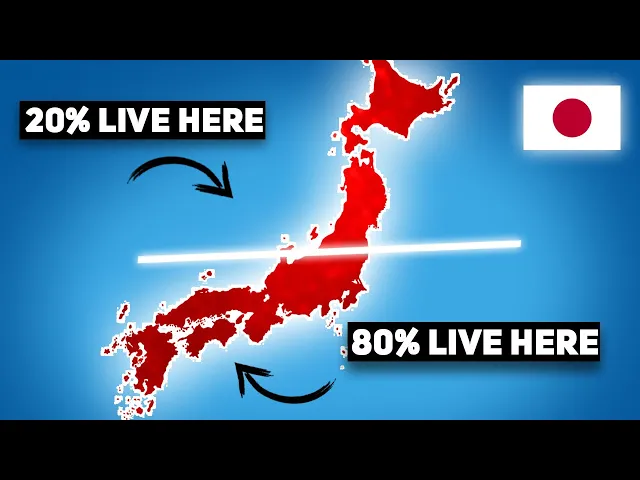
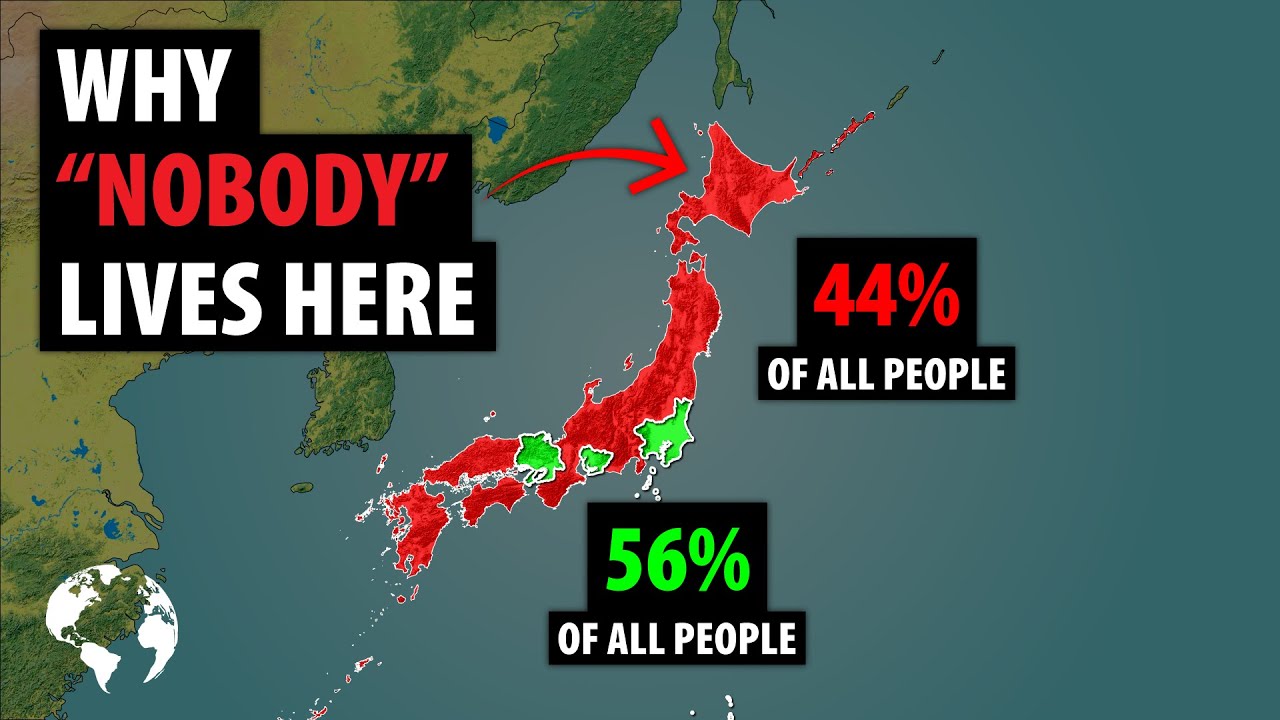
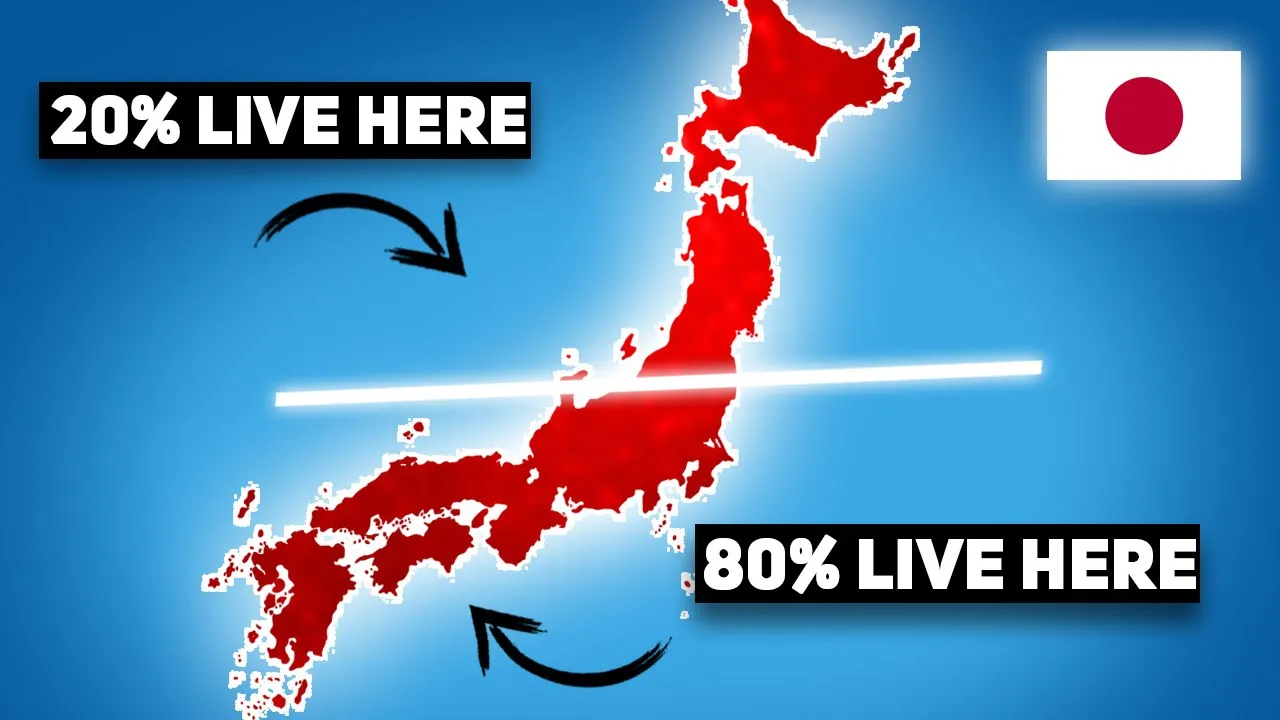
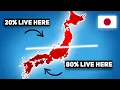
entire population is only about 16 million more than Japan's but if one looks at how Japan's population is spread out today a curious trend is clear first of all the majority of Japanese people live in cities as of 2021 a huge 91.7 of the total population lived in cities and secondly the majority of these Japanese cities are clustered together south of this line the 36 degrees north latitude in fact 80 percent of Japan's population lives below this line and astonishingly a vast majority of these live just within this tiny belt running along the 36th north
latitude comprising the cities of Tokyo Yokohama Nagoya Osaka Kobe and Hiroshima now you might be wondering why most Japanese cities lie to the south of this line and why are most of its people concentrated within this belt stick around to find out even though Japan is a tiny country made up of a number of islands it has very different weather conditions across its different regions Japan has four distinct regions Northern Japan is is made up of the island of Hokkaido Eastern Japan consists of the chubu region and Kanto Plains this is where the capital Tokyo
can be found Western Japan is where the Kansai Plains along with the regions of chigoku and shigoku are found Southern Japan is made up of the tiny southern island of Okinawa and the southern portion of the Kyushu region Northern Japan experiences moderately warm Summers and extremely cold Winters with high levels of snowfall especially on the western side and in the mountainous regions Southern Japan has Summers that are hot and humid and Winters are moderately cold in most places except for the side facing the Sea of Japan Japan lies off the east coast of Russia separated
from Siberia by the Sea of Japan in the winters icy cold winds blow in from Siberia towards Japan as they pass over the Sea of Japan they pick up moisture from the ocean which they then deposit as snowfall once they reach Japan and hit the mountains that are centrally located across the country this is why the parts of the country that face the Sea of Japan along the western coast are the areas that receive more snowfall and have harsh Winters as the harsh Winters discourage people from living up north people would rather live where the
weather is nicer and since these weather conditions have been around for centuries even in historical times the Japanese empire flourished in the South where conditions were more suitable for agriculture and for people to live now we've already discussed how the central mountains in Japan cause heavy snowfall in the western coastline and to the north making them difficult areas to develop but the mountains also cause a great deal of difficulty as almost 80 percent of Japan is mountainous and these regions can't be used for agriculture or for large cities to spread out this means the capacity
for human growth is very limited Japan has only two large planes the Kanto and Kansai Plains in the East and the West respectively but both of these planes also lie south of the line which is the 36 degrees north latitude the ancient cities of Nara and Kyoto developed in the Kansai plain in the East is the Kanto plain where the Tokyo metropolitan area lies in which one-third of Japan's entire population lives however quite ironically this region where so many live is also the most prone to earthquakes something pan suffers from a lot being so densely
populated this region has witnessed several disastrous earthquakes the Tokyo Yokohama earthquake of 1923 measuring 7.9 on the Richter Scale alone caused more than 100 000 casualties but since there are no other options in terms of space for people to expand Japan has had to find other Solutions in terms of construction now if you have been paying attention until this point it's quite clear to you that the main reason for most of Japan's cities lying to the south of the line is the climate and geographical factors that affect the country these have been present for a
long time and have shaped the way the country's population has been spread out even centuries ago even in its early days as the Yamato state in the early 300s their empire was in the Kenai region of Central Japan their territory covered the central portion of the southern island Honshu but did not extend northwards later on during the Nara period from 7 10 onwards the new capital was at where modern day Nara is in Southwest Japan in what is the Kansai region today the region apart from being located centrally also had relatively better protection from Cyclones
Storm surges and tsunamis the Japanese empire became a centralized power during the Edo period which began sometime around the start of the 17th century at this time the Empire ruled from the Southeastern city of Ido which later turned into the city We Now call Tokyo it was an ERA characterized by peace and stability however it was also during this era that the Japanese started moving North until this time the northern island of Hokkaido as it's known today was inhabited by indigenous people called the ainu people during the Edo period however Japanese settlers began to migrate
north towards Hokkaido and eventually colonized it by 1869 and made it one with their empire thus the Japanese empire first spread over the hansu island in the South up until the Ido period This is why most Japanese cities even today are located on this island as these cities were these strongholds of power during the various historical eras of Japan it was only during the Ido period that they began to move north to colonize these areas and even then it never was urbanized to the extent that the South was even in present times Japan being an
island nation consisting largely of mountains does not have much in terms of Natural Resources this makes it dependent on trade for centuries Japan has traded through sea roots and this has led the country's ports to develop in the most convenient locations since the west coast of Japan has closed Seas with narrow inlets and Outlets building ports on this side has never made much sense due to this the Eastern side of Japan which faces the open Pacific Ocean is where the majority of Japanese port cities were built and can still be found in addition to this
since Tokyo and Kanto plane lie close to the Eastern Coastline and are the thriving Hub of Japanese industrialization the area also serves as the market from which goods are exported and imported these areas have developed out of a need to create goods and attracted people from other regions of Japan to shift to them due to the Opera opportunities they provided the southern cities are connected by bullet trains commuting between cities is also a lot easier which means that more and more people have moved to these areas however since it's difficult to construct train tracks over
mountains the northern regions which are mostly mountainous are nowhere as well connected due to this these areas continue to grow while the north empties as more and more people move South looking for employment and better standards of living now we've seen all the varying reasons which have led to Japan developing the way it has but what about Japan's future Japan has a rapidly aging population and is also one of the country's most at risk to the threat of climate change so how will it compete with its ever strengthening and much larger neighbors of Russia and
China well surprisingly the northern island of Hokkaido May hold the key in a world where superpowers are fighting for dominance and strategic positioning hokkaido's location gives it importance it sits at a unique Crossroads between the Arctic Asia and the Pacific its position means it serves as a Midway point between the three behemoths of China Russia and the United States and could serve as a crucial point to help one of these nations establish military economic and political power China has recognized its importance for decades and has been trying to strengthen its economic importance in the area
for a long time by buying up valuable real estate Moscow too recently stepped up its efforts in the region through its dispute with Japan over the possession of the kuril islands that lie close to Hokkaido the USA has also noticed the actions of its Rivals and is increasing its attention towards the area realizing the value it holds in the struggle for worldwide dominance but the country with the truest claim over the islands Remains the one closest to them Japan if Japan chooses to use its technological and Military resources towards developing the island and increasing their
military presence in the area they could succeed in holding off their seemingly oversized Rivals and gain a vital stronghold to use to compete against these superpowers on an international stage in a struggle where Japan seems hopelessly outmatched in terms of size it's forgotten Northern regions just might be the key to its survival we hope you enjoyed learning about this subject let us know your thoughts in the comments down below and if you enjoyed the video make sure to like And subscribe to the channel until next time take care and thanks for watching