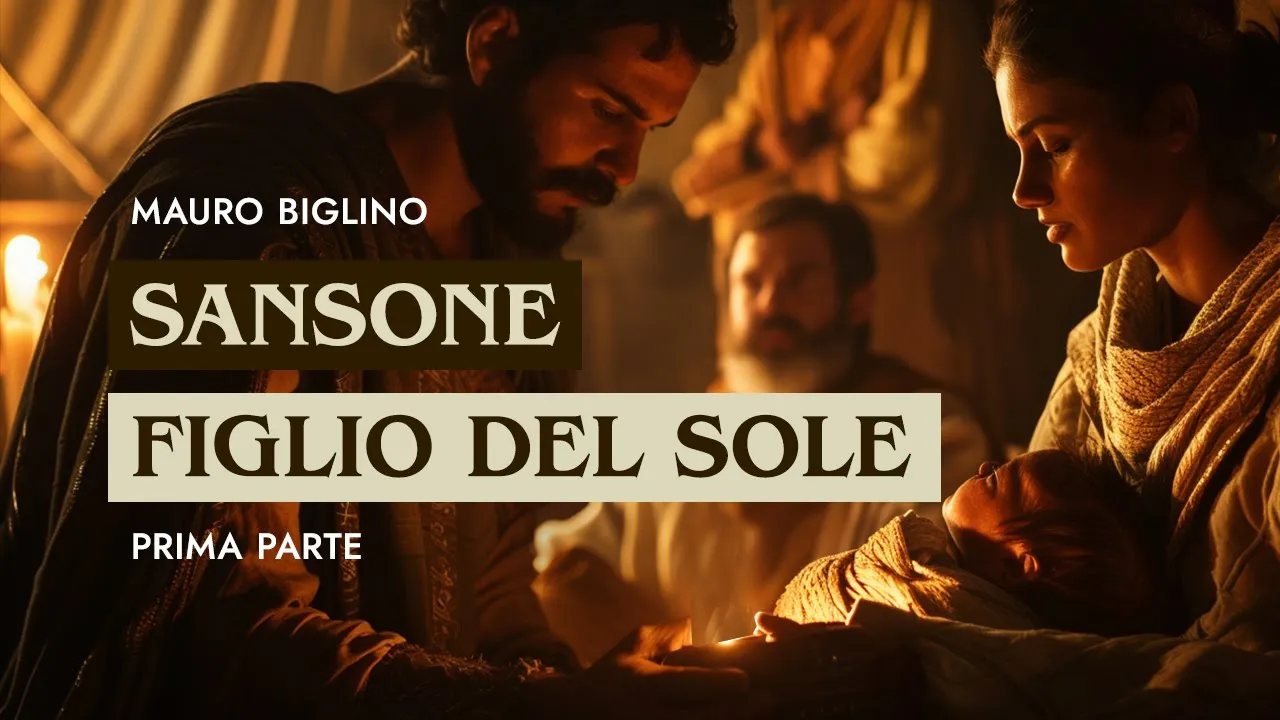
Good morning. Today I'm talking to you about a topic that I've never talked about even in conferences, at least I don't remember having done so: let's talk about Samson. Samson whose meaning is son of the Sun.
Samson is a somewhat particular character in the Bible and his story is also a bit particular because, meanwhile, his whole life is narrated; it is part of the book of Judges and its narrative is also full of "humour", "humour" towards the enemies of Israel and, obviously, they were able to write it after having defeated them because before they were subjugated by the Philistines and therefore they had to remain calm and then at a certain point, when they finally got rid of it, they were also able to, so to speak, play with it, make fun of it a little. And therefore Samson is a particular figure and we examine him because he has many things to tell us, truly many things: for the way in which the Bible is written, for the way in which the term Elohim was understood, for the relationship that existed, for angels etc. So now let's start reading a chapter together.
We are in chapter 13 of the book of Judges and it says "The Israelites returned to doing what is evil in the eyes of the Lord" that is, of Yahweh "and Yahweh handed them over to the Philistines for 40 years. There was then a man from Sorah , of the tribe of the Danites". I like when we talk about the Danite tribe because it refers to stories that concern the whole Mediterranean, it concerns the Greeks, Homer's Danaoi; refers to the Shardana, it was that tribe that was equipped with ships as the Song of Deborah says, so in short a very particular tribe.
So there was this "man from the tribe of the Danites called Manoah. His wife was sterile and had no children" and this takes us back to the figure of Sarah, Abraham's companion, because she was also sterile and Manoah's wife was succeeded by something similar to what happened to Sara. "The angel of Yahweh appeared to this woman and said to her.
. . ".
Meanwhile, here the angel of Yahweh is written but in the Bible there is no article so it is an angel, a "malach", a messenger of Yahweh and then we are again with the verb 'appeared' which, in reality is 'he showed himself, he presented himself' therefore 'appeared' is a theological vision because, since angels are spiritual beings according to theology, this verb is always used which, however, in short, leads us to get the wrong idea of angels and then we will also see what it does. Then "an angel of Yahweh showed himself" then went to meet "this woman and said to her: behold, you are barren and have not had children but you will conceive and give birth to a son" exactly as happened to Sarah. Sarah was barren, is visited by Yahweh and becomes pregnant.
Here she is, so to speak, visited by an angel and becomes pregnant; the Madonna is visited by an angel and becomes pregnant. In short, let's say that in this so-called sacred book this is a story that is repeated several times. "And he says to her: now beware of drinking wine or intoxicating drink and do not eat anything impure.
" For intoxicating drink in Hebrew the term "shakar" is used which is the same term used for that intoxicating drink that Yahweh used, asked to have every day - we talked about it several times - and wanted a certain quantity and here it is clearly distinct from wine because it says "wine or intoxicating drink": from the Sumerians we know that they drank beer; the Egyptians drank beer; it could also be beer for goodness sake, but we are not able to define exactly what it was: let's say that it was a drink that made you drunk, there is no doubt about this, a drink that induced you to say nonsense things. And then he says "Beware of drinking, etc. .
. . for, behold, you will conceive and give birth to a son whose head no razor will pass because the child will be a Nazirite of Yahweh from the womb.
He will begin to save Israel from the hands of the Philistines" . So this obviously seems like a prophecy but, as we know, the prophecies in the Bible are always written "post eventum" because the story of Samson, therefore belonging to the Judges, occurs long before the advent of the kingdom of David, Solomon etc. , therefore we can say that we are around the 11th century BC, these books were written - or at least rewritten - between the sixth and fifth centuries BC and therefore this prophecy was written a few centuries after the events.
Then he says "he will be a Nazirite". Now, the figure of the Nazirite was a very particular figure: it meant consecrated, consecrated to Yahweh and the Nazirite had, must have had particular characteristics: he must not cut his hair, he must not drink intoxicating drinks, he must not drink wine and he must not have contact impure, especially with corpses. Therefore the figure of the Nazirite was also somewhat reminiscent of the figure, in some aspects, of the high priest, in other aspects, of the priest who had, let's say, similar obligations.
The figure of the Nazirite was not specific to Israel but belonged to the Semitic world, it also belonged, for example, to the Syrians, it belonged to the Egyptians, Herodotus tells us about it in his second book, even if in short there were some differences but, in short, these figures were recalled and the figure of the person consecrated to the divinity was a particular figure. The Nazirite could last a lifetime, as for Samson, or it could be limited to a period of time: generally it could only be about thirty days. Flavius Josephus also tells us, among other things, that a certain sort of Nazirite could also be followed by women, for example he tells us about it in relation to Berenice who was the sister of King Agrippa II.
Here, however, it is said that Samson would have been a Nazirite all his life and therefore he had to begin to be pure from his mother's womb and it is also said "he will begin to save Israel from the Philistines". Why does it say "it will begin"? "Post eventum" prophecy, so already when the book was written it was known that Samson had failed to save the Jews from the Philistines, which would later happen in the times of Saul and David and therefore Samson begins this work of liberation from slavery of the Philistines, from submission to the Philistines but fails to complete it.
"The woman went and told her husband: a man of Yahweh has come to me" so it says a "man". First we talk about a "malach", here we talk about an "ish" so, once again, we have the reconfirmation that the "malakhim" were men of flesh and blood, therefore they were not those little angels with wings that we are referring to get used to thinking. And he says however "A man of Yahweh came to me: he had the appearance of a malach of Yahweh" that is, of an angel of God "a majestic appearance" it is written here.
In reality, the Hebrew term does not indicate, does not have the concept of, as expressed here, a pleasant majesty but indicates something terrifying, that is, it was scary, it had a terrible appearance and we have already said that meeting angels was never pleasant but we will see later, shortly, what they say about this. "Then Manoach" that is the father "prayed to Yahweh and said: a man of God sent by you" and in Hebrew it says "ish ha-elohim" and it is strange because Manoach shouldn't say "a man of the elohim sent from you" in the sense that, if Yahweh is the unique elohim, he is the unique God, he should say "your man, your angel", instead he says "a man of the elohim sent by you". In short, the meaning is decidedly different, the concept itself is different.
"Forgive my Lord, the man of God" therefore elohim "sent by you, come to us again and teach us what we must do for the unborn child" because, precisely, the first time he presented himself to Manoach's wife Manoach he wasn't there: so there was a two-way meeting. "The elohim heard the prayers of Manoah and the angel, the malach of the elohim, returned again to the woman while she was in the field but Manoah, her husband, was not with her", again, i. e.
the angel shows up when the husband is not there. We can have some suspicions if we want, but, in short, let's think carefully. "The woman quickly ran to inform her husband and said to him: behold, he appeared to me" again that appearing which derives from the "niphal" i.
e. passive, passive-reflexive form of the verb and which indicates the "to be seen, to show oneself" is not to "appear" as if appearing from nothing but to "come forward". And again he says "That man appeared to me" - so once again there is the word "ish" - "who came to me the other day.
Manoah got up and followed his wife and came to that man" sorry if I always put the emphasis on 'man' but it is to make it clear that it was absolutely not a spiritual vision "and said to him: are you the man who spoke to this woman? He replied: it is me. Manoah said to him: when your word comes true" so in Hebrew it is "when what you have said comes, what will be the standard for the child to follow and what will he have to do?
" and here he becomes an angel again "The malach of Yahweh replied to Manoah: let the woman abstain from what I have said to her, do not eat any produce of the vineyard nor drink wine or intoxicating drink" again 'shakhar ' "and do not eat anything of observe what I have commanded you. Again he said to the angel of Yahweh" that is to the messenger of Yahweh, to the malakh of Yahweh "let us detain you and prepare a kid for you" in Hebrew there is precisely "that I detain you" it is an exhortative and therefore he says he wants to prepare something for him to eat to, in short, nourish himself. "The angel of the Lord answered Manoah: even if you restrain me I will not eat your food" as an angel, i.
e. Yahweh's malakh, did not eat human food: therefore here there is food or bread also, the meaning of the term "but if you make a burnt offering, you will send it Up to Yahweh. " And we are back to that type of sacrifice which was called a holocaust and which consisted of burning the victim entirely and sending the smoke upwards , which was particularly pleasing to the elohim.
"Manoah did not know that that was the angel of Yahweh" so Manoah, poor thing, had not yet understood and here, among other things, a particle is skipped in the translation, the particle "ki" which means "since, since, In fact, "Manoah did not know that he was the angel of Yahweh" that is, essentially, Manoah offers him something to eat because he did not know that he was the angel of Yahweh: this is important because it means that they evidently knew that the angels, the so-called Angels , they did not feed on human food and in fact the angel tells him: if you really want, make a sacrifice, send the smoke up "Manoach said to the angel of Yahweh: what is your name so that we will honor you when the your word? " That is: tell us who you are so we can honor you when the child is born. "The angel of the Lord answered him: why do you ask me my name?
It is mysterious" is translated here. the meaning of the Hebrew term is also "incomprehensible", that is: it is useless for me to tell you my name because you cannot understand the meaning anyway. So mysterious gives us, in this way, an idea of a fascinating, incomprehensible statement means: there's no point in me telling you because you wouldn't understand it anyway .
works mysterious things". Now there is one thing to say: the translation of this part "who works mysterious things" is very controversial because here there is a participle and it is introduced by an "and", not by a "that" therefore the fact that "doing mysterious things or doing mysterious things" may not refer to Yahweh as the subject, so much so that many translators even put it as the subject, which is not in the Hebrew, but they put the angel as the subject , the one who does this mysterious, wonderful work, which we will now see, could be the angel. The problem is that this part here is still inserted in the verse referring to Yahweh but we know that the verses, the division into verses and chapters was made by the Archbishop of Canterbury in 1226 AD while the Bible was originally written without distinction between letters and words, therefore the distinction in verses, the subdivision, is arbitrary and, in fact, it is more correct, more coherent, more logical, to think that it is the angel who does this work, this mysterious, admirable, wonderful act, which arouses wonder - this is the meaning of the Hebrew term - , because what happens?
So we repeat "Manoah took the kid and the offering and on the stone offered them as a burnt offering to Yahweh" and then there is "and what is astonishing, while Manoah and his wife were watching" - "Manoah and his wife watching" this is the literal translation - and what is so surprising about it? "As the flame ascended from the altar to heaven, the angel of Yahweh ascended with the flame of the altar" that is, he goes away and goes upwards "Manoah and his wife who were watching, then fell down with the came to earth and the angel of the Lord no longer appeared to Manoah or to his wife. Then Manoah understood that it was the angel of Yahweh" that is, Manoah, perhaps a little slower in mind than his wife, took longer to understand.
that that was the angel and he finally understood it when he saw the angel ascend and go into the sky, go high. Here the verse says "he appeared no more", in Hebrew it actually says "he no longer continued to be seen" that is, they never saw him again: he came that time, he came several times, both times he met Manoah's wife alone without the presence of her husband, Manoah's wife becomes pregnant and Samson will be born. The discussion relating to food.
. . Manoah offers a goat, the angel says: I will not eat your food but put it on the stone and offer it to the Lord, it reminds us of the story of Gideon.
Gideon is another character in the book of Judges to whom a similar thing happens. I'll read it to you "At that moment" at the time of Gideon who therefore comes before Samson "the Israelites feared being exterminated by Midian" that is by the Midianit. i I remember that the Midianites were first cousins of the Israelites, I remember that Jethro was the priest of Midian and that Jethro was Moses' father-in-law, so it was infighting.
However we say: Israel feared being exterminated by Midian and Gideon therefore turned to the Lord "Yahweh said to him: I will be with you and you will defeat the Midianites as if they were one man. He then said to him: if I have found favor in your eyes, give me a sign that you are speaking to me" that is, Gideon wants to be sure that it is "God" speaking to him in quotation marks but this is something that makes absolutely no sense: if God is the only God it can only be him, instead Gideon asks a sign, as Moses asked for a sign: to see the power of Yahweh, that is, the so-called glory of the Lord. And he says "If I have found favor in your eyes, give me a sign that you speak to me.
In the meantime, do not leave here before I return to you and bring my offering to present to you. He replied: I will stay until your return". That is, so let's imagine Gideon speaking to God and telling him: give me a sign that it's really you who's speaking and then listen, have a moment of patience, stay here, I'll pop over to the house to prepare something for you to eat and then I'll come back - now, if this were God, we all understand that it would be an absolutely ridiculous and unacceptable story - and he tells him: yes, okay, I'll wait for you, I'll be patient and wait for you.
"Then Gideon entered the house, prepared a kid, with an "ephah" of flour he made unleavened cakes: he put the meat in a basket, the broth in a pot, brought it all to him under the terebinth and offered it to him. The malach of Yahweh " and here too we discover that it was a messenger of Yahweh who spoke to Gideon "he said to him: take the meat and the unleavened cakes, place them on this stone and pour the broth. Then the angel of God stretched out the end of the staff in his hand and touched the meat and the unleavened cakes: a fire came up from the rock and consumed the meat and the unleavened cakes, and the angel of God disappeared from his eyes.
" Here too we have an action that is astonishing. Both in the case of Samson and in the case of Gideon the food is not consumed by the malach but is burned and here it is even burned with an act that, in fact, arouses wonder, that is, the angel of the Lord he touches the food with a stick and a flame immediately starts that burns everything and therefore the angel does not eat. Then it says "and disappeared from his eyes": the Hebrew verb "alàch" does not mean disappeared, it means that he went away walking.
Here we are again at a translation, a theological interpretation, that is, since he is an angel he must disappear. No, he doesn't disappear, he goes away walking calmly. "Gideon saw that it was the angel of the Lord and said: elohim Yahweh, I have therefore seen an angel of the Lord face to face" but, be careful, this translation does not convey the meaning of the Hebrew because in Hebrew there is an exclamation that English translate it as "alas" and we would say "Ah!
Oh God! " we would say, "I saw the angel of the Lord face to face" and it expresses fear, it expresses terror, because meeting angels was never a pleasant thing, it was always rather risky and here we see it for Gideon but let's go back to Samson or rather to his parents and, after everything we have read before has happened and the angel leaves and is never seen again "Manoah said to his wife: we will certainly die because we have seen an elohim". This is literally written in the Hebrew text and why does it say we saw an elohim?
Because it may be - this is obviously a hypothesis because, as you know, we don't have certainties and therefore we can only "pretend " - the malakim i. e. the angels, the so-called angels or rather the messengers of the elohim, were probably belonging to the same typology but, in the military hierarchy that went from Elyon, who was the commander in chief, and then the elohim and then the malakhim who were their messengers, we could, with modern terms, talk about a general, talk about senior officers and talk about of troops, so to speak, or at least of non-commissioned officers and therefore they could all be defined in the same way because they belonged to the same type of individuals but were divided into a military hierarchy.
But what is important is that both Gideon and Manoah express fear for having seen one of these characters because there was the risk of dying. In fact, if we go back to Gideon for a moment "The Lord said to him" after he expressed this fear "Yahweh said to him: peace be with you. Do not be afraid, you will not die".
Gideon needed to be reassured, Samson's father expresses terror at having seen an elohim and says: we will surely die. So, effectively, the distinction between the elohim and the adams, let's say men, had to be such that the elohim were seen as very dangerous characters. But his wife, perhaps wiser than him, "and his wife said to him: if the Lord had wanted us to die he would not have accepted the burnt offering and the offering from our hands; he would not have shown us all these things nor would he have made us hear now things like these.
And the woman gave birth to a son, and he named him Samson; and the child grew up, and the Lord blessed him. " I remember that in the Bible, blessing always means providing particular material tools and therefore not giving a spiritual blessing. We have already seen it when, speaking about the story of Esau, when Esau asks his father: do you still have no blessing for me after his father had given it all to Jacob and his father says to him: no I no longer have any, l 'I gave it all to Jacob.
Which would be ridiculous because it would be like coming to a priest at the end of the mass and saying to him: give me the blessing and the priest said: I don't have any more, I gave it all to the faithful during the mass and therefore Now I have none left. So this was the concept of blessing in the Old Testament, that is, a very material concept and in Samson, obviously, the blessing, that is, this power that he had, was linked to his situation as a Nazirite, that is, as a person totally consecrated to Yahweh: from there they derived all its features. “The spirit of the Lord began to work upon him when he was in the camp of Dan, between Zorah and Eshtaol.
” Here there are two considerations to make that help us understand. Here, in wit it says "ruach" and "ruach" is one of those terms much discussed, at least as far as I'm concerned, because "ruach" has multiple meanings. Hebrew is a polysemous language and we know that the meaning of "ruach" must be deduced from context each time .
So it is clear that while in certain passages of the Bible the term "ruach" indicates something that travels producing wind, in other passages of the Bible "ruach" indicates the spirit: by spirit we also mean the attitude or intimate characteristic of a person, not necessarily the spiritual entity. So, from time to time, "ruach" must be interpreted in quotation marks and that is why I, together with Paul Wallis, have made and have made videos in which we say that "ruach" is one of those terms that is good don't translate because at least this way you can avoid arguments. And it then says “The ruach of Yahweh began to act upon him when he was in the camp.
” Here too the term "act" is a translation, so to speak, very tamed, very softened, because in reality the Hebrew term even indicates "disturb" indicates "shake, agitate" in fact many translators, if we look at various Bibles, especially in English language, they use the term "agitate" that is "he began to agitate him, he began to push him, he began. . .
" for example in the passive it also means "to be disturbed" but also to be mentally disturbed and therefore in reality Yahweh acted on Samson in a very particular, thanks to the fact that he was a Nazirite for life. Then the story of Samson has many other things to teach us. Meanwhile he teaches us that "malacca and ish" that is "angel and man" are absolutely superimposable; meanwhile it teaches us that when a woman was sterile it was enough for her to meet one of these and she became pregnant; meanwhile it teaches us that the angels did not eat, they tended not to eat human food but then we will still have many things to see because, in the irony with which this book treats the Philistines for example, we will also examine the riddle that Samson asks the Philistines who it is sometimes subject to interpretation etc.
but which is well explained in the Bible. So for now we'll stop here and I'll see you next time. Bye thank you.