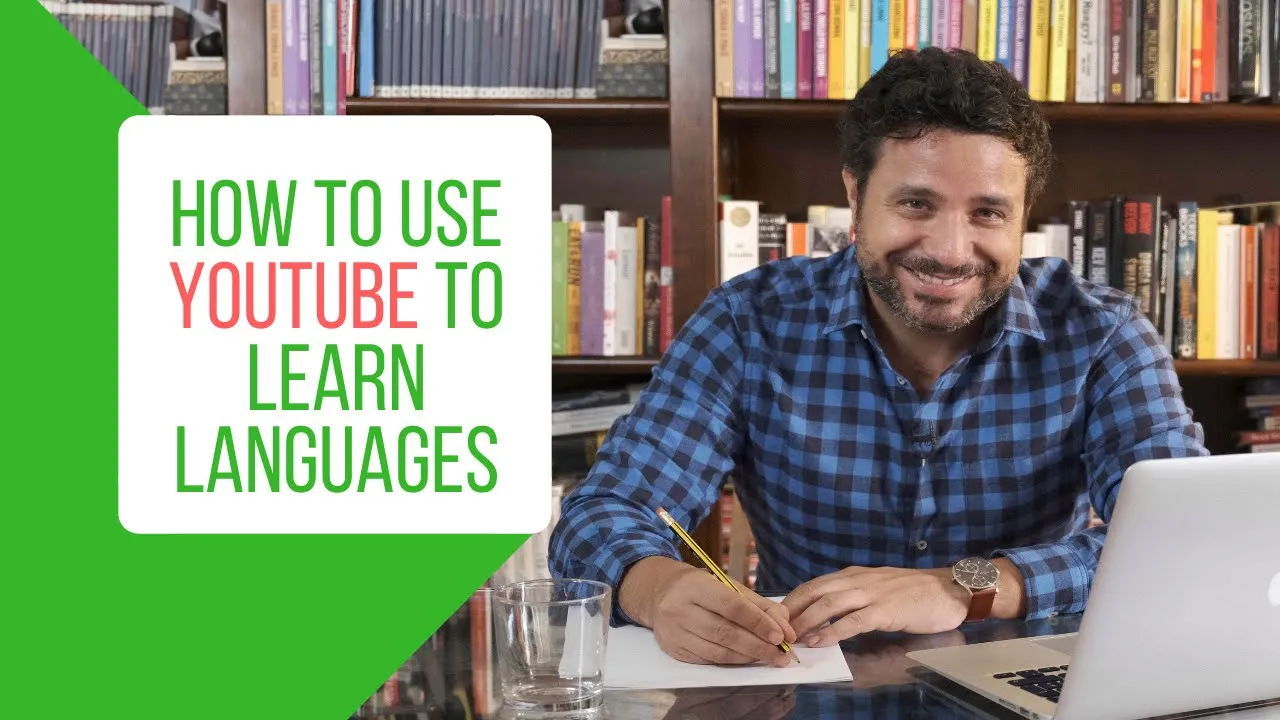
The internet - and YouTube in particular - offers a vast ocean of content, and if you don't want to get lost or waste time, you have to learn how to navigate it. Hi My name is Luca from Luca from LucaLampariello. com, and today I'm going to show you how I use the Internet, and in particular YouTube, to learn and improve my foreign languages.
Now, specifically for deliberate language learning, there are three criteria that are very good when it comes to choosing your content. The first criterion is that you should abide by content that is interesting to you. If something is interesting, your main focus is not the language itself, but it's the message and as a consequence you will learn the language that is used to convey that message.
The second crucial factor or point is that this content should be comprehensible to you. So, you don't want to choose content that has maybe just audio or in which the audio is too fast and is not good quality, but instead you want to focus on content that is very clear, that is possibly made for learners, but not necessarily, and that has subtitles in your target language and in English. The third important point to keep in mind for what I'm going to tell you later is that the video be a maximum of five-six minutes.
In fact, if the video is short, you can focus on it better, and you can do a number of repetitions on it which are going to expand the amount of time that you're going to spend on the video. And if the video is, say, ten minutes, then it will take you 1 hour to do that so. .
keep it short, keep it sweet and keep it effective. So, one of the resources that you can find on YouTube which satisfies the aforementioned criteria is easy language. Easy Hungarian, easy French, easy Italian you name it!
There are multiple versions for multiple languages, and for multiple learners. In particular, I have been learning Hungarian for quite some time , and I still use easy Hungarian as a wonderful learning resource. So now let me show you directly how I do it on my computer.
So, one recommendation as you can see here on the screen: you have the box of the video itself, but you also have to consider that there's this column on the right that shows you the other related videos. A very good recommendation for avoiding distractions is to put it in full-screen because what happens with YouTube is that you have a lot of other videos possibly that you can watch, but you have to pay attention because those are distracting. The moment you start watching the video, your eye falls on the other videos as well, and you want to change the video even before you finish it, so make sure that you have it on full screen.
So as you can see, we are in full screen now and the presenter Justyna is holding a microphone and she's going to go around interviewing people on the street, which allows you to actually enjoy how people really talk. We're in Budapest here and this video is easy Hungarian - let's get started. .
oh one second before we start - an important thing is that as you can see, I have my piece of paper here to write the title of the video. So, you have here easy Hungarian, and then the title of episode 1 and then to add the date this is important for your episodic memory and for your motivation, and I'm going to talk about this a little bit later. So, let's get started.
(Speaking Hungarian) (Speaking Hungarian) (Speaking Hungarian) So the very first step that I do do is very simple: I watch the video, I enjoy the video, and I look at the subtitles. As you can see, you have subtitles, both in Hungarian and in English, which makes this video comprehensible and very nice to look at but the first thing that I do a step number one is to watch this video in Hungarian and with subtitles in Hungarian, and why do I do that? Well because I focus on the video itself, on the content itself.
It does not matter how much I understand, I'm focusing more on the relationship between the spoken language and the written language. So, here they're talking and you know about somewhere do you want to travel etc and I finish watching the entire video once. Then, step number two is to rewind the video as I'm "rewinding" it right now and to watch it by focusing this time on the English subtitles so let me watch this again this time looking directly at the English subtitles below.
Okay, after watching in a second time, but this time with the English subtitles, I have started understanding more and more of the content because this is content for I would say intermediate-advanced learners, it really shows how people talk on the streets these people were getting interviewed they don't know that they're doing this content creating content for learners so they talk very fast and they use expressions that are commonly used so it's normal that I will miss a lot of stuff. So, after step 2, I already got a better idea of the content but I still miss a few things so you want to do something else and it is to watch it again watching it with Hungarian subtitles. So you're integrating the whole thing and you're getting the whole framework, or the whole picture (Speaking Hungarian) (Speaking Hungarian) Ok, so, you have watched it three times.
Now, one more thing that I do that does make a difference is that I jot things down. I always say. .
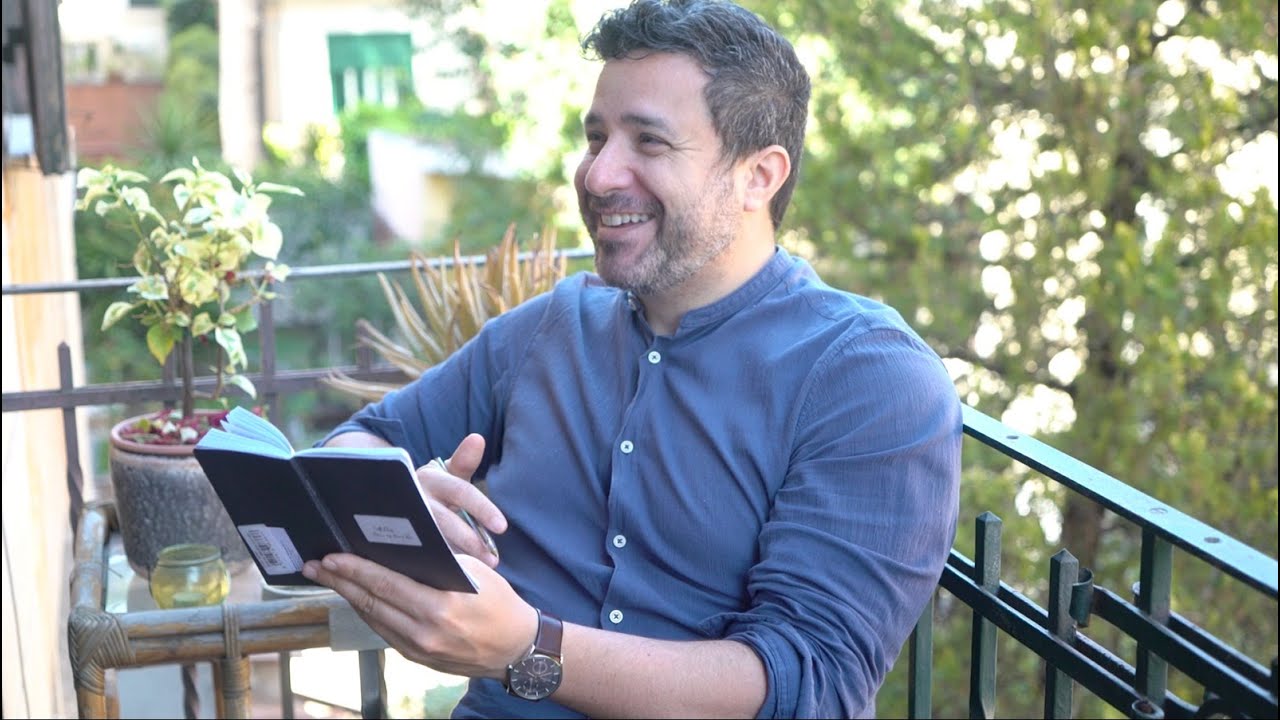
you know, the Romans used to say "Verba volant sed scripta manent" and I can't stress this enough, if you want things to stick, use a piece of paper or find somehow some way to save the words or the expressions or the information somehow on a piece of paper. So what I do is I watch the video for the fourth time but this time I'm going to stop it here and there and I'm going to jot down and mark and then look up the words that I find interesting related to this video. So, let me show how I do it (Speaking Hungarian) So I go back, I found a word that was interesting there, "fordítani", which is "translating" - which is word I love - and I can see directly the translation - no pun intended - below I've neat I'd need the internet to translate this so forditani So, another thing that I do and I want you to look at my position is that this configuration allows me to easily use my left hand to stop the video, and my right hand to write directly, so I just need to stop here and write it, and you want to make things easier for yourself because if you're in an uncomfortable position of your body, then you have to change the position of your body, you have to stop, you have to go back.
. this way, I just use left hand right hand it's really straightforward and it goes really fast Okay so I've done step number one, step number two, step number three, step number four, and we are at step number five. If you want, and some things are still not clear, the last thing you can do is just to relax now - now you got the content, because you've seen multiple times in different versions - you're adding variety to your brain and each step serves a specific purpose, now I just watch the video again you can choose which subtitles or you can even watch it without looking at the subtitles to see how much you understand but the idea is that now you can relax and look at the full content and focus on the message and this is a very straightforward way to look and extract information from a very simple video which you can see is four minutes it took me 30 minutes to complete it, 25-30 minutes, and that's the reason why I was stressing the fact that the length be 5 minutes or 3 minutes or 4 minutes because if you decide to tackle a 10 minute video, then this exercise or training or whatever you want to call it, is going to become very very long.
You want to keep it smooth, you want to keep it efficient, and you want to keep it smart. So, I've gone through these five steps and that's great! I'm satisfied, I've put in the work.
But the truth is that my learning session is not finished yet there is one last point that makes a difference. What I do is I make sure that every time I finish a learning session, I first put an entry into my logbook which is in a Google Docs or online and on top of that I also make sure that I save these pieces of paper into a folder. I'm going to give it a label - Hungarian or easy Hungarian - and then every single time that I finish, I put this piece of paper into the folder.
The reason why I do that is because a folder is a physical entity that you can actually see and every time that you start learning or finish learning a session of Hungarian or any other language for that matter, I'm constantly reminded of the amazing amount of work that I've been putting every single day. So, if you want to use YouTube as a fantastic learning tool to learn a bunch of languages, you want to keep in mind the following: first, you want to find content that is short, comprehensible and interesting to you. Second, make sure that you break down your learning session into multiple steps in which each step serves a specific purpose and make sure that you jot things down and you have a good body configuration or body position so that you can do multiple things smoothly at the same time.
And third, make sure that you store the information and every time you finish a learning session you jot down the entry on your logbook and you keep a piece of paper and you accumulate pieces of paper into a physical folder that reminds you of the amount of work you put every single day. So there you have it. If you want to learn how to use YouTube to learn or improve a bunch of languages, please don't forget to come to my website where I have written an extensive article about this very same matter, you can find a lot of resources, a lot of other links and there's going to be a lot of new surprises in the next future, so stay tuned, subscribe to my blog, subscribe to my channel if you haven't done so and good language learning and see you very soon!
Oh and one last thing: if you have any comments or questions, please write them below because I'm going to take the most interesting and curious and funny ones I'm going to comment them myself and reply to them, so stay tuned, and please write below.