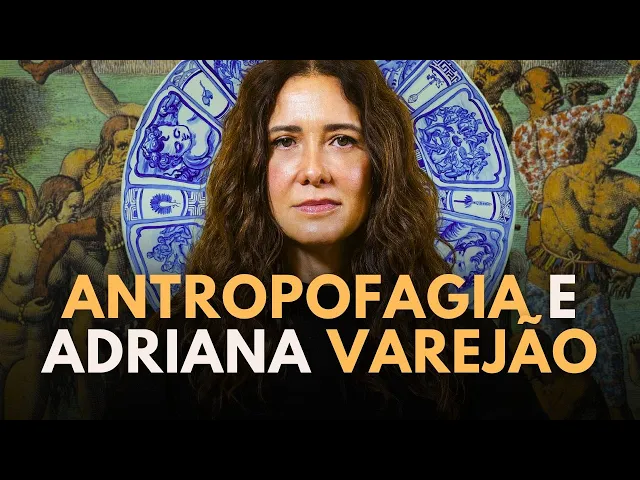
Well, before starting the video, I came here to remind you to leave a like and share on your social networks, as this will help our project a lot. - THANKS! In today's video we're going to talk a little about contemporary art, especially the work of the great Brazilian artist Adriana Varejão.
So stay here to watch this video in which we will talk a little about art, contemporary art, baroque and decolonialism. So stay there and enjoy the video. (Canal Vignette) Baroque is an artistic style that initially emerged in Italy, between the end of the 16th century and the middle of the 18th century, and which had reach and influence in different parts of the world, including the Americas.
But despite being strongly associated with Architecture, Fine Arts and Literature, Baroque can and should be seen as something bigger than just an artistic style. Baroque can also be interpreted as a cultural phenomenon of a certain historical period, where new ways of understanding the world, man and God were formulated. Not surprisingly, we are talking about a context marked by religious wars, the rise of the bourgeoisie and the consolidation of absolutism and its pompous monarchs.
The Baroque emerged at a time of contradictions and conflicts between manifestations of faith and the appreciation of reason. Therefore, it is marked by religious themes, antithesis, metaphor and also paradox. Baroque language is known and recognized for its refinement, exaggeration and drama in compositions that result in contrasting tensions between the spiritual world and the material world.
In Brazil, baroque manifestations emerged at the beginning of the 17th century in architecture, painting, sculpture and literature, this being the artistic manifestation that lasted for almost the entire colonial period. Gold exploration in Minas Gerais contributed to the flourishing of the movement in the region, mainly in the field of architecture and sculpture. To understand the work of an artist like Adriana Varejão it is necessary to have a concept of Baroque in mind.
Because it is in the false concreteness of a concept that Varejão seeks the foundation of his work. It is in the deconstruction of baroque imagery and aesthetics that it is possible to read and interpret much of his artistic production. His career and public recognition began with the completion of some works following his first trip to the city of Ouro Preto, in 1986, when he came into contact with the baroque and colonial imagery of the city's churches, with emphasis on the Igreja Matriz de Santa Efigenia.
- I became aware of Brazilian Baroque. - It was on one of the visits, a visit I made to Ouro Preto, Minas Gerais. - And there I entered a baroque church and I had a kind of epiphany - Because there was so much materiality, - So much volume, it's as if that matter danced like this - And I was very impressed by it all - So I decided to incorporate these baroque elements religious - From the colonial period in Brazil in my work.
The experience resulted in the adoption of religious images and symbols in his paintings, in addition to a commitment to studying the Baroque of Brazil and Latin America. The exaggeration and drama present in the Baroque can also be seen in works like this. It is by revisiting our past and colonial imagination that Adriana Varejão finds an artistic path.
His look at Portuguese America seeks, based on his critical work, to reveal how violent colonization was and continues to be. Behind some monuments that we have learned to admire, there is the blood and flesh of anonymous people. It is not the concrete that sustains them, but the body of anonymous people.
According to art critic Agnaldo Farias, in Varejão’s work, “things are alive. Things have flesh. Firstly, because they were produced by ourselves.
So, it's not just about the crafted, processed nature. They are marked by us. They bring our traces, our marks, our desires and our drives.
" The surface of the screen was never a mere support; rather, it is an essential element of the painting's message. His works constantly question surfaces as we see them and reveal what they may be hiding. Cutting, splitting, slashing and fissure are recurring features in Adriana's work, the artist who never fears rupture and experimentation.
Gradually, the artist began to create works dedicated to the construction of “historical fictions”, with paintings that seek to attribute new meanings to hegemonic views on the myths of the formation of Brazil, European cultural domination and the violence of slavery, reworking through parody and fiction, maps, scenes and landscapes created by traveling artists who are part of the country's past, leading to an investigation into Brazilians' skin tones . - I work on paintings in various ways - And this work I think I worked on painting as a tube of paint - When in the 80s, when I started painting, - There was still that issue of "skin color" - And skin color that was what pink was, it was a light pinkish color - That caused discomfort - "But what is that? what is the skin color in oil paint?
" - And then this name is wrong - The name is wrong - And sometimes what we have to draw attention to as artists - Is, sometimes, changing the name of things - Giving new names to things - So the name of this paint that I invented, - I invented a brand of paints called "people paints". - So this is a different way I'm talking about - Another kind of violence - I'm talking about miscegenation, but in this room we make a point - Of saying that miscegenation was not a peaceful process - It was even a process of domination - A We know that the idea of the whitening of the population - It carries with it the idea of erasure - Of certain cultural matrices and everything else - So this work is also talking about perversity - About a project of domination but talking about it in another way - In a way more political - A way that is more implicit than explicit - The wound would be the staging, the theatricalization of this violence - But that doesn't mean that there isn't violence here too - It's just that here it is implicit. In Varejão’s words: “If my field were literature, I would write historical novels.
I am a contemporary artist with current concerns. The figures from History that I use, despite being recurring, are shaped for a present time. I use parody, imitations.
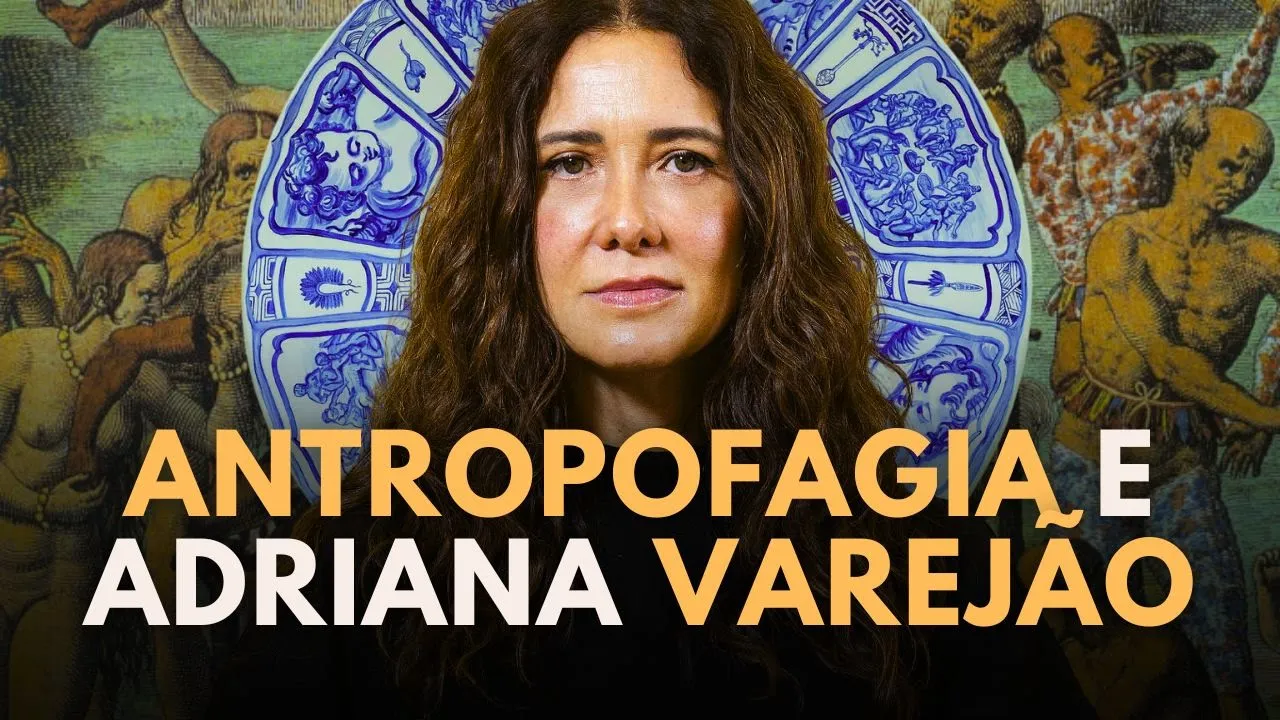
” In this work made by Adriana Varejão in 2014, she appropriates engravings produced during the 16th century by the Belgian artist Theodore De Bry. These engravings illustrate the stories of Hans Staden, a German navigator who became a prisoner of war of the Tupinambá people, on the north coast of São Paulo. Where he was prepared to participate in an anthropophagic ritual.
In which he would be sacrificed and his flesh would be consumed by that community. Although Theodore de Bry's engravings were used as a reference for Adriana Varejão's painting, it is possible to notice some differences. Note the central figure, which appears attached at the waist.
Tied by a rope. The figure appears to be a man with straight, long hair and a beard. On his left hand he has the middle and index fingers raised, while the others are facing him.
In Christian iconography, it is common to depict Jesus making this gesture with his right hand. Above this figure we can still read an inscription in Latin taken from the Bible, from John chapter 6, verse 57: "He who eats my flesh and drinks my blood is in me and I in him”. This inscription refers to the passage of the Eucharist, and symbolizes the consecration of the body and blood of Christ to be shared with the faithful at the time of communion.
Well, first we need to mention that it is an anthropophagic ritual. it is not the same as cannibalism, as the Europeans tried to sell it. These images that we see produced at the time of the colonization of America, do not bring the objective reality of the ritual, but an exaggeration and demonization of the act.
Firstly, because De Bry, who produced such images, never set foot in Brazil. Second, the idea of indigenous cannibalism was often exaggerated and sensationalized by European travelers and colonizers as a way to dehumanize and justify exploitation and violence against indigenous people, as well as being an editorial choice to sell more books. In fact, in some cultures, ritual anthropophagy was associated with religious and spiritual beliefs.
It was believed that consuming body parts of a captured enemy or tribesman could bestow specific powers or abilities. It was not a simple consumption of meat like our friend here Hannibal Lecter. Varejão's work takes up this idea, of anthropophagy as a ritual that confers the qualities of those consumed on those who consume.
But in the case of this work, it is about the body and blood of Christ. It is no coincidence that this work is titled “Proposal for a catechesis” and is made in the shape of a giant plate. Is there an easier way to catechize indigenous people than direct consumption of the central figure of Christianity?
In the Catholic tradition, at the time of communion, there is what we call Transubstantiation, in which the bread and wine present in this “ritual” are transformed into the substance of the Body and Blood of Jesus. That's why many children have been told by their parents not to bite the bone, as there is a risk of bleeding from the mouth. In other words, it is an anthropophagic ritual, which among indigenous people was demonized.
The catechization that the artist refers to in the title is one that was carried out as a pedagogical and political program for the colonization project of the territory we currently know as Brazil. Carried out by groups of Jesuit priests, the catechization of the original peoples began in 1549, with the arrival of the Society of Jesus, founded by the soldier (currently Saint) Ignatius of Loyola in 1534, to evangelize, catechize and make Catholic Christians the indigenous people and settlers. The entire catechization process involved learning the Portuguese language, reading biblical excerpts, adapting stories and narratives from local culture to equivalents from European culture, denying local culture and beliefs and a strong system of commands, obedience and punishments.
carefully intertwined with narratives of salvation and eternal life, imposing a strange and foreign culture and religion on the local population. By calling the work a “proposal”, Adriana Varejão suggests the possibility of thinking about “another catechesis”, inverting the stories associated with European Christian catechesis and its ideas, by placing them juxtaposed with images of anthropophagy rituals and knowledge of original peoples. .
His proposal considers the following question: what can we learn from the narratives of indigenous cultures after their processes of erasure in colonial Brazil and today? Or even: what if the story were different and it was the indigenous people who “catechized” the Europeans? In Varejão's work the idea that colonizing is violence is powerful.
I had the opportunity to see Adriana Varejão's work in two situations. First on a trip to São Paulo. I saw a good part of the works presented in the video at the Pinacoteca de São Paulo.
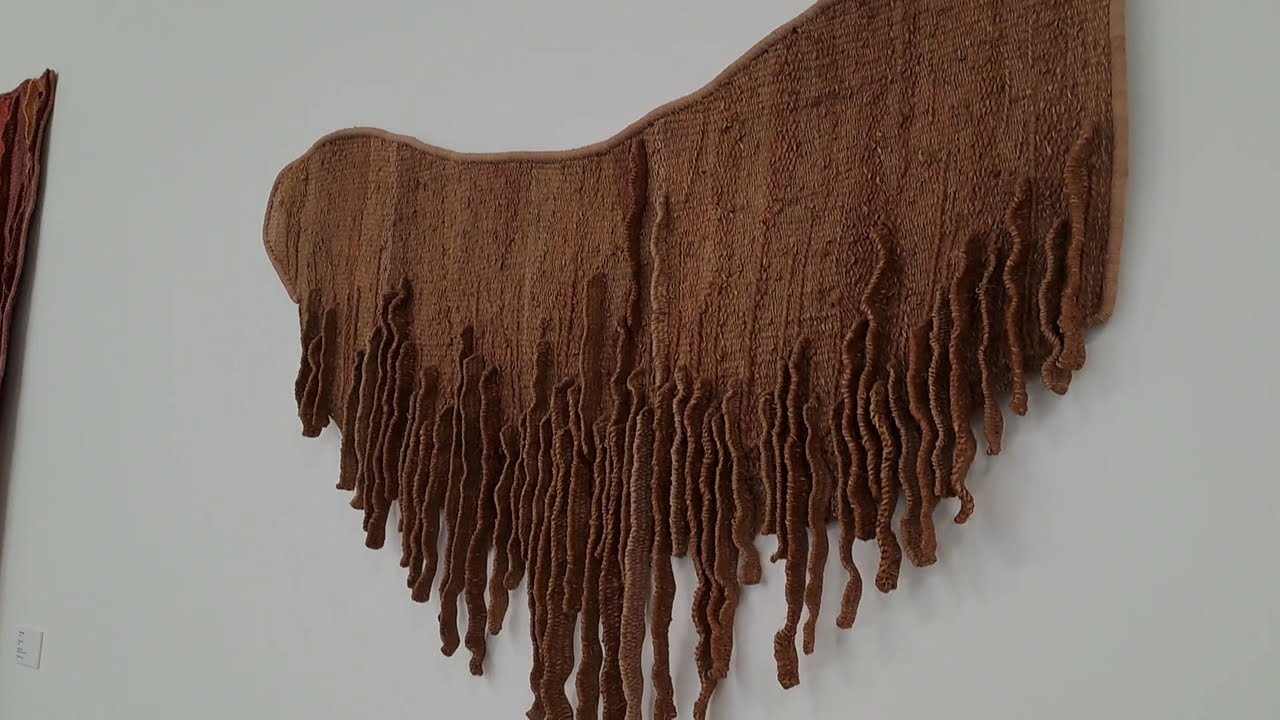
And I also saw another part of her work in an installation at the Inhotim Art Museum. So, it's an interesting experience. Anyone who has the opportunity to have access to these works, I think it's essential to visit them, to take a closer look at this whole issue of materiality that is so important for analyzing Adriana's art.
It is very impactful in the sense that you have it there, it is visceral and in certain works even in literal terms With those simulations of viscera. And precisely because she tries to unveil this issue of red, of violence, of the organic that is behind the entire Brazilian historical formation. And it is precisely her recovering the colonial imaginary and at the same time associating with this imaginary this issue of viscerality, of this violence, which we often worked on from the historical perspective of Brazil, of a country with a peaceful history and is not, never It was and is not a story of peace.
Quite the contrary, it is conflict, violence, erasure, massacre, genocide, in short. It's a story that still has a lot of violence to this day. So this is a fundamental point to observe in Adriana Varejão’s work.
And then it's interesting because I like a quote from the German philosopher Walter Benjamin that says that "every document of culture is a document of barbarism. " In other words, it is very important to look at what we understand as art, as a monument, as an object of culture, that behind that there is violence. These historic buildings that we observe, for example, in the city of Ouro Preto, there is violence behind them, there is slave labor on top of that.
So this very idea of Adriana Varejão's art is to show inside the concrete viscera is precisely to show that many of these buildings, these monuments that we build as part of a historical heritage are also a heritage of violence. It is a monument to a past that was violent and that we cannot in any way forget and we must remember this violence at all times. And that's why I think this work, this work by Adriana Varejão, is important, which is very much based on the perspectives we have today on decolonial art.
So that's why it is fundamental to understanding contemporary art, decolonial art and the past, historical art, art that builds a narrative about Brazilian history. And it reveals the mechanisms of violence behind an entire process of colonization that marked and continues to mark our society. Anyway, we've reached the end of this video.
I just have to thank those who stayed until the end and ask you to leave a like, share this video on your social networks, this way you will be helping our channel to grow a lot. This year, folks, there are going to be a lot of videos here. We are working a lot.
There will be live. We're going to do frequent lives here again and we're thinking of some very interesting material to open our members tab. So keep an eye on our social networks, we'll leave the Instagram and Twitter here of Canal História Nossas Histórias in the description.
Anyway, if you have any questions, comments or even a joke, leave them here in the comments section and we will respond immediately. So that's it for today. A hug and see you next week, with another video here on the channel.
I went!