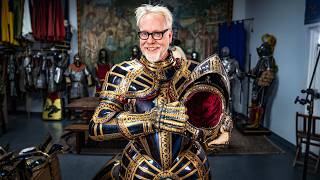
Hey everybody, Adam Savage at Global Effects with Chris Gilman. How are you, sir? Good, good.
How are you? Now, your your main business, your main thing is space suits. Uh, and you rent them, you make them, you build them, you design them.
And these are one of my primary obsessions, but one of my other obsessions is armor. And holy hell, you are also an armor collector, maker, commissioner, and you have a tremendous collection. Can we take a tour?
We can. And interestingly, this is what started the rental department. Really?
Yeah. So, it all begins with armor. It does because that was my hobby was arms and armor.
So, I thought I'd pull out um I mean it's part of our other rental department. Yeah. And as I said in the earlier earlier video, you know, people come in and I say, "Are you doing a medieval picture or a midvil picture?
" So, what I've tried to pick is the medieval stuff period authentic. Yeah. So, we'll start here.
We have a a gladatorial helmet. This is beautiful. And if I re I don't really know a lot about early Roman early stuff.
Um and so I don't remember the name of this helmet. Your viewers of course will probably know. This was done by a very talented armor named Ugo Serrano.
Ugo's done some really fantastic stuff. And he's normally doing a little more fantasy, a little more authentic looking, but with a twist. Yeah.
And so he did this gladatory helmet and it's all in aluminum. It's really quite nice. I think I just cut.
Wow. I love his little catches, too. All opens and Wow.
Oh, that's gorgeous. But all single pieces of them. So, Gladatorial helmet.
This This is a fiberglass helmet. Um it's been metalized. Oh, wow.
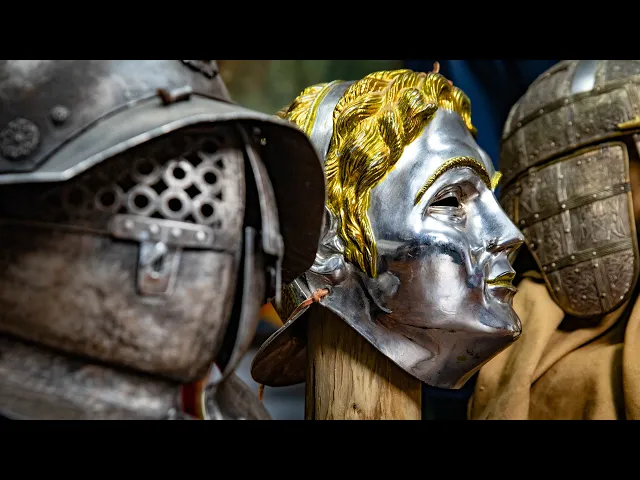
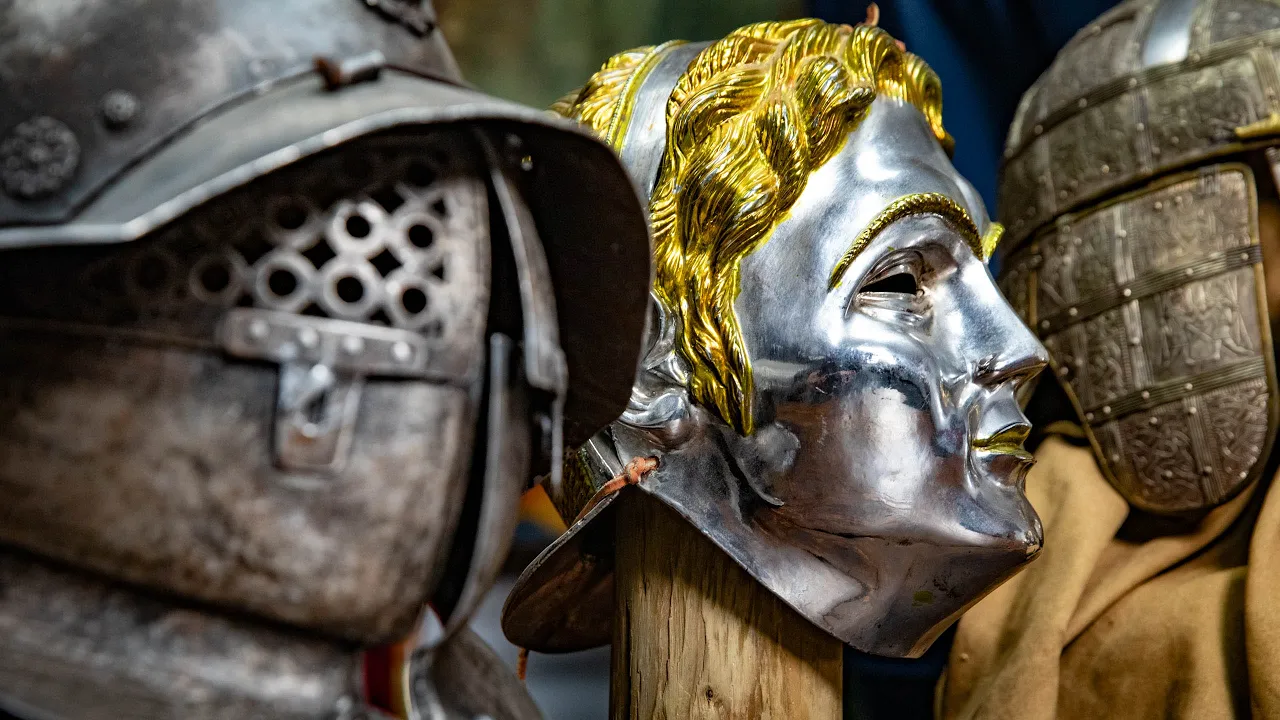
Um but this is a Roman uh calvary helm. And they there are a number of of examples they found with these very realistic faces. Crazy.
And they they fit incredibly close. And when your eyes are in here, they're really creepy. Yeah, they're really creepy.
And they would have been bright silver and gold. Probably silver, silvered, actual silver and actual gold. And when they put gold on in the in the early times, they used a a process called mercury gilding.
Yeah. Not fun for your for your health. But it laid the gold on really thick and so you get this super rich gold color that's really hard to get with electroplating.
Almost impossible to get electro. Wow. So that's a Roman calvary helm.
Now, you probably recognize this. This is the Sutton Who helm. Now, this was a decorative helmet.
Now, another thing to bring up about decorated armors. Yeah. The modern thought is, "Oh, they're parade armors.
Oh, they're only for ceremony. " That's really mostly not true. Most of the decorated armors you find were made 100% real functional armors, hardened steel, intended to use in tournament or in battle.
So, while this might have been, it probably was a real fighting helmet. And people go, "Well, I can't believe you take something so beautiful and take it out in battle. " The paint job on a Formula 1 car is unbelievably expensive.
Yeah. Fair. Fair.
Because you want to look good. Yeah. Right.
So, now the other interesting thing about these helmets is they were piles of fragments. Piles of fragments. little pieces of rusted that some guy sat down and tried to piece together what it looked like.
Well, we're starting to find out that a lot of these things that were pieced together in the early 20th century, they weren't made by armorers. They weren't pieced together by armorers and there's a lot of mistakes in them. Oh, wow.
So, some of the things that we think are iconic, right, might not be true at all. Probably right now. So, this early dinosaurs being built with the wrong head on a different body.
Exactly. Exactly. Same thing.
So, this is an early style of decorated helmet with with these hollow thin sheet metal plates that are done on a press block. They're done on a bronze. Oh, okay.
I was wondering they look chased, but they were done as stand block. Okay. Now, this is a replica that one of the museum replica companies I think made.
It is quite nice. It's really nice. Now, little known are the Vendal helmets.
Previking. Okay. And this is a Vendle.
Ah, that's Now, this is one I made. And this is based on the Vendel 14, I think it is. And it had all of these pressed foils.
Now, the real pressed foils would have been done on a bronze matrix. And they have found these plates that they would press the the sheet in. People think they're solid, but if they were solid, this thing would waste so much you wouldn't wear.
Yeah. Now, what's interesting is these are very, very similar to the Roman ridge helms, the helmet that is in this time period. And these are from about 600.
Okay. Pre pre Viking. The Roman ridge helms have a ridge down the center in their two hemispheres that have been joined.
Right. So the theory is is that since a lot of these guys were mercenaries for the Romans when they came back they copied what they knew. Of course.
And they copied this. You want to try it on? Oh yeah.
Oh please. Oh. Now I feel like I kind of look like um Pippen.
in the battle of the return of the king. I think it's the glasses that don't help sell it, do they? We have these decorated helmets pre Viking.
Yeah. Now come along a show. True Blood.
Yeah. Mhm. They have a flashback scene with Vikings and they wanted a Viking crown.
I have a research library of about 2,000 books on various history, you know, pre uh Renaissance, I mean, well, pre- 18th century, including a huge thing on Vikings. I went through everything and I could not find one crown from the Viking era that didn't look like a Burger King crown, the paper you get. So, I said, "How if we do Vendal?
" So, this is Eric's crown that we did for copied off of this. And you'll see that it's a copy. Oh, that's beautiful.
It also feels a little like the crown of Beth Mora from Hellboy 2. Oh, that's lovely. Wow.
Oh, man. So, this is fun to have. Holy historic thing to be able to put out there.
Okay, so now we get into uh Roose Viking. So, the Vikings people during that age, they didn't go, "Oh, we're Vikings. " right?
You know that was something we applied later. So there were during that period there were Vikings all through uh northern Europe, Europe, Russia. They found graffiti in Italy for the Vikings and the Vikings made it as far south as Vietnam in their explorations.
That's insane. So this is a based on a Roose Viking or Russian Viking. Now, I made this again for myself.
Hardened steel. They probably wouldn't have been using hardened steel at that time, but um I was going to do some uh Polish reenactment, some some actual combat fighting in Europe with this. And when a guy came back with a huge slice underneath his eye, and I saw the shields that were so destroyed, I go, you know, I don't need to prove anything to anybody else.
But a friend of mine wore this and he ended up getting a dent in the back of it. A guy hit him in the back of the head with a Dan axe and dented the hardened steel helmet. Got really new.
Your friend's okay. Yeah. So, this is all worked brass punch work based on it.
So, uh this painted salad is so beautiful. So, this is known as is kind of nicknamed one of the black salads. And what's interesting is you see how sort of uh crude and immature the the the shape is.
It hasn't been refined. Well, pretty sure that when helmets are made, and you can find a video of Italian bucket makers using the same technique. Okay, what they'll do is there's two types of raising.
Modern armor is often made with a raising technique where you're you're hammering from the outside. It's really more of a silver smithing technique, and it probably was not used as much with armor as it's used with silver, but modern people use that often to make armor. Okay.
There's also squish raising where you start with a plate and if you can do this with a piece of clay, in fact, it's a great way to learn metal forming is start off with a piece of clay and use your finger to poke at it and watch what it's doing. The bucket making that you can find the video of. They start off with a stack of plates.
Now, the more mass you have, the more heat you get to keep, right? So, you're going to heat these plates. And if you heated one, it would cool down quicker, right?
But if I heat a stack of six or eight of them, it's going to hold heat longer. So you wire them together so they don't fall apart. Yeah.
You put some flux in between or some some um material between them so they don't stick, right? So they don't weld to each other. You heat them up and with a trip hammer, you put them in a dish and you squish the raisin into your shape.
And what you're doing is you're making eight helmets at one time. Wow. You're doing the root you're doing the rough forming of eight helmets at once.
So if you look almost like vacuum forming, there's almost no undercuts on this helmet. Just a little bit here on the sides. So if I was to rough form, you know, forget the visor, but if I was to rough form the skull, I could get to this point and then pry them apart and have a stack of helmets.
And that's pretty sure how they made multiple helmets, multiple breast plates at the same time. Um, talk to me about the paint. I I I I love the fact I I believe I I've understood that more helmets were painted in bright garish colors than we realize.
Think of anything you're going to personalize. Put pins on your backpack or stickers on your car. Look at Vietnam.
The number of helmets that had decorations that were markered or painted on the nose art on aircraft. Right? Humans are humans.
They want to do these things. So if you have a helmet that's an inexpensive rough from the hammer already black, why not put a protectant coat in on it and why not make that coating interesting? And some of them there's a great You were at the Wallace.
There's a great helmet at the Wallace. It's got this demon with big fangs. Oh wow.
I don't know if I've seen it. Beautiful. It's a salad.
It's a closed salad with this beautiful painted. There's breast plates with scales painted on them with lions. Is this a replica of a historical paint job?
Yes. Yeah, this is a replica. This is done by a guy in Eastern Europe.
Really nice. I I found it online and bought it. Got a beautiful suspension liner.
Oh, it's gorgeous. Yeah. And it's um And then the spring catch to open the visor.
Oh yeah. Now we get to the end. Now this is a more fully developed salad.
Mhm. Now there's a term salai. Yeah.
Basin. Gorge. Yeah.
Well, that's the French way of saying it, but the academic world sort of uses the English. So this would be a salad, a gorge, or a bassinet. Sorry, French people.
Yes. So you see how much more refined the shape is. Yeah, it's really lovely.
Yeah. And this is a pretty good shaped one. This is probably to hold a little spring-loaded catch to put a plume on the top.
And again, suspension liner. Oh, it's beautiful. So, I've gotten to the point now where most of the replica armor I could probably come up with a list of maybe a hundred guys that claim to make armor and I would buy armor for maybe six of them only because it's that huge of a difference.
Yeah. And it's not snobbery. It really is the technical because armor is technical.
Yeah. It's sculpture. It's being able to move the metal where it needs to go, not where you can get it to.
Right. Right. Right.
and and there's so many. So, we look at some of these armors behind us and we start over there. That's probably 10th century scale.
Um I made the first one I made I made out of aluminum scales. I I made a punch and had the scales done and then I dished them. I made a I made a cast urethane dishing to tool.
Oh, amazing. Two pieces on a hinge. You put the scale in and whacked it with a hammer and it dished them perfect.
Right. Beauty. I laced up a sample.
It looked like I had raided a cafeteria of all their spoons. So, I had to age them so they didn't Fair. Fair.
Uh, this is a piece I'm doing now with uh Sugarloaf with an underh helmet. This is right about the time they would wear a helmet under this because it was just when they started to have visors, but they would ditch this and have that helmet. Right.
Right. And you see this also has suspension liner. This is all hollow.
This is all toolled. Amazing. And same thing, this all hollow toolled.
Yeah. Then we have the the bash for the bashan, the one that's wrong. This is a pretty one, although it's a little rusty.
Uh this is a Italian armor with a great bassinet. And again, you're there for protection. You're not there on a sightseeing tour.
So these helmets, well, you can't move your neck. Well, yeah. Neither could Batman, you know, but they gave you excellent protection.
Yeah. And then you see these these asymmetric counters. That was another uh thing when you talk about import or export armor.
Uh you could tell because each culture had a different style of fighting. Some on horseback, some on foot, some and so the type of armor you would wear would be different. And I never quite understood.
I mean, how can you tell it's Italian export armor? Well, it had to do with the way it was configured so that you could remove pieces and change the style of fighting. Fascinating.
Versus set up for a specific style of fighting. The uh the shape of this helmet is really beautiful. It's I love the sculptural aspect of all this.
Really, really incredible. This German Gothic German Gothic German Gothic. So, Gothic armor, you get all of these flutes.
Now, a lot of people want to put these in with a roller or machine, but it's wrong because they all gradually build and then gradually fall away and that's brings the life to it, right? M what's the from the black sales fruit tits tits but they can't make the difference between they're talking about two paintings and and the guy one guy can't tell the difference between this master painting and this thing that looks like paint by numbers. So this is again has a a really nicely developed salad with a nice bever with a nice little mechanical latch.
It's gorgeous. I love this kind of hollowed out beautiful steel work. This is again, Eastern Europe.
And this is probably the second finest replica I have. Oh wow. Uh this was done by Rob McFersonson.
I got married in this armor. Oh man. I I'll show you I'll show you a picture.
Um the theme of our wedding was formal any period. So any time period and you could show up. So I was of course not without This is so beautiful.
So again, we get to style. We get to what was like you see where the waist is on this suit and you see the shape of the breastplate right and we get to this one the waist is a little different and then we have the one behind you which is German also but little a few this is about 1525 this probably at 1560 pointed here right so it's all about style why did Cadillacs have fins and made it more aerodynamic style it was style that people think these flutes are that oh it makes it stronger No, it was style. It was It was because it's sculpture.
Yeah. It's clothes. You walked out and went, "Look how awesome I look.
" Amazing. So, this German is a black and white. Now, we talk about painted armor and color.
Mhm. Painted protects it. Yeah.
Right. It stops it from rusting. Now, my night and shining armor, right?
That might have been more rare than we think. Yeah. A lot of these armors that um have been preserved in museums wasn't really until you get to early early to mid 1800s an armor was really looked at at anything other than just old military gear.
Right. Right. There was a senator, not a senator, it was a I think it was a member of House of Parliament who had one of Henry VII armor that he borrowed for a party and he had it in his house and when the armory asked for it back, he said, "Well, you got tons of armor.
You don't need this one. " And it was just treated as it's just a thing, you know. Well, a lot of those armors, believe it or not, were cleaned with groundup brick dust and water.
So, when you see armor with heavy scratches in it, yeah, that's what that is. That's probably what that is because the aggregate in the brick and piece of quartz in there. Oh my gosh.
So, we're starting to find more and more evidence of armor that was darkened either chemically. Yeah. Heat or painted.
Incredible. So it may be Yeah. And it the jury is still out on whether that's 100%.
Right. But when you look at these paintings, you see a lot of paintings where they're all in black armor. Yeah.
See that? And Yeah. And the swords are silver.
So it isn't likely to know the difference. Right. Yeah.
All right. We got two more pieces here. Yeah.
Okay. So save the best for last. So this is a real Morian.
Now think of it as a concistador helmet. Well, this is actually postates Cortez's return to Europe by like 60 years or 40 years. I found this at a costume shop.
Really? It was all painted Kryon spray paint and I spotted it from across the room. And we were talking about your eye and and recognizing Yeah.
When you look at armor long enough, you look at anything long enough, you're able to see the difference. It's made out of a single piece of steel. I was just saying this looks like it's raised from a single effing piece of steel.
And this particular one is Italian. Dude, that's insane. I'm so glad you rescued this from a costume shop.
Yeah. What a beautiful thing. That's crazy.
See the patches? Yes, I do. Now, try to find them on the outside.
Could those have been from battle? Yeah, they were probably back in the day. Right.
There we go. That's one that wasn't repaired. Dude, that's insane.
So, we have patches that you can see in here. They're riveted in. They're riveted in, but everything's been concealed on the outside.
This saw action. Yeah. And it shows you the skill.
Yeah. And this so Ellis Merkantile Ellis was a prop company around forever and I did ice pirates there. I designed a bunch of weapons for ice pirates.
Ice pirates. Ice pirates. And I was going through the prop place and and Ellis has been around.
It's one of the old it was at one time the oldest prop house in LA. Yeah. And I found this threequarter suit of armor missing the helmet and no lower legs, no gauntlets.
I'm looking at it and I'm only like 20 something. And I asked the the guy in charge. I said, "Hey, can I borrow this?
I really want to look at this. " And he goes, "Yeah, sure. " Had Nerburgg armor stamps on it.
City stamps. It was real armor. Jeez.
And I was like, "Oh. " Now, the armor guy in me said, "There's no way a prop house is going to use this cuz they want a complete suit of armor for the Haunted Mansion, you know, in the corner. And this has no helmet, no lower legs, and no gauntlets.
" So, it's less useful to them. Absolutely. I should tell them I lost it.
pay whatever they want or say, "Look, I'll make you a whole armor in trade. " Right. That's not how it was brought up.
So, I told them it was a real armor. Yeah. So, it got put in a box and then Ellis was bought and the guys claimed they were going to redo Ellis, but no, they sold everything.
They auctioned everything. Well, there were some really garbage armors made in India that people were spaying ridiculous amounts of money for. And I am searching for this armor.
Yeah. I can't find it. Yeah.
And I'm so bummed because I could have had it and I couldn't find it. So then they have a shop auction and as you know with shop stuff it's, you know, sometimes you get stuff in for repair or whatnot. So I bought a bunch of stuff and including a bunch of the garbage armor because I had some pieces I might need to fill in.
Yeah. And I load everything in and we got another big truck loaded and I get back to the shop and the guy did you find anything good? You find anything good?
I go, "No, it was all garbage. " And I reach in the back of my Suburban truck and pull this thing out and I went, "Yeah. " Oh my god.
I couldn't believe I actually found the arm. I didn't even know that it was in the box of garbage armor. And so this is the only thing that survives of that whole armor.
Oh, its weight is something. Yeah. A little bit heavier than I would have expected.
Yeah. But now I'm even more angry that I didn't take it because now it's been broken up the pieces. Who knows where the pieces are?
You know, I realized years ago that my love for spacuits and my love for armor are based on the same thing, which is I'm constantly fascinated by human beings ability to create our own hermit crab shells to explore the world. Yeah. You know, these are tools of war warfare, but they're also tools of going to the edge of the known, right?
So, I really appreciate you sharing this, man. It's absolutely beautiful. Well, you have to come back and uh try one of these on.
I totally will.