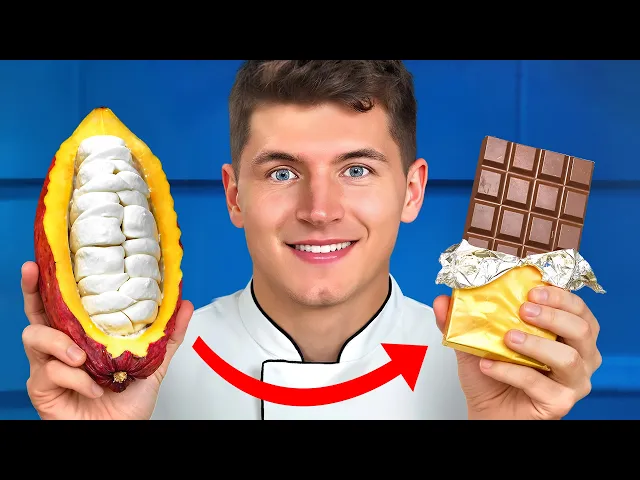
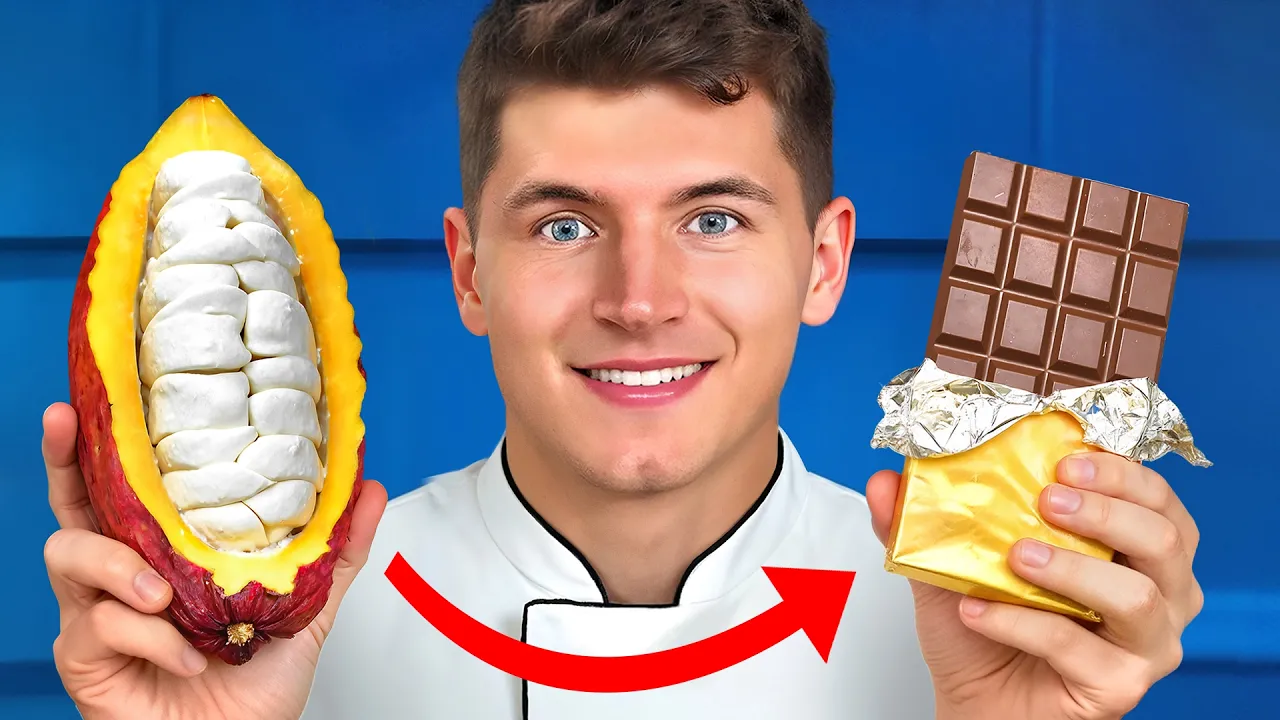
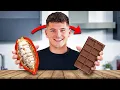
Nick: Milk chocolate. Do you actually know how it's made? Because I've found that most people actually have no idea.
I mean, do you know where a cashew comes from? Did you know it's this weird little thing that hangs on top of a fruit? There's so many foods out there where people just don't even think about where they come from.
But that's why I'm here today. And I'm going to show you exactly how all of our favorite candy is made. But to start this stuff right here is no good.
Now we're gonna make it ourselves. But first, let's go grab some cacao pods. The fruit where chocolate comes from.
Oh, one thing we forgot to mention. We're actually flying all the way to Ecuador to pick up the cacao pods ourselves. We do it big here.
So I'll see you in Ecuador. So we are in fact in Ecuador now. We touched down late last night, so I didn't want to film anything, but we're gonna get a quick cup of coffee right now.
Man1: Here we have the Ometa. The Ometa is like a Mexican tamale. It's made with corn and with cheese.
It's sweet, and it's very common to have it here for breakfast or for lunch. Wow. Oded: I usually have it for breakfast, for lunch, for dinner, for a late night time.
I love it so much. Nick: Quick little last stop for some coconut water. Then we're at the cacao farm.
And how long till the cacao farm? Drver: 15 minutes. Nick: We're almost there.
Perfect. Nick: Okay, let's drink some coconut water. Wow.
Oh. Thank you. Thank you so much.
So we finished the coconut. Now they're gonna open it up so we can eat the flesh on the inside. Gracias.
Thank you so much. Nick: This reminds me more of of me. And then right there is Manny.
Manny: It's messed up. Drver: Start with the flower. You hit the small pot.
It's one week. So this is the stage one. We have six stages.
This is stage one. This is stage two over there. If you if you can take a picture, you see the stage three and four and five.
Every day we harvest in the morning. And wow. Now you see the big the size.
This is 5050 and 51. You can. Nick: I, can I open it?
Drver: Sure. But it's it's difficult. Look, look.
Nick: Oh is that okay. Drver: Take take a picture. You see.
Now you can taste it for you. Nick. Manny, here you have the pulp, you have the bin, and you have the husk from the husk.
Today we prepare the flower, the pulp. It can be the pulp, freeze pulp or a aseptic pulp. And from the past, we can take the liquid and make the juice.
Okay. And inside we have the beans. So.
Good. Yeah. You see the bean?
If it's not fermented, it's purple. So when we talk about the ruby now, you can understand the color. It's natural.
Nick: As you continue to grow, you get those massive, big, thick boys back there. That's cool. We're here right now in Ecuador.
Like like we said, we started out in Boston. We're gonna make some milk chocolate. But this here is my good buddy Oded.
Who is it fair to say you're you're you're basically Willy Wonka, right? Yeah. The reincarnated Willy Wonka.
Exactly. I actually have a picture here. Oded: I lost my hair, I got older.
Nick: Do you see any resemblance? Well, anything here? Oded: I lost my hair.
During like. I mean, they told me that cacao actually grows your hair, but I don't know. I ate too much.
Probably. Nick: He is the modern day Willy Wonka. Oded: You didn't believe me.
The chocolate doesn't grow on trees. The chocolate is a fruit. I wanted to take you here to the farm in Ecuador, where we can really see there's no chocolate bar on a tree.
It's a fruit, actually. An unbelievable fruit. Delicious.
We're gonna describe it. So many colors. You know, always.
What's weird to me is that this looks right, but it's not yet. You're going to see when it's ripe. I would think it's right.
But, um, in the middle of the the process of ripening. Yeah. Then it's becoming red and yellow.
And there are different varieties of cacao. You know that Criollo or here in, in, in Ecuador they call it Arriba Nacional. It's a very, very expensive cacao look different than this one for that.
Also many different types of chocolate flavors, nuances of the taste. Nick: Anything you need to know about chocolate? He's your guy.
Drver: Don't open it with your hands. Nick: Oh, I was so ready to karate chop it. Drver: You can try it, but we will take you to the hospital.
Did you see the difference? Nick: Oh, wow. Look at that.
Drver: The size. You see the sap? Nick: Manny.
Go ahead. You can take a little bit. It's okay.
Yeah. You won't be fired. You're fired.
No. Drver: The moment you cut it from the tree, it's like the umbilical of the mother starts fermentation. Now when you eat it.
Let's say. Oded: You can see. The evolution why human beings are so close to the monkey.
You see, it's like that's the closest you can see. There's the closest evidence of a monkey. Nick: He's eating the whole seed.
The whole thing. It's on your hand. I love, I love cacao, I love it, I love it.
Oded: $400 bar. They make it from this national. Nick: $400 chocolate bar from these pots.
Drver: Look. Ah, this is a disease. Oh, okay.
Yeah. Tom Brady is throwing this one to Oded in the Super Bowl. That that should be that.
Manny: That's a beer commercial. It's actually like a football a little spiral. Nick: Yeah.
The flavor of this is I can't even begin to describe it right off the trees. It's like a little bit gooey, but it's almost like a carbonated taste and texture with like, citrusy sweet, almost a little lemony. I don't even know how to describe it, but it's incredible.
Look at that. Amazing. Crazy to think that this turns into chocolate, right?
Manny: That's too bad. He's too fast. He's too fast.
Nick: Yeah. So they have three massive farms here. There's fields literally just go on forever.
And it's just tree after tree after tree, all super packed together. You have this perfect little cute building in the middle of nowhere, right? And then all these massive, massive companies that all of us know and eat all the time, they're all using this to make chocolate.
Yo, cut. Cut the cams. First.
Manny: Yeah yeah, yeah. Nick: What are you doing? Drver: This is the solar farm.
It belongs to Mars. Nick: But this is where Eminem's come from. Look at that entrance sign right there.
Biggest cacao pod ever. So if you look back right behind me, this is a whole water reservoir. Oftentimes, if the guy that runs the whole city towns water isn't paid, he'll just go and turn off the switch.
He'll just turn off the knob and then you're stuck with that water. So they have all these backup supplies. Now we're gonna see that second stage of the process where they fermenting and they're drying, because that's when you're getting closer to the actual final product that we all know, chocolate.
So the way they keep the trees going, because they're harvesting 25,000 pods or more a day on each farm right here you can see this is an old tree. This is 20 years old right here. Okay.
And you have all these pods and they're still small, but they're growing. And then you already have the second one that they're having grow off the side of it. And what they'll eventually do this is brand new, but they'll eventually do is they'll chop this tree off after they harvest all the pods off the tree.
Right. And then they'll pull this one up and this will be the new tree, and then a new one will come out of this tree and keep going. So that's the way they keep the cycle going, which is really, really cool.
So we finally made it to the drying process here. And now it smells like chocolate. And here's where we're gonna get closer and closer to chocolate.
Look at this. All chocolate. Oh wow.
They smell really fermented. Wow. Look right down here.
Now it's all laid out. They've taken the seeds out of the cacao pods, and they're all really slimy and gooey. And this is how we've been eating them the whole day.
So they lay it out at the start of the process. And this is when they begin to ferment. So now look at the gradient over here.
So we have the lighter colors. It starts to ferment. And then if you slowly look up it starts to get darker and darker and darker as that as that fermentation process happens it's amazing.
So eventually it's fermented. Right. And then you have this you have these dried beans and they're hot and they're hard.
Right. And that's when they pack it up in these big bags right here. And this is what would get shipped to a factory like Mars.
That's going to go ahead and take these and make chocolate out of it. So that's that process. And you can see that if I pick up a couple of these here and I crack this one open just like this inside here, I'm going to have cacao nibs, which you may have seen on top of a smoothie or something like that.
But this ground into a fine paste is what would eventually make a chocolate bar. Crazy, right? He pretty much goes back and forth and moves the cacao around.
That's amazing. So this is a storage facility with all the the dried. Sorry, Manny just fell down, but this is where they would store all those seeds that are about to ship out.
Manny: That's a big pallet. I've never seen a pallet that big. Nick: Oh, wow.
Oh my gosh. It's a crazy tower of cacao. This is okay?
Oded: Is it a video? Then I have to kill you. Drver: I'll tell you something.
Look. Oded: They collect them and bring them to the collecting center, which is here. Nick: This is unbelievable.
This is insane. Nick: It's a beautiful bright purple seed, right? Some people eat it raw.
Manny: Like this guy. Nick: Monkey man over here, I guess. Oh, look at that.
You know? And if you want, you can eat this just like an ice cream cone. You know, we're not going to taste a whole lot if you're just licking it, but.
Nick: All right, everyone, I just wanted to go to a quiet place here to debrief a little bit. I know that was a crazy, crazy day. We have quite literally been here since 8 a.
m. , and it's been the entire day right now. We're headed to dinner right now.
There was so much more to this farm than I actually thought there would be. And actually think about the final product, right? Think about a chocolate bar sitting on the shelf in a store, and suddenly we find ourselves in this massive, massive oasis of cacao everywhere.
I just wanted to take a moment to kind of almost debrief and think about just the experience that we had, just to see the kind of behind the scenes, behind those mysterious walls of all this stuff that ultimately makes it into one of the most common products you could possibly think of in the entire world. No one's really ever shown anything like this behind the scenes, so I'm really happy, and I'm really fortunate that we got to do this. So we can't take any of these home in our bag because it's illegal.
But I am gonna ship some of these back home and we're gonna make chocolate. But we literally just came to Ecuador. So I want to say thank you to all of you that are watching, because you're the ones that make this kind of thing possible.
I mean, you are the reason that we were literally just able to fly come to Ecuador from Boston. Now we're going back home and we're making chocolate. It doesn't get more homemade than this, so we'll see you back in Boston.
Yes, I did just get back from Ecuador. We really did just go all the way there and come right back to this kitchen. And look, I brought some beans and more importantly, some pods with me.
Unfortunately, I couldn't take the pods on the plane because they just weren't letting us on with them. But we shipped 18 pods right behind us, so they got here perfectly in time. Man, these boxes are big to start.
Let's take off this lid here. I know that every time we get cacao pods, they're really well packaged because they're actually quite delicate. Now, when we open these things up, inside each wrapper will be one of the pods from the exact farms that you just saw.
Because of shipping, some of them are going to be cracked like this already. But if I go inside, you all now know what cacao should look like. And the fact that it's really juicy and slippery like that means it's nice and fresh.
I absolutely love the fact that they're all different colors, shapes, and sizes. They really are beautiful, and looking at all of these already makes me really miss that incredible, incredible farm we visited. Now that we've opened that first box, let's remove the second lid.
I find it just so incredibly amazing, somewhat magical, one might say, at how incredible these things are. Who could have ever thought that this is what makes chocolate? Fortunately, it looks like most of the pods were okay in transit, so at this point, we're ready to crack a bunch open and begin that fermentation process.
Now, after we've finally removed all of these cacao pods from their protective casing from that shipping, I want to take a really quick moment to show you all those colors again. We have some of those beautiful orange yellowish ones. Then perhaps my favorite are those rainbow ones with green, yellow, orange and red on them.
And of course we have some of those deep red ones that have some darker black spots on them. But now it's time to have some fun and open all of these up so that we can begin the fermentation process that's going to take us about a week. First things first, it's time for some karate chop action.
Here we go. Oh, cleanest cut yet. Look at that right down the middle.
Perfect shock all the way through the whole pod. That right there is a karate chop. And I'm not even going to do any more, because that's the best I can do.
Now I'm gonna crack this bad boy open. It does look like I messed it up a tad bit by hitting it too hard, but it looks absolutely gorgeous. Let me get a paper towel real quick, okay?
Bro. What are you doing? You're fired!
You just ate half the pot. Spit it out! At this point, I'm gonna use my knife like a normal person to open up the rest, wedging them all open such that we can easily take off these seeds and start fermenting.
So give me a few minutes while I crack all these open. Once we've gotten all of our alien like pods open and separated, I'm gonna go ahead and put these all on a big tray, and then it's time for perhaps what is my favorite part? Squeezing them all out.
Just take a listen. We just want to take all of the seeds out and put them on our tray here so that they can then sit and ferment for a week. And this is what ultimately will give them those flavors that we all expect in chocolate.
Now, it's true that if we just roasted these seeds right away in our kitchen, the entire room will actually smell like a chocolate bar. But fermenting actually develops things. It brings out the flavor that you're otherwise not going to have.
As we separate off all these seeds, we're gonna leave behind this stem in each of our pods, which we really have no need for right now. However, all of this stuff behind me, I'm going to toss in my garden as compost to try to get some flavor in there as well. Once we finally squeeze these all into our tray, it's now time to spread all of these out and set these aside for a week to ferment.
I'm going to be keeping a really close eye on these for the next week to make sure that there's no mold that develops, and I'll try to update you to make sure you're looped in as well. After about a week of fermentation, the seeds have changed quite a lot. Unfortunately, during the process, some of them started getting a little bit of mold at one point, so I rinsed them off with a little bit of alcohol, put them back and they seem to be fine.
Now, the first thing you're hit with with these is this overwhelming smell of alcohol, that really fermented aroma that we smelled on the farm in Ecuador. The other part of this is the fact that they are really gooey. You can see that when I open up these gloves, there's just all this goo there.
And again, that's the same thing we saw at the farm in Ecuador. At this point in time, it's time for the roasting process. So after mixing these around just a little bit, I'm simply gonna lay them out flat and toss them in the oven.
And at this point, I'll roast these bad boys at 300°F until they're a deep brown color and have been fully roasted. Not my flip flops. What are you doing?
And finally, at this point, they are all fully roasted. Now, these seeds right here at this point, smell like a perfect mixture between vinegar and chocolate. And I know that sounds really strange, but like we talked about before, that's how you get that flavor.
And now that these seeds have all been roasted, it's time for what's going to be the most hands on part of what we're doing today, which is breaking all these seeds open and getting those nibs out. Now we're gonna put all these cacao seeds into a bag, because crushing them up in a bag is going to be a lot better than trying to individually crush them all in our cutting board. What's gonna happen here is this when we crush all of these open together, we're going to be separating the shell.
And then what's inside? All these beautiful cacao nibs which will be used to make chocolate. Now it's time you got a rolling pin.
And pretend that what's in this bag is someone you really don't like. I'm pretty good with a rolling pin. What are you doing at this point?
We smash. And now, after we've been smashing for quite some time, we'll pour the contents back onto our tray. And as you can see here, we've got a nice mixture of shells and nibs.
At this point in time. We'll take a quick pause, and I'm gonna separate out all the nibs from the shells. All right.
Cut the camera for a second. All right. Um, you're gonna separate all these out real quick.
I'm gonna take a bubble bath really fast, all right? Yeah. All right.
Are you still filming? Dude? You're fired.
Are you done? Manny: Yeah, yeah. Nick: All right, don't film me.
Don't film me. At this point, after about an hour of separating all these cacao nibs out, we have our roasted nibs. In general, I'm sure some of you have seen these before.
They often put them on top of things like smoothie bowls, acai bowls, that kind of thing, but we all actually know them from being liquified into chocolate liqueur, which is ultimately transformed into all the chocolate bars you know and love. Now we're ready to start grinding, and I'm super excited because we have a real stone grinding machine here with us right now. Just before we roast, I want to show you a perfectly peeled cacao bean here.
It's beautiful and looks just like a dinosaur egg. So this right here is the whole bean without the shell. And then when I crush it, we have all those nibs.
I am very excited about this machine right here because this is a stone grinder. These beautifully polished stones on the inside are gonna go for hours and hours to grind those cacao nibs into the perfect, perfect, smooth chocolate that we're looking for. Before I put anything in there.
Watch these spin for a minute. Now it's finally time. I'm gonna start dumping these cacao nibs slowly into here and let them start to grind up.
But this machine is really loud, so I may not be able to talk while I'm doing it. To start, we're gonna let these grind for a little while to let the first small batch start to get broken up. Then we'll add more.
We've been letting it go for about five minutes now, and this is what it looks like again, I've turned off the machine because it's really loud, but if you look in for a second, it's almost like we have a slightly rough peanut butter consistency right now, but for now, I'll fire it back up and continue adding nibs. I've turned this off again because of how loud it is, but at this point, we're gonna add those last cacao nibs into our machine here, as we can now get from the bottom, that chocolate has become even softer and smoother, and we're slowly getting to the point that we could add our final flavorings and then turn it into a bar. For now, I'll turn it back on.
At this point, once it's almost a liquid, we're going to start adding our sugar. The sugar is going to have to go in bit by bit, so that it slowly sort of melts and combines itself into that chocolate. Now finally, we have this beautiful liqueur here.
It's a really soft, smooth, beautiful consistency at this point, as you can see here from my rubber spatula. Let's take out a nice big scoop of this chocolate and just look at that chocolate. We have just made this from cacao pods.
Once our chocolate's finally done mixing, I'm going to tilt the machine all the way over so that it can slowly drizzle into our chocolate mold. I'm slightly skipping a step here by not going through the full process of tempering the chocolate, but you'll see that we'll get a smooth chocolate bar with a nice crack. Regardless, once we let all that chocolate flow into this beautiful mold here, we'll let it spread through our chocolate mold.
This looks incredibly good. At this point, we'll run a bench scraper across all of the chocolate, making sure that our whole bar will be perfectly level. And once we've cleaned off all these edges, we'll set it aside to cool.
Now for our milk chocolate bar. We're going to go ahead and sprinkle in a little bit of milk powder across our cacao and let this blend again. And now we'll pour in our milk chocolate and repeat the same process that we did with the dark chocolate bar.
Once we've given that chocolate some time to rest, here it is. This is my favorite part of the entire process. The classic moment of truth as you pull back the mold.
As you can see, we have a beautifully smooth bar of chocolate here. It's got a fantastic shine on it, and the thought of having this come all the way from cacao pods from Ecuador is really, really cool. We certainly did take 1 or 2 shortcuts throughout this process, primarily in the name of just moving this along.
But I'm really, really happy with how this turned out. And now it's time to make sure that we get that nice classic snap. Here we go.
Our milk chocolate also looks absolutely gorgeous, and I have to say, I'm really proud of how this came out. But there's only one way to know how truly good this is. So here we go.
First, you must let that chocolate melt slowly on your tongue and let it slowly melt with the heat of your mouth. Once that beautifully soft cacao and cocoa butter begin to melt across your tongue, you'll begin to pick up all those flavors. This chocolate is, not surprisingly, absolutely delicious.
It was such an incredibly fun trip, and I hope you learned something about how all this stuff works. I mean, it really is crazy that most of us have no idea where any of this kind of thing comes from. I'll try to think of more examples that we can go and show you firsthand, to really give you an insight into where some of your food comes from.
But I'll first pause to say one quick thing that I'm really excited about. Before we close things out, I want to take a moment to give you a great offer. And before you go, this is not a sponsorship.
This is purely me having talked to Blue Stripes, the company that so kindly brought me on this trip, and I asked them to pick out all my favorites and make a box that you could get. So they are quite literally offering this to you at the cheapest price possible. I'll have a link in the description below, but if you click that link and enter promo code Fly Cacao, Fly Cacao, you'll get 20% off.
This will be $35 plus shipping, and what's inside are one of each of the types of the cacao water that they have. One cacao pod, which I imagine will be quite exciting for a lot of people, and some of these chocolate hazelnut bars that are absolutely delicious. It's basically just a healthy candy bar.
Again, I really wanted to put something together to give you what I experienced on this trip, and this will give you virtually all of those flavors fresh from the farm in Ecuador. Now, I know it's been a long video, but to finally close things out, I want to first say a big thanks to everyone who did help make this trip possible, because it was quite a production. And now I want to encourage you to go down and smash that like button, because that's what keeps us going.
And don't forget to subscribe. If you're watching right now and you're already subscribed, make sure you hit the notifications icon. Just take a quick second to do that because you do not want to miss what's coming soon.
See you later.