From BBC Learning English. This is Learning English from the News - our podcast about the news headlines. In this programme: Gaza ceasefire at risk Hello I'm Georgie.
And I'm Neil. In this programme we look at one big news story and the vocabulary in the headlines that will help you understand it. You can find all the vocabulary and headlines from this episode, as well as a worksheet on our website: bbclearningenglish.
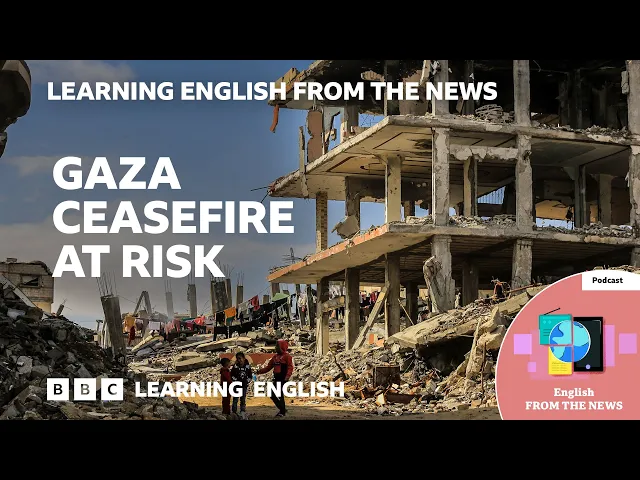
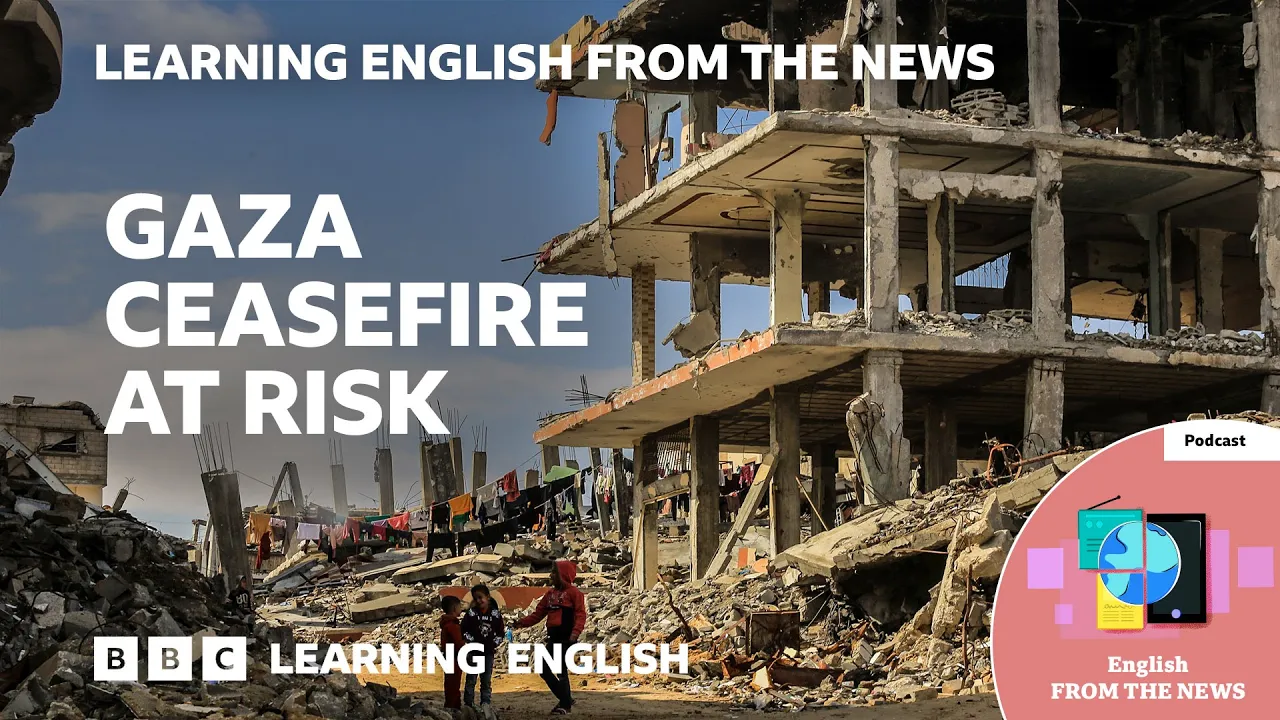
com So let's hear more about this story. There is currently a ceasefire - that's a pause in fighting - in Gaza, which began on the 19th of January. The ceasefire deal has three stages.
Some of the terms of the deal include the release of hostages taken by Hamas on the 7th of October 2023, in exchange for the release of Palestinian prisoners held in Israel. The deal also says Israeli forces must leave populated areas, allow displaced Palestinians to return to their homes, and hundreds of aid lorries are to be allowed into Gaza each day. 16 Israeli and five Thai hostages have already been released in exchange for 566 prisoners.
But now, the ceasefire is at risk. Let's have a look at our first headline. Is the ceasefire in Gaza on the verge of breakdown?
That's from the Middle East Eye. Okay, that headline again from the Middle East eye: Is the ceasefire in Gaza on the verge of breakdown? So the headline writer is asking whether the ceasefire in Gaza is about to break down - fail or collapse.
We're looking at the phrase 'on the verge of'. Neil, firstly, what is a verge? Well, generally, verge means the edge or boundary of something.
We often use it to describe that bit of grass on the edge of a road or pavement. You might see a sign that says 'please don't park on the verge'. Yes, so that's the literal sense, but in the headline it's metaphorical.
Is the ceasefire on the verge of breakdown? We have this sense of being on the edge of something happening. Yes.
The headline writer is asking if a ceasefire breakdown is about to happen - is it on the verge of a breakdown? Okay, so that's as it's used in this news story, obviously a very serious context, but we can also use on the verge of in everyday speech, a common combination is to be on the verge of tears. For example, I could see she was on the verge of tears when she lost her job.
Yes, and we can also use this expression in more positive contexts. For example, the scientists are on the verge of discovering a cure - they're about to make an important discovery. We had 'on the verge of' - about to happen.
For example, the company is on the verge of signing a huge contract. This is Learning English from the News, our podcast about the news headlines. Today we're talking about the Gaza ceasefire and why it's at risk.
So we've mentioned that the Gaza ceasefire is at risk. But why? A number of things have happened that have led to both sides accusing the other of not following the terms of the ceasefire.
For example, Hamas has announced a delay to the next scheduled release of Israeli hostages, saying Israel has broken the ceasefire agreement. A Hamas spokesman accused Israel of delaying the return of displaced Palestinians to the north of Gaza, continuing to fire on people and failing to allow in agreed humanitarian aid. Israel delayed allowing displaced Palestinians to return to the north of Gaza, saying Hamas had not returned an Israeli hostage, which they'd promised to do.
Israel's Prime Minister, Benjamin Netanyahu, has now said the ceasefire will end if the hostages are not released by Saturday. Let's have our next headline. Hamas suspends release of Israeli hostages over 'violations' of ceasefire.
And that's from The Guardian in the UK. Okay, that headline again: Hamas suspends release of Israeli hostages over 'violations' of ceasefire. And that's from the Guardian.
And we are looking at this word 'suspends'. Now it has a few meanings, but Neil what does it mean in the headline? Well, Hamas suspends the release of hostages.
This means to stop or delay something temporarily. Yes, but if we describe something as delayed, we usually mean that it will happen - just at a later date. But with the word suspend, it's less certain when or even if it will happen.
If you suspend something, you don't have to give details about when it will continue. Yes. So if my train to work is delayed, for example, I might wait to see when it arrives, knowing that it is supposed to arrive.
But if the trains are suspended, it's uncertain that they'll continue, so I might find another transport option. And another everyday example of suspend - The football match was suspended halfway through because of bad weather. We've had suspend - delay something without being certain when or if it will continue.
For example, the company suspended production while they fixed the machines. This is Learning English from the News from BBC Learning English. We're talking about the situation in Gaza.
So we've talked about how Hamas's delay to this week's hostage release over concerns about Israeli ceasefire violations may be putting the ceasefire at risk. But also in the background, US President Donald Trump has made comments suggesting the US could "take over" and "own" Gaza, moving its population to neighbouring countries Jordan and Egypt in the process. At first, these comments seemed unplanned, but Trump continues to repeat these statements.
Last Sunday, he told reporters, "I'm committed to buying and owning Gaza. " And on Monday, he told Fox News that Palestinians would have no right of return to Gaza if he moved them. Trump's plan would be considered illegal under international law and has been widely criticised.
And we have a headline about this. US President Trump doubles down on plan to take over Gaza. That's from Euro News.
And that headline again. US President Trump doubles down on plan to take over Gaza. And that's from Euro News.
We're looking at this phrase 'double down'. And it comes from the world of gambling, doesn't it? Yes, specifically the game BlackJack, where to 'double down' means to double your original bet, even if the odds are against you.
Now, if you double down on something outside of the world of gambling, it usually means you say or do something which receives criticism, and instead of going back on what you've said or done, you defend your actions and may continue doing them. Yes. So in this story, Trump made comments that shocked the world and were widely criticised, but instead of going back on his words, he is doubling down on his plans - he is continuing with them with more determination than before.
Just a note on its use - we can use 'double down' on its own: Trump doubles down, but we can add 'on' when we want to be more specific: Trump doubles down on his plan. The phrase double down is common in the context of politics, where political parties have to defend their plans, particularly when they're unpopular with the public. We've had double down - defend your opinion or action strongly in response to criticism.
For example, Despite heavy criticism for the proposed tax cuts, the politician doubled down, saying there would be benefits in the long run. That's it for this episode of Learning English from the News. We'll be back next week with another news story.
If you want to test yourself on the vocabulary you've heard in this programme, there's a worksheet on our website, bbclearningenglish. com And don't forget to follow us on social media - just search for BBC Learning English on your favourite platform. Bye for now.
Goodbye.