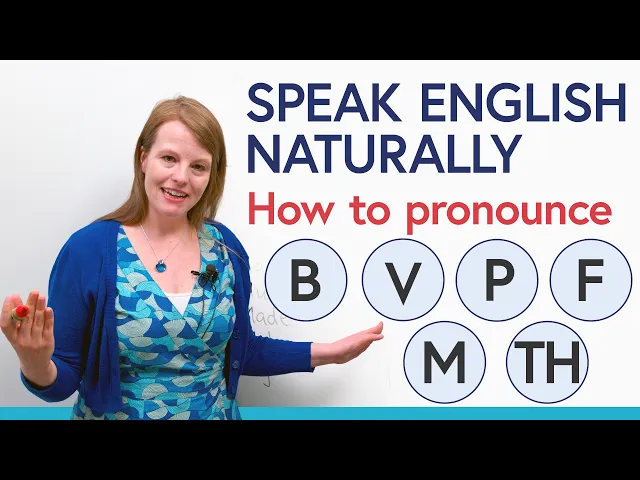
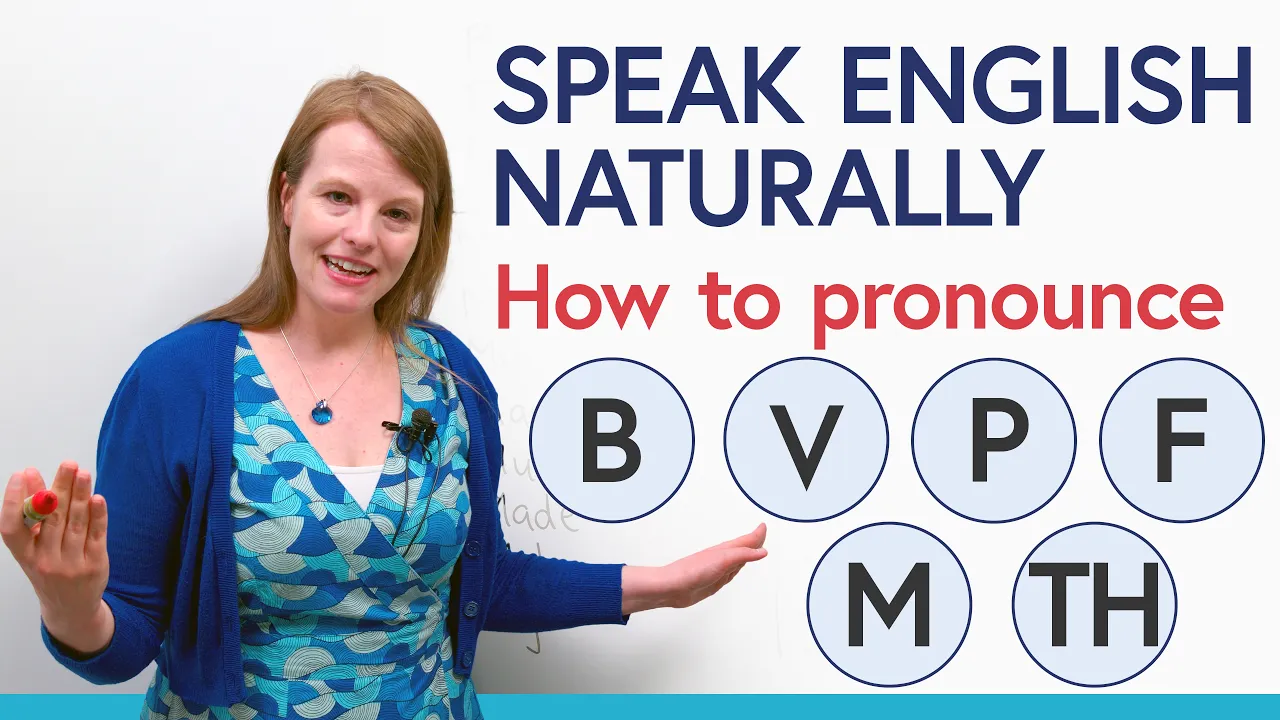
Hello, my name is Emma, and today I am going to help you with pronunciation. We will look at some difficult sounds in English that many people have problems with. We're going to look at how to pronounce the lip sounds of English, so these are lips.
You pronounce "b", "p", and "m" with your lips. We're going to look at the "teeth" sound of English, so those are sounds that have "th" or "th" in them, and then we are going to look at the sounds where you need to use both your lips and your teeth, like "b" and "f", so the "v" sound and the "f" sound in English. So how are we going to do this?
Well, first I'm going to teach you how to pronounce the sounds, and then we are going to use those sounds in the most common words. So I will give you the top 10 most common words for each sound that you should be practicing. So let's get started.
Let's talk about tips. Before we start on any of the sounds, you should have a mirror close to you because it's very helpful when you're learning pronunciation to have a mirror to look at what your lips are doing, what your tongue is doing, and what your teeth are doing. That will really help you to improve your pronunciation.
We're also going to start slow, pronouncing the sounds slowly, and then the words slowly, and then we will increase the speed and say them quicker. It's easier to learn pronunciation when you start slow and then start saying these sounds quicker. We're also going to be very careful or very logical in the way we are learning these sounds.
We're going to start with the sound, then the sound in a vowel, and then the sound at the beginning of the word, and maybe at the end of the word. So let's get started on learning the pronunciation for these important common English sounds. Okay, so the main lip sounds of English are "ba", and notice what my lips are doing.
I'm using both the top and the bottom lip to pronounce the sound. "Ba", "ta" with a "p", and "ma". So you'll notice my lips are doing the exact same thing, "ba", "pa", "ma".
The difference in these sounds is actually if the air is flowing through your nose, or in the case of "ma", or if you have a vibration in your larynx for "ba" versus "pa". The main thing I want you to know is that "ba", "ma", "pa", you have the same lips. What's really interesting about the "b" sound, the "p" sound, and the "m" sound are they are actually some of the earliest sounds people learn as babies.
Not just in English, in many languages. And the reason for this is it's easy for babies to see the sound. They notice, oh, my mom is doing this sound where her lips come together.
So because babies can see this sound, it's frequently the earlier sounds that they make. And that's why in a lot of languages, "ma" or something similar means "mother", and "ba" or "pa" means "father". It's because these are some of the first sounds children are able to make.
So let's practice these sounds. Let's start with the "ba" sound. So I want you to have a mirror, put your two lips together, and say "ba", "ba".
Okay, good. Now let's say the next lip sound, "pa", "pa". And there's a bit of a pop sound with that.
You have air coming out when you say "pa". In fact, if you hold a Kleenex in front of your lips and you go "pa", the air can actually blow the Kleenex up because it's a strong puff of air. And then we have the sound "ma", which is, again, more coming through the nose, "ma".
But all of these are our lip sounds in English. So if you have trouble with these sounds, my recommendation is use a mirror and make sure that both lips are touching, "ma", "pa", "ba". Okay, so when it comes to learning pronunciation, it can be very difficult.
My recommendation is to think about what are the most common words that have the sounds you're having difficulty with. I have here the top ten most common words with the "m" sound. Do you have any difficulty with these sounds?
Let's look at the list. The first word is "more", "more". And while I'm doing this, you can repeat after me, but pay careful attention to what your lips are doing.
"More", "most", "most". Many learners have trouble with this sound, not so much because of the "m", but because of the "st". Saying "most", it's really difficult for your tongue to move in the proper ways to do an "s" than a "t".
It's the same with the next word, "must". "Most", "must". These have different vowel sounds, so that's something to pay attention to.
The next sound, or the next word that's very common with "m" is "many", "many". Then we have "much", "much". "Made", "made", which is the past tense of "make", "make".
"My", "me", and "maybe". So these are the most common "m" words. If you have trouble with the pronunciation of any of these words, I recommend really focusing on them, because they're very, very common.
Let's look at the most common "b" sound words. So we have the word "but", and again, both your lips should be coming together. "But", "be", "because", "being", "before".
Okay, so this might be a little bit tricky for some of you, because it has this "f" sound. We'll talk about the "f" sound later, but notice what my mouth is doing, "before". So that's a tooth and lip sound.
"By", okay, so this is a difficult one for a lot of you, I think. "Both", "both". So this is one of our.
. . We have our "b" sound at the front, but then we have our "th" sound, where you use your tongue and your teeth, "both".
"Between", "being", "being", and "below". So I want you to think to yourself, do you have any trouble with any of these words, or do you not know some of these words? These are common words, so it's good to learn what they mean and how to pronounce them.
All right, let's now look at our "p" words. So, "b" and "p", we do the exact same thing with our mouth and lips. The difference is the "p" sound, it's what we call a voiceless sound, so our larynx or this area doesn't vibrate when we make it.
So let's say the first word, "people", "place". This might be hard because we have a "p" and an "l", which can be difficult. If you have trouble with this word, try to say it slowly.
"Puh-lace", "puh-lace", "place". "Part", "point", "problem", again, we might have trouble with the middle part of the sound. "Public", "puh-blick", "public".
"Power", "pay", "policy", and this is a longer word. Remember I said longer words can be harder. "Particular", "particular", "particular".
With the longer words, you have to pay attention to where the stress is, where we say it louder and longer. So, my advice for these words is make sure you know what they mean and how to pronounce them. You can watch this video as many times as you need to to listen to the correct pronunciation and to practice.
These are our lip words because we use both our lips when we pronounce them. Alright, so now let's get started on our lip and teeth sounds. We're going to look at the "f" or "fuh" sound and the "buh" sound.
You'll notice that both of these sounds look the exact same way, my mouth and my lips and my teeth are doing the exact same thing when I pronounce these sounds. So, you'll notice also that I'm using my bottom lip, and what's happening is my bottom lip goes under my teeth, like this. I recommend you use a mirror, get that bottom lip under your teeth.
That's how you pronounce these sounds. So, for example, if I wanted to say "vuh" or "vee", "vee", "vee", and if I wanted to say this sound, "fee", "fee", we even have a word here, "fee", "fee". So, the lip and the teeth are the same for both the "v" sound and the "f" sound in English.
This is important because many learners from different language backgrounds, for example, Spanish, have a difficult time with the "v" sound. I also believe Korean students sometimes have trouble with their "v" sounds, but I think it was a "v" sound they sometimes have difficulty with. So, if you have trouble with the "v" sound, take your time and really practice the sound with this video.
Let's look at these three words. They rhyme. The first word is a very common English word, "very", "very".
The next word is a magical creature. It's a "fairy", "fairy", like Tinkerbell. And again, you'll notice both of these, my lips and my teeth are doing the same thing.
Now, this is where we see something different. We have our lip sound, "berry", "berry". Do you see that?
There's no teeth with the "b" sound. Remember, it's the two-lip sound, "berry", "fairy", "very". So, learners have trouble with these sounds.
If you really take your time, use a mirror, think about where your lips and teeth are, you can pronounce these sounds no problem. So, let's look at some of the most common sounds with "v". .
. Or sorry, the most common words with "f" and with "v". We just did "very", "view", "value", "voice", "visit", "version", "video", "volume", "various" - and so that has three parts to it - "various", "various", and "vehicle", "vehicle".
So, if you're somebody who has difficulty with the "v" sound, I recommend starting with these words because they're the most common "v" words you will probably use in English. All right, let's look at the "f" sounds now. Or sorry, the words that begin with "f".
We have "for", and again, my lips are doing the same thing for "v" or "f". "From", "first", "five". Now, this is a difficult sound because we have a "v" and an "f" together, so we're saying "five".
So, we have to be really quick with this, but "five", "five", "five". "Five", "four", "family", "food", "friend", "father" - okay, so we'll be coming to "th" soon, but that can be difficult for people - and "bunny". These are the most common words that begin with "f" in English.
Okay, so the next sound is one of the most difficult sounds in English. It's our "th" sound or "th" sound. With this sound, we need to use our teeth and our tongue.
"Th", "th". So, this is a very difficult sound for a lot of learners because most languages do not have "th", so I know students from around the world or English learners from around the world who have a lot of problems with the "th" sound, but in English, many words have "th", so it's important to learn the pronunciation. So, let's look at two examples.
Look at what my tongue and my teeth are doing when I pronounce this word. "That", "that". So, I recommend you have a mirror, make sure you see your tongue, stick out your tongue, and make sure that it touches the top teeth.
"That". So, the "th" sound actually can be voiced, which means that we feel a vibration down here, or voiceless, where it's more whispery, like in "both", "th", where you don't really hear a lot of sound, it sounds more like air, "both". But for both of these sounds, they're both spelt with "th", and you'll notice my tongue and my teeth are in the same place.
"That", "both". So, let's look at some of the most common "th" words in English that you should be able to pronounce, and when you're pronouncing these words, pay careful attention to your tongue and your teeth. So, the first set of words all have "th" at the beginning of the word.
It's usually, for many people, it's usually easier to practice "th" pronunciation at the beginning of the word. So, let's start there. So, repeat after me.
"The", "the". "That", "that". "This", "this".
You'll notice I'm really showing you my teeth and my tongue. The reason I'm doing that is it really does help pronunciation. As you get better, your tongue will not come out as much, but when you're first learning these sounds or if you have problems, it's good to really have your tongue out more.
That will help you. "This", "they", "them". Oh, and here we have that lip sound.
"Them", "then". "Their", "these". "Than", "oh".
How do you pronounce this word? There's O-U-G-H, what? This is a hard word for a lot of learners.
It's pronounced "though". The pronunciation is actually kind of simple because this becomes like an "oh". If you can say the letter "o", you can say "though".
All right, well let's look at "th" at the end of words. What are the most common words that have "th" at the end? And this might be difficult for a lot of you, so try your best.
Go slow, use a mirror, and let's get started. "With", "with". "Health", "health".
And again, this "th" is a very breathy, air-sounding "th". There's not a lot of sound to it, but our lips and our teeth and our tongue are in the same position. "South", "south".
"Both", "both". "Math", so we got that two-lip sound, "math", "math". "Earth", "earth".
A lot of students will say "eart", but that sounds like something else, so "earth". This is a very important word. "Month", "month".
"Path", "path". "Strength", "length". Okay, so watch this video as many times as you need to practice the words you're unfamiliar with or that are difficult to pronounce.
Again, these are the most common words you will see with the "th" sound in English. What I would also recommend you do is start with the sound, so look in a mirror, practice saying "th", "th", "th", then start with the words, and then put these words into sentences. That way, you start off at the easiest level, just the sound, then the word level, and then the short sentence level.
So, for example, "I'm with my sister. " It's a nice, short sentence. Once you're able to do that, then you go to longer sentences, and you try to go faster with your pronunciation.
So, thank you so much for watching. I invite you to take our quiz at www. engvid.
com. There, you can practice what you learned today. You can also subscribe to my YouTube channel to see more videos like this on pronunciation, on writing, speaking, reading, vocabulary, and so much more.
So, thank you so much for watching, and until next time, take care.