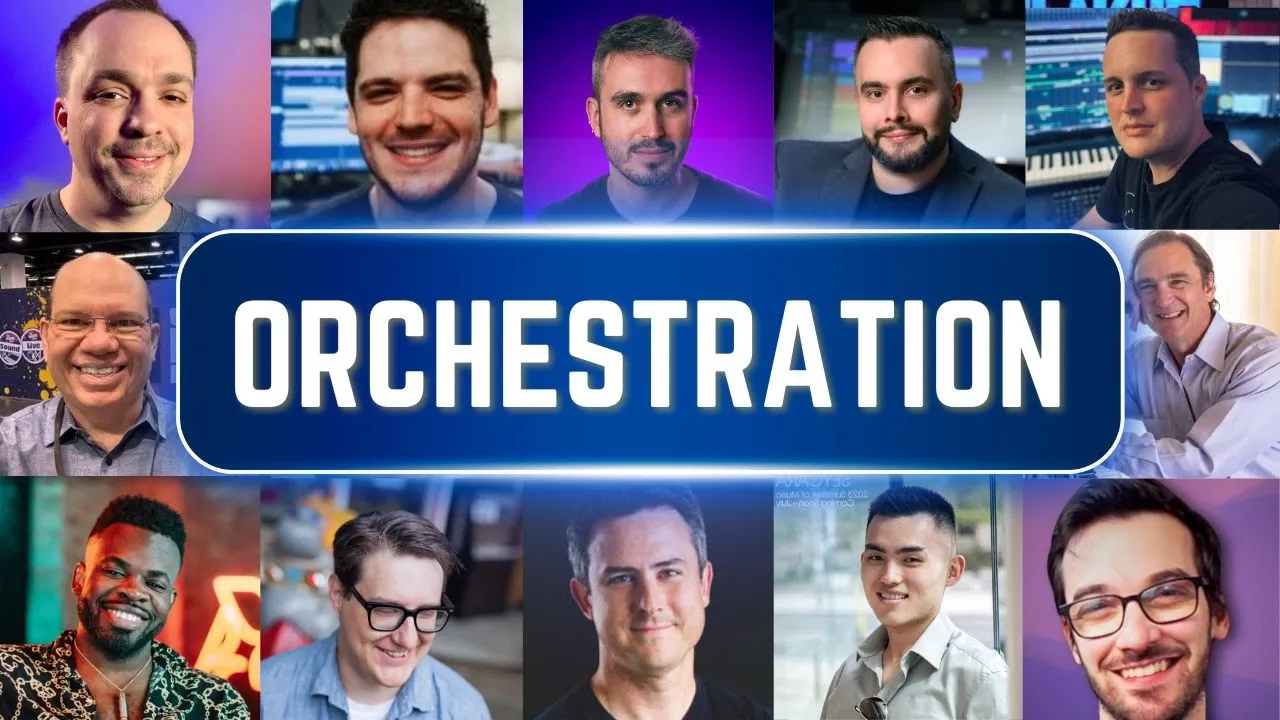
Today I've got an absolute treat for you. As you can tell by the title, I went around and asked more than a few of my composing friends in the industry to share their very best orchestration tip with you in today's video. I promise you this will be so valuable because everyone has a slightly different approach when it comes to making music.
And being able to hear a multitude of perspectives on the same thing allows us to expand our knowledge, take new pieces of information and insight that we might not have considered before and apply them to our music. and it can create exponential results for our music. So, I really hope you enjoyed this video.
It was such a blast to put together and a big big thank you to all of my friends who agreed to contribute something to this video. So, so valuable and I've left all their uh details in the description below if you want to follow them individually. In any case, let's get into it.
I'll share my personal tip at the very end as well as a parting gift as well. So, let's just get into the very first tip. Just so you know, I've categorized this alphabetically and yeah, that's it.
Enjoy. Hey guys, it's Adam Gubman, composer. Uh, orchestration tips.
Boy, this is a this is a fun one. I did not study orchestration in college. So, everything that I learned, I had to kind of learn on my own.
Um, but there's a couple of things that I've done over the years that have sort of stuck with me and become a mainstay of the way that I like to work. Um, the first thing is sort of a well, you know, there's general things like recording solo instruments here and there, but one thing is the way that I mix when I orchestrate. So, um, something that's really key to getting my sound, which I think is like brighter and a little bit more, uh, theme park and younger is that I have a couple of instruments in every family group.
So, for example, in the woodwinds, I'll take one or two instruments and I'll make them completely dry and sort of bury them in the mix. And that gives me a little bit of an edge on the top end and the high mids. Um, and then the rest I'll use a normal reverb on.
So, uh, even with the strings, I'll take my string library and I'll dry out one or two instruments and I'll and I'll tuck them, um, uh, within the mix so the high mids really pop out and that gives me a little bit of a bright edge. Uh, another orchestration tip that I love actually, and this might seem totally basic to a lot of folks and it's informative on the way that I was trained as a musician, um, is because I'm a piano player, I think sort of pianistically. So, to get me out of that, what I often do is when I sketch, I will, um, sketch like a piano player, right?
like I'll play everything in, play the melodies, all that, and then I'll print out the PDF and I'll work off the PDF. And working off the PDF helps me to stay true to my harmonies, stay true to my melodic content, and also see where there's space to add uh counter melodies and interesting things that's going to make the music pop. So, I hope that helps and good luck in orchestrating.
>> Hi everyone, I'm LA from Score Club. Hi Chris, thank you for the invite. And here's my orchestration tip.
My quick orchestration tip. uh is very simply orchestrate your dynamics. Shape your music, shape your phrases by orchestrating your dynamics.
Uh what I mean by this is even even in the context of a phrase, if you have accents or crescendos, add notes, add unison, add octaves, add extra notes, fill out the chords. And if you have a diminuendo, then you remove notes. This has the effect of shaping the music.
of uh making it flow very organically and also having an orchestration that really works itself out on the stage that guides the performance, guides the musicians. Just orchestrate your dynamics, right? Works great.
Uh seems simple. Try it. Hope it helps.
Thanks again, Chris. And that's my tip. So, here's my orchestration tip.
Do not listen to orchestration advice from people who write the kind of music you would never want to write. and the music that you don't like, no matter how many views they have on YouTube, no matter how much clout they have, because at the end of the day in orchestration, just like in life, there's not a one-sizefitsall answer. The strategies that may work for you may not work for someone else because maybe you're not headed in the same direction.
Each track has a different goal usually, right? So, the way you want to approach the orchestration for that track may differ from the orchestration in another track that was written for a different purpose. Now, if you want to learn how to write music in my style specifically, then my advice is use more than just the legato, sustain, and spicato articulations in your instruments.
In my mind, if you write music only using those three, it's akin to coloring a picture with like eight basic colors. You can definitely color a picture beautifully with eight colors. But in my mind, music gets a lot more expressive when you have a lot more than that.
Like what about 200 colors? Many different shades and colors that you make by combining multiple colors together. That's kind of like layering articulations together, right?
Using multiple articulations in a track and letting instruments change articulations over time is akin to making your music feel like it's being performed by actual musicians who have something to say. And this, in my mind, is one thing that maybe shields us from AI music. the idea of adding as much life and as much detail as possible even in your virtual orchestrations to simulate a violinist who's trying to put more life in his playing by adding a tremolo at the end of a legato line like these sort of details especially when they compound over and over over like hundreds of instruments.
This is the stuff that will make your tracks in my mind sound way more realistic and way more alive. >> Hey, so here's my most valuable orchestra writing tip and it honestly changed my entire approach. So I stopped thinking about the orchestra being just a collection of instruments.
Instead I started thinking why did the orchestra evolve the way it did. So what I want to say is back then there were no digital audio workstations. There were no EQs or plugins and the orchestra and the hall was actually the digital audio workstation.
I mean it was more like an analog workstation but you get the idea. So sound was created by seating positions. how the players were seated in the orchestral hall and of course the layering of instruments.
So just as a simple example, if you want to have more warmth in your cellos, add a bassoon. If you want to have a little bit of more sparkle on your horns, just add a trumpet. Or a little bit of more edge on the string line, just add a piccolo flute playing the same line on top.
So basically experiment around with layering instruments and think of using all of these instruments as the EQ or the sound shaping tools and finally if your arrangement sounds great mixing and mastering then will become way easier. Thanks. Hi everyone.
When we are talking about orchestration, we usually think on the orchestra and its instrument. But for me today orchestrating is more than that. Nowadays you can have a cinematic pad, a texture, a motion piano and also a synthetizer playing a deep breathing pattern.
I say this because for me orchestrating is the combination of colors. Now if we go back to the orchestra a good tip is start to put more focus and listening to carefully the different color that instrument produce in the different register. For example, the clarinet if it's playing the melody in the low register is going to be a little bit more melancholic.
But if you go to the up register, it's become more sweet, dolce and transparent. This is so important because we need to understand that every instrument has a point and area in where its sound change the color the energy and also the emotion. When we are orchestrating sometimes we are doing automatically because we know the rules and we know the technique.
For example, if I have a melody in the first volume, I know that I can double with the flute. And this is so important, the technique and the rule. But let's try to keep in mind all of this about the color.
And you will see that you are going to get a more clear and balanced sound on your piece. Good day there. One of my favorite orchestration tips is that whenever I'm using a full French horn section playing a melody, I'll often sneak in a solo trumpet to play in unison.
It just kind of gives this really satisfying extra bit of width and brightness that I find really pleasing. Hi, I have a few tips specifically when it comes to arranging songs. First of all, be aware of who you are arranging the song for.
If the singer has a soft voice, you might want to write an arrangement that's delicate and not too loud that complements the singer's voice. And if the singer has a loud and boommy voice, you want to write a big powerful arrangement that supports that. And also um if the song has lyrics, be aware what the lyrics are about so that the style of your arrangement kind of goes with the meaning of the song.
So that you don't pick a style that has nothing to do with the meaning of the song. And um and lastly, when you do a reharmonization of a song, which means you're picking new chords to an existing melody, be sure that these chords actually work with a melody. Try to be still true to the melody.
The melody is king, and you as an arranger, are there to support the melody and not change the melody. That's it. >> Hi, my orchestration tip is to think about unconventional voicings.
I'm talking about things like writing your cello line above your viola line, allowing your violas to support the cellos up high in their range, giving them that strained, passionate sound. Another example might be to write your second violins above your first violins. Second violin sections usually tend to be a little bit smaller and so you get a much more sort of passionate intimate sound if you have a smaller number of players soaring above a larger number of players playing something like chords underneath.
Uh, other examples of this include allowing your clarinets in their shallow mo register, which is a little bit lower, to support a bassoon line above them, where the bassoon is very much in its bright, strained range, which can really give your music that passionate feeling. It's something that doesn't always work out, but it's definitely something worth experimenting with. It can really, really bring new sounds to your music.
Hey, how's it going everyone? So a tip from me which is maybe a bit more unconventional and that is coming from somebody who is mainly self-taught and that is to listen to a lot of classical music and a lot of film music and just try to hear what is happening in the colors in the orchestration. Another passion of mine has been doing mockups uh and just try to recreate and create them as realistic as possible simply by listening to these recordings over and over again.
Uh, these two things have worked really well for me and hopefully they could for you, too. All right, take care. Bye.
>> All right. Hi there. So, an orchestral tip.
Well, I know there are probably thousands of ideas for orchestrating and arranging that speak specifically to how your music's going to sound, but I thought I would offer something a little different, which is this. The tip is when you're doing orchestration, keep in mind how the music is going to look, how it's going to appear to the audience, not just how it's going to sound. Now, it may be that you have no intention of having your music being performed live.
But I always when I write try to think about what it will be like when it is performed live. And there are choices that we have to make to have that best visual appearance. So, for example, suppose we take a setting like this.
Let's say we have a quiet opening to a piece. The strings are in motion, but the first violins are not. They're waiting for an entrance that might come at bar eight.
Right? So, the second violins are playing, but the first ones are not. That is a look.
And the first violins, maybe there's 12 players there. They're sitting there like this with their bow ready and the violin on their knee, and then they're going to pick it up. Or you could have them in motion from the beginning, maybe playing pianisimo along with the second violin.
So, it's a different look. So, it's not like there's a right answer or wrong answer in that situation. it's just what you think is right for you.
But it is a choice for sure and you should be conscious of that choice. So in that situation, you might consider just giving them things to do to keep them involved. Uh it doesn't have to be all the time, but you know, at least occasionally so that they're on their toes and ready to play and ready to participate.
And you may find that the orchestra uh appears better. >> Hi, I'm George Shaw. I am a film and TV composer, but I'm also a clarinet player.
And so today I wanted to share an orchestration tip about writing for woodwinds. Now woodwinds can do a lot of great things. They are great doublers.
Uh they can do pads very well whether they're on their own or doubling strings or brass. Um they're great for solos. They're also great for whimschool writing.
Uh but today I wanted to talk about writing for winds when you're trying to create a big orchestral climax and everyone is playing. It's a 2D moment. And so if you were simply to double strings of brass, uh, the winds are underutilized.
They're basically going to be drowned out by how loud the brass are or by just how many strings there are. And so if you really want to maximize your use of the woodwinds, first thing is to go high, particularly with the high winds and particularly if you're going to add piccolo. So creating a lot of motion will will do that.
whether it's runs or oenado or trills, you know, stuff that creates sparkle and magic. And that's how your woodwinds are gonna sort of be heard above the orchestra. And of course, really high piccolo can be heard above the entire orchestra just by itself.
And just another little aside, when you're if you have a lot of intricate constant motion, it's good to dovetail uh between like first and second flute for example. Um so that one player plays and then another player will pick up and continue the line so that both players can can breathe. So you can do this between each section.
Um, but but yeah, just creating motion and sparkle and and you'll really get a lot of magic out of your woodwin writing. Okay, so here's a quick example of this in practice. And this is from a a sci-fi fanfare march that I've written.
Uh, as you can see, it starts with trills, which kind of just gets things going, um, but is somewhat static. And then once we start the theme, there's runs on just about every bar. And it just adds an exuberance that helps drive the music.
[music] [music] Hey everyone and hello from Rainy Sophia. So Chris was kind enough to ask me to share my favorite um orchestration tips. So I'll try to do so right now.
It's a very simple thing and we tend to forget doing this when we're in the MIDI world because things are like recorded properly with nice equipment and great ensembles and so forth. But especially during a life scenario, this is uh in my opinion a lifesaver. So, um, the idea is that you are going to have, for example, if you're having some sort of arpeggio in the violins, some sort of ostenato arpeggio, then you could potentially would use like a softer instrument uh on the background, like for example, two clarinets doing a triad in piano or met, something that will just amplify the harmonic um like fundament of of the music.
So this is very useful because especially in the concert hall um we we tend to listen to kind of more I would say transients and so stuff that's more piercing and we need to think about the overall impact of the music from a harmonic point of view. So this is a really nice trick to use something that's very subtle and that could help elevate your music. Um, you could also use like a French horn and a very soft dynamic layer using like a common tone between multiple harmonies.
You can uh make like this dialogue between the first and the third horn for example or something like this. Just something that's very subtle like and then you have some music from like going on behind it. And normally you won't be able to hear it very distinctly, but you're going to feel it.
So this is one of my most favorite things that I'm using while orchestrating, and I hope that this will help you in your creative process as well. Cheers from Bulgaria once more. My best tip for orchestrators who are also great piano players is to never think of the piano as an orchestration tool.
Think of it as an input tool. speed up your input. But if you are orchestrating on the piano, playing it in, and exploding into the orchestra, I would argue you're missing out.
Uh, first of all, your range and your voicings are going to be those that are comfortable on piano. You might be not thinking of something that would be much more obvious if you were in a score or in your DAW uh than what feels good on the piano. What feels good on the piano might not feel good in the orchestra.
Um, you also might overestimate or underestimate the technique of players. Um, a lot of woodwin players can shred scales really fast. Don't even have to move your fingers anywhere as opposed to the way that you shred scales on a piano.
And on the other side, uh, big arpeggios might be a lot more comfortable on piano than on a violin where you're doing a bunch of string crossings. Uh, so think of the instrument you're writing for and know the amount of technique that you can write for those instruments. It will sound so much better.
Uh similarly uh tremolos are always a giveaway that the orchestrator is a piano player who wasn't quite thinking about the instrument because a lot of fourth tremolos that are so comfortable on piano are an absolute nightmare to play on winds and strings. Um similarly grace notes can be a tricky one. Uh the grace note that feels good that like little like third jump down that that you would always play might not sound that good on trumpet.
The trumpet player might want to play a little half step. uh listen to those instruments and you will know exactly what to write. Listen to the way that instruments ornament and copy that.
Don't force them to ornament the way that you ornament on the piano. Uh and finally, the biggest giveaway for me that someone uh made some mistakes while orchestrating on the piano is that wind players have lungs. Um I've seen a lot of instances you forget that wind players have to breathe.
And the rule is if you do not know where your wind players are going to breathe, they will breathe where you don't want them to. So all that being said, piano is a great input tool. It can speed things up.
If you are orchestrating on piano, you are going to be forgetting and missing a lot of great things and a lot of great writing that you might be able to hear, but you might forget in front of the piano. Hey, it's Joshua Sone. One of my favorite orchestration tips is actually regarding the chord track, which is a pretty simple tool, but I like using it when I'm composing because uh it keeps me on track, so to speak, with all of my notes, especially in a big session where you're stacking lots of different layers together.
Um, you can take all your notes and then you can have the chord track up on top just to make sure that all of your notes are aligning with the chords. Um in Qbase you can actually uh get different chords chord qualities such as the minor major diminished uh sus uh suspended chords and as well as augmented chords. This is really useful in not only when you're just composing but let's say you come back to it six months from now from for whatever reason.
It's just a great way to uh relearn and and and uh reference the music in a uh easy way. My number one orchestration tip for you is to use the bass to add beautiful movement into your chord progressions, even when using simple triad chords. So, let's say you start with C minor.
I'm not talking about creating an inversion, but like playing the G at the bottom or the E flat at the bottom here. I'm talking about the baseline. So, regardless what inversion you play up here, use the bass to add movement.
For example, C minor. You can go from C, D, E flat, G. And then when you go to G, you might change chord to E flat with G in the bass, creating these beautiful slash chords like this.
Let's go to F minor with A flat in the bass. [music] B flat G in the bass here. And then maybe G flat with the F in the bass.
[music] E C7 F minor cadence. [music] Try it out. My advice, if I had to give a piece of advice to orchestrators and composers, is to treat the dynamics and the articulations, the slurs, all that stuff as importantly as you treat the pitches themselves.
For I've seen a lot of orchestrations come undone from these balances and then the mixer has to get involved and um it's a big mess and something maybe that isn't fixable in post-production. So these dynamics are so important and articulations are in this age very exaggerated. So you have to be very careful what you write on the paper.
Uh that being said, I feel like an excellent resource for such economical writing as Shastikovich. And if you look at the history of Shastikovich, it's because he was being censored by Stalin and was very very careful what he committed to paper. And during this period post Lady McBTH, I think it's his best writing, possibly because of the censorship.
But when you trust the orchestra more, they give you more. And that's my thoughts on the matter. >> So one orchestration advice I would say is, and this might sound really stupid and obvious, but it's to think about the human that is playing the instrument that you're writing for.
That person that's sitting in that chair. They're sitting in that chair. They have the music in front of them.
They've never seen it before. Uh, so you really want to make sure that it's like thoughtful, that you're really making it easy to understand what it is that they have to play. Uh, if you're a musician and you've ever site readad anything before, make sure it is very sight readable.
Uh, I and that just comes from being an instrumentalist and I'm sure most composers have some kind of ability on an instrument. What is it like to site readad something? because we've all gotten parts before that like the music is fairly simple, but it could be written in a way that's very complex.
So, think think about obvious things like nharmonic spellings and uh where the phrasing happens uh where the page turns are uh and this is a lot of a lot of this stuff we just say ah the copist will handle it but a lot of it the copist can't do it really comes down to you as the orchestrator. So, yeah, think about the human who is playing your music. My orchestration tip would have to be at the very least trying to not see composing and orchestrating as two completely separate things.
And what I mean by that is if you're somebody like myself who kind of likes to sketch first, um not that I sketch everything, but whenever I do, you know, regardless what that part may be, I kind of try to keep in mind that it's not going to be a piano part. I don't know. I feel like having a plan for that part, you know, just picking your main leading instruments straight away kind of helps.
Not not just orchestrating further down the line, but composing as well, cuz at the very least, you'll have a rough idea of some of the registers you may be choosing. So, that's it. Have a plan for your sketch.
Sometimes it doesn't work out as well as you picture it in your mind, but um it does help. Hey guys, I'm Ryan and this orchestration tip is at the very beginner level, but still an important one. Especially when you're starting out, rather than thinking about all these different instruments you have to work with, just focus on the four main groups: woodwinds, brass, percussion, and strings.
It can be intimidating and even overwhelming to look at a massive score and feel like there are dozens of different things happening all at once. If you focus on groups rather than individual instruments, you'll realize that even complex and rich orchestrations are often simpler in design than they might at first appear. But more importantly, you'll learn to focus on tambber and not just volume or range.
For example, I once reviewed a piece by a student who had their melody on flute and their baseline on trombone. The flute and trombone are so unbalanced and contrasting in tamber that they're going to be a problem no matter who else was playing in the rest of the orchestra. In this case, they could have gotten a much more balanced and effective result if they were thinking in groups.
So rather than putting their two most important lines on very different colors and strengths, they could have instead used instruments from the same family. For example, flute with bassoon or trumpet with trombone. Keeping the lines in the same family makes them feel more related and cohesive.
As you learn more and develop your skills, you'll of course learn how to approach this differently, but even the most advanced orchestrators tend to focus on separating the four main instrument groups as a fundamental principle for their work. If you're looking for some great examples, you can't go wrong with Tchaikovsky, whose orchestrations have page after page of very clear separation between the different groups. All right, I hope this is a helpful framework for those of you just starting out or even for some of the more seasoned orchestrators out there.
Thanks. Don't use EQ to compensate for orchestration issues. Think of instruments not only in terms of dynamics or color, but also in terms of the frequency spectrum they occupy.
Registers, tambers, dynamic ranges, these things are all connected and they ultimately decide what cuts through and what gets masked. Also, good orchestration depends a lot on the context. If you have an orchestra only piece, you can use the full dynamic and tonal range that you have available.
But in the context of a song, for example, the orchestra has to sit somewhere and thus also leave space for other things as well. And even if you work only virtually, thinking about real players and real instruments limitations also helps a lot. improving the orchestration.
So on an actual session, making the parts easier to perform always leads to better results and quicker results as well. So in my experience, clarity and reliability often matter more than pushing the virtuosity. And I think that thought can also help a lot if you stay in the virtual world with the door and samples and so on.
>> Hey there. So for my orchestration tip, I'm going to be talking about textures and how you should put them together. I had a very good professor tell me once that a difference between an ingredient and a cake is how many of the ingredients there are and how you're using the ingredients.
Now, barring exceptions where you have very very sparse textures going on with just a few violins and um a simple percussion rhythm, I'm talking about those dense moments where you have interesting, you know, uh 2Ds, uh interesting background textures going on with a theme above it. Those are the moments you should be thinking of. What am I including here?
Is there a couple of different voices? you know, is there a melody countermelody? Is there some kind of accompaniment rhythmic figure going on?
And am I combining these together to make different combinations? So, um, by putting these different layers together and having them interact, you end up with something that is greater than the sum of its parts. So, with that in mind, I urge you to keep track of what exactly you're putting into each section and making sure you have a little bit of variety.
So, some short notes, some long notes, lines going up, lines going down, rhythms that are fast, uh, repetitive, and rhythms that are maybe a bit more intermittent. Put that all together, and chances are you'll have a more interesting sounding combination. >> Hey, thanks, Chris.
You know, one of the things that I find, especially with keyboard players, is that because you have 10 fingers doesn't mean that you have to use all 10. especially when you're recording like string ensembles because I can play with all and it sound you know they say well that's the dead giveaway that it's a synth. What I would say is if you're trying to play a lot of times I'll hide a hand behind my back or I'll use open chords.
I'll just kind of pretend like I don't have as many fingers on my right hand as I as I actually do. So I would just kind of play open chords and then play the bass. It it just makes it see and and even though as [music] opposed to So less is more.
We hear that all the time. But uh yeah, so try to use less fingers, open chords, and continue to make beautiful music. Stay joyful.
So one of my favorite orchestration tips makes use of the trombones. Whenever I want to grow the intensity between sections, such as between an A or A1 section, I use them playing a note from each chord to quickly and easily beef up the sound. Now, just be mindful though of your chord voicings.
So, use wider intervals like fifths or octaves in the low register, and that helps to stop things getting muddy. And then keep the smaller intervals like thirds for the higher notes. [music] Hey mate, what's up?
I hope you are fine. Well, I usually start from the sound. I'm a sound designer as well as a composer.
And for me, sound plays a huge role in the creative process. Creating a sonic world is what really inspire me. I love hybrid sounds, mixing acoustic and electronic instruments.
So layering is always a big part of my workflow. But honestly, I don't have a fixed method, a fixed workflow. It really depends on what I'm working on.
Sometimes I start very simple at the piano, just scratching a an idea, and then building everything from there. Other times I get inspired by sounds, preset, an instrument, a percussion, uh or even presets I build myself, especially when I working on uh uh when I work into picture. For instance, when I was working for Fox, I often had to write music very, very fast, sometimes in just one day.
That's where I learned how important a solid template, good optimization, and of course, the right simple libraries are. >> My top orchestration tip is to hire an orchestrator. Now I know that sounds a little trit because well as a composer that is one of my main skill sets right is the ability to write music and maybe turn it into an orchestral piece.
Uh but the reality is uh in my lane which is working mostly in video game soundtracks. I often get to work with live orchestras and live choirs and of course live soloists. So my job primarily is to come up with that final music.
And so I'm often writing sketches and I'm writing demos. But there is a large gap between that initial idea and that initial draft and the final piece of music. And so the people that help get you to that finish line are the orchestrator and the copiest.
Both of which are absolutely invaluable as a composer, especially working on a lot of music and projects that require tons of music and lots of loops and lots of layers. And so ultimately that orchestrator is the person that is taking the core material, taking those ideas and extrapolating them out to fill out the piece of music. So instead of just a piano sketch, an orchestrator can take that and fill it out for the full orchestra.
Or maybe I write a string arrangement and now I need the orchestrator to take that and add brass, add woodwinds, add choir. And so it's just one of those skill sets that is so so important um as a composer to have that person on my team. Hey >> everyone.
A little orchestration tip that I love to utilize these days and something that I actually utilize quite a lot on the Lego Horizon score by um Homay Schmidz, which is well worth checking out, is having Chel take up the harmony um while all the upstrings are left to to basically play the melody, whether in unison or or octave or whatever. This works really well, especially when you've got a smaller string section. It essentially leaves the the function of, you know, the upstream playing the melody and then the cello filling out the harmony below.
So, say you've got a G major chord, you can have G D G D G D G D G D G D G D G D G D G D G [music] above that and then the B above that, you know, nice wide kind of voicing. Um, and it just makes the sound so thick. I mean, I even now like when I'm listening in the control room and you just got three chi playing, you know, one note each, um I still I'm like baffled that the cellos can make make that sound.
So, you know, cuz they're wide body, they're rich, resonant, um instruments, so it just lends itself so well to that kind of sound. Um and yeah, frees up the upper strings to to play like a really big lush melody. like I say, works really well when you got a small string section and you don't want any of the other strings sort of having to fill out harmony as well.
So yeah, that's that's a trick that I love using. Um John Williams, of course, the absolute master did this. I think it was in a queue called family portrait or something.
It's just the start of the queue. He's got four in there and you you can hear just how rich those those chell are. Um so yeah, well worth kind of experimenting and uh yeah, I'd recommend it.
>> Hello. Thanks, Chris, for inviting me to do this little video. My tip is less of a traditional orchestration tip, per se, and more of an orchestral production tip.
Record one live instrument. Obviously, we don't all have the luxury of a live orchestra, but even recording one single real instrument can completely change how realistic your mockup feels. Maybe a solo cello or a flute or a vocal, your ear locks onto that one live element, and it makes all of the MIDI instruments around it feel more real as well.
I've been collecting various wind instruments over the last few years for this very purpose. And I'm not a great winds player by any means, but even with all the comping and editing and tuning that I do, the resulting sound is still way more human and realistic than a sample library. Uh, so I definitely suggest giving it a go.
And if you don't have the resources to record a live instrument at all, a great alternative is to use a soloist sample library and blend that with the ensemble. You could take a solo violin patch and blend that with the first violins of your string ensemble library, but record a brand new performance. Don't just copy the MIDI from the ensemble patch.
That's important. If you get the balance right, it won't sound like there's a soloist layered with the ensemble, but it will just add that extra presence and detail and make the string section sound more intimate. Maybe that was two tips in one.
Anyway, I hope it was helpful. See you later. >> Hey Chris and friends.
So, my tip might sound a little strange coming from someone who was really obsessed with the complexities of orchestration, especially somebody who loved John Williams and still do. My tip is this. Don't assume that because your ideas are simple that there's something wrong with them.
You can use orchestration to take a simple idea and not make it more complicated, but just make it more expressive. And the example I have for this is one of the students I was working with in mentorship had an idea that sounded like this. really simple, right?
He was worried it was too simple. But all we did with that idea was we just gave it to some strings. Just did like a light tremolo and then a little flute for the melody.
And that is enough. It's okay to have simple ideas. Don't assume you have to get more complicated.
Just stay expressive. All right. And to wrap things up, I wanted to share one of my own personal orchestration tips, and that can very easily be summed up into three words, and that is less is more.
So, this is a phrase or a mindset that I've really tried to not preach, but um to establish since day one, really just making music with more of a minimalist mindset. And this is very powerful because it just makes things so much simpler and it it just creates a more streamlined workflow for your process. Um, if you've listened to any of my music, especially like the more romantic cues, even the adventure fantasy cues, you might think that, oh, there's probably, you know, 100, 300, 500 different tracks going on in the in the sessions in DAW in the DAW.
But actually, if you take a look behind my sessions, very, very few of them ex exceed like 30 to 40 tracks. So, if you actually look at my Logic sessions, usually it's between a 30 to 40 track count. And the reason this works is because I really try to make the most out of every single instrument that I'm using.
Yes, I do put in all of my lines individually for the individual section. So, for example, the string ensemble has, you know, five tracks. Violence one, violence 2, violas, cellos, bases, all on their own separate tracks.
And I do the same with the rest of the orchestra as well. But even so, that amounts to really just 30, 40 tracks at the very most. And so if you can take this and adopt this mindset of doing more with as few instruments as possible, then honestly I think it can be one of the most freeing things that you experience in your music making life.
Um, just knowing that you can trust in your samples, trust your own musical decisions, and if your musical material is strong enough, if it has a solid foundation in the notes themselves, the melodies, the harmonies, the structure, and of course, you know, just the core musical skeleton, then you can be confident knowing that your arrangement can stand on its own without needing to jumble everything together, putting in thousands of instruments just because you have them at your disposal, right? Do more with less. And the more you practice this, the easier it is.
It's almost like a little challenge that you can play with yourself. How full of an arrangement can I create with as few instruments as possible? So, I hope that was valuable.
I hope you found everyone's insights valuable. And actually, it would be amazing if you could let me know down below in the comments. Uh maybe one or two of your favorite tips that you heard in today's video what gave you like a distinct aha moment, like something I have to try in my next mockup.
please let me know because it would just be amazing to show some support to these wonderful musicians and composers who agreed to contribute a an idea here. A big big thank you to you once again. And I did promise you a gift at the very beginning.
So um you know what we've been talking about in this video specifically was focused on orchestration. Sometimes live orchestration, sometimes uh MIDI orchestration, but we haven't talked about the other phases of the music making process, right? Composing music, coming up with ideas from scratch, the production side.
We touched on mock-ups a little bit, but we didn't do a deep dive into it, right? And then there's also mixing, mastering, releasing your track. So, how do we put all of those different things together, right?
[music] And that's the gift I want to give you today. And that is my complete composers framework workshop. So, this is a 4550minute didactic practical training workshop.
It's on demand that you can watch [music] anytime. And if you want to check that out for yourself to kind of uncover my entire music making process, not just focused on orchestration, but all the other elements as well to see how a track comes from the very beginning, the inception of the idea to the final released master, then I invite you to check it out down below in the description. It's 100% free.
Again, as [music] a gift for watching this video today and sticking with me to the very end. And if you did want to go a little deeper with me and explore my full virtual orchestration workflow, the way I put together mockups from start to finish, how to get the best out of your sample libraries, all that stuff, I do have a program dedicated exactly to that called Virtual Orchestration Mastery, and you can check that out on my website if you like. I'll also leave a link down below in the description if you do want to check that out as well.
Of course, there's no obligation to join. Um, but I just want to let you know that resource is available if you do want to take that next step and really just take your mock-ups to that professional level. So, thank you so much for watching.
Again, huge, huge thanks to all my friends who contributed to this video. Uh, again, please give them a subscribe, follow their their channels. They all do amazing work.
And big big thank you to you, of course, for watching and supporting, you know, my content and everything else. So, I really appreciate it. I'll catch you in the next video.
And I'll see you very, very soon. Take care.



![The Most POPULAR Out-Of-Key Chord [III aka V/vi]](https://img.youtube.com/vi/bQujCSNV0Ms/mqdefault.jpg)