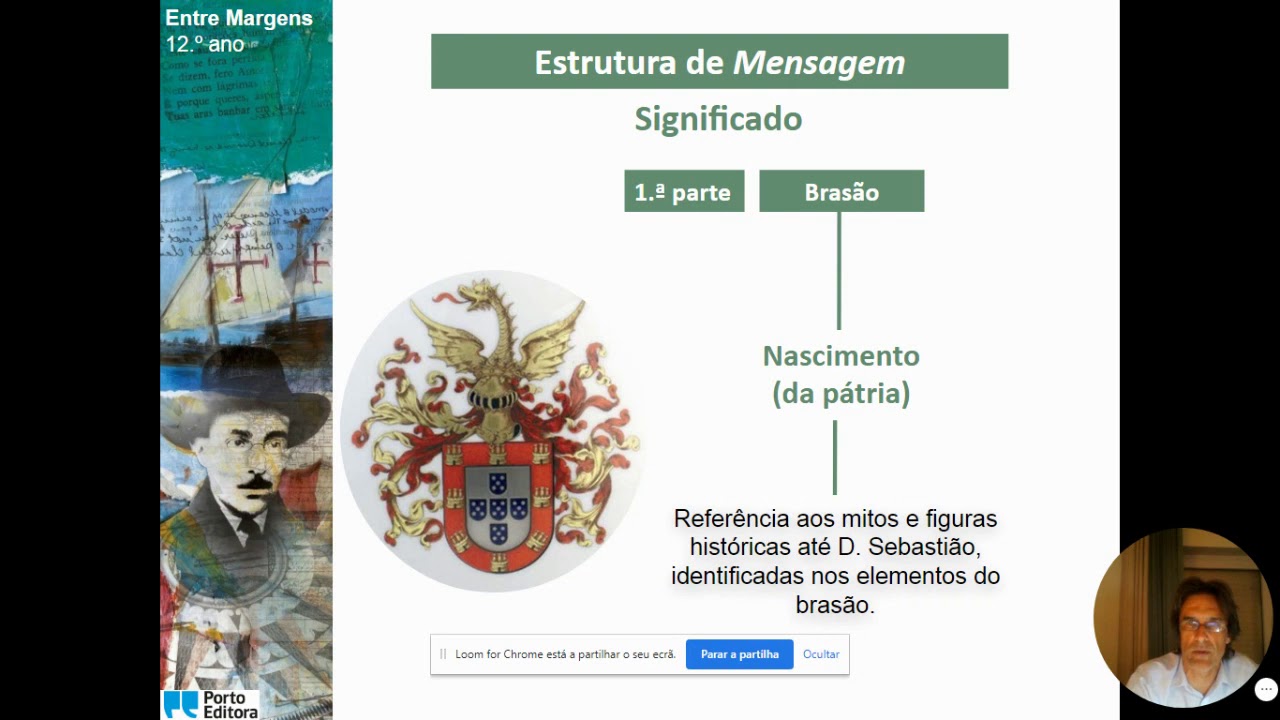
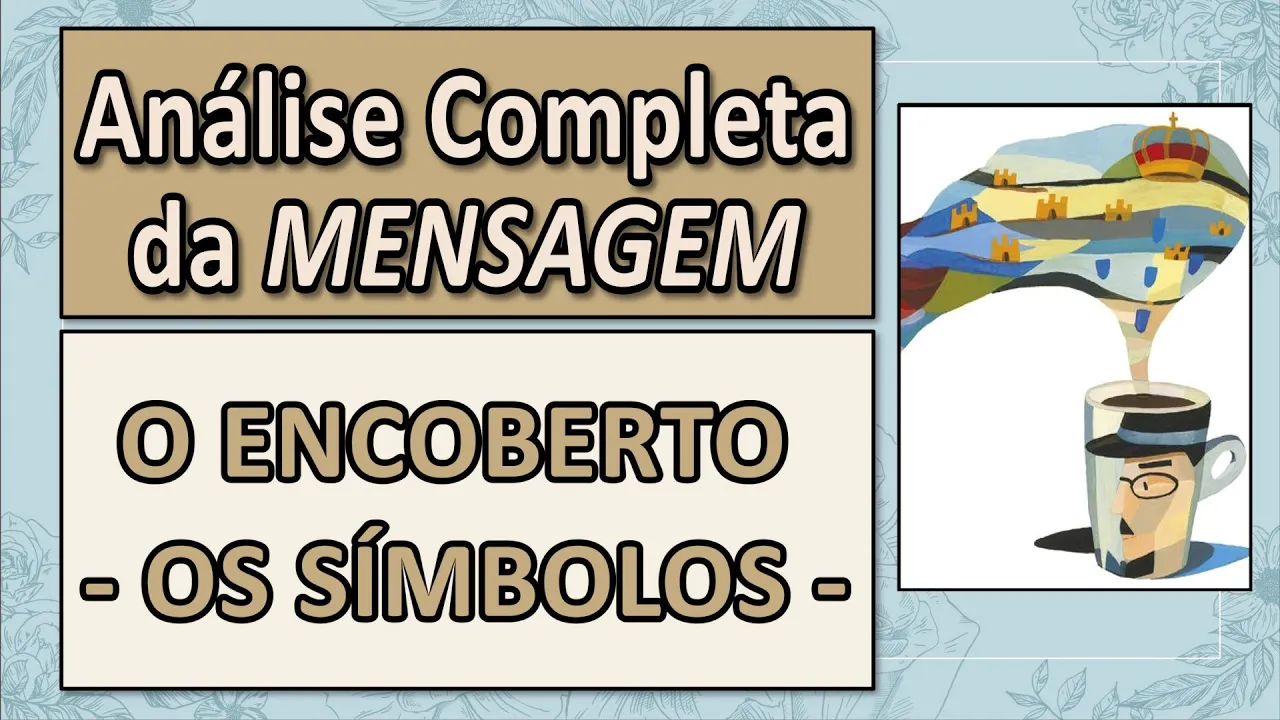
[Music] Hello everyone and welcome to another class in Portuguese with Professor Sofia Pedro, let's continue the study of Fernando Pessoa's message and let's move on to the analysis of the third part of the covert so that we can start this analysis and not become too much extensive we will divide it into three parts and we will move on to the analysis of the first part, that is, the symbols, the third part of the message that Fernando Pessoa calls the hidden one was mostly written after 1928, as we had already seen in the first part of the message that is, in the coat of arms too. In this part, Fernando Pessoa will make a division, it will not be the same division that he already made in the coat of arms, it will be a tripartite division. Which is curious since this is the third part of the message, which will be divided into three parts the first part will be called the symbols and will have five poems, the second part will be called the warnings and has three poems and the third part is called the times and also has, like the first part, five poems and although everyone agrees that the message does not is already a book of poems easy to interpret, the third part of the covert will be one of the three and in my opinion the most complex and the most esoteric of the message, we will find here what is considered the hermetic Fernando Pessoa, a more hermetic language, much more esoteric and as we had previously seen the The reasons that led Fernando Pessoa to divide the message into three parts will have to do with the cycle of life, birth, growth and then death, since we are talking about the hidden.
Let us now move on to this last part of what the cycle is of life and in this case the death of an empire but also what will be its resurrection and we cannot talk about the third part of the message without referring to the Sebastianist myth since this third part entitled the hidden Fernando Pessoa seems to warn us of that we will talk about mystery and we cannot forget that Dom Sebastião, before he was born, was what was desired and after his death he was what was expected and this entire third part will revolve around prophecies Prophecies of hope Prophecies of a Messiah who will come to save Portugal and then go back to making it a great empire, not the material empire that we had previously been, but the spiritual empire, so we are going to move from the body now to the soul and whoever is this covered one, this covered one, will then be the Emperor of this fifth Empire, he will emerge after a initiatory death and will bring with it this light from the ethereal that will reveal the Holy Grail that will dissipate the novoe and that is the creative force of the Nations, just like the other two parts, the third part of the message also has a Latin epigraph Pax in excelsis this epigraph Latin translates as peace in the heights or supreme peace, which ends up being in the context of this part and also of the message itself, a message of peace and fraternity, it's almost like an appeal that Fernando Pessoa makes, an appeal to Fraternity, an appeal to peace to spirituality to the most part of the soul and not of the body, now the totality of poems in this part, therefore five in the first part, three in the second and another five in the third, is equivalent to 13 and even before we move on to the warnings and the times we have to start with the first part which will be the symbols and we have to consider then that Fernando Pessoa In this part of the cover, he will not speak exactly about the death of a nation but rather about its resurrection. We have something that will be reborn. Not exactly the same as what it was before, but in a different way, since at this moment it is not We are interested in the material empire, the physical empire, but a more spiritual empire, so the conclusion we will reach is that death is just a transitory state, it is not something that is final, it is a process of resurrection of the dead body to transform it into something different and better And what is the first symbol that Fernando Pessoa will choose to begin precisely the part dedicated to symbols and obviously it would have to be Dom Sebastião .
God grants his people for the interval in which the soul is immersed in dreams who are God who matters the sand and Death and misadventure if with God I kept myself that is what I dreamed of myself that eternal lasts that is what I will return to this is the starting point for the hidden is the dead body of Portugal and we have to remember that this figure had already appeared in the first part of the message in the coat of arms, namely in the subpart of the corners with the title Dom Sebastião King of Portugal, here we no longer have the figure As King of Portugal but simply As Dom Sebastião as a myth, the figure carnal the physical figure is practically dissolving and transforming into the myth that it is what matters here for Fernando Pessoa is this essence of the myth is not the physical flesh This is left behind but what symbolizes the image the idea to figure of Dom Sebastião And so what does this symbol mean since it is here at the beginning of this part of the cover, it is the founding myth of the New Portugal of the New Empire and we then return to having the figure speaking in the first person and in this first stanza What is Dom Sebastião asking for? Dom Sebastião asks for time now according to the narratives of the Battle of alcer kibir moments before Dom Sebastião died in the sands of Morocco he would have preferred the following words to die yes but slowly and could then be the reference to this wait now for a person death is not the goal is not the end, it is just a state of transition between two moments, hence this adverse time to which the poetic subject refers is precisely this transitional state and in the second stanza we confirm that this idea of death for those who believe in the immortality of the soul does not will have meaning since what matters is the soul is the essence and this does not die this remains Always Alive whoever keeps this Essence will then be God and we cannot think that it is the figure of the king who will remain who will remain but the essence of his acts of his courage the echo of what he dreamed of and that he tried to achieve his strength, his will and above all his myth and his dream and that is why precisely in this stanza Dom Sebastião states what I dreamed of is that eternal lasts and the first symbol We move on to the second, or the fifth empire, and I'm going to start reading the poem, what a sad empire of those who live their home at home without a dream of raising their wings making them even more Red to the Embers of the fireplace abandoning the sad lives of those who are happy because life is hard, nothing in the soul tells you more than the lesson of the root, having the Grave as life, ages upon ages disappear in time, who you were comes to be discontented, is to be a man whose blind forces are tamed by the vision that the soul has and so After the four times of the being who dreamed, the earth will be the theater of the clear day that in the depths of the herme night began Greece Rome Christianity Europe the four go where the whole age goes whoever comes to live the truth that Dom Sebastião died following the myth of Dom Sebastião Fernando Pessoa will then choose the myth of the fifth empire and we will see that Fernando will build this poem with five stanzas, with each stanza having five verses and we will also realize that the number five here will symbolize this idea of perfection and we cannot forget that it is also the fifth Empire, so here we have the fifth Empire with a poem with five stanzas and each stanza has five verses, that is, they are quintillas, this myth of the fifth Empire is not new, it is already old, the first time it appeared to mention it was in a biblical reference and it is precisely in this biblical reference that the prophet Daniel reports a dream of Nabuco, the king of Babylon, and in that dream the monarch saw four empires and a fifth Empire that would always be eternal since it was not material but spiritual Fernando Pessoa not only if based on the thunder of bandarra but also on what we give in Camões and Father António Vieira considered that this fifth Empire was the Portuguese empire, he defended this fifth Portuguese empire not as a material empire but as a spiritual empire and it is then that Fernando Pessoa in the first stanza will start by ironizing ironizing what to ironize all those who allow themselves to stay at home and who are otherwise satisfied with what they have all those who think that this dream of the fifth Empire is madness and that the happiness that they have is not worth fighting for They consider happiness for Fernando Pessoa, it may even be happiness but it will not be true happiness and whoever is content with little is a simple soul and instead of living it just survives, however, on the contrary, whoever has a dream has something that will make it fly, or it is a dream so big that not even the fireplace of a safe, comfortable, quiet house can stop it from leaving and taking risks, obviously, the more you get, the greater the reward can also be, and that's why people dream, that's why people take risks, and in the second stanza it will once again reinforce what I already said in the first sad stanza about whoever is happy lives because the hard life and These are people who don't know there is more in life than this happiness to have for life in the Grave is something that Fernando Pessoa despises and already in the poem related to Dom Sebastião that we also find in the first part of the message in the coat of arms and in the subpart of the corners we already had this idea that the A man without a dream is nothing but a deferred corpse that he creates and here we come again to have the same idea reformulated in another way and also in a poem dedicated to Dom Sebastião, but Dom Sebastião is already completely or almost completely considered a myth. since the dream the dream is what matters, the action doesn't matter, the intention matters, and in this case the intention of going further, of getting out of that complacency that binds us to normality and that prevents us from becoming much greater than what is ours mortal body, in the third stanza, we then see that time is cyclical, it comes in eras, it is made up of generations that pass and with each generation that passes, with each era that passes, man continues to be dissatisfied, but a new time is foreseen, coming to a new order there is a vision that the soul has and that shows us that something greater will emerge in our future and here in the fourth stanza that Fernando Pessoa will then indicate the four times, that is, the four empires that have already passed and that he will leave the reference to the emergence of this fifth Empire of this New Empire that will emerge from the night to illuminate the world with its spiritual light and knowledge and in the fifth stanza we then have confirmation of which are the four empires that have already passed according to Fernando Pessoa and we then know that Greece, Rome and Christianity and Europe and the Fifth Empire only will fulfill on the spiritual plane and it is precisely at the end of this fifth stanza, therefore at the end of the poem, that Fernando Pessoa issues a challenge to the reader who comes to live the truth that Dom Sebastião Pessoa then urges the appearance of this grand Empire of a final empire of an empire of fraternity of an empire of peace and that will remain forever this rhetorical question then challenges the interlocutor to reflect on this figure of Dom Sebastião and think a little about his example, think about his example, courage, his example of strength, in his myth and through this belief that this King lives in this example of his dream is that someday this fifth spiritual Empire can come to fruition, so this new time will depend on the return of this mythical Dom Sebastião, this spiritual Dom Sebastião and we will continue with the figure of Don Sebastião in this third poem of symbols, that is, the desired one and I will start reading the third poem, the desired one, wherever between shadows and sayings, jaas remote, feel dreamy and rise from the depths of not being for your new fado, come Gá with Pátria raise again, but already at the height of the supreme test, the penitent soul of your people to the Eucharist, new master of Peace, raise your anointed sword exc libro of the end in such a way that its light to the Divided World reveals the holy degree and we could think that this third reference to King Dom Sebastião would be a repetition of what had already been said before, but let's not notice that there is a change here, the king is progressively becoming more and more symbolic and less physical, we have a king who is completely losing his appearance human and becoming a pure and absolute symbol This is the third poem in which Fernando Pessoa speaks directly about Dom Sebastião, the first, as I had already said previously, happens in the first part of the message on the coat of arms in the subpart of the corners where the poem is entitled Dom Sebastião King of Portugal we will find there a King Dom Sebastião still a man despite being crazy but still a man already here in third part in the part of symbols We then find the poem Dom Sebastião in which the king is no longer flesh and blood, he is already dissolving into what is his myth and now we have the desired one in which the king completely loses his physical characteristic in which it doesn't even have a name and it's practically almost a perfect myth and that's how we find Dom Sebastião in the first stanza almost like a memory that walks between shadows and sayings he's just a rumor he's passed from person to person he's just spoken he is such a memory and which, like all memories, does not die and it is enough for us to dream it for it to become Reality Again Bringing us back to us and this is what myth is.
Myth is something that does not exist but we just need to talk about it for it to become reality to be something concrete, rise from the depths of not being, here we have another exhortation, there is now a new mission and this new mission will fit the myth, a new fado, initially when Dom Sebastião was flesh and blood, his fado was different at this moment as a myth, let's go have a different fado and in this case it will then be bringing life back to the dead body of Portugal so that it can then be considered the fifth Empire in the world, we have in the second stanza a reference to a figure that appears a lot in Arthurian legends and which is precisely the myth of Galas or in English sir galahad pray and who was galaj according to legend galaj was the son of Lancelot and one of the knights of the Round Table was Noble, he was an individual of great purity and together with two other companions he managed to find the holy grail and then he was taken to the sky is like that Fernando Pessoa will then compare Dom Sebasti in nobility and character with galaaz and compares how saying that he is a galaaz with Patria since the knights of Estáva Redonda did not have a Patria but were only linked to this Estáva Redonda and what are you going to ask of him ? the mission was to find the holy gral it was a war peace mission this culmination of the supreme test will then be this crucial moment in history in the third stanza we find here the reference to master and already in the poem Dom João the first in the castles in the first part of the coat of arms message we also had the reference to master and this word is a very templar reference in this case it is the master of Peace and this reference will be quite Rosa cruciana the idea of master plus the idea of peace together give precisely this very hermetic and very esoteric idea since the Rosicrucians also considered that their mission would be this idea of universal peace of brotherhood in the world, which is then Rosicrucianism or Rosa Cruz, a philosophical movement that became popular in Europe at the beginning of the 10th century after the publication of several texts that spoke in the existence of an esoteric order that until then was unknown to the world, Rosa Cruz comes from the legendary character Christian Rosen Krautz and who is said to have been the initiator of precisely this order, the order of Rosa Cruz is an international organization of a mystical and philosophical character that has as mission the spirit of fraternity always respecting individual freedom was also intended to assist the spiritual evolution of humanity, this is how Dom Sebastião appears here in the third stanza as a knight but not as a knight who goes to war but rather as a knight of Peace his anointed sword does not bring conflict but rather change and that is why the expression Excalibur of the end reinforces precisely this idea, it is a sword, yes. But in this case it is the symbol of peace of the last kingdom of the kingdom of the end and that is why from this sword will gush the light that will show the Divided World the holy degree and we conclude then that this symbol, this myth, this Dom Sebastião, he will then be the bearer of this light to the world, this light that will take him out of the darkness and will then bring them the knowledge to freedom and Fraternity and after this desired we then move on to the fourth place and in this case the Fortunate Islands and I will start reading the fourth poem the Fortunate Islands which voice comes in the sound of the waves it is not the voice of the sea it is the voice of someone that speaks to us but that if we listen it falls silent because it has Vi listen and only if half asleep without knowing how to listen we hear that she tells us hope that like a sleeping child we smile they are fortunate islands they are lands with no place where the king lives waiting but if we go therefore Shut up and there is only the sea and where will this covered one return from according to this poem he will return from these Islands where he was waiting we know that the legend says that Dom Sebastião will return On a foggy morning on his white horse coming from a distant island and it is on that Island that he was waiting until the right moment to return, according to some world maps, this island or these fortunate islands would be to the west of the African coast, as can be seen on this map, how this return of Dom Sebastião's desire will then operate, precisely in this poem we are going to have that answer and he starts by saying that there will not be a return from this Island since the physical Dom Sebastião cannot return so no he will not return we will not have that return panto people can stay waiting for this not to happen this mystery this secret this rumor if people start talking or start listening it disappears because the mystery is only a mystery as long as it remains a mystery Because from the moment it is discovered it disappears and these mysteries cannot be seen as reality, the mystery does speak, but it speaks through symbols and the mystery that is revealed will obviously lose its power and this mystery will only be understood according to what the second stanza says here in a very unconscious way, almost sleeping is a voice that will reveal itself not by forcing itself but precisely On the contrary, it will reveal itself by intuition, by instinct, unconsciously, we know what we are doing But we don't know what we are doing, there is no real understanding of this mystery here, but rather the idea of belief, we have to believe because unconsciously we already know that, so it is not There is no need to be forced and that is why in the third stanza Fernando Pessoa comes to a conclusion these Islands do not exist they only exist in legends what remains of all these legends is the idea of Hope the idea of dream because that voice does not reside in material Islands and if we try to listen to this The voice is silent because there is no longer any mystery .
The Secret has its strength and the mystery has its strength because they are mystery and they are secret and it continues to be so Fernando Pessoa gives here a very powerful warning to those who are wait for the physical King Dom Sebastião he will return he will not return in a physical way he will return as a symbol and as a myth and that is why the fortunate Islands also do not exist as a reality they do not fit into our reality and they are unreal Fernando Person goes then finish the part of the symbols in a completely esoteric way, so if we start to lose Dom Sebastião's physical body throughout the message and particularly here in the covert, we then arrive at this poem, which is precisely the covert that will also have the name of the third part.