In this chapter I'm going to be talking about a variety of immune disorders and they're going to be sort of grouped into two categories the first category are hypers sensitivity reactions which you can think of as an overreaction by our immune system to something harmless like pollen grains which is what you see here in this picture the other group of disorders we're going to talk about our uh diseases where the immune system Attacks our own body cells and these are referred to as autoimmune diseases let's go ahead and get started I want to start off
by talking about a hypers sensitivity reaction referred to as toxic epidermal necrolysis this is a fairly rare disease that's usually to uh that usually occurs in response to certain drug drugs that are taken drug metabolites from for example antibiotics or corticosteroids in this disease the drug Metabolites the breakdown products um instead of being viewed as harmless uh they accumulate in the skin and initiate an immune response and as the immune system responds some damage is done to those skin cells which ends up separating the epidermis the outer layer of the skin from the dermis the
deeper layer of the skin so in other words the barrier is weakened you the the skin as a physical barrier is damaged and these patients Typically will die from opportunistic infections now part of the problem here is that early on in in the course of this disease it's not very clear what's going on especially because it's so rare so often times these patients will be misdiagnosed as having um you know scarlet fever for example and given a course of antibiotics but as I just mentioned antibiotics are part of the problem in most cases so as
antibiotics are given it just amplifies the Issue so the goal here then after going through all four hypers sensitivity types is to sort of come back and be able to diagnose this patient and um not with a particular disease but which hypers sensitivity mechanism underlies this disease so let's see if we can do that after going through the four types so the word hypers sensitivity is referring to basically an overreaction by the immune system to an antigen and Normally this antigen is completely harmless um this is kind of an overview of the four types and
so I'm going to go ahead and refer to this left box first which refers to the first three types type one hypers sensitivity type two and type three and some various examples now the thing I want you to take from this right now is that we have B cells and plasma cells involved which means that we're going to have antibodies involved as well as some Other cells over here on type four or this is referred to as a delayed hypers sensitivity reaction because it takes several days before any sort of symptoms appear and we'll talk
about why that is later but for now I just want you to see some examples and that primarily T cells are involved which is part of the reason why it's delayed because or major reason why it's delayed because it takes time for those te cells to be activated even If the antigen has been previously encountered so in this chapter we're going to be talking about how you some how we're going to sort of take all this stuff we've been learning about the immune system and apply it to these different diseases so B cells t- cells
antibodies mass cells we haven't really talked about much basophils compliment all this is going to come into play and more as we try to understand these disorders so Let's start with type one so a type one hypers sensitivity reaction is actually quite common uh in parenthesis I'm giving you the alternate name for it so it's also referred to as an anaphylactic hypers sensitivity reaction and the word anaphylaxis means without protection and in fact I would almost say that it's like over protection you know usually to something that's completely Harmless U this hypers sensitivity is character
rized by a very quick reaction to the presence of that antigen So within minutes of encountering this particular antigen these symptoms appear um type one reactions can be localized which means just confined to one area or systemic where it's body wide and this can actually be life-threatening within minutes so we're going to talk about both types localized and systemic anaphylaxis I want you to see the list Of things involved here we have IG we haven't talked much about IG um but now we're going to put them to use so IG is the class of antibodies
involved here no other types uh masked cells basophils we'll talk about those and some details there uh histamine we have talked about before which increases blood vessel diameter and increases permeability of blood vessels as well and this is a major uh chemical mediator that's involved in Type one reactions then we have some other things um some other so-called chemical mediators that uh also have significant effects and these are called lucot triin and prostaglandins and you can think of these as local hormones these are uh paracrine hormones that affect neighboring cells and neighboring tissues nearby so
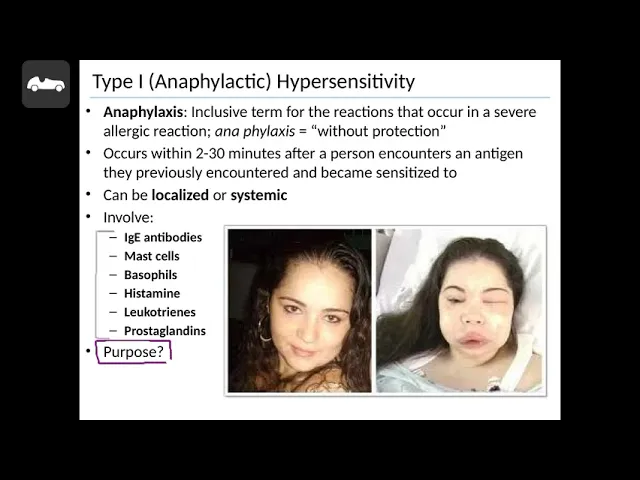
not real long distance but uh just kind of in the vicinity um in this picture here there's A a p an example of a woman who has uh apparently had um some reaction here maybe it's a beasting on the face or or some exposure to an antigen and she's having a pretty severe anaphylactic reaction to it and uh one thing that's obvious is that her face is very swollen and so um you know with considering our our list here of things involved perhaps we can make some guesses as to why swelling might be one of
the Symptoms so the last thing I want to mention here is uh actually a question you know is there a purpose to a type 1 hypers sensitivity reaction or is it just all a giant mistake and that's a really good question that we don't really know the answer to however some ideas have been proposed that have some support for example um if you think about some of the symptoms involved with a type 1 hypers Sensitivity reaction vomiting diarrhea coughing sneezing tears these are all so-called expulsion reactions trying to get whatever it is out of the
body you know get it out get it out um these explosion reactions are actually very effective against parasites for example like parasitic worms and so it's been proposed that these anaphylactic reactions sort of evolved in order To uh Be an Effective defense against parasites and in countries and areas of the world where parasitic infections are common uh type one hypers sensitivity reactions just really don't exist but in uh developed countries more affluent countries and and areas of the world these hypers sensitivities are on the rise and they are in in epidemic proportions and so the
idea is that this Set of reactions has kind of evolved and gone arai in the absence of these pathogens that we have evolved with as well one last thing I want to mention that I realized I forgot is uh when you think of the term allergy this this is the hypers sensitivity that you're referring to so we can just refer to these as allergic reactions as well it's almost always referring to a type one hypers Sensitivity so let's go through the step by step of how this actually happens now this figure is missing a couple
steps that uh I'm going to fill in and we'll expect you to know as well so there are really two major steps we have the sensitization that occurs and then we have upon a subsequent exposure this degranulation that leads to the symptoms so sensitization occurs during the first exposure to an antigen now in Reality sometimes it takes multiple exposures to be fully sensitized but for our purposes we're going to stick with first exposure fully sensitized now future exposures at after one has been sensitized can lead to the degranulation and all of the symptoms that one
experiences all right let's go through step by step now in the beginning here we see an allergen is um you know enters the body maybe it's inhaled for Example and our immune system makes IG now there are some steps missing here so IG is not just magically produced automatically right remember this is a an allergen that's our first exposure to it and um in order to generate IG first of all what makes IG plasma cells or B cells basically how do we activate B cells so going back to all that stuff well the allergen first
binds the B Cell so let me make a B cell roll quick even though it's going to disappear on me B cell receptor allergen binds to it and all of this is internalized right so the receptor and the allergen are internalized and the B cell uh breaks it down and then presents it to a T Cell so remember that A B cell is an antigen presenting cell it engulfs the antigen breaks it down and presents it to a helper T cell specifically th2 so Th2 communicates with the B cell through cyto kindes and tells it
to proceed and to make IG so the helper T cell is a little bit mistaken here in promoting this reaction against something that's harmless so the the activated B cell is going to differentiate you know make clones differentiate into plasma cells and make IG so now let's follow IG which this figure shows pretty well This IG is going to come down and in this example bind to a mass cell now this could also be a basofil if it was in the blood either way so mass cells are in the tissues basophils are in the blood
but they basically have the same stuff and do the same thing notice that the FC stem right here the base is what's binding to the surface of the cell and that leaves the variable regions exposed and poking out So that means that the FC stem is not hanging out in space and uh available to activate compliment so there is no compliment activation occurring here IG cannot activate complement so a take-home message here that's distinctive about type 1 hypers sensitivities is that complement is not activated all right once IG binds to a mass cell like this
the person has been sensitized to that allergen right so Step one complete now it could be weeks it could be months it could be years later and then another exposure to that allergen will lead to our degranulation okay so down here at the bottom we see a sensitized cell that is encountering an allergen when the allergen again this has already been previously encountered we have sensitized MTH cells and uh those receptors those IG receptors bind to the Allergen and cross link which means they get they just sort of come together like this and um that's
called cross linking this cell has been activated and is going to degranulate or just release these chemicals called chemical mediat just because these chemicals are going to mediate a reaction or cause a reaction in the body so these chemical mediators are released through exocytosis and this is called Degranulation the reason why it's called degranulation is because these chemical mediators are held inside of the cells in these membrane vesicles called granules speaking of a mass cell let's go ahead and and kind of uh make it official and go over the details of what a mass cell
is and compare it to a basofil so as I mentioned in the previous slide mass cells and basophils are basically the same thing they look The same they do pretty much the same thing it's just their location is different so mass cells are found in the tissues especially mucous membranes especially close to blood vessels so that's a clue that they're going to affect blood flow affect blood vessels somehow um basophils are this the cousins of the mass cell and they are in the blood and we've previously talked about what basophils do and what they look
like so That's why I'm showing you a picture of a mass cell here because you've seen basil fills before on the left we have the surface electron microscope image and on the right we have the transmission where you can see inside the cell I want you to notice the purple spheres I guess my arrow is purple it's kind of hard to see it but all these purple spheres in here these are granules basophil if this was a basophil that's Why we call it a granulite okay because of those granules and those granules are just membrane
vesicles that contain chemical mediators specifically preformed chemical mediators because they're they're already made they've already been formed and they're just waiting to be released and the most important one is histamine it's the most abundant and the most important we've talked about histamine Before so you have an idea of what it does for example Vaso dilation we already know that increased permeability we already know that this is going to lead to that swelling that we saw in that uh woman in the hospital bed a couple slides back also a TR lucco sites to the area so
chemotaxis and causes smooth muscle contraction in some smooth muscle like respiratory Airways but vascular smooth muscle does the opposite it relaxes which is why vas of dilation is possible okay after degranulation occurs of pre-formed mediators like histamine then a while later maybe hours later there is a so-called late phase uh reaction or response this late phase reaction uh and this Includes the synthesis of mediators chemical mediators on the spot so after immediate degranulation gluc trines and prostaglandins those those local hormones I talked about before they are synthesized fresh and they are released it's going to
take some time to do this which is why it's called the late phase response and if you look at the list of what these do it's basically the same thing as Histamine so the point here is that the gluc triin and pranin are going to intensify the effects of histamine and PR the effects of histamine okay so let's put all this together now at the very top of this flowchart we see IG cross linking on an immune cell so let's pause there that means that this person has already been sensitized okay so they went through
all the steps to become Sensitized now would be a good time to go back and make sure that you remember what those steps are once this person has been sensitized then um and if they encounter the allergen again then IGG is crosslin which leads to degranulation right so that immediate degranulation is kind of shown here on the left with the Yellow Boxes we have this immediate degranulation which results releases preform Mediators especially histamine which has those lists of effects smooth muscle contraction chemotaxis vascular permeability and so on phaso dilation uh as well as another one
called serotonin which basically just kind of does the same thing and this can lead to a variety of symptoms depending on where this anaphylactic reaction is occurring so for example if this allergen was Inhaled we're going to see symptoms in the Airways like um uh excess mucus production uh some sneezing and uh difficulty breathing right thanks to those chemical mediators histamine and serotonin if it's the GI tract or elsewhere going to have different symptoms now several hours later the so-called late phase response occurs and this is where mediators are formed fresh and released these are
the loop ucot Trines and prostaglandins and they basically have the same effects as histamine and serotonin did so again prolonging and intensifying the effects so now that we understand the basic mechanics of a type one hypers sensitivity reaction let's compare localized versus systemic anap axis so localize is kind of what we've been seeing and referring to the most already in this presentation uh that's where the reaction is confined to one Area and so if it's you know upper respiratory tract or lower respiratory tract or GI tract now that's an example of a localized reaction occurring
where the the symptoms are um are are only occurring in that that spot so the symptoms of course are going to vary as I was mentioning on the previous slide so if it's upper respiratory tract you know these are very very common allergens right here and the symptoms are familiar to everybody I'm sure if It's lower respiratory tract it might be more difficulty breathing if it's G tract it might be uh vomiting and diarrhea one thing that's interesting about true food allergies is that often the skin will have some sort of expression like hives as
you see in this picture here all right so localized anaphylaxis is usually just kind of annoying but not lifethreatening and that's going to be quite a bit different when we talk about Systemic anaphylaxis next so systemic anaphylaxis is where the antigen has entered the bloodstream and if it's entered the bloodstream then it's able to be carried all throughout the body and lead to a widespread anaphylactic reaction so usually this occurs to an an occurs due to an antigen that has been injected in some way so for example an insect like a bee is Sting or
uh you know food allergy of Some sort that's been absorbed through the GI tract and enters the blood upon absorption so imagine these effect we've been talking about that the histamine has like vasod dilation or increased permeability happening body wide now not just one area causing swelling and increased blood flow you know not just in one area but now body wide so with vasod dilation being systemic that's going to lead to a significant drop in Blood pressure and with an increase in permeability that means that we lose blood volume to the ti tissues which drops
blood pressure even more so if blood pressure drops low enough this can cause tissue death organ failure and basically the tissue's needs are not met that's referred to as shock this type of shock is anaphylactic shock so in the past we've talked about septic shock and toxic shock and now here's a Third type anaphylactic shock now this can be lethal Within minutes one of the things I don't have listed here too is not just the blood pressure issue but also breathing problems with the Airways being so tight uh it's very very difficult to breathe so
the the Lifesaver here is is the treatment uh it's it's basically an self injection of epinephrine or adrenaline uh this is a you know hormone That's naturally produced in the body and it basically does exactly the opposite of what hisam does so histamine leads leads to Vaso dilation and spasming of the Airways whereas epinephrine leads to vasil constriction bringing blood pressure back up and it opens the Airways making it easier to breathe so example of uh this self injection with epinephrine is called an EpiPen so let's kind of come back to this idea Of if
there's a purpose to this and what's causing this you know why is this happening and why is it on the rise especially in developed countries I want to introduce to you this idea of immune tolerance and this Theory called the hygiene hypothesis so there's um you know there's quite a bit of support for this so-called hygiene hypothesis and it can be summarized by this figure and basically by the first sentence um This is education of the immune system by pathogens or not even pathogens just microbes in general so for example on the left without getting
into the details the left side of this figure is a high hygiene low pathogen environment so being in growing up in this uh area uh notice that a lot of th1 th2 is produced um which leads to the promotion of inflammation and immune reactions Even if it's inappropriate um however in a lwh hygiene High pathogen environment you know growing up in that environment there is more production of regulatory te- cells which suppress the inflammatory reaction from various immune cells and so that promotes what's called tolerance now that tolerance is just the ability to not react
to a particular antigen like Al um like pollen for Example something that's harmless like pollen maybe it's part of ourselves maybe maybe it's a self antigen you know so the ability to tolerate those things as promoted by regulatory te- cells and Regulatory t- cell number and activity is increased uh growing up in environments that are I guess dirty um for lack of a better term um and so this kind of helps explain what I was referring to before With uh underdeveloped countries don't have these allergy problems of course they have lots of other infection issues
but allergies certainly are not is not one of those issues uh whereas in countries like the United States or other affluent areas um everything is sterile and everyone's careful and uh allergies are are skyrocketing so as far as diagnosis of type 1 hypers sensitivity reactions There are a couple very common tests uh for example uh we can have a little bit of different allergens various allergens scraped underneath the superficial layers of the skin and look for a a reaction a visible reaction like a a raised welt or you know red area red inflamed area and
measure its diameter and so on and by measuring the size of these um the these skin Expressions we can Determine uh if the person is allergic to something or not another common one this time is involving blood so taking blood serum and looking for IG antibodies in the blood serum against particular uh antigens and uh that's a test called Eliza and we'll talk more about Eliza in a future chapter as far as treatments go I was referring to an EpiPen as a treatment at least initially for um anaphylactic shock but some other Treatments include antihistamines
which I'm sure you have had experience with right this is a a drug that binds and blocks histamine receptors on body cells so most body cells have histamine receptors and respond to histamine in some way and an anti-histamine temporary block temporarily blocks those receptor sites so that those cells cannot not react to histamine um another common treatment that's more effective at kind Of trying to get to the root of the problem at least somewhat is uh referred to as immunotherapy so for example allergy shots of course it doesn't just have to be a shot uh
it can come in many forms but uh very very commonly a shot where very small concentrations of an allergen are introduced into the body and slowly increased in concentration over time and the idea is to sort of train the immune system is being used to seeing it um and and by introducing it In minute amounts sort of train the immune system to react differently so specifically making IG G making some IG which circulates through the blood so should you come in contact with the true allergen in your environment you have IG to bind it and
block it so that IG never has a chance to cross link and degranulate leading to the symptoms immunotherapy has been very very effective for for many specific allergies now I'm going to talk about Type two hypers sensitivity reactions and right off the bat I want to make some distinctions between this and type one so with type one we think of the those as um common allergies for example IG was involved uh we had a variety of chemical mediators like histamine involved and there was no complement activation with type two which is also referred to as
cytotoxic which is a big clue to us here so cyto means cell toxic Means bad for the cell so this is leading to cell death cytotoxic hypers sensitivity um this type of hypers sensitivity is where the immune system targets antigens bound to the surface of whole cells IG G IGM and complement are all involved and that is very different than what we saw with type one so remember from a previous chapter that IG and IGM Can both activate complement so let's talk about some examples uh let's actually start with the last one just because that's
what this figure shows thrombocytopenic perpa a thrombos site is a platelet and Pia means um a Loc count so a low platelet count and purpura is a symptom that is shown here on the skin so let's start with the mechanisms here so we have a Platelet and there is some sort of drug that's been taken some drug and by this by itself the drug is a hapon so recall that a hapon does not initiate an immune response by itself but but when it sticks to something it might so in this case it does so the
the drug um binds to the surface of a plet and the combination induces an immune response specifically a type two hypers Sensitivity so the combination of this antigen bound to the surface of this platelet initiates an immune response and we have IGG in this picture um targeting the the plate plet with these antigens and activating complement and uh as you know from previous chapter complement activation results in several outcomes and one of those is Lis of the cell through the Formation of these pores called Mac complexes so to sort of zoom out and look at
the big picture we had an antigen on the surface of a Hol of a well it's not technically a cell but it's a platelet in this case um an antigen bound to the surface of a platelet we have a different antibody involved this time IGG and it results in Lis okay so it's cytotoxic um because platelets are being Lost thrombocytopenia results low platelet count because platelets are involved in clotting and the clotting resources are being lost that leads to these little bleeds under the skin which is this symptom called Pera couple other examples include transfusion
Reactions where um a person with for example a person with type a red blood cells gives those red blood cells to a person with type B Blood the person with type B blood is going to react to the presence of the a antigen on the transfused cells so antibodies are going to Target those red blood cells and result in their license so that's an example of a type two hypers sensitivity reaction hemolytic disease of the newborn is very similar to a transfusion reaction except uh it's it's occurring through the placenta uh and it's not a
newborn Actually it's before birth so the fetus is in the mom's womb fetus is is in mom and maternal IGG cross the placenta Target baby red blood cells which are as forign and uh results in their Lis drug induced hemolytic anemia is very very similar to what we see in the figure here with platelets except imagine instead of a platelet it was a red blood cell so if that was a red blood cell being liced that's an example of hemolytic anemia that was induced by A drug metabolite binding through its surface activating compliment resulting in
Lis so again take- home messages here antigens on the surface of cells being targeted IGG IGM and complement result in Lis here's a figure that I think better illustrates the transfusion reaction I was trying to describe on the previous slide so here we have um a Particular antigen that for example a drug or uh a blood type that's not appropriate for them to receive and they're going to make IG against it IG binds to the surface of that cell again this um these little teal half circles on the surface could be uh a drug or
maybe it's the A or B antigen uh in a transfusion reaction so the antibodies bind to the surface of the red blood cell in this Example and that leads to complement mediated Lis now as you see there's also another possible path with the FC stem hanging out it turns out that natural killer cells can go up and see that that cell has been tagged for Destruction and go ahead and and destroy it with perence and granzymes leading to its Lis either way we have cytolysis or Lis of the cell and again it was due to
an a Particular antigen on the surface of a whole cell let's talk about type three hypers sensitivity reactions now uh these are also referred to as immune complex hypers sensitivities because that's exactly what's going to form and cause this reaction so in contrast to type two which had antigens on the surface of cells being targeted here we have antigens that are just by themselves they are small soluble antigens they're Not stuck to a whole cell and our immune system is able to recognize them make antibodies against them and form these little immune complexes where you
know we have these little blobs these little clusters and these little clusters are too small to undergo fos to initiate a phagocytosis which is sort of the normal course of events um instead they can sort of embed into uh so so normally this would happen right Phagocytosis but instead if the right ratio of antigen and body is present then these little complexes embed in the tissues activate complement and initiate inflammation and inflammation is what does all the damage okay so again this is where these immune complexes embed themselves in the tissues and initiate inflammation so
it's primarily IGG that is responsible in this type of reaction and we have several examples so rheumatoid arthritis is where immune Complexes get deposited in the joints and initiate inflammation which damages the cartilage and the sovial membrane ends up permanently deforming the joints not to mention the pain glarin aritis is where this occurs when the immune complexes are deposited in the the filtering portions of the kidneys so from anatomy in physiology we learned that the Glarus is a little ball of capillaries that where the filtration of the blood Is occurring and the nephron is another
portion of the kidney that contains the Glarus so this is referring to inflammation of those structures which ultimately leads to the inability of the kidney to filter blood normally so in other words it can lead to kidney failure lupus is um a type three reaction where immune complexes form Um in the tissues but it can really be almost anywhere in the body and result in uh a wide variety of symptoms lupus is also considered an autoimmune disease and so we're going to revisit it in a little bit these last two reactions here talk about on
the next slide the last two hypers sensitivity type three hypers sensitivity reactions I wanted to to mention give them a little More detail here is the arthus reaction and serum sickness the arthus reaction is shown in this picture here um this is basically a hypers sensitivity reaction to a vaccine uh it's some sort of antigen that's been in injected and so this is relatively uncommon but even uh some relatively common vaccines cause it so the most common vaccines that cause it are the toxoid vaccines for diptheria and tetanus and these would be in the DAP
vaccines and the DTaP boosters and so immune so the person first of all the person has to have been exposed to uh those antigens in the past so they already have memory cells and antibodies against Deion tetanus and then when they receive the injection perhaps it's a booster shot then these immune complexes form deposit in the tissues and initiate this uh this reaction in the skin which is quite painful and last for several Days uh serum sickness is a little bit different this is a Type 3 reaction to antibodies received from from an animal source
so serum sickness received from an animal Source uh this might be in response to you know a bite a wound um basically receiving passive immunity uh in the hospital setting and uh if your immune system targets the antibodies that are being injected into you this so-called serum sickness can Result um and a while wide variety of symptoms can occur um kind of uncharacteristic of type 1 type two and type three hyers sensitivities which usually have a very fast onset serum sickness has kind of a slow onset it takes several days before any symptoms are observed
but again this is the exception the last hypers sensitivity reaction we're going to be talking about is a type four also called delayed Hypers sensitivity um the reason why this is called delayed is because it takes a couple days before the symptoms are observed compared to types 1 two and three which usually have a very fast onset within minutes or hours the reason why it takes days before any symptoms are observed is because this response is dominated by te- cells specifically helper T cells and even if There have there has been previous exposure it still
takes quite a bit of time so there are two major categories two major examples of these types of hypers sensitivity reactions the first category are referred to as infection allergies and this can be a really a viable defense against an intracellular pathogen but even though it's a a viable defense against the pathogen we still get this kind of overreaction this hypers sensitivity Expression um on the skin here and the best example of this in a clinical setting is the tuberculum test or the TB test so almost anybody that goes into the healthcare field is at
some point going to have a TB test to see if they have been infected with tuberculosis microbacterium tuberculosis is uh a pesky a pesky little um dis uh organism that can infect someone and they might not ever know it but be unknowingly Spreading it so that's why it's important to be tested and when someone is tested they get these Pro this these TB proteins injected into their skin and they have to come back a few days later to have have their results read which basically means looking for a reaction of some sort so this reaction
right here called an induration um you know it's going to be a particular size as it can be measured In millimeters and that's going to indicate if it's a positive or A negative U contact dermatitis is another example of a type four delayed hypers sensitivity reaction and a good example of that is this little organic molecule found in poison ivy in the oils of poison ivy we have this little organic molecule that um when in contact with the skin combines with skin proteins and the combination initiates a Type four hypers sensitivity reaction now of course
this um this takes a couple days so it's not going to be an immediate reaction and it's not just poison ivy that might cause this it could be reactions to latex it could be you know cause Cosmetics um really uh variety of detergents and so on bunch of different examples so the take-home message here is that in a type Four hypers sensitivity reaction the onset is delayed because it takes these helper T cells some time uh to react here is a table that sort sort of summarizes everything we have just talked about uh we have
the four different types of hypers sensitivities and their alternate names we have the cells involved whe whether it's B cells making antibodies or T cells um the different types of Antibodies are listed IG for type one G IG and IGM for type two IG G for type three and nun for type four for uh we also look at other cells that are involved the mediators that are involved how much time it takes to see the onset and a bunch of examples which we uh we hit on all of those now we're going to sort of
focus exclusively on what happens when the immune system not only overreacts but Reacts against something that is part of us something that is part of self and this is referred to as an autoimmune disorder so the first question really is how does this come about you know how can the immune system make such a mistake as to Target self we have to remember that the immune system is always walking this fine line between being sensitive enough to Target and Destroy as many pathogens as possible While not being overly sensitive and accidentally Target our own antigens
so it's very easy for it to go one way or the other a little bit and make a mistake so in this case um self tolerance has been lost you know somehow self- tolerance has been lost and in order to understand how that happens let's first talk about how self tolerance is generated in the first place so there are three major Components to self- tolerance clonal deletion as we'll see on the the figure on the next slide as well uh this refers to the screening process that occurs in the bone marrow and thymus gland when
B cells and t- cells are developing in the body and so those B cells and T cells are challenged against self antigens and if they do react the B cells and t- cells are eliminated right we do not want any self-reactive lymphocytes so they are eliminated in This screening process if they make it through that then they're circulating in the body they still might accidentally react to self at some course and you know some point in their lives and if that happens then there's this process referred to as clonal energy which um eliminates the uh
the lymy that's self-reactive so even if a lymy makes it through this really strict screening process the clonal deletion process we Still have another backup mechanism to take it out if it's self-reactive the third one here is pretty important it's been popping up several times this is uh the presence of regulatory te- cells so the presence of regulatory te- cells uh are going to dampen or mute an immune response and promotes tolerance so you can imagine if something goes wrong with clonal Deletion or if something goes wrong here with clonal energy and a self-reactive cell
is allowed to go through or you know t-reg activity is low any of these things or any combination of those things can contribute to a loss of self- Tolerance and the promotion of an autoimmune disorder um all right so we can lose self- tolerance and maybe there are some just direct causes as well so rather than losing something Maybe it's directly correlated to you know to one of these causes so here are a couple another couple possibilities um perhaps the immune system has access to an area that it normally is off limit from like the
brain like the testes um you know normally there's the blood brain barrier or blood test barrier which keeps the immune system out but during some situations maybe during An infection or during inflammation uh the immune system has access it might see those cells and those antigens and see them as foreign and initiate an autoimmune response alter alternatively some autoimmune disorders are strongly correlated with microbial infections and uh this idea is referred to as antigenic mimicry where a microbial antigen looks very similar to a self Antigen and so if our immune system generates a response to
a microbial antigen and that antigen looks a lot like our antigens well those resources might be misdirected to our ourselves initiating an autoimmune response all right so I know this is a lot it's going to be seen more visually on the next slide um but just trying to make sure you have an explanation of all the details now now for the bad news not that there Was any good news on this slide but for the worst news how about that there is no cure at this point we don't know how to cure this at at
its root so instead only the symptoms can be treated which usually involves suppression of the immune system obviously that's going to come with a host of other possible problems like opportunistic infections so here is a figure that Summarizes everything that I just said on the previous slide just to kind of reiterate it um an autoimmune disease is the loss of Tolerance how do we lose that well first of all how do we gain it we usually have this process called clonal deletion where self-reactive cells are screened during development and if they react to self they
self-destruct apoptosis clonal energy where cells get past the screening Process and uh if they self- react then they self-destruct t-reg promotes tolerance by suppressing an immune response if any of these goes wrong that's going to promote an autoimmune disease um we can also have some more direct causes maybe the immune system has access to areas of the body that it normally doesn't and it's going to see things as foreign so that can that can promote an Autoimmune response and then finally Maybe maybe an infection has you know a pathogen has antigens that look very similar
to our antigens and our immune system will mistakenly crossreact it's called antigenic mimicry all right so now we're going to get into some specific examples so our first example is Graves disease fairly common autoimmune disorder and this can be summarized with this figure so Normally the hypothalamus which is right here which is part of the brain stimulates the pituitary gland which is an endocrine gland to release a hormone called thyroid stimulating hormone thyroid stimulating hormone does what its name implies it stimulates the thyroid to release thyroid hormones okay so thyroid stimulating hormone stimulates the thyroid
to make th th can go off and impact target cells and most Cells in the body uh have receptors for thyroid hormone one of the things that happens um is that the metabolism of that cell is going to be kind of cranked up so in Graves disease our our immune system makes antibodies Against The receptors um for TSH so let me try to draw something here if this is a thyroid cell and it has a receptor for TSH let's call this TSH right here binds that Receptor and that causes this cell to make th now
I want you to imagine so that's normal now I want you to imagine this cell with its receptor but instead of TSH binding an antibody binds and instead of causing destruction of that cell this antibody actually activates the cell and so it makes th even when it shouldn't so even when TSH is not around this cell is mistakenly making th And so other words too much thyroid hormone is going to be produced and this is called hyper thyroidism so hyperthyroidism so metabolism is going to be increased weight loss is common feeling hot uh increased heart
rate is very common as well and a couple of more severe symptoms exal is shown right here which is the bulging of eyes in the orbit um because kind of peculiar but uh the connective tissue in the orbit in this Disease grows gets bigger and causes the eyes to bulge out that's called exal and then goer refers to this enlarged thyroid gland so pretty severe case here but uh with this over stimulation the thyroid gland hypertrophies it's called a goiter the next disease here here is kind of similar in mechanism to Graves so this one's
called myasthenia gravis and it has to do with chemistry at the neuromuscular Junction so to review a Little bit of anatomy here this is a motor neuron and this is a skeletal muscle cell and what normally happens is the motor neuron which is a nerve cell releases acetylcholine which is neurotransmitter um to the muscle cell which initiates contraction right so these acetool receptors bind acetycholine and that initiates contraction of the cell in mythia gravis I want you to notice that we have antibodies so Auto antibodies all that Means is antibodies that Target self Auto antibodies
bind and block acetylcholine receptors and also cause their reduction in number as some of them go away so this means it's going to be a lot harder or even impossible to stimulate this muscle cell so no matter how much the motor neuron wants wants to send a signal it doesn't matter how much acetycholine is there really because those receptors are blocked and so the Muscle is going to be weakened or fatigued very easily or um uh be completely paralyzed so one of the first symptoms to be observed of course any muscle can be affected but
uh kind of peculiar PEC peculiar but the one of the first targets appears to be the uh the eyelids so this is called tosis where the eyelids are kind of Droopy Myasthenia gravas um one last thing I want to Mention about this disease is that it kind of resembles a hypers sensitivity reaction notice what's happening we have antibodies targeting antigens on the surface surf of whole cells that sounds just like a type 2 cytotoxic hypersensitivity so this has the same basic mechanism the only major difference is that the muscle cell doesn't undergo Lis um by
the way Graves disease also has that same basic mechanism of course This the thyroid cell is not destroyed but antigens on the surface of a whole cell is targeted so it's similar to type two lupus is next and um the unfortunate thing here is that not much is understood about it but I will mention what is what is understood so when I say lupus that's kind of short for systemic lupus erythematosis and um in this particular autoimmune disorder which which is almost always Seen in women by the way Auto antibodies form against proteins that are
normally hidden from the immune system but in a lot of people with lupus they have um they are they have this predisposition predisposition for cells that do not undergo apoptosis correctly and therefore components of the cell that are normally hidden from The immune system are suddenly exposed and so then after that exposure antibodies complex with the antigens and form these immune complexes that deposit in body tissues and initiate inflammation and inflammation causes all of those symptoms so it might be just an expression on the skin um but it could be affecting the bones kidneys heart
lungs pretty much any tissue in the Body and that's part of the problem in diagnosis is that the symptoms are so varied they come and go sometimes years between or months between symptoms it's just really really difficult to diagnose uh here's one symptom that's actually somewhat characteristic and that's this so-called butterfly rash that occurs on the face sometimes but uh most of the time it's not going to be quite as straightforward so when I say immune Complexes I want you to think of which hypers sensitivity me mechanism that makes you think of so immune complexes
depositing and body tissues that's a type three hypers sensitivity in fact lupus was mentioned as an example of one of those hypers sensitivity reactions so it kind of fits in both categories here type 3 hypers sensitivity and autoimmune another autoimmune disorder this one has a Type 3 hypers sensitivity mechanism as well and it was also listed Under type 3 hypers sensitivity it's called rheumatoid rheumatoid arthritis or just ra and this is where immune complexes called rheumatoid factors at least most ra patients have these so-called rheumatoid factors where we make Auto antibodies against other antibodies so
we have immune complexes of of antibodies that deposit in joints activate complement and initiate inflammation and over Time uh this leads to damage of the joint permanent deformation and this is kind of a severe case but um an advanced case of RA might look like this in the hands where it's most obvious where the fingers are obviously deformed and the wrist joints are deformed with this sort of olar deviation and the the crunched up fingers of course this would also be not only difficult to to move these joints would not only be difficult to move
but painful as Well so with an immune complex this is a type three hypers sensitivity mechanism so I'll describe to you what's happening with multiple sclerosis here and I want you to think of which hypers sensitivity that sounds like so multiple sclerosis or just Ms is where we have t- cells becoming activated and actually attacking the cells that make the myin sheath of neurons so from anatomy and physiology We learn that neurons send electrical signals and sometimes they have this thing called a milein sheath it's a coding that acts like insulation and makes those electrical
signals go faster so with Ms the t- cells are targeting the cells that make myelin and destroying them so if we look at a section of the brain you see white areas white matter and you see this outer area where it's gray and some other gray matter elsewhere as Well wherever it's white it's white because of myelin and in someone with MS and that myelin is being destroyed they get these dark patches where the the white has gone away right they turn gray these are called sclerosis so with multiple sclerosis that's how this disease gets
its name and here's an on the right where you can see these scleroses appearing as well so depending on where these appear in the brain there can be a wide variety Of symptoms some very very mild maybe none at all all the way to complete complete paralysis and inability to move so the other thing that happens here is that these sclerosis come and go and they move and they get bigger and they get smaller just like any of of these autoimmune diseases there are bad periods called flares and then there are good periods called remission
where symptoms are not that Bad as far as the cause of multiple sclerosis just like any autoimmune disorder the cause is unknown however um Ms has has U been connected to genetic predisposition and uh also been connected to certain infections so so it's most likely that many factors come into play here genetic environmental infectious um to contribute to this disease now to go back to my original question to you I wanted you to think About what type of hypers sensitivity mechanism this is similar to and because te- cells are involved and they're targeting self um
this would be a type four hypers sensitivity mechanism that uh this disease reflects another autoimmune disorder with a type four hypers sensitivity mechanism is called Hashimoto disease and I wanted to bring this one up because it's it's kind of the um Opposite of graves so Graves disease was where uh here we have it on the right side Graves disease is where the thyroid cells down here have the TSH receptors Bound by Auto antibodies and that causes them to make TH or hyperthyroidism right so Graves we get hyper thyroidism with Hashimoto we have te- cells leading
to the Destruction of thyroid cells so we actually have destruction not turning them on but instead destroying them and therefore this is going to lead to hypo thyroidism where not enough TH is made and uh with hypothyroidism you know one might be cold weight gain slow metabolism Etc my last autoimmune disorder example for you is Diabetes melodus Type 1 so There are two types of diabetes melodus and this is very specifically type one type two is not an autoimmune disorder this is where t- cells destroy cells in the pancreas called beta cells beta cells make
insulin and if beta cells are destroyed then insulin levels will either be low or non-existent let's talk about what insulin does for a second by looking at this figure over here so first of all we Have the pancreas right here it's involved in digestion but it also is involved with the endocrine system and releasing hormones and so there are these little clusters of Endocrine cells in the pancreas and uh beta cells are part of those cluster so beta cells detect blood glucose levels blood sugar and when blood sugar goes up like for example after a
Meal then insulin is released so what does insulin do let's look over here insulin binds insulin receptors which all body cells have uh or most anyway have insulin receptors and these insulin receptors lead to the Mach expression of glucose transport proteins so we temp these cells temporarily stick this glucose transport proteins in their cell membrane and allow glucose that was out here in the Blood and Tissue fluid to go Into the cell now this does two things it lowers blood glucose and it feeds the cell now I want you to imagine where we don't have
insulin you don't have insulin then none of this can happen we don't have the glucose transport proteins and the glucose stays out here stays in the blood stays in the tissues so therefore hyperglycemia or high blood sugar is one of the symptoms Of Diabetes melodus Type 1 so let's look at some of these other symptoms here all right um diabetes actually the word diabetes refers to this symptom right here increased urination so this is where we're talking about the kidneys so I'm going to draw a kidney tual which is going to slowly disappear from me
here but this is where urine you know blood is filtered and uh eventually all of this turns into Urine but these tubes have proteins that are able to absorb stuff that we want to keep and not pee out so for example glucose which is filtered from the blood and the kidney glucose usually is completely reabsorbed and 100 of it% of it stays in the body in the blood and none of it enters the urine that's normal but in someone with type 1 diabetes there is so much blood glucose that those proteins can't keep Up and
yeah some of it's reabsorbed but there's so much that it ends up in the urine so we get glucose in the urine and that glucose in these tubule cells here I am drawing it again all this glucose in the urine that's passing through these tubes makes water want to stay with it as well through osmosis so water goes into those tubes and stays there and so that that's why we get increased volume increased Urination okay if you're peeing so much that's why we have increased thirst now these last two have to do with the cells
not being fed so if the glucose transport protein is not present and glucose is not allowed to enter the cell that cell is is going to ask the brain to eat it's going to tell the brain through chemical signals it's going to say you know I'm hungry please eat we need glucose and So Hunger is a is a common symptom as Well um even eating more though won't help if you don't have insulin and so how is this cell ever going to get energy well it it switches over to metabolizing fats metabolizing fatty acids and
a metabolic Bri uh byproduct of fat digestion are these so-called ketones or Ketone bodies and so they are going to end up in the urine and that's yet another symptom of Diabetes Type 1 so again we have te- cells involved This is a type four hypersensitivity mechanism behind this autoimmune disorder all right so now that we have a good foundation I just have a couple loose ends to tie up here and this first one is uh immune reactions that are related to HLA HLA is basically the same as MHC so first of all let's remember
what MHC is Major hysto compatibility Pro uh complex this was the little Holder that body cells use to hold and present antigen it's exactly the same protein with a different name so human Lucy antigen is just an alternate name and it's commonly used by the tissue typing community so understanding what HLA we have on our cells is important for a couple reasons first of all just by knowing which hlas we have is going to tell us if we are sort of predisposed to Certain diseases there is a connection a correlation it's also going to be
very important for organ transplantation it's really really important to try to match the recipient and the donor and their HLA proteins because that's going to increase the chance of success that the organ will not be rejected by the recipient so this figure is showing the most common way to tissue type a cell or or a Person so here are two different cells with two different HLA proteins and we want to know which one has the HLA that we are interested in finding so we are going to be adding an anti-hla antibody against the HLA protein
that we are interested in so we know what we're looking for to this experiment we're also going to be adding compliment and a D so this anti-hla antibody if the cell is um has the correct hlaa the antibody Will bind that HLA activate compliment and complement will begin to lice the cell right through Mac complexes but early on in this stage that those holes that that um are poked in this cell is going to let this die inside and cause it to look like a stained cell and so the fact that that cell is is
stained with the Dy will tell us that we found the cell with HLA that we are interested in if the cell does not have a match for our antibody then Uh the antibody will not bind complement will not be activated and the D will not be able to get into the cell as an alternative to this type of tissue typing we can also just do genetic sequencing and this kind of leads me to my last disease in this immune disorder chapter and this is where there is a rejection in this case um for bone marrow
transplantation it's called graft versus host disease and this is where a Recipient is reing receiving a bone marrow donation a bone marrow transplant and the bone marrow the cells in the bone marrow the immune cells in the bone marrow launch an immune response against the host so rather than the host rejecting the transplant or The graft is how it's worded here The graft or transplant rejects the host and that's possible because there Are immune cells in the transplanted bone marrow and the host the recipient their immune system is going to be suppressed on purpose through
medication in order to hopefully um lessen the chances for rejection of the marrow transplant so in order to increase our odds of success the patient's going to have a suppressed immune system but that's also Going to make it more likely for the graph versus host disease to occur and this can be acute or chronic and a lot of patients even if they have success initially with certain drugs will'll have this disease in a chronic form um and the only real treatment is just to suppress this continue to suppress the immune system


![Upbeat Lofi - Deep Focus & Energy for Work [R&B, Neo Soul, Lofi Hiphop]](https://img.youtube.com/vi/THh4fT0O7IY/maxresdefault.jpg)