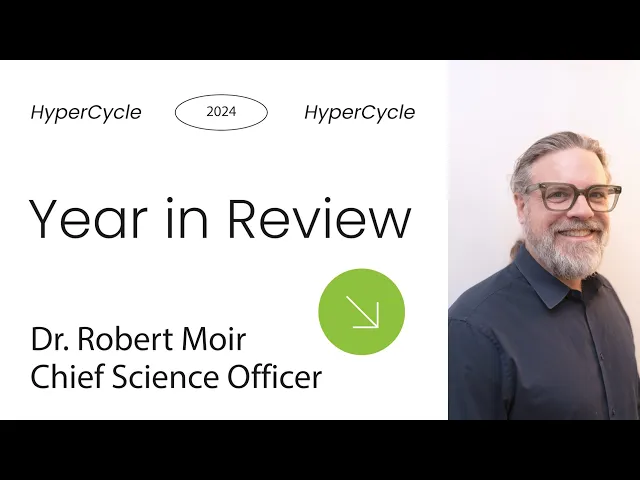
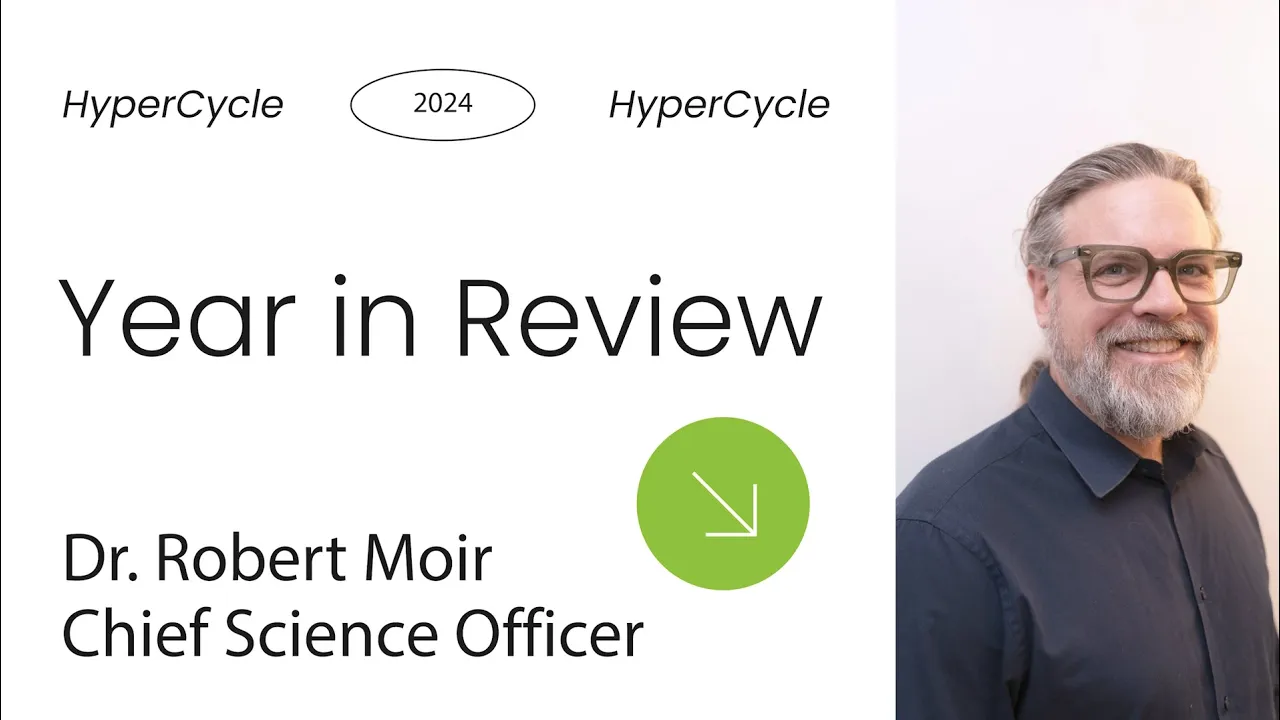
Hello Hypercycle Community! Welcome to another installment of the Hypercycle Year in Review. This series is all about reflecting on the incredible journey we've had in 2024 and looking ahead to the exciting opportunities in 2025.
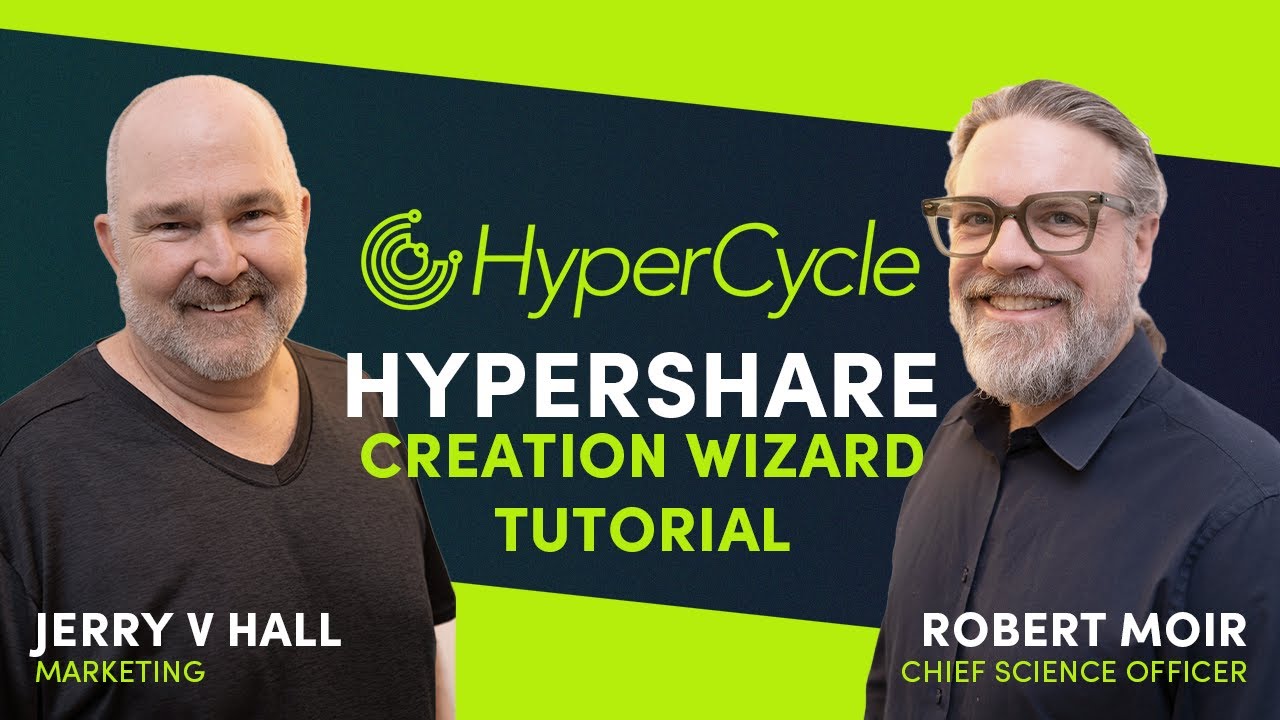
Today we're diving into Hypercycle's journey, its incredible milestones, the hurdles we've overcome, and what lies ahead. Let's get started! Allow me to introduce Robert Moyer, Hypercycle Chief Scientist.
How are you, Robert? I'm good, thanks, Jerry! Great to be here with you.
Oh man, it is always a joy to hang with you, my friend. So, Robert, I've got these bullet points I wanted to kind of, like, pose them to you in the form of questions and have you respond. How does that sound?
Sure! You can give it a go. All right!
So, as Hypercycle is on this journey of building strategic messaging, I'd like to have you fill me in on what that means and where you see that going for us. I think, really, what we want to do is emphasize the technology that we're building and what we have available and accessible to people, and to build an understanding of how people can use the technology and what they can do with it. So, as opposed to giving a sort of laying out a plan for how things will evolve—I think a lot of people would quite like to see that kind of thing—the challenge with a technology like Hypercycle is that we're doing something totally new.
It's not something that has been done before, so the nature of that is that we don't have a lot of other examples we can reference for how things might go and what we might anticipate based on that. But also, what it is that we're building is in a constant state of shifting, changing, and adapting to market demands, technological possibilities, business requirements, and all these kinds of things. So, we're sort of navigating this rich and complex space of possibility, and it's not always clear what path we're going to take through that space.
So, rather than giving this plan of where things are going—we have lots of ideas for what we want to do, but it's hard to be able to share that as much as we would like—the strategy for communication with what we're doing is to focus on what we know we have to provide for people and what people can do with it. Celebrating the accomplishments that we've been able to achieve, along with a bit of a window into what's coming down the pipeline and what people can look forward to in the future, is essential. No, I really appreciate that.
I know from where we sit on my side of the business, communicating to people what we are and what we're about is easier than the requests we get from folks asking what we are doing, what the next thing is we are going to release, and for a roadmap because every other project gives us a roadmap. It's really interesting that we're in this space where there's never been anything like us before; we can't necessarily say, "It's not like we're copying Bitcoin," where we can tell you with almost pinpoint precision this, this, this, and this, and then you get that. It's not like that with what we're doing, and so these community updates are essential for at least letting folks know what we have done and what we may anticipate as our next one, two, or three steps versus being able to say, "Here's a roadmap for the next five years.
" I really appreciate you bringing clarity to that. Here's another one: You've been intimately involved with the Hyper Appliance business. Let's talk a little bit about Hyper Appliance, its sales, its shipments, and what you believe that means from a kind of like—you know, keep in mind this is a 2024 Year in Review kind of thing—so what does that say to you?
What does that speak to you? So, I mean, Hyper Appliance is its own company and is focused on providing largely edge hardware to offer a decentralized network of compute nodes and the possibilities that exist there. It's also intended to provide, at least in terms of the products we've provided thus far, a really easy way for people to access the Internet of AI as it grows and develops.
Hence the idea of an appliance—something you can plug in, and it sets itself up for you. There's maybe a little bit of configuration you have to do to get it going, and then it can become a way for you to benefit from the growing emerging AI economy. So that's the vision for Hyper Appliance.
I will never forget being able to spend that time with you in Panama when we were making that short kind of marketing film about the Hyper Appliance. What a rock star you were that particular day in filming, considering we didn't have scripts—we were just going in there and, you know, speaking from our hearts, so to speak. You really stole the show!
Oh, thank you! That was a lot of fun. Hey, let me transition to this topic, and this is one I know you've been really working hard on lately, and I think that you have some good news for the community around it—and that is hackathons.
Let's talk about, number one, their importance to us. And what we've accomplished in 2024 and what we look to maybe go to in 2025 with that topic. Yeah, so most of the hackathons that I was involved in were actually back in 2023.
We had a little bit of that happening this year; there was a great one that happened in, I believe, Costa Rica, that you had a big hand in organizing, so you'd have more to say about that than I would. But it was great to see development happening there with the hyper ring and using the software development kit, and people had some really neat things happening there. I think what's really exciting to me about the hackathons is it's where we really start to see people's imagination come out in terms of what the possibilities are for creating essentially little AI apps and then businesses that you can build around them that can actually become part of the hypercycle network.
So far, this has been more sort of opportunities for creative imagination tackling technical challenges on the AI side. As things evolve coming into the following year, we'll be in a position to actually have things being built on hypercycle and have a shift in focus in terms of the hackathons that really bring those explorations to life. So I'm very excited to see where things go for 2025 in terms of what we can do on the hackathon front.
Yeah, I'm really looking forward to that, too. I want to share with you a quick story. At ETHPur, the third place winner of the hackathon that we sponsored—hypercycle did in conjunction with Hyper ring—this young man took the ring and an Android phone and the SDK, and he built a very simple game based off the rock-paper-scissors game.
You would tap the ring to your phone; each of the three NFC chips on the ring was either a rock, paper, or a scissor, but they weren't rock, paper, scissors; they were various mythical creatures. The game was this visually stunning little battle between this guy with his ring and that guy with his ring playing rock-paper-scissors, and the creatures corresponding to rock, paper, and scissors would fight. Yeah, that's amazing!
And he did this in two days! Yeah, and he used AI tools to do it. One of the things I thought was really amazing was how we’re on the frontier, on the border of something—like we're right there.
It's literally our only barrier is imagination. And it's just absolutely thrilling to see what these—I'm calling them young people—are doing with this tech. I really look forward to seeing hypercycle and its software SDK jump into the mix because we all know that that is a platform for almost exponential growth.
It is really exciting stuff, and talking about creative possibilities like that really is where things are going for hypercycle. There's a phenomenon in mathematics or physics in terms of— I mean, I guess it's really just the difference between adding things to each other versus allowing them to interact, where things grow multiplicatively or geometrically. So the more units you add in, the more the possibilities just explode.
With the internet of AI, as we're plugging more and more AI into that, there’s a dizzying number of possibilities for how these things could all interact and play with each other, and really, the sky's the limit in terms of where the imagination can take us for what those interactions can make possible. There’s no way of anticipating ahead of time. So this is quite an interesting phenomenon and situation to be in with this company; it's literally impossible to predict what people will do.
So I'm very excited to see the ideas that people come up with—yet exciting, and extremely exciting—to see what people do come up with and implement. Right, and I think that's a really great segue. Let me take you to my next bullet point: nodes running successfully.
I can distinctly remember when I got brought on in August of 2022; it was like, "Wow! This is almost ethereal—like, okay, I get it, and I can conceptually understand it," but there was nobody who could show me. The tech wasn't substantiated yet, and here we are; nodes are actually doing stuff.
So I would like you to share with the community in 2024 what have been some of the milestones around nodes and their functionality. I mean, the biggest sort of example of this that I can talk in detail about is really what's happening behind the scenes with the HPER PG telling service, or HTS. All of that is running on hypercycle nodes, so hypercycle nodes are actually powering that.
We have transactions happening on nodes through that. There's compute tiling happening behind the scenes, so all of these things that we were talking about for a long time are actually now happening in production behind that service, which is part of the reason why it's been so complicated to get that running. There are so many different moving parts; so much complexity comes in.
Uh, when you have different systems talking to each other in a distributed setting, there are many components involved. There's the blockchain, your interface to the blockchain, the dApps, and the HTS. The HTS behind the scenes is the hypercycle node.
There's also a thing called the Merkel service, which is responsible for the cryptographic registration of uptime and compute. All of these elements have to interact seamlessly with each other, and any number of things can go wrong. There's a long story of working through all the subtleties and getting the whole system to function correctly, but it's now in a position where things are settling, and the few remaining wrinkles are being worked out.
The key point to emphasize is that this whole network, particularly that product, is the first example of successful compute operations happening on the hypercycle network. Gosh, incredible! I also want to stand corrected; it was not August of 2022 when I came aboard, but August of 2023.
I'm getting senile in my old age; it seems like longer. Yeah, well, you know, it does, because so many incredible things are going on. I mean, it seems like every week brings a new challenge, and we have this incredible team that is knocking down barriers that have been in the way of reaching our final destination.
It has been phenomenal to be a part of this, and it feels like every day we're at it. Let's segue from nodes running successfully to node factory implementations and management. Let's talk about that for a little bit because that has been my largest learning journey with the company.
I've really started to understand the nuances of this novel element of node operation, which is so unlike any other node operation aspect that I knew prior to coming here. With node factories, there are different financial models built within it: the S token, the R token, and the binary distribution or growth of a node into multiple nodes through this incredible binary structure. Let's discuss that and how this is actually happening today; it's no longer theoretical.
We have been talking about these ideas for a long time, and part of this "S of your" review is that we've been in the process of developing stronger and easier ways to put this into people's hands. What we’ve seen this year is the evolution of the product, which is part of what I referred to earlier. You can't predict exactly how things will evolve because the product itself is evolving.
The name changed from Hypershare, which focused on the R tokens and the S tokens that you mentioned, to emphasize the wealth creation stemming from the exponential growth of the share over time. Revenue generation comes when these nodes are performing compute and receiving payment for compute requests. This concept then evolved into the idea of a node factory, which underscores that this product is an exponentially growing entity.
You are continually generating more licenses to run nodes over time. This has been a foundational element since the beginning, but it really helps to solidify what is novel about this. We are at a unique point in history where AI is bursting into powerful possibilities and evolving.
The market for this is expanding, and the appetite for compute is growing, creating a whole new economy. What’s novel about this product, among other things, is that the node factory idea allows this product to grow exponentially, enabling you, with a single upfront cost, to benefit from this exponentially growing economy. It's a very wonderful way of bringing not only awareness but also literally—and perhaps figuratively—wealth creation into people’s hands.
This concept has always existed in economies; wealth is created by establishing businesses or initiatives that generate revenue. This is a way of empowering individuals, allowing them to directly benefit from that. The engagement aspect will be intriguing; it will start simply with a single node, but as it grows, you'll be managing more nodes, which can perform interesting tasks.
There will be many creative possibilities, and there will be support to simplify this process for people. Ultimately, you will navigate this massive new economy in ways that align with your interests and vision for AI and its impact on the world. There is a very interesting kind of engagement that people will have with the technology as we move forward, and that's all built into it.
The core product of the Node Factory, so this, no, I remember distinctly getting brought on, and I went out and bought my own license from Nod Market. It was an NFT, and I remember buying my hypercycle tokens, and I was like, "Okay, I read all this; I read all the papers and stuff. Now let's put this together," because I wanted to have my node, right?
And we did have the technology, and you guys have—oh, I remember. You remember? You and I did that first recording of a tutorial for the V1 contract to create Node Factories.
Back then, we called them Hypershares, right? And then you guys refined it, you added some secret sauce, you made it better, and then you injected that tutorial for the V2. And now, there are actual bots tracking the creation of these Node Factories because now we are—it's no longer speculation; we're on the internet.
We are—these are viable things; you can trace them through explorers and things of that nature and pinpoint them. That is a sense of reality. I know it's digital, but there's an element of it's tangible, right?
Because it's verifiable; it's there, it's real. Maybe it's not like, you know, this thing I can knock on my noggin, but I can see it with these analytic tools, and I know it's real, and I know it's there. Boy, in such a short time, this is good stuff.
Good job, Robert! Well, thank you, and you know we recognize that it's a complex product, and we're working on ways to make it simpler and easier to use. And I, you know, I'm looking forward to what we're going to be able to provide for people—that's growing that possibility and accessibility in the future.
Cool! I think I don't we should close this out without—well, let's bring this up. This is the thing that's been the most interesting to me: the closed Alpha program.
What can you share with us that we've done this year in 2024 around the closed Alpha and maybe a hint at what that might lead to for folks in 2025? Sure! Yeah, so the closed Alpha program emerged as just an idea earlier this year as a way of gradually bringing out the hypercycle compute technology to the community.
So, going through a sort of a series of stepwise releases, starting with internal ones, and eventually sort of moving up, out into the community and putting it in the hands of developers, getting them to work with it, getting detailed feedback, and improving the product itself as well as the documentation. So that whole process has been underway. I think for maybe about six months— a little bit less—probably more like four in terms of when we really started to get it going.
So it hasn't been around for a long time, but we're making progress, mostly on the internal side so far, but we're starting to get more people internally involved in working on that and smoothing things out. Certainly, in Q1 of next year, I expect we'll be moving out that next layer to get the first people in the community involved in it. So this will be selected people from those who have expressed interest in participating in this program, who are really the most tech-savvy and from the development side because there'll be a lot of technical development work involved to begin with.
But then, as we simplify that even more, we'll be able to gradually sort of go out to the next layer of the onion. And then, once this solidifies, then we can start talking about a beta release, and that would be where we have this much more broadly accessible to the community. So, I can't tell you exactly when that will happen because it's, again, it's one of those branching possibilities; it depends on where things land, but I'm very, very excited to get to that stage.
I'm really looking forward to that. So, yeah, and I think the other piece of this that I'm looking forward to working out is how this can feed into the kinds of things that I talked about before that we'd like to do with hackathons in 2025. So I see there being a relationship there that could be a lot of fun.
That's exciting stuff! I'm really looking forward to it. If you are watching this video and you are a developer interested in the hypercycle ecosystem, we want to hear from you.
Reach out to me at Jerry Hypercycle, and let me know what you're working on, and we'll see if there's a possibility we can work with you. So, Robert, is there anything that you would like to leave the community with? This is your parting shot for our year-in-review video together.
I guess this is just how I'm feeling about where we are right now. I feel like we're still in that kind of humble beginning stage as a company, but there's something really powerful that we're building, and we're right on the precipice of that starting to take in—like, emerge into de-form. The first sort of inklings of where this is all going are coming very, very soon.
So, there's this special quality—it's a word I'm looking for. I can't think of how to articulate this, but it's kind of like this quiet period before something really big is going to happen. That's the feeling I have about where Hypercycle is at this moment.
So, good stuff—very exciting, uh, to see what's going to take shape in the coming year. All the work that's been done in 2024 is really set to lay the groundwork for what I would say is breakthrough stuff, or at least what the community gets access to. I'm fortunate; I'm in all these various meetings and calls every week, so I get updated on things all the time.
The community, not so much. So, I can tell you folks, your patience will be rewarded. We are definitely making the transition from concept to actual, right?
And the mission— the mission is not always easy, but it's worth it. So hang with us, stay excited, because there's a ton to be excited about! Please comment and let us know what you're thinking and how you received this video.
Make sure you're following us all on our socials. Until next time, on behalf of Robert and Jerry, for AITA, be well, everybody! Thanks, everyone.
Bye-bye!