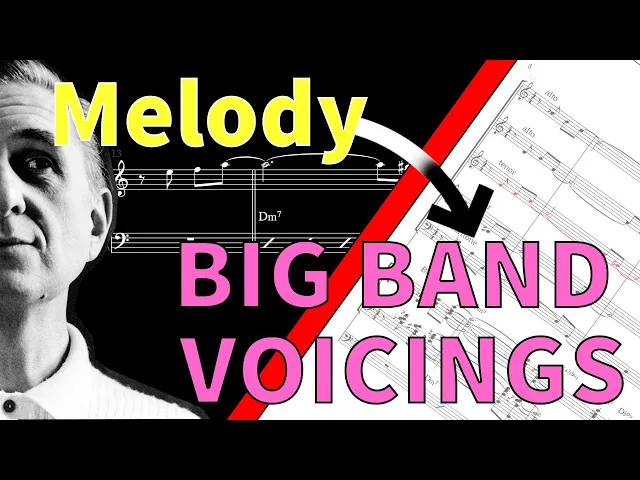
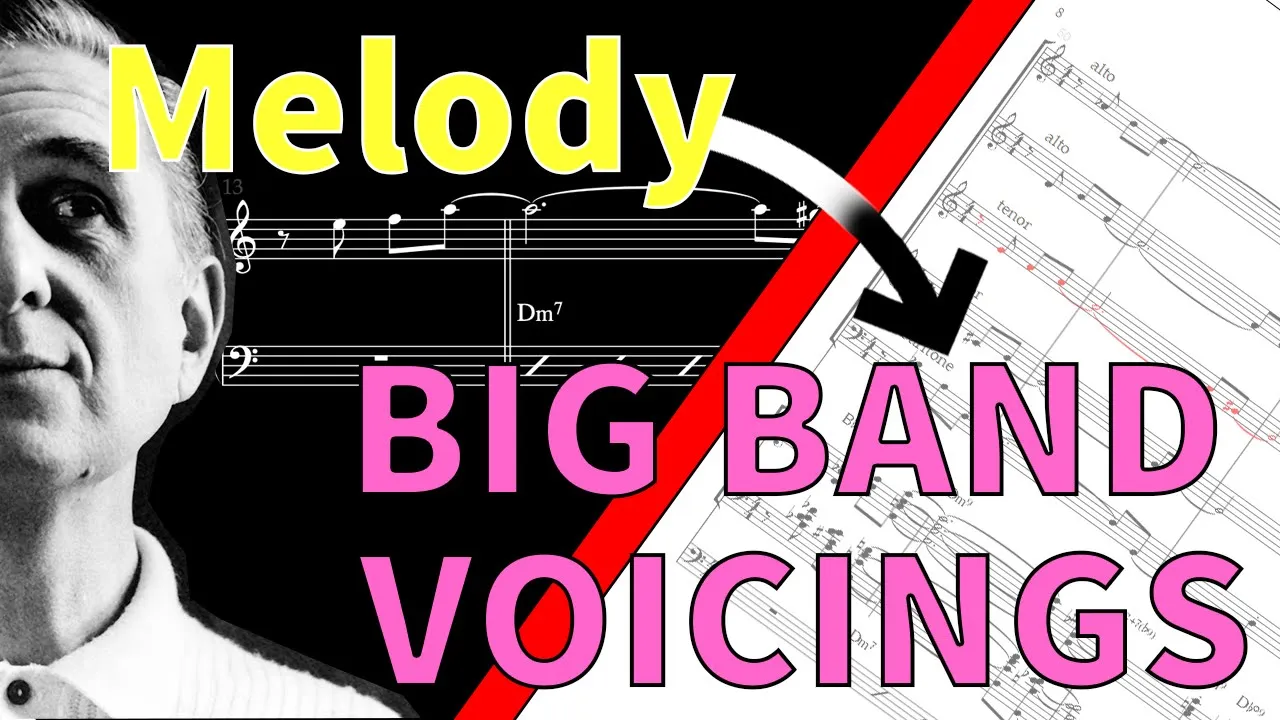
in this video i'm going to go over how girl may have harmonized the short passage but then also voice it for a traditional big band girl evans is known for his use of unconventional instruments earlier in his career with the claude thornhill orchestra he utilized some slightly more regular instrumentation so here is the short passage i have written for this example it's a simple repeated phrase over typical chords i'm going to complete and discuss the first voicing in detail and then continue on to the basic harmonisation of the passage [Music] as you might know already
i like to do the target chords first and this first d minor 7 is pretty important so i'll start there i like to work on the trumpets first as they can be tricky and they alter the texture of the sound as they are on top of the voicing and generally i let them dictate the chord extensions i'll show you what i mean on this first d minor 7 chord on a chord like this the most basic harmonization would be d minor seven a f d and c but as i mentioned in my previous big band
video gil almost always leaves the root note out of the top voices so in this case he would probably add a ninth gil used 9th 11th and 13th freely preferring them over roots and fifths in the upper parts especially check out these voicings from it ain't necessarily so there is no root note in the upper parts and there are lots of altered extensions present so i'll voice this d minor 7 as a d minor 9 a f e c then we have the question of how dissonant to make this voicing as it is this is
completely acceptable but this is a broad sort of melody so i think opening up the voicing would be more successful i'll drop the f down an octave this shape looks really good with the fourth trumpet on an f we get the full chord minus the root spelled out nicely with a sweet voicing [Music] gill does use a variety of voicings for his trumpets depending on the sound he was looking for here is the same example from it ain't necessarily so note how the trumpets have a nice open voicing he could have placed the trumpets in
a closed voicing but instead opened it up for a more expansive sound and here is an example of a brassy and punchy closed position trumpet voicing from the start of the shout course of there's a boat that's leaving soon for new york note how the trumpets are placed right up next to each other well within an octave next i like to complete the trombones if i'm using the bass trombone on the root note i'll place the bass note first and then the third and seventh i'll make sure that these are in a good position not
low or grumbly and not so high that they have to scream in the simple swinging passage then i have a choice of where to put the fourth trombone note i feel like my options are this a e or a up here i'm less inclined to use e in this instance as it will accentuate the semitone over this long note so i'll select this a i'm not usually too worried about the distance or doubling between the lower trumpets and upper trombones i think it's more important to get the trombone range right as they are very powerful
and can ruin a texture if they don't sound pleasant on their own and i can have the saxes fill any inner gaps if needed and now on to the sexes it's not a hard and fast rule but in general it is a good idea to have the basic harmony represented in the sex section so that they would sound good and vibrant on their own as don zabeski writes in the contemporary arranger in large ensembles of this kind the bra should be voiced as a separate entity and the saxophone section should be added to the brass
giving support where it is needed most yet voiced in a way which will also enable it to sound complete within itself while still contributing to the overall ensemble sound it's also prudent to make sure that if there is a large gap between the trumpets and trombones that the saxes at least partially fill the space the tessitura of the melody will usually decide where the first alto sax will play in lower moments the first alto can easily double the lead trumpet as the tessitura rises the alto is more likely to play an inner part often the
second or third trumpet part the baritone sex has a few options one it can play the root note of the chord on its own or double the root with the bass trombone two it can double the melody down an octave or three simply play one of the inner parts adding strength when needed for this voicing i'll place the alto sax on the third trumpet part the baritone will double the root with the base trombone the remaining sexes will be on the inner parts making sure someone is reinforcing the melody if the baritone isn't going to
be doubling the melody down an octave as in this case i'll usually assign one of the tenor sexes to the melody down an octave and that is the voicing for that chord completed for the entire big band this is the sort of thinking i have in the back of my mind as i'm trying to harmonize a passage like gil okay now it's time for the harmonization and as usual i'll start with the important points the target chords and the bass line so let's start here right at the end with the f that's going to be
nice and strong and let's do the lead up to it these g minors and i'll try c there that looks okay let's do this g sharp next now that's an anticipation for the c7 just put a c on the bottom all right this g minor seven i want a nice strong g on the bottom okay let's look here to the c major seven good strong c there let's finish this phrase i'll put a g on the bottom back to the d then we'll have something then the c and that's it for the main points of
the melody gill generally harmonised passing notes with a new chord it was often a functional chord or tritone sub or a diatonic chord have a look at this example from miles ahead each new melody note has a new chord helping to drive the harmony forward okay let's work on some of these passing notes so yeah i was just here i think a d flat would be good there it could be a tritone sub or something else and i could do the same over here d flat 7 to c7 that could work okay i think here
it's wise to borrow the a minor and then say that a flat like another tritone sub going to the g that would be good that just leaves the very start let's have one of these flat seven seven six seven then a two chord and that's the bass line done all right let's put on a few of the important voicings or harmonies on the trumpet parts start at the end again f major seven fifth third and of course i'm not going to put on the root note again i'll put in a ninth let's go back here
to this g minor seven put in the seventh fifth third and this is a repeated chord so i can just do the same now for the c seven there's a third i'm gonna put a ninth but i'm going to flatten that 9th so that trumpet has a bit of a better part to play and i do have quite a few repeated notes here now i know there's disagreement about repeated notes but i think in this sort of little bit of passage here it might be nice for it to move if possible so i'm actually going
to change this g minor 7 to a g7 or g9 and that just gives that fourth trumpet a better part that's looking good okay i'll do the c7 now put on the third ninth and flat seven that looks good g minor seven seventh fifth third and like earlier in the d minor seven might be nice for this to be a more open sound put that f down the octave yeah i like the look of that okay c major seven i'm not going to put on the root here i'm gonna go straight to a seventh fifth
and then a ninth down there for the d minor seven i'll use the same voicing as i did earlier and here we have onto this g7 i could actually put a f there there's a minor third between the f and the g sharp augmented second that could work but i think i like the sort of option better putting in the augmented fifth then the third then the seventh that's a nice open trumpet voicing okay that's all the main target chords done i could see i've got some repeated notes in this fourth trumpet part again although
these are longer notes so it's not as bad i could think about it here when i tackle this d flat seven i'll try that now it's got a ninth flat seven and there's the third yep it's another f okay i could leave it wouldn't be the end of the world if i did want to change it though i could try something like this put in a minor third have a double flat seven so make it a diminished chord basically got a minor third double flat seven ninth and flat fifth and for these sort of little
options you need to try each one out and see what you like best that's a personal taste thing okay i'll do the other d flat seven or d flat chord flat ninth seventh and fifth that looks good okay i'll tackle this a minor a minor there's a third seventh and then i can put in a ninth so it's a minor nine and here i have a a flat 13 chord of some sort there's my third it's my seventh [Music] so here i do have a repeated note the c c d it's not too bad um
here's another option i have my ninth back i can put in the fifth there and then the third that way each part is moving we do have a momentary major second at the top of that voicing and i'm actually okay with that um mostly because it resolves and i think it would sound fine in this instance i'll leave it like that okay here we go to the a7 augmented let's have a third seventh let's put in a ninth b flat seven ninth flat seven and third and that's the completed harmony i do have a few
options if i'd like to make some of the voicings more open i could drop this f by an octave but because there's a bit of movement in that phrase i think i i like it how it is i could do the same here but this little phrase it's sort of punchy and snappy so it's nice with the trumpets up there nice and tight together and here's what that sounds like [Music] [Applause] [Music] [Applause] [Music] [Applause] okay now that i've got the basic harmony in there i can add the trombones and i'll utilize the same extensions
that i have done in the top harmony for instance with this c7 flat 9 i won't put a natural 9 in the trombones it'll be very crunchy okay i like to start with the target chords again so on to this f of a third and a seventh and i think a fifth will be nice there i'll work on the c7 flat seven third into the flat nine okay g9 i've got options here i could go for this third and that for that seventh and let's have that fifth that looks pretty good i do have a
repeated note here from this e to e i could go up to the fifth if i really want to stop that or move it down an octave that's a bit grumbly for me there i don't like that i'll leave it like that for now okay i'll do the c augmented nine seventh third got options here i could go down to my ninth or up to that g sharp then i'll go up to a nice jaunty moment seventh ninth third that's all looking good okay g minor nine third seventh let's go for the ninth there that's
looking good okay i'm gonna go back to the c major seven seventh third let's go for the ninth ah this d minor we already did earlier and the same voicing here okay let's look at this g augmented seventh let's have the third seventh okay similar to before i could go down to the e flat or i could have the first trombone player g sharp i'll go down to the e flat this time okay to some of the passing chords now let's do this d flat diminished double flat seven third and flat five okay a minor
nine third seventh let's put the fifth in there too a flat 13 third first flat seven i've got a repeated c but that c does resolve down to the b flat i'm going to leave it like that for now i think it works okay in that phrase okay to the start a augmented ninth third seventh put in the augmented fifth b flat nine third seventh and let's put in the sharp eleventh there and that's the trombones done i've made sure to include the third and seven on each cord so it's nice and solid and i've
tried to keep them in a good range there's varying amount of overlap with the trumpets but i think that's fine here's what it sounds like sorry about the nasty midi by the way [Music] [Applause] [Applause] okay now it's time for the saxophones i'll put in that voicing i did earlier with the alto on the third trumpet part and i've got the baritone doubling the bass trombone which isn't always typical and i've got the other sexes on the inner parts now i want to make sure one of these sexes is doubling the melody down an octave
so i'm going to do that now that way i know the melody will be being reinforced by at least one of the sexes and i want the baritone sax to double the bass trombone so i'm going to put that part in now okay now it's time for the other sexes and again i like to tackle the target chords first let's have a look at this last chord i'm gonna put in the ninth the third there still got one more note to add could happily put in the c that'd be fine it all sits in a
really nice range the chords completed or at least vibrant on its own back to the c7 i think i'll try that for that chord that looks pretty good for the g9 notice how the saxophones are sitting nicely in the middle in a comfortable area with their nice vibrant voicings that sound good on their own c7 g minor nine [Music] now i'm not sure about this voicing i think i'll put that b flat down an octave yeah i think that will sound better with the b flat up here i am accentuating that minor second by quite
a lot just in the one section okay back to the c major seven g seven now that is quite a tight voicing there but i feel like it should be all right d minor nine same as before okay now just a few passing chords left to do let's have a look at this a minor the seventh in ninth third seventh okay i'm going to alter these so they will have a bit of a bit of voice leading i'm going to drop that b an octave and let's see an octave as well i like that better
okay d flat seven seventh ninth fifth now with this voicing i've got my d on repeat i could move something by an octave i'll do that i like that voicing better anyway it's gonna sound better with the seventh nice in that solid range just the first couple to go now ninth third seventh third seventh and there's the ninth all right d flat diminished i'll put the third there double flat seven and there's the ninth now i made this d flat diminished chord to avoid some repeated notes but in this voicing i've got a repeated e
and e that sometimes happens it could be a part where those players swap notes or i could alter the voicing what if i did this each part now moves it's not too bad but the voicing should sound good on its own oops i missed my b b-flat there and that's the sexes done i put the sexes onto separate stage so i could have a good look at the voice leading and i thought the end could be improved slightly so i changed it to this that looks pretty good and here is what it all sounds like
together [Music] [Applause] [Music] [Applause] thanks for watching the video and let me know what you think of this method of voicing for big band do you do something similar if you need to look at the score on paper you can purchase the pdf the link is in the description