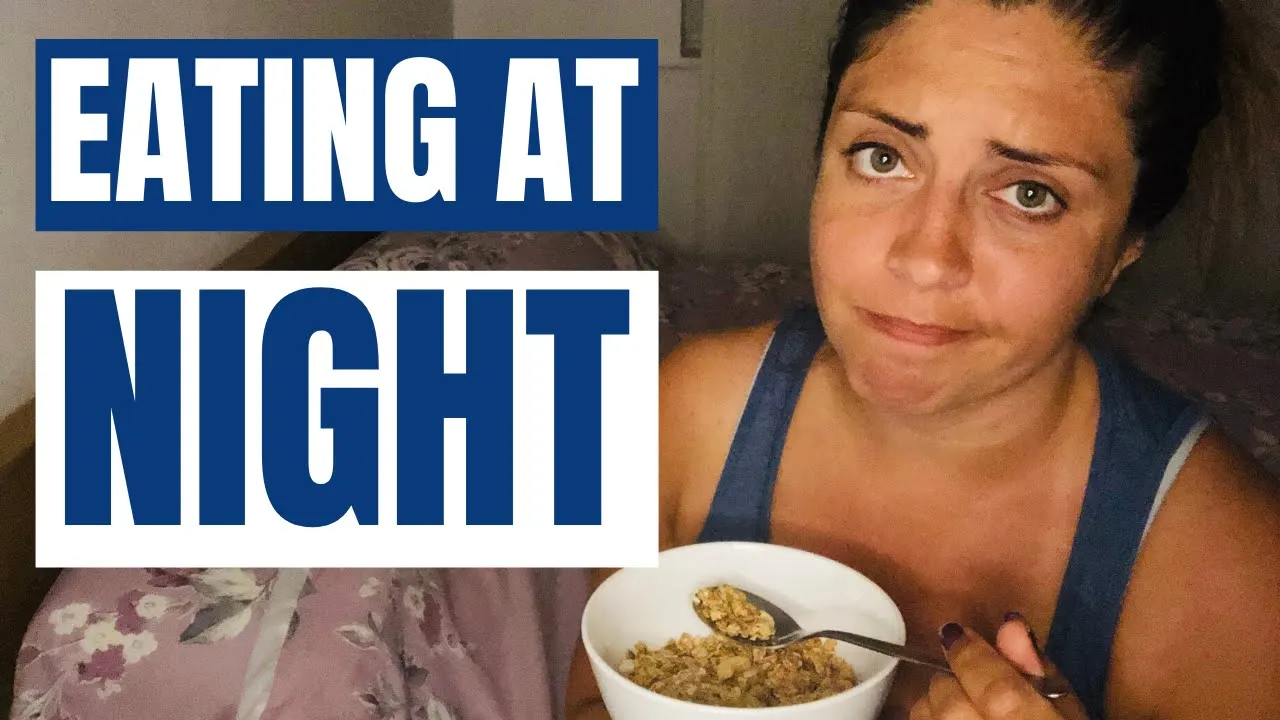
welcome to my channel the binge eating therapist I'm Sara former bindu 210 psychotherapist and my mission is to use this space to bring content to you that will help you understand your struggle with food and break free from binge eating I get a lot of people asking me the question how did always stop eating at night time and it's a question that's really common I think because most people when they're struggling with food and binging nighttime is the hardest time and there are some really good reasons for that which I'm going to get into in
this video as well as talk a bit about what you can do if you particularly struggle with binging later in the day and from my perspective when my binge eating first started my night eating was off the charts I mean I would I could have a dinner at eight pm a big dinner go to bed and I could actually wake up at 2 or 3 o'clock in the morning feeling and I want to say hungry I could practically still feel the dinner in my stomach but I would wake up at 2 or 3 o'clock in
the morning feeling compelled to eat and then I would be getting up in the middle of the night and eating Bowl after bowl of porridge or something like that and that was a really dark time and for me I think because there was such a hormonal influence I think behind my struggle with food at this time I had a lot of hormonal stuff going on problems going on that hadn't been diagnosed yet so when they were diagnosed and I started getting hormone replacement treatments for that and the waking up in the night to eat calm
down but I still really struggled with eating in the evenings sometimes eating quite late and then struggling to sleep as a result and feeling too full so it was definitely a problem for me and so if we're thinking about why it's so much harder later on in the day to manage our eating and there's two things that I think pay the biggest role the first one we have to talk about ghrelin it's the hunger hormone and it's a powerful hormone and ghrelin has its own circadian rhythm it could own daily rhythm we have hormones that
spike at certain times during the day or night and ghrelin is one of those so your ghrelin is that its lowest normally around 8 o'clock in the morning which is interesting really because it's it's when you've gone the longest period of time without eating normally in any 24 hour window but we wake up less hungry most people experience that and then the time when it is highest is it around 8 p.m. at night and these kind of stay the same regardless of how much food you've eaten but the swing might be higher so if you've
not eaten all day and then you get your 8 p.m. ghrelin hit it's likely that your ghrelin levels have gone up through not eating and then your circadian ghrelin has kicked in which has given you an even bigger spike so that that is a big part of it we are naturally hungrier later on and in the evenings the theory behind that is is it's um it's a biological necessity to encourages to eat more before we go to sleep because we're gonna fast while we're sleeping and it really goes against the whole diet culture messages around
like that you shouldn't eat too much at night you shouldn't cuz if you eat and then you go to sleep you haven't burned it off and it's just gonna turn into fat and it's just it's all a load of nonsense and its really unhelpful because what it means is people are trying to follow the diet culture rules as opposed to what their own biology is telling them another reason why I think that evenings become such a problem for so many people is that we experience something called decision fatigue we make so many decisions these micro
decisions throughout the day about everything we're doing and that part is a specific part of the brain responsible for decision and it gets tired so by the end of the day when you've been making all these decisions about work or what to eat or like what to wear anything by the end of the day like a part of the brain is quite tired so your decision-making abilities are impaired so hopefully this gives you a little bit of an idea about why evenings and naturally gonna be a time where the desire to eat more is present
and rather than trying to fight it I wonder if we can make peace with that and not make it mean something terrible about this people think because all I've been so good and I've been in control all day that I should be able to it's so easy to not eat too much during the day so it should be easy to not eat much in the evening of course it's easier to eat less during the day because you're growing levels are lower and they're gonna be higher later on but if you do eat more during the
day that ghrelin increase of ghrelin is not going to feel so intense and the urge to eat might not feel as urgent and there's something called night time eating syndrome and it's technically an eating disorder but it's also a mood disorder and a sleep disorder as well so it's kind of all three rolled into it all at once and they reckon is actually quite common amongst the public and so I also want to kind of urge you to be cautious about self diagnosing this videos just for informational purposes and I think with a lot of
these diagnoses you can make yourself fit but there are five criteria for nighttime eating syndrome and the you only have to meet three of these criteria so I think a lot of people could potentially see themselves in it so the first one is that you have a very low appetite in the morning you're not hungry for breakfast and most people with nighttime eating syndrome most mornings they're not going to eat till midday or later so they're eating window has been pushed back which then has an impact later on are described in the circadian rhythm and
then another one is that their mood tends to go down or drop significantly in the evenings so it might be that you feel more depressed or you feel more anxious in the evenings and that seems a quite significant change compared to how you might feel during the day another one of the criteria is that you eat at least 25% of your caloric intake between dinnertime and bedtime so you tend to like proportionate to how much you're eating during the day you're eating kind of like a substantial portion or daily quota your food is in this
smaller window later on in the day and another criteria is that you have trouble falling asleep or staying asleep so there's some insomnia there and the last one is that you have a belief that eating something is necessary to fall asleep or to stay asleep so out of those five criteria you only need to meet three of them to have nighttime eating syndrome and so if we look at the people who are most at risk of experiencing this they are people with a history of anxiety and depression because mood has such a role in the
way that our well may be in the way that we experience our circadian rhythms and hormones are impacted by our moods so that makes it more likely if you have a disordered relationship with food or an eating disorder this can be an add-on to that it's more likely and they also think that there's probably a genetic component as well they found a gene the PE are one gene which always makes me laugh when I see it written down because it looks like Perry is in peri-peri chicken that makes me think of lamb days I'm looking
forward to having a Nando's when lockdowns over so there's a few things that might make it more likely so it means probably then the kind of people that I'm talking to who struggle with binge eating this is much more likely to be around as well this nighttime eating syndrome and of course as I said it's a it's a mood problem it's a sleep problem and an eating disorder that means it's in order to improve it or to recover or move away from nighttime eating syndrome is gonna involve a three pronged approach like as a mood
disorder you need to look at like your anxiety levels or your depression get getting support for that whether that's through counseling or whether it's through medication you know research has shown that for some people medication really helps with nighttime eating syndrome and I'm of the opinion that for some people medication is really important necessary and helpful and for other people it's just not in such a personal decision and that I would never try to suggest either way whether someone should or shouldn't try medication um because it is also a sleep problem all the ways that
you might tackle insomnia are gonna be important so things like having a consistent bedtime routine a way to wind down at the end of the day reducing screen time reducing light levels in the evenings if you can getting out in the mornings into natural light into daylight really helps kind of balance out our circadian rhythms as well so anything that's going to help with your sleep it's gonna also help because with people who are binging in the evenings they're not sleeping as well so then they're more tired during the day and we know that feeling
tied increases our cravings particularly for like simple carbohydrate foods things that are going to give us quick energy of what we're drawn to and then of course if we look at the disordered eating part I mean that's probably why you're watching my video you've watched any of my videos because you're trying to make peace with food you're trying to get to a place of wellness with food because if you're caught up in this restrict binge cycle evenings are always gonna be the hardest time you because biology makes it the hardest time but it's only the
hardest time because there's a fight going on with food so it's really about that idea of prioritizing and I appreciate this is not a quick thing but prioritizing making peace with food finding out for you like what works being willing to eat more during the day and just play around with it to begin with you know try it for a couple of weeks if it doesn't seem to help it doesn't like it always know that you can go back to old behaviors I think that really helps when you're trying something new to know that the
old behaviors are still there waiting for you if you feel like you need them so that's nighttime eating syndrome also applicable just to general evening eating and if this is something you're struggling with you're definitely not alone it's one of the questions that I hear come up again and again it's just one of the reasons why I thought it was a good idea to do a video on it so hopefully it was useful and I hope you enjoy your weekend I'll see you on the next video

![3 Reasons You Always Want To Eat Even When Full [& How To Stop!]](https://img.youtube.com/vi/whyTEAV5sE0/maxresdefault.jpg)


![33. [part 1] why & how I quit drinking alcohol after 26 years of binge-drinking alcohol](https://img.youtube.com/vi/ErFYJV6Hz7g/maxresdefault.jpg)