in an obscure Museum in Eastern Europe a fossil hunter has made a momentous discovery the young paleontologist was randomly sifting through a collection of drawers but haven't been examined for 30 years I was going through these drawers finding drawer off the drawer of very much the sort of fossil that would expect to find really nothing any particular excitement and then pulling over monitor I spotted in the middle sitting in little cardboard tray laxer a fossil the likes which never been found anywhere in the world of all the tales of life on earth there is one
more fabulous than all the others the story of how we got our legs scientists believe that long ago a fish came onto the land grew legs and started to walk it is one of the most crucial events in the history of life because that animal is our ancestor but how and why that fish grew legs is one of the biggest mysteries in evolution it baffled the finest minds in science for over a century all they had to guide them for the theories of Charles Darwin evolutions founding father Darwin said the answer would lie out there
in the rocks somewhere there would be fossils that would explain everything paleontologists would go scurrying all over the world trying to find them but such early fossils are rare there's still so very very few pieces of evidence this is like one of those terrible classic murder mysteries you know that goes on for 30 or 40 years and people slowly trying to pick up a little bit of evidence a little bit there but the more scientists looked the more they realized one crucial fossil was missing this was become a challenge to the whole theory of evolution
and the story of how we got our legs would become the quest for the ultimate missing link the whole quest began a hundred and fifty years ago with one simple observation a vast array of animals are in fact related they all have four legs they are tetrapods we are tetrapods to it one two three four every mammal every dog cat as is a tetrapod four legs a horse is a tetrapod evidently enough so is a bird all the reptiles or frogs salamanders and even the snakes which don't have legs at all whales which don't seem
to have legs they're all tetrapod animals scientists became bewitched by the fact that under the skin all tetrapods are basically the same they all had spines kept firm by special interlocking Spurs it is as true of us as it was of the dinosaurs all tetrapods had a pelvis attached to the backbone to support their weight they all had a ribcage to protect their heart and lungs and they all breathed air through nostrils their limbs invariably consisted of one single bone at the top a pair of bones underneath leading to feet or hands which scientists noted
never seemed to have more than five fingers or toes it was true of dinosaurs human beings and even whales for under their flippers they have five fingers this similarity convinced scientists all tetrapods must come from just one type of creature a single common ancestor to prove it they thought they needed just two fossils they needed the first tetrapod the very first land walking creature with four legs with five toes and they needed the fish from which it came a fish that could grow legs find these two fossils compare them and in the differences between them
we would learn the reason why a fish had developed legs they had one huge clue to set them off they knew this evolution must have happened 400 million years ago in the Devonian era the Devonian is so long a girl that barely any rock cannot be found from it let alone fossils but academics knew that before it nothing walked and after it everything did so the evolution of legs must have happened there and they thought they knew something else textbooks said it was a time of blistering heat when almost nothing could live on the land
not even plants it meant most life survived not on land but in the water this was the age of fish and one of them the one with the beginning of legs was the first fossil they needed to find finding that fish fossil proved easy by the turn of the 19th century all eyes were on a Devonian group called the Lobo fins lobed fins uniquely have a bone structure in their fins that seems to be a precursor to our legs and arms and one particular lobe fin the long extinct Houston Opteron had all the leg bones
except the feet and toes here in these fossils the limb was just laid out simply beautifully and it was so easy to turn it in your mind into a tetrapod limb the these bones the one of the two bones they were they were laid out and there were these bits in the lead up to the ankle and the wrists and so on absolutely fantastic beautiful material clinched it really what they thought they'd clinched was the fish from which we all came the ancestor without legs and early last century scholars developed a theory to explain why
it might have evolved legs and started walking that brutal Devonian son must have been the cause of droughts fish would have been trapped in drying pools and faced death to survive a few youthful of torrents must have dragged themselves on their fins as mud skippers do today out of the puddles in search of deeper water some could then have evolved on land their fins became legs they grew five fingers and toes they started to walk they became tetrapods our ancestors limbs had developed so they could do what we all do walk on land the drying
pools theory seemed to explain everything that's why we've grown our legs and from what we'd evolved all they needed to confirm it was to find that very first tetrapod the creature into which the fish had evolved once it was on the land if it was as they predicted an animal with five fingers and toes then the whole thing would make sense many would seek this mythical beast and for years no one found it in the 1930s a team of Swedes made a series of trips to Greenland one of the few places in the world without
crops of Devonian rock their mission to find that first creature with legs among the party Erica Vic javac steam found what everyone had been searching for fossils of the very first creature with legs rather than Finley's they called it pick the austega people have been looking for this in a way ever since Darwin ever since 1859 this transition is the one that's so intrigued everybody going from the water to the land and no evidence of it and then boom they found it terribly terribly exciting really very very important it felt a Yahveh to analyze and
describe the new discovery this meant years of digging the fossilized bones out of the rock and then trying to reconstruct the anatomy of this strange creature javac was a brilliant anatomist but he was also painstaking he started in 1948 but did not finish until 1996 in those 48 years no one else was able to analyze the fossil to be honest it shouldn't take that long that's frankly I mean you have to be a really sort of anal to take that long to describe anything especially when the world is just hanging on this but yar Vic
did produce two preliminary papers these did confirm the existing theory Ixia stager was an identikit land walking tetrapod with five fingers and toes the mystery of how we got our legs was solved after Ustinov Tyrande fish had struggled on its fins on to land it had evolved into ixia Steger the first tetrapod with legs it was just as science had predicted but then the doubts crept in oddly avec had ever analyzed the Ichthyostega fossil and you just had to take his word for it but worse mutterings began that there was a gaping hole in the
story Ustinov Turan could not be the immediate ancestor of atheist ager the difference between them was too vast Ixia stager was a fully-formed tetrapod with a ribcage pelvis attached to the backbone a spine with interlocking Spurs and limbs with fingers and toes the fish was still a fish despite its primitive leg bones it showed little sign of evolving any of these other tetrapod features to prove one had become the other they needed more evidence what this really adds up to is that these changes into to gross have happened in one step there must be missing
animals in here for a start somewhere out there there should be other species of Devonian tetrapods which might shed some light on the theory but above all they needed to find an intermediate animal one that showed the changes between fish and tetrapod actually happening some strange beasts that could walk but was half fish half tetrapod there was a missing link the missing link had to be what Charles Darwin called a transitional form these lie at the very heart of his theory of evolution because they show how one animal can mutate into another transitions are hurry
LEvolution when there is a dramatic environmental change creatures that cannot adapt to the new environment die out but chance mutations often turn out to be the key to survival there is an explosion of hazhar forms as a host of mutants experiment with living in the new environment these freaks of nature will die out quickly and just some will become transitional forms creatures that are half one animal and half another which bridge the old way of living and the new transitional forms are the most crucial fossils in all evolution they are important to these zoologist to
the paleontologist because they they show you what the process actually was I think they're very important to the public as being direct evidence that there was a process of change that you can document but transitional forms are also the rarest of beasts by their very nature they were few in number and lived for just a short intermediate time until a wholly new animal evolved in fact for years there was only one accepted transitional form the Archaeopteryx which was a dinosaur with feathers that marked the transition to birds presumably the transitional forms were very rapidly out
competed by their more by their own more advanced descendants so these transitional episodes in the history of life tend to be brief and involved it seems relatively low numbers of species and probably low numbers of individuals the trouble was without anything half fish half tetrapod between youthful Opteron an atheist ager the story of how we got our legs remained incomplete and lurking out there was a group dedicated to pointing out such gaps in the story of evolution with the aim of its ultimate destruction Duane Gish is a scientist my bachelor's degree in chemistry from UCLA
and my doctorate is in biochemistry from the University of California at Berkeley after I finished my doctorate I went to Cornell University Medical College for three years he's also a creationist a believer that the world was created in six days just as it says in the Bible according to God's plan and therefore the whole theory of evolution he thinks must be wrong evolution has no plan no purpose it's a random process creationists believe that all animals were made fully formed by God one main line of attack is the rarity of transitional forms if you cannot
show how a fish evolved into a tetrapod then they argue evolution never happened at all the fossil record is enormous ly better now than it was in Darwin's time but it hasn't solved Darwin's problem in our Museum today we have about a quarter of a million different fossil species if evolution is true tens of thousands of those things should be of obvious intermediates but they're not there every major type of creature appears fully formed no ancestors in no transitional forms off right now the irritation for paleontologists was that no one had yet unearthed the transitional
form between fish and our earliest ancestor with legs one just had to be found and then for a brief moment it seemed one had been when in 1938 a miracle happened East London in South Africa 63 years ago just before Christmas the curator of the local museum was idly sifting through a fisherman's catch down on the waterfront Marjorie Courtney Latimer was then just 31 years old 22nd of December 1938 was a wonderful day I came onto the Smurfs beautiful fish it was just on just on that foot it was silver and gold and green and
blue and had what kind of flex on it and to my horror it had these slimming luck feelings and I thought to myself what earth can this be and never seen the fish tractors she rushed the fish off to have it preserved then she asked dr. jlb Smith a South African academic to identify it he stood at the head of the table and he said well unless he said this fish will be on the lips of every scientist in the world it's a coelacanth coelacanths were a breed of Devonian lobe-finned fish that were thought to
have been extinct for over 76 million years I was absolutely fantastic because it was its living and it it's exactly like having found a live dinosaur or alive Archaeopteryx the scientific community was transfixed for decades the coelacanth have been touted as a possible transitional form between fish and tetrapods but no one had really known enough about it it existed only as a fossil Smith proclaimed the coelacanth a transitional form and as proof he announced it would actually walk on the bottom of the sea yes the professor says the fish is a kind of ancestor of
man poor fish but he knew he would have to find one alive and walking to prove the coelacanth was the elusive transitional form he looked for 13 years until another one was found and it didn't walk it swam it was just another fish well it was thrown out the requital often Austin it's essentially I'll beat you says he was having a daydream there was still no transitional form nothing to show that a fish with fins had walked over land and evolved into our first ancestor with legs nothing to silence the creationists and they're arrested for
30 years evolutionists still clung to the theory that a fish evolved into the first five-fingered land walking ancestor as a result of drought even though they knew there was a gap in the story but without new evidence no one could come up with a better idea in 1981 Along Came paleontologists avenging angel Jenny clack had long dreamed of embarking on the quest to find out why we first walked on the land but when she arrived in Cambridge it seemed a remote home I had just finished my thesis when I started work here and was looking
around for another project and a colleague of mine said don't worry something will turn up and I didn't believe him what turned up was the notebook of a geology student who had visited Greenland in 1970 in one corner he'd made an extraordinary note that showed though he knew about rocks he knew little of fossils he'd written that he had found remains of ixia Steger yaa vyx legendary first tetrapod of which only one complete specimen existed anywhere in the world he noted atheist eager bones and skull bones common and early tetrapod specimens are not common anywhere
particularly not Devonian tetrapods on a mountain in greenland and to see this in his notebook just set the bells ringing we have to go there by 1987 clack was off to this apparent goldmine of tetrapods taking along a student pair albergue it was a big undertaking and of course it was possible that we were going to find almost nothing or at least nothing new so the potential was there on the one hand for spectacular success and on the other hand for considerable embarrassment at first it looked more like embarrassment as the week wore on the
two first two weeks wore on we still hadn't found that's the locality that we were looking for we were beginning to think are we on the right mountain then plaque saw something it was covered with dirt and soil it very really got thrown on scrappy but fortunately we brushed some of the dirt off and we could see part of a skull plaques team had not found the transitional form between fish and tetrapods but she had found something almost as rare it was another species of Devonian tetrapod a species called at camphor Steger different from llaves
but clearly sharing the same ancestry and therefore also related to humans a cantor stager was only the second complete Devonian tetrapod ever to be found clack returned to Cambridge with dozens of tetrapod fossils it meant that at last someone else would be able to do original work in the field of how we got our legs but the true importance of the trip did not emerge until 1990 when a colleague mike coates started work on the specimen she'd almost thrown away the acanthus tiger he started to dig its hand out of the rock and he expected
of course to find just five fingers the first thing he found on this book was a finger this digit here so we got a number of finger bones aligned along the edge of this block then he continued with the preparation he found the next finger which is here but its end curled over and then a third similarly with this crook'd finger end and a fourth again with that and then there's a gap and then he went on to find another finger individual finger bones are really quite clear and that makes a total of five but
he still had all this area he had to prepare so instead of stopping he went on to clean up the rest of this area and lo and behold here is another digit so that makes six if any expected to finished there and then to his amazement here's a sense and finally an ex what but it was true acanthus Sega had eight fingers on one hand the very earliest tetrapods did not as all the textbox claimed have five fingers after all it suddenly raised the question if the most basic assumption behind the previous hundred years research
was wrong then what else might be wrong until that day I had assumed like everyone else that five was the primitive number of digits for a tetrapod limb the old explanations for the origin of the structure after all one of the most fundamental and defining stretches of being a tetrapod and in our own way of being human was in the beam scientists now believe our earliest ancestors with legs must have started out life with numerous digits and then evolution reduce them to five over the eons that followed and the shocks just kept getting bigger another
fundamental assumption that we had evolved legs for the express purpose of walking just could not be true if you look at the limbs what you find is that the joints are all angled so that the limb would have stretched out just to the sides there's just no way that they could have brought its leg underneath to take any weight similarly with the hind limb which we found a bit later on similar kinda arrangement no ankle to speak off just a paddle light limb a cantor stagers legs would have been useless for walking and what's more
although it was a fully-formed tetrapod it could never have lived out of the water it had gills just like a fish it meant the evolution of our legs could never have had anything to do with walking on land Jenny clacks discovery of the acanthus taker had changed everything the old explanation that we'd evolved our legs after a fish came onto land just could not be true so the thing that has really changed is that rather than was a fish going onto the land while it's still still got fins we've turned that completely on its head
so now we've got tetrapods in the water still in the water while they've got limbs with digits stunned by these revelations clack decided to check her findings against IKEA stager javac iconic first tetrapod a fragment of which she'd also collected in Greenland her team prepared the specimen and counted the toes seven why didn't you exceed this there was more that Yahveh could not see clack discovered that ik Thea stager did not as Yahveh cat shown have legs made for walking they too were pedals javac had simply got it wrong and no one will ever know
why phlex discoveries meant the whole quest as to how and why we had evolved limbs would have to start again now they didn't just need the transitional form to link fish the tetrapods that was still missing but they also needed a whole new reason why limbs had evolved why would any creature need legs that weren't for walking in a valley bypassed by the American dream they would find the answer the real story of how we got our legs Lenovo Pennsylvania is what happens at the end of the railway line when the trains don't come anymore
but the town is rich in something rare and precious beneath the trees are swathe of red Devonian sandstone so in 1993 along came a lone fossil hunter he's called Ted daeschler Deshler made his name finding two more new Devonian tetrapod species in a roadside cutting called Red Hill but the thing that took both him and Red Hill into fossil hunting legend was when he examined one of the site's peculiar features in amongst all the red rock was a broad green layer okay majority the rock out here at red hill of course is red climbing up
through sandstones silty sand stones and mudstones what I did into this zone up here we start with a green layer it's reduced probably because of all the plant material it's buried within the rock here fossil plants by finding them alongside Devonian tetrapods Deshler had made a vital breakthrough he could now reconstruct for the very first time the true environment in which the first tetrapods had evolved the Devonian wasn't the barren treeless landscape spoken of in textbooks it was more like a rain forest the most common thing we're finding is a tree like plant it actually
has a long tall trunk and some people say these got up to 30 meters tall so these were truly the first canopy sort of producing plants we also find fern like plants and a variety of other things and so we're really seeing a diversity from a site like Red Hill and I think it's important because it's showing us that these were actually complex environments the textbooks have got it wrong again the earth may once have been barren but by the end of the Devonian it was very very wet and densely forested with huge permanent rivers
these were bordered by something completely new swamp that grey area between land and water the first tetrapods had evolved in this wholly new ecosystem precisely the kind of thing that could indeed be a spurt a major evolutionary change oh it's completely new by the time we get to the end of the Devonian for the very first time in Earth history animals and plants living on land in a significant permanent way that's that's brand-new and a lot of open niches in that waiting to be exploited those new niches were the margins of this watery world in
the tangle of vegetation limbs with fingers would have given tetrapods a unique advantage of a fish I think we have to think of these fins or limbs or flims as something that would be used by the animal for moving through more complex environments like swamps or environments that where there may have been trees down in channels or just shallow water to pursue prey but to escape the guy who's trying to prey upon you and that was most definitely something from which to escape over and over again Deshler and his team found evidence of a fish
called heinie Lea a predator of terrifying proportions i Neriah is the most common lobe-finned fish at this site it's also the biggest it's probably 2 or 3 meters long this this is a single tooth from a large high Nereus and these were carnivorous obvious when you see the early tetrapods in the same fauna with these tiny area it really does make you think well maybe escaping from large large predators like the scenario was was a pretty important thing for these early tetrapods the mystery of why we had evolved limbs was finally solved they were not
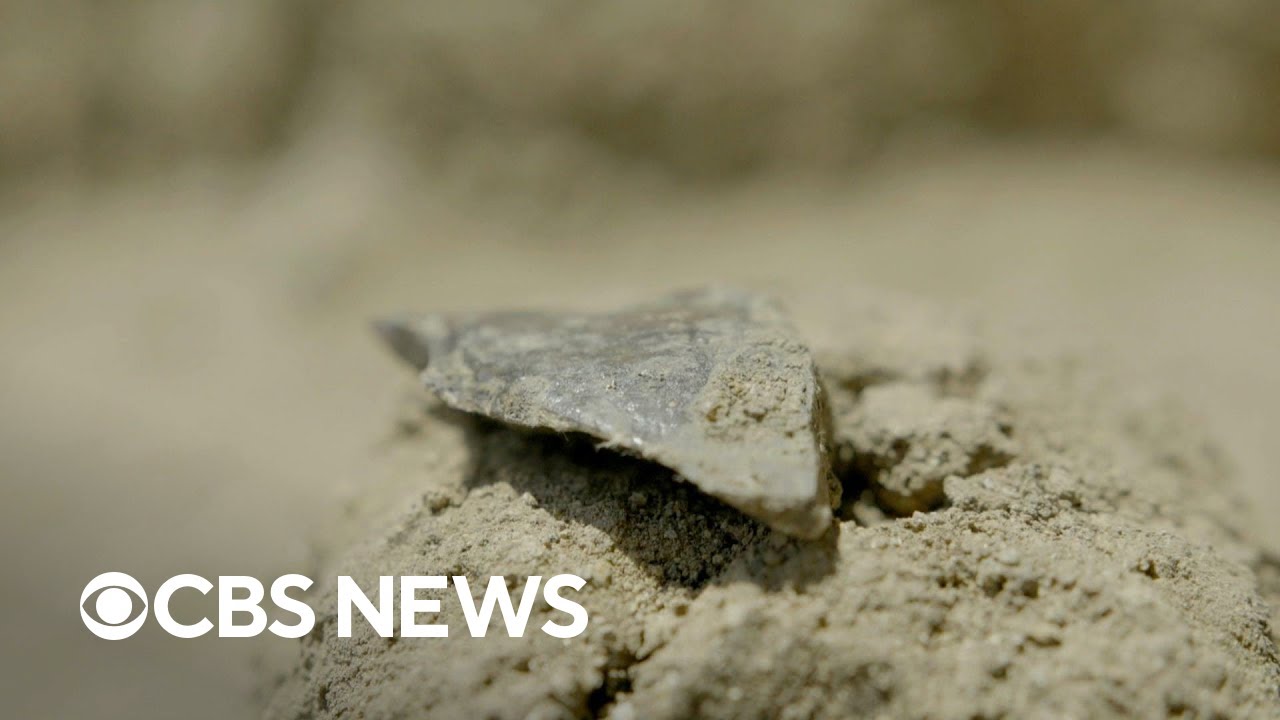
for walking but navigating through swamps just like this hellbender salamander does today but there was still a hole in the story there was still no fossil that showed the process of change from fish to tetrapod actually happening the transitional form something half fish half four-legged animal was still missing and then pair Albert made his fateful visit to Latvia in that forgotten museum draw he may have found what everyone had been looking for his trained I told him the fossil was a fragment of jaw right from the time of transition and it was certainly part fish
and part tetrapod the information we get from this one poultry little bone is quite overwhelming he named the jaw LaVon IANA and to prove it really was a transitional form he ran it through something called a cladistic analysis a computer is programmed with all the anatomical features that distinguish fish from tetrapods some obvious such as does the specimen have limbs or fins others are tiny shifts in the position of blood vessels or bones such minut details allow scientists to identify a creature from just a fossil fragment and place it in an evolutionary tree relative to
other animals but this comparison a lobe-finned fish jaw is on one side LaVon IANA is in the middle and that Devonian tetrapod jaw is on the other side what you can see if you look at the end points is that these two jaws differing quite a lot of ways first of all if we look at this pit in the fish store which is particularly important feature a deep hollow there goes all the way through to underlying bones the bone you get on the bottom there is different one to the last that are coming up on
the surface here in Livonia honor that's the same place the pit is almost disappeared surrounding now a blood vessel hold here which we didn't have in the other duel if we look at the tetrapod we have the pit now gone altogether and here's that lower blood vessel hole were varying the tetrapod so in this respect Laverne iana kind of agrees with the tetrapod on the other hand we find that in the fish a bone from the outer surface of the jaw comes round down to here and and ends and it's it abuts against another bone
up here called the pre articular in the tetrapod the bone from the outer face comes all the way up here it forms a big tone standing backwards so and it comes all the way up here beneath it so quite a different arrangement Livonia here has got a junction and the bone exposed on the surface just like a fish so in this case leave only on aggressive the fish so as you can see depending on which characteristic you look at it either lives with a halfway between or integrates a tetrapod or it agrees with the fish
exactly what you would expect from an intermediate form Albert believes Livonia Anna really is an elusive transitional form almost exactly half fish and half tetrapod it is certainly the only fossil yet discovered that shows the process of change between the two actually taking place it also has one freakish feature there are seven rows of teeth it is unlike any other creature we know of this suggests it must be one of the hosts of mutants that made this change just one of which would eventually become our ancestor Livan IANA is a real missing link Darwin's 360
million year old riddle about how we developed our legs has been solved it was vegetation on land and in the water that let flourish an explosion of mutations among lobe-finned fish the most successful of these mutations the one that stood the test of time was the development of limbs with fingers and toes it was out of this swampy area that our earliest ancestor came crawling over land it was not preordained but chance a series of evolutionary accidents but it just so happened that that creatures children would indeed inherit the earth one day