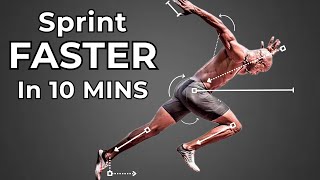
Are you an athlete who struggles to get off the line? Well, after training hard for years, I was always the athlete who got beat off the line and struggled with acceleration. Short explosive speed was easily my weakest link as an athlete my entire career.
That was until a few years later when I met NFL speed development coach Le Spelman. He mentored me to be a great coach, but also learned the science of acceleration development. I not only took my acceleration from trash to fast, but I have also been able to help thousands of athletes on my Speed Academy program also transform their acceleration.
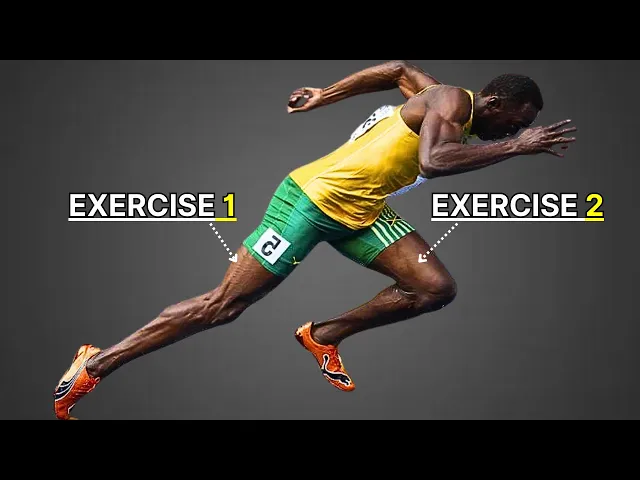
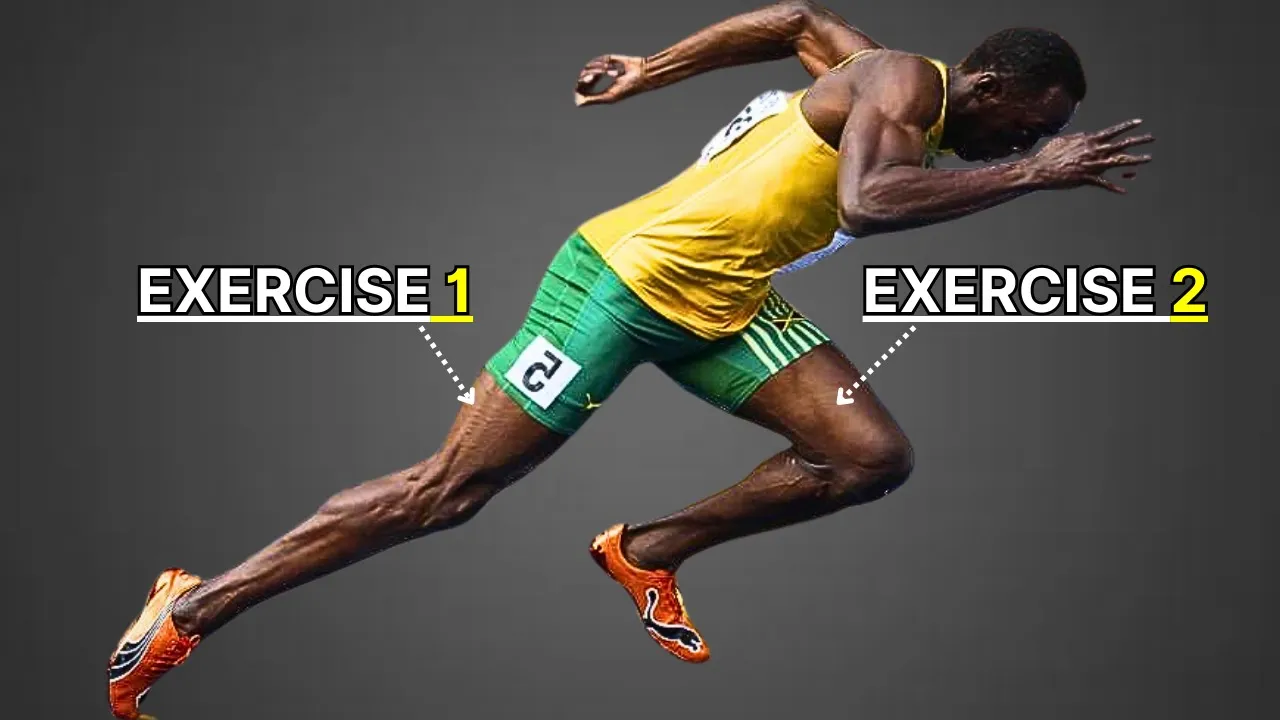
In this video, I'm going to show you the only two exercises I needed to help athletes improve their acceleration. Now, the first exercise I'm going to break down is for your overall acceleration speed, but later in this video, I'm going to show you the key exercise you need to develop that first three-step explosiveness. A common problem athletes have is being strong, but not explosive.
The main reason is that in acceleration, what matters most is the angles and speed of force production. Most athletes sprint with something I call vertical shin angles. And this is going to be a problem for a few reasons.
This is usually happening because athletes are producing too much vertical force early on in their sprint. The issue is you can get as strong as you want, but if the lifts are only vertical and slow in velocity, then you will never be able to produce force in the right angles. You see, in the first 10 to 30 yards of a sprint, horizontal force production is higher than vertical force production.
So, yes, you can improve overall explosiveness just by doing Olympic lifts and sprints. But if you don't work on power and strength in a horizontal force production at least one to two times per week, then you just won't be able to optimally move your body forward, which is what we want when we're trying to be fast. And that's why after years of training hard like my athlete Jaylen G, you can still struggle to sprint faster no matter how hard you work.
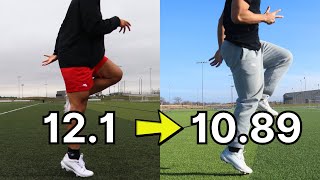
So once we programmed the exercise I'm about to show you for him, he followed our next steps and he went from a slow and unathletic athlete to running 4. 4 seconds in a 40 yard. And if you want us to develop your explosiveness off the line, check out the Speed Academy online speed program, top link in the description.
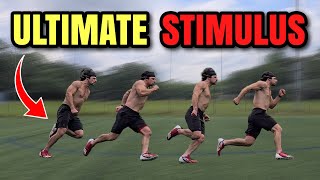
This is also why Randy Huntington, the coach of one of the fastest accelerators of all time, Sunbing Tian, famously promoted that you need to develop force at the right speeds and aims. If you only get strong at vertical angles and slow speeds, then you're going to see good gains in the standing vertical jump, but your vertical jump from an approach and your sprint speed after 10 yards is probably going to suffer. And if that's not convincing enough, just take a look at this NFL combine sprint workout we did with Les Spellelman.
All these NFL athletes are getting faster by using this exercise I'm about to show you. Resisted sprints might be the most important exercise for acceleration. This is because it's the highest velocity movement that overloads horizontal force.
So, I'm going to show you how to do this exercise and a couple alternatives if you can't do the best variation of this movement. Step one, you wrap a sled around your waist. I think having a strap around your waist has the highest transfer.
Step two, set up a distance of a sprint around 10 to 40 yards. Step three, get into a two-point squatted stance and then push your hips back to engage your hips and have a slight lean forward at a 45°ree angle. Step four, project your body forward.
Focus on throwing your shoulders straight forward. And every step you take, don't just step or drive the foot out. Drve the foot down and back under your center of mass or your hips.
Step five, sprint as hard as possible. Step six, rest 1 to 2 minutes per 10 yards you sprint and repeat for enough total volume. But regardless of how much weight you use or what type of sled you're using, the most important thing you need to focus on is not overstriding or over pushing.
We don't want to push so hard where we overextend the lower back. And we don't want to stride too far in front of our center of mass. Once you do this right, you'll run into the next common problem, which is how much resistance you should be having.
Most athletes are either going way too heavy or way too light. If you want to target early acceleration, so our first 1 to seven steps, then we want to do 40 to 50% body weight for 5 to 15 yards. And most athletes, we want to target a mixture of both, which will be around 10 to 25% body weight or V-deck for 10 to 40 yards of max effort sprinting.
Unfortunately, without a basic sled that you can get from Amazon, there isn't many great ways to get resistance while sprinting. But you do have a few options that I'm going to show you that will range from $0 all the way up to $1,000 plus dollars. The best free option that most people can do is hill sprints.
For most athletes, we don't want an overly steep hill, but if your goal is early acceleration, so your first one to three step explosiveness, it might be beneficial to go very steep. We usually want a gradual incline that is around 5 to 25 yards in distance. You can do your hill sprints on grass or concrete, but most people can't do hill sprints.
So, here are some other options. One other option you can do is partner banded, which is very common. But for early acceleration, we want medium to heavy band resistance.
And for most sprinters, we want light to medium resistance where the athlete doesn't pop up vertically after one to three steps. Incline roads, even if it's concrete or gravel. Now, for premium options around $200 to $1,000, you have the 1080 Sprint, Xerini, and the Run Rocket.
But here's the thing. Your acceleration isn't just how good you can get to the first 20 yards. If you want the type of explosiveness off the line that gets people like this old damn, then you need to target a quality called explosive strength.
Now, to target this athletic trait, you still want exercises that focus on horizontal force production. But unlike your overall acceleration speed, your first three-step explosiveness can be improved with much less sprint training needed. You actually can see a lot of gains from the weight room and from basic pometric exercises.
So all this means is that we need a power exercise that focus on jumping for distance. So first I'll show you a beginner version. Then I'll show you my favorite variation that I program in the speed academy for my athletes who run this in the 40 yard dash after only four months of training.
If you want to hop on the speed academy to develop your short explosive speed, click the top link in the description. For the beginner version, all you need is space to jump forwards. The first step, we want to simply start with our hands above our head.
The second step, we want to take a solid, relaxed breath in. Third step, we want to drive the arms down aggressively while also hinging and dropping into an athletic stance. The fourth step, we want to push into the ground and jump as far as possible.
The fifth step, we want to land on our midfoot and mark down where we land. based off our heel. The sixth step, we want to repeat this for three to eight sets of one to three reps and try to beat our distance every workout.
The main problem I see with athletes in this exercise is that they're either dropping too softly or slowly. This is usually the lack of a good stretch shorting cycle usage. But even if you jump less with a fast drop, we want to develop this quality since it has higher potential than a muscle dominant strategy.
The fast drop will always have higher potential. To progress, you can use band resistance or even do doubles or triple bra jumps. Now, for the advanced variation, we can have the exact same setup as the standing bra jump, but this time we're going to land on one leg, then we're going to push off that one leg to jump as far as you can, then land on the next leg and push off as far as you can off that leg.
Finally, land on two legs. And this will complete something called the standing triple jump. And then the standing triple jump will look like this if you do it right and get better at it.
But this exercise won't help you if you jump the wrong way. Instead of just jumping normally, we want to measure out the distance so we can beat it each session. If you don't track, then you can't improve.
The next thing is making sure you're pushing with your posterior chain and not jumping only vertically. This is a knee dominant strategy, and we want to develop our short explosiveness from the posterior chain. But before you jump into doing these two exercises, you need to do one key principle correctly, or nothing will improve.
The weird thing about speed development is that you can't add load to every exercise you do. And because you can't progressive overload naturally like you would in the weight room, you often end up training with no way to see progress consistently. Which means when you do these exercises, you need to follow a few key principles to continue to see results.
The biggest thing is making sure you track every single sprint and every jump so you get something called max intent. Max intent is shown in the research to help athletes get the best result from sprinting and jumping for multiple reasons. But here's the problem.
You have to program these exercises into a full workout plan with proper structure. Because just doing the exercises alone with no strategy will not be enough to help improve your explosiveness. That's why the speed academy is the best online speed program to help transform your explosiveness and short sprint speed.
So if you want a done for you speed program with weekly coaching from me, click the top link in the description to join the speed academy today. And you need to pair these exercises with proper plyometrics to continue to see consistent results. So, watch this video right here on a full guide on how to train with plyometrics to sprint faster.