Donald Trump Jr. walked into the House Oversight Committee hearing room that Tuesday morning with the swagger of a man who had survived Mueller investigations, two impeachment proceedings, and countless congressional testimonies. He expected the usual political theater.
Democrats asking loaded questions he'd deflect with practice talking points. Republicans lobbing softball questions that would give him opportunities to attack the Biden administration. and the whole circus wrapped up in time for him to appear on Hannity that evening to declare victory.
But when Jasmine Crockett opened her meticulously organized folder and adjusted her reading glasses with the laser focused precision that any experienced prosecutor would recognize immediately, the next 47 minutes would expose a web of financial deception so extensive that it would leave the Trump Organization's executive vice president completely and utterly speechless. The morning had begun routinely enough for Don Jr. He'd arrived at the capital in a black SUV with tinted windows, surrounded by a small army of expensive lawyers from Williams and Connelly, communication specialists whose job was to spin whatever happened into a political victory and family retainers whose primary qualification was unwavering loyalty to the Trump brand.
His Tom Ford suit, a navy pinstripe that cost more than most Americans earned in two months, was pressed to perfection. His hair styled to echo his father's signature look, and his demeanor projected the entitled confidence of someone who had never faced real consequences for anything in his 45 years of existence. What Don Jr.
didn't know was that three floors below in the house office building basement, Jasmine Crockett had spent the previous 72 hours in a windowless room surrounded by banker's boxes full of documents, financial records, correspondence, and sworn affidavit that painted a picture of systematic fraud so clear and comprehensive that even the most partisan Republican would struggle to deny its implications. As a former public defender who had fought for clients whose freedom depended on her ability to pass complex evidence under impossible time constraints, Jasmine understood that preparation wasn't just important. It was the difference between justice and injustice, between truth and political theater, between accountability and the kind of impunity that had allowed wealthy connected families like the Trumps to operate above the law for decades.
The Rayburn House office buildings room 2154 had been configured for maximum institutional intimidation. Its mahogany panled walls polished to a mirror shine that reflected the harsh fluorescent lighting designed to make everyone look slightly sickly under the television cameras. The air conditioning was running at full capacity, maintaining the temperature at a crisp 68°, cold enough to keep everyone alert and focused, but not so cold as to create visible discomfort that would distract from the proceedings.
The horseshoe-shaped committee table elevated the House members above the witness table in a clear display of congressional authority, while the gallery behind held approximately 60 observers, reporters taking notes, C-SPAN camera operators capturing every angle, curious hill staffers who had heard whispers about the explosive evidence Jasmine had uncovered, and political junkies who sensed that something historically significant was about to unfold. Don Jr. sat alone at the witness table in the center of the room, isolated by design in a setup that was meant to make him feel important, but instead created the psychological effect of being surrounded and exposed.
His expensive legal team occupied two rows of leather chairs behind him, three partners from one of Washington's most prestigious white collar defense firms, two associates frantically reviewing documents on iPads, and a communication specialist whose job was to immediately begin damage control the moment anything damaging emerged. Their presence was intended to project strength and competence, but would ultimately serve to highlight Don Jr. 's 's isolation when the questioning began in earnest.
Jasmine's assigned space at the committee table was a study in methodical organization that reflected her background as someone who had learned early in her career that attention to detail could literally mean life or death for her clients. Three color-coded folders were arranged in precise order. Blue for financial documents, red for correspondence and internal communications, yellow for contracts and legal agreements.
Each folder contained documents separated by manila dividers with handwritten tabs marking specific topics and page numbers. A legal pad with her questions written in careful script sat to her right accompanied by two Mont Blanc pens, one black, one blue, and a small digital recorder for preserving exact quotes. Her water glass remained untouched.
She had learned long ago that taking drinks during critical moments could interrupt the flow of devastating cross-examination. The institutional symbols of American democracy surrounded them like watchful sentinels. Twin American flags flanked the committee chairs position.
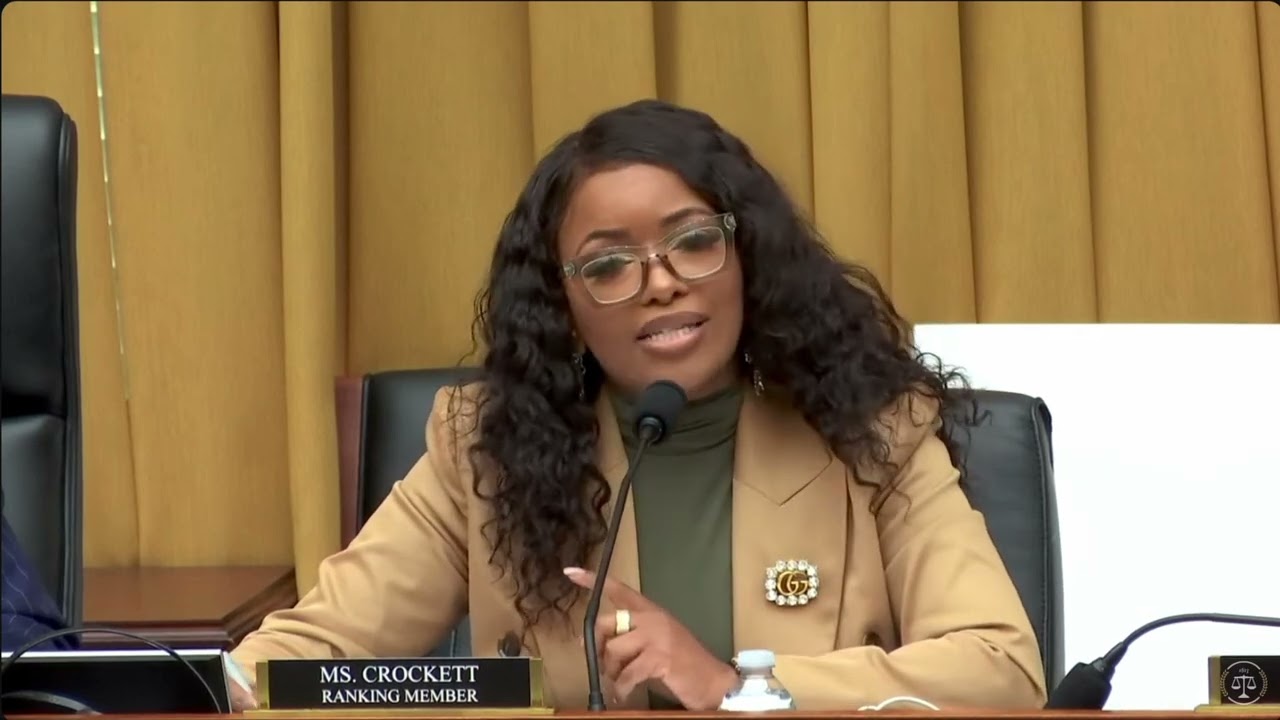
Congressional seals were embedded in the burgundy carpet, and oil portraits of former committee chairs gazed down from the walls with the stern expressions of men who had wielded congressional power in eras when bipartisanship was more than a quaint memory. The mahogany name plate in front of Jasmine read, "The Honorable Jasmine Crockett, Texas," in gold lettering that caught the television lights every time she moved. A reminder that she had earned her place at this table through the votes of constituents who believed in accountability, justice, and the radical idea that no one in America should be above the law.
The hearing began with the ritualistic formalities that characterize congressional proceedings. The committee chair gave the session to order, reading the witness oath that Don Jr. accepted with practiced ease, and opening statements from ranking members that fell along predictable partisan lines.
Republicans framed the hearing as political persecution designed to distract from Hunter Biden's laptop and the border crisis, while Democrats emphasized the importance of transparency and accountability in government contracting. Through it all, Don Jr. maintained the confident demeanor of someone who had performed this dance dozens of times before, occasionally whispering to his lawyers, but generally projecting the image of a successful businessman who was cooperating with Congress despite its obvious partisan motivations.
When the first round of Democratic questions began, Don Jr. handled them with the smooth professionalism of someone who had been media trained since childhood. Questions about his role in the Trump Organization were answered with detailed explanations of corporate structure and his responsibilities as executive vice president.
Inquiries about his knowledge of federal contracting procedures were deflected with humble assertions that he relied on experts and lawyers for technical compliance issues. Attempts to pin down specific dates and meetings were parried with the reasonable sounding explanation that he participated in hundreds of business meetings and couldn't be expected to remember every detail without reviewing documents first. Republican committee members used their time to ask sympathetic questions that allowed Don Jr.
to expand on his opening themes. his commitment to American business, his family's dedication to transparency, and his frustration with what he characterized as endless partisan investigations designed to damage his father's political prospects. He spoke passionately about the Trump Organization's contributions to American tourism, their employment of thousands of workers, and their pride in operating properties that showcased American excellence around the world.
His lawyers nodded approvingly behind him. Communication specialists took notes for the press release they would issue immediately after the hearing, and Republican committee members smiled broadly at responses that would play well in their districts. But experienced congressional observers noticed something different about Jasmine Crockett's behavior during these early exchanges.
Unlike her democratic colleagues who had asked broad questions about ethics and accountability, she remained silent during the first hour, taking notes in her precise handwriting and occasionally making marks in her color-coded folders. Her expression remained neutral and professional, but there was an intensity in her focus that reminded anyone who knew her background of a public defender preparing for a closing argument that would determine whether her client spent the next decade in prison or walked free. She was listening not just to Don Jr.
's answers, but to the specific words he chose, the claims he made, and the factual assertions that she could later use to demonstrate the vast gulf between his public statements and the documentary evidence she had spent weeks analyzing. When Chairman Comr finally called on Jasmine for her first round of questions, the atmosphere in the room shifted subtly but perceptibly. Television cameras zoomed in on her face as she opened her blue folder with deliberate precision, removing a single document that she placed directly in front of her without looking at it.
The silence stretched for perhaps 3 seconds, not long enough to seem theatrical, but sufficient to focus every person in the room on what was about to happen. Mr Trump, she began her voice carrying the measured tone of someone who had spent years questioning witnesses under oath. I'd like to start with something straightforward.
Can you tell us the gross revenue for Trump International Hotel Washington DC in fiscal year 2018? The question seemed innocuous enough that Don Jr. relaxed visibly, the tension leaving his shoulders as he leaned back in his chair and consulted briefly with his legal team.
After a whispered conversation that lasted perhaps 10 seconds, he turned back to the microphone with renewed confidence. "Approximately $47 million," he answered, his voice carrying the authoritative tone of someone stating an indisputable fact. Jasmine nodded politely and made a notation on her legal pad, her pen scratching against the paper in the sudden quiet of the room.
Then she looked up and asked, "And would you say that figure represents accurate reporting to all relevant government agencies? " It was the kind of question that seemed like a softball. Of course, a legitimate business would report accurate figures to government agencies.
Don Jr. shifted slightly in his chair, the first micro sign of discomfort that experienced body language experts would later identify as the beginning of his psychological unraveling. But his answer came without hesitation.
Of course, the Trump Organization prides itself on accurate financial reporting. We have teams of accountants and lawyers whose job is to ensure compliance with all applicable regulations. The response was perfectly crafted to sound responsible and professional, exactly the kind of statement that would play well in news clips and social media posts.
Behind Don Jr. , his lawyers nodded approvingly at the answer, and Republican committee members looked satisfied that their witness was handling the questioning competently. But Jasmine Crockett had spent six years as a public defender, and she knew the difference between a true statement and a statement that was technically accurate, but fundamentally misleading.
Her follow-up question was delivered in the same conversational tone as if she were simply seeking clarification on a minor point. That's interesting because according to the GSA lease agreements I have here, she said holding up a document without looking at it. The hotel reported different revenue figures for lease calculation purposes.
Would you like to explain that discrepancy? The temperature in the room seemed to drop several degrees, though the air conditioning hadn't changed settings. Don Jr.
's smile faltered for a fraction of a second, a micro expression that lasted perhaps 2/10 of a second, but was captured by every camera in the room. Behind him, his lawyers began shuffling papers with slightly more urgency than before. and the communications specialist stopped taking notes to focus entirely on the exchange unfolding at the witness table.
"I'd have to review the specific documents you're referencing," Don Jr. said, falling back on a standard deflection technique that had served him well in previous hearings. "His voice remained steady, but observers who knew what to look for could detect the first subtle signs of stress.
a slight tightening around his eyes, a barely perceptible increase in his breathing rate, and the way his hands had unconsciously moved from a relaxed position on the table to gripping the edge with his fingertips. But Jasmine was already moving to her next question, her preparation allowing her to maintain momentum without giving him time to recover his footing. "Of course," she said, her tone remaining perfectly professional.
Let's look at them together. What happened next would later be described by Politico as a masterclass in methodical destruction and by the Washington Post as the most devastating congressional questioning since Watergate. Jasmine didn't raise her voice, didn't make dramatic accusations, and didn't engage in the kind of political theater that had become standard in congressional hearings.
Instead, she began laying out documents like a prosecutor. building a case for a jury. Each piece of evidence perfectly positioned to create maximum impact while maintaining the appearance of simple factf finding.
This is your signature on the GSA lease modification in March 2018, she said, sliding a document across the table toward Don Jr. 's legal team. The paper made a soft rustling sound as it moved across the polished wood surface, a sound that seemed amplified in the suddenly tense atmosphere of the room.
And this is the revenue report submitted for tax purposes the same month. I wonder if you notice anything interesting about the numbers. Don Jr.
leaned forward to examine the documents, his lawyers clustering around him in a way that created the visual impression of a man under siege. The discrepancy was immediately obvious to anyone who looked at both documents side by side. A $7 million difference that couldn't be explained by standard accounting variations or reporting period differences.
The numbers were stark black ink on white paper, impossible to misinterpret or explain away with technical jargon. For perhaps 15 seconds, the witness table was a hive of whispered consultations. As Don Jr.
and his legal team tried to formulate a response that wouldn't create additional legal jeopardy while still maintaining his public position that the Trump Organization operated with complete integrity. The silence stretched long enough for television viewers to fully absorb the implications of what they were seeing. a man who had confidently claimed accurate financial reporting, being confronted with documentary evidence of his own contradictory statements.
When Don Jr. finally responded, he attempted to regain control through the kind of bluster that had worked for his family in previous political battles. Congresswoman, with all due respect, you're cherry-picking documents without understanding sophisticated business accounting.
These are complex financial instruments that require considerable expertise to interpret correctly. The Trump Organization employs some of the finest accountants and tax attorneys in the country, and I resent the implication that we would engage in any improper conduct. It was a tactical error of monumental proportions, questioning Jasmine Crockett's competence in front of cameras and witnesses who knew her background as someone who had spent years passing complex financial evidence in life or death criminal cases.
The condescension in his voice was unmistakable, and it provided her with the perfect opening to demonstrate exactly why his assumption about her capabilities was so catastrophically wrong. Her response came after a strategic pause that lasted exactly 3 seconds, long enough to let his condescension hang in the air like a toxic cloud, but not so long as to seem theatrical or calculated. When she spoke, her voice carried the quiet authority of someone who had faced down hostile witnesses, skeptical judges, and overmatched prosecutors throughout her career.
Mr Trump, I spent 6 years as a public defender in Dallas County. I'm quite familiar with reading financial documents under pressure, particularly when my client's freedom depended on my ability to identify discrepancies between what people claimed and what the evidence actually showed. Shall we continue?
The verbal slap was delivered with such professional courtesy that it took several seconds for its full impact to register throughout the room. Don Jr. 's 's face underwent a subtle but unmistakable transformation, the confident smirk being replaced by something approaching genuine concern.
Behind him, his lawyers exchanged glances that suggested they were beginning to understand that this wasn't going to be the routine political theater they had anticipated. The communications specialist had stopped taking notes entirely and was now focused completely on the unfolding disaster, undoubtedly calculating how much damage control would be needed once this hearing ended. Jasmine opened her red folder with the deliberate precision of someone who had every move choreographed in advance.
This is an email from you to your chief financial officer in April 2018. She said, removing a document that appeared to be a printed email exchange. You wrote, and I quote, exactly, "We need to massage the numbers for the government lease, but keep the real figures for our investors and lenders.
Can you explain to this committee what massage the numbers means in your business context? " The room went completely silent except for the mechanical hum of air conditioning and the almost inaudible sound of television cameras adjusting their focus. The quote hung in the air like an accusation that couldn't be taken back couldn't be explained away and couldn't be dismissed as a partisan interpretation of ambiguous evidence.
Don Jr. 's face underwent a visible transformation that would be analyzed frame by frame on cable news shows for weeks afterward. The confident expression dissolving into something approaching panic as he realized that his own words in his own handwriting had just been read aloud to a national television audience.
behind him. His lawyers were now passing notes frantically, their earlier confidence replaced by the kind of urgent consultation that suggested they were confronting a legal crisis they hadn't anticipated. The expensive Tom Ford suit that had looked so sharp when he entered the room was beginning to show signs of stress.
His shoulders had tensed visibly. His hands were gripping the edge of the table hard enough to whiten his knuckles, and there was a slight sheen of perspiration visible on his forehead despite the cold air conditioning. I, Don Jr.
, began, then stopped, his mouth opening and closing as he struggled to formulate a response that wouldn't create additional legal jeopardy. That email, I'd need to see the full context. There might be other emails that clarify, but Jasmine was already ahead of him, her preparation allowing her to anticipate every possible deflection.
"Of course," she said, her tone remaining maddeningly reasonable. "Let's look at the full email chain. " She removed another document from her folder, this one several pages thick.
"This is the complete correspondence between you and your CFO over a 6-w week period. Would you like me to read the entire exchange into the record, or would you prefer to explain what massage the numbers means in plain English? The trap had been set with mathematical precision, and Don Jr.
was beginning to understand that every possible response would only make his situation worse. If he allowed her to read the complete email chain, additional damaging statements would be entered into the congressional record and broadcast to a national audience. If he tried to explain the phrase himself, he would be forced to admit either to intentional fraud or to using language so careless that it suggested a pattern of reckless disregard for legal compliance.
For the first time since the hearing began, Don Jr. looked genuinely frightened. The realization was spreading across his face like a slow motion explosion as he understood that this wasn't political theater.
This was a methodical presentation of evidence that could result in criminal charges, congressional referrals to the Department of Justice and the kind of legal consequences that money and political connections might not be able to resolve. Desperation makes people do predictable things and Don Jr. was no exception to this fundamental rule of human psychology.
Faced with evidence he couldn't explain away and questions he couldn't deflect, he fell back on the Trump family's standard playbook. Attack the questioner's motives, claim political persecution, and attempt to change the subject to more favorable terrain. This is clearly a partisan witch hunt designed to damage my family politically, he declared, his voice rising for the first time during the hearing.
The change in volume was so sudden and dramatic that several observers in the gallery actually startled in their seats. You've already decided to attack us regardless of the facts, regardless of the evidence, regardless of our cooperation with this investigation. This is about the 2024 election, pure and simple, and everyone in this room knows it.
It was the kind of response that might have worked in a different context with a different questioner in front of a different audience. The Trump family had successfully used claims of political persecution to deflect criticism and energize their base for years, turning every investigation into a rallying cry and every legal challenge into evidence of deep state conspiracy. But Jasmine Crockett wasn't a political operative or a partisan prosecutor.
She was a former public defender who had spent years representing clients whose freedom depended on her ability to focus on facts rather than politics, evidence rather than rhetoric, and truth rather than convenient narratives. Her response demonstrated exactly why she had been such an effective advocate for her clients and why she was now proving to be such a devastating congressional questioner. She didn't take the bait, didn't respond to the personal attack, didn't even acknowledge the political framing that Dawn Jr.
was desperately trying to impose on the proceedings. Instead, she looked down at her yellow folder, the one she hadn't opened yet, the one that everyone in the room was now staring at with a mixture of fascination and dread, and said quietly, "Mr Trump, I'm not interested in politics right now. I'm interested in whether you committed fraud against the United States government.
" The word fraud landed in the room like a physical blow. Its legal implications immediately clear to everyone present. This wasn't about political differences or policy disagreements or the kind of ethical gray areas that characterized most congressional hearings.
This was about potential criminal conduct, the kind of serious federal crime that carried prison sentences measured in years rather than months. Television cameras zoomed in on Don Jr. 's face, capturing the moment when his pupils dilated slightly.
A stress response that was visible to anyone paying close attention and would be analyzed endlessly by body language experts in the days to come. That's a very serious accusation, Don Jr. managed, but his voice had lost all of its earlier confidence.
The bravado that had carried him through the first hour of questioning had evaporated completely, replaced by the kind of barely controlled panic that comes when someone realizes they might be facing consequences they had never seriously considered possible. Sweat was now clearly visible on his forehead despite the 68° temperature in the room, and his expensive suit looked rumpled despite having been pressed that morning. Behind him, his legal team was engaged in increasingly urgent consultation, papers being shuffled with obvious desperation as they tried to formulate advice for a client who appeared to be digging himself deeper into legal jeopardy with every word he spoke.
Jasmine opened the yellow folder with deliberate, methodical precision, removing a single document that she placed directly in front of her without looking at it. The gesture was simple but powerfully theatrical, suggesting that this final piece of evidence was so devastating that she didn't even need to review it before proceeding. Every person in the room was now focused entirely on what she was about to reveal.
The earlier political theater and partisan positioning completely forgotten in the face of what was clearly about to be a moment of historical significance. It's a very serious word. Yes, Jasmine replied, her voice carrying the quiet authority of someone who understood exactly how serious the implications were.
But sometimes serious words are necessary when we're dealing with serious actions. Let me show you why I'm using it. The trap had been constructed with the kind of methodical precision that reflected not just Jasmine's legal training, but her deep understanding of human psychology and the way that guilty people respond when confronted with irrefutable evidence of their wrongdoing.
Three rounds of escalating evidence, each building on the last, each creating a narrative that was not just compelling, but mathematically airtight. financial discrepancies that couldn't be explained by accounting differences, email communications that revealed intent to deceive government agencies, and now the final piece of evidence that would tie everything together in a way that made denial impossible and deflection futile. "Mr Trump," Jasmine said, her voice perfectly calm despite the electric tension that now filled every corner of the room.
You've told us today that your family business prioritizes accurate reporting. You've insisted that any discrepancies are simply the result of complex accounting procedures that require expertise to understand. You've suggested that my questions are politically motivated and that this entire hearing is a partisan attack on your family.
So, let me ask you something very simple. She held up the single document she had removed from the yellow folder. Not multiple pages, not complex financial instruments, not ambiguous email chains, but one piece of paper that everyone in the room could see clearly.
The document appeared to be an official government form printed on a letter head that was immediately recognizable to anyone familiar with federal law enforcement agencies. This is a signed affidavit from your own chief financial officer, Alan Weiselberg, submitted to the FBI last month as part of his cooperation agreement," Jasmine continued. Her words falling into the silence like stones dropped into still water.
In this sworn statement made under penalty of perjury, he states that you personally directed him to submit false revenue figures for government lease calculations, specifically instructing him to under reportport income by approximately $12 million over a three-year period, resulting in reduced lease payments to the General Services Administration. The impact of her words was immediately visible throughout the room. Don Jr.
's 's face had gone completely pale, the color draining from his cheeks so rapidly that it looked like someone had adjusted the contrast on a television screen. Behind him, his lawyers had stopped their frantic consultation and were now staring at their client with expressions that suggested they were seeing him clearly for the first time. Even the Republican committee members who had been defending him throughout the hearing were now looking uncomfortable.
their earlier confidence replaced by the kind of strategic silence that politicians adopt when they realize they're on the wrong side of an unwinable fight. But Jasmine wasn't finished. Her preparation had been so thorough, her evidence so comprehensive that she had anticipated every possible response and prepared devastating follow-ups for each one.
Mr Weiselberg also provided FBI agents with digital recordings of your conversations, including one from March 2018, where you specifically told him, and I quote from the FBI transcript, "The government doesn't need to know our real numbers. They're getting a good deal either way, and what they don't know won't hurt them. " The silence that followed was so complete that the mechanical hum of the air conditioning seemed deafeningly loud.
Television cameras captured every nuance of Don Jr. 's expression as the full implications of what he was hearing began to register. This wasn't just about financial discrepancies or accounting irregularities.
This was about recorded evidence of intentional fraud, conspiracy to defraud the government, and the kind of criminal conduct that federal prosecutors built careers on prosecuting. "Given this testimony from your own employee, made under oath with corroborating audio evidence that has been verified by FBI technical analysts," Jasmine continued, her voice remaining perfectly level despite the magnitude of what she was revealing. I have a very simple question for you.
She paused, looking directly at Don Jr. with the kind of steady eye contact that trial lawyers use when they're about to deliver a devastating blow. The pause lasted exactly 5 seconds, long enough to ensure that every person in the room, every television viewer, every reporter taking notes, understood that what came next would be the moment that defined not just this hearing, but potentially Don Jr.
's entire future. Are you going to keep lying to Congress? The question hung in the air like a suspended sentence of judgment.
Don Jr. opened his mouth, his lips moving as if he were trying to form words, but no sound emerged. He closed his mouth, opened it again, his eyes darting frantically between his lawyers, the committee members, and the cameras that were recording every second of his complete psychological collapse.
For a man who had spent his adult life giving interviews, making speeches, posting on social media, and defending his family in public forums, the silence was absolutely devastating. 10 seconds passed in complete quiet. 20 seconds, 30.
The room was so silent that observers could hear the scratch of pens on paper as reporters took notes. The soft wor of camera motors adjusting focus, even the barely audible sound of Don Jr. 's increasingly rapid breathing as the full weight of his situation began to crush down on him like a physical force.
When he finally spoke, his voice was barely above a whisper, so quiet that the microphones in front of him had to strain to pick up his words. I I need to consult with my attorneys. It was the sound of complete defeat, the verbal equivalent of a white flag being raised on a battlefield where the outcome was no longer in doubt.
For someone who had built his public persona on aggressive confidence and defiant confrontation, the admission that he needed legal counsel before he could even respond to a direct question was tantamount to a confession of guilt. Jasmine's response would become the most viral political moment of 2025. A phrase that would be printed on t-shirts, shared millions of times on social media, and quoted in history books as an example of how truth and preparation could triumph over wealth and privilege.
Her delivery was perfect, not triumphant or gloating, not angry or political, but simply the calm statement of an incontrovertible fact. The truth doesn't need consultation. Seven words that captured everything wrong with a political system where wealthy connected families had operated above the law for so long that they had forgotten truth was still more powerful than money, preparation more valuable than privilege, and facts more devastating than any political spin machine.
seven words that demonstrated why Jasmine Crockett had been such an effective public defender and was now proving to be an unstoppable force for accountability in Congress. The immediate aftermath was chaos barely contained by congressional protocol. Don Jr.
was conferring frantically with his legal team. Their whispered conversations growing increasingly urgent as they realized that their client had just been caught in provable lies before a national television audience. Republican committee members were suddenly finding their phones fascinating, checking messages and making notes with the kind of desperate focus that politicians display when they're trying to avoid taking positions on careerending scandals.
Democratic members were struggling to maintain professional composure while internally celebrating what they knew was a watershed moment for government accountability. In the gallery, reporters were typing frantically on phones and laptops, filing stories that would dominate news cycles for weeks to come. The phrase, "The truth doesn't need consultation," was already trending on social media platforms, being shared and retweeted by millions of Americans who had watched the exchange live and understood that they had witnessed something historically significant.
Television producers were making split-second decisions about breaking news coverage. Cable networks were clearing their evening schedules to provide wall-to-wall analysis, and political commentators across the spectrum were struggling to find adequate words to describe the complete demolition they had just witnessed. But perhaps most importantly, federal prosecutors in the Southern District of New York were watching the hearing with the kind of professional interest that suggested Don Jr.
, as legal troubles were just beginning. Within hours of Jasmine's questioning, the Department of Justice would announce the formation of a special task force to investigate financial irregularities in federal contracting during the Trump administration. Within days, grand jury subpoenas would be issued for Trump Organization financial records.
Within weeks, Don Jr. would be facing the kind of federal criminal charges that his family's wealth and political connections would be powerless to prevent. The Trump Organization's stock price, which had been trading at near record highs based on expectations of political rehabilitation and renewed government contracts, dropped 12% in after hours trading as investors realized that the company's executive vice president might soon be facing federal prison time.
International business partners who had been negotiating new deals suddenly discovered scheduling conflicts that prevented them from proceeding with agreements. Banks that had been extending credit began quietly reviewing their exposure to Trump organization debt. But the most significant impact wasn't financial or legal.
It was cultural. For years, the Trump family had successfully convinced their supporters that every investigation was politically motivated, every legal challenge was partisan persecution, and every damaging revelation was fabricated by hostile media outlets. Jasmine Crockett had demonstrated with mathematical precision that some truths are simply too powerful to be spun away, some evidence too comprehensive to be dismissed, and some lies too obvious to be defended.
Social media exploded with variations of her viral phrase, "The truth doesn't need consultation," became a rallying cry for accountability advocates, a response to political spin from all parties, and a reminder that in a democracy, facts still matter more than narratives. Women across the country, particularly black women who had seen themselves reflected in Jasmine's calm competence under pressure, shared the clip with pride and determination. Lawyers and prosecutors praised her technique, noting how she had built her case methodically without ever losing her temper or resorting to political rhetoric.
Even conservative commentators who had spent years defending the Trump family found themselves struggling to explain away what viewers had seen with their own eyes. The evidence was too clear, the contradictions too obvious, and the moment of collapse too complete for even the most skilled spin doctors to rationalize. Some attempted to argue that the hearing was still politically motivated, but their arguments rang hollow when confronted with audio recordings and sworn affidavit from Trump Organization employees who had cooperated with federal investigators.
International media coverage was equally devastating with foreign news outlets treating the hearing as evidence of American democracy's ability to hold powerful families accountable despite their wealth and political connections. The contrast between Don Jr. 's confident arrival and his speechless departure became a symbol of how preparation and principle could triumph over privilege and corruption.
Diplomatic cables from allied nations noted the exchange as evidence that American democratic institutions, while damaged, retained the capacity for self-correction when guided by principled leaders who prioritize truth over political advantage. In the weeks that followed, Jasmine Crockett would become one of the most recognizable faces in American politics. Not because she sought celebrity, but because she had demonstrated something that millions of Americans had begun to doubt was still possible.
That truth properly presented by someone with the skill and determination to present it effectively could still matter more than money, connections, or political spin. Her methodology would be studied in law schools. Her questioning technique analyzed by prosecutors and her calm demeanor under pressure cited as an example of how to maintain dignity while fighting for justice.
The long-term consequences extended far beyond Don Jr. 's personal legal troubles. Congressional Republicans who had spent years defending the Trump family's business practices suddenly found themselves explaining to constituents why they had ignored obvious evidence of fraud.
Democratic candidates across the country used clips from the hearing in campaign advertisements, not as partisan attack ads, but as examples of the kind of accountability and competence that voters could expect from their representatives. Ethics courses in business schools began including the exchange as a case study in how financial misconduct inevitably comes to light when subjected to thorough investigation. Most importantly, the hearing demonstrated that the American system of government, despite all its flaws and failures, still retained mechanisms for holding powerful people accountable when those mechanisms were operated by individuals with the skill, preparation, and moral courage to use them effectively.
Jasmine Crockett had proven that no family was too wealthy, no individual too connected and no organization too powerful to escape consequences when their actions violated the law and their lies were exposed by someone who understood that the truth properly presented doesn't need consultation, doesn't require political cover, and doesn't depend on partisan support to retain its devastating power. As Don Jr. left the hearing room that afternoon, surrounded by lawyers and communication specialists whose expensive services had proven utterly inadequate.
When confronted with simple facts presented by someone who understood how to use them effectively, observers couldn't help but notice the contrast between his defeated posture and Jasmine's calm professionalism as she organized her folders and prepared for the next witness. She had demonstrated that in America, at least on this day, in this room, with these facts, the truth still mattered more than everything else, and that sometimes, just sometimes, that was enough to change everything. I could end it here, but what's really going to stay with you is in the next video.
It's on your screen now, and honestly, it's the best thing you'll watch this week.