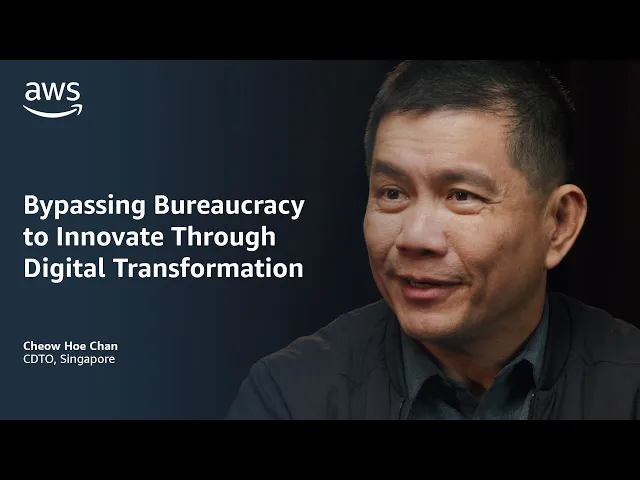
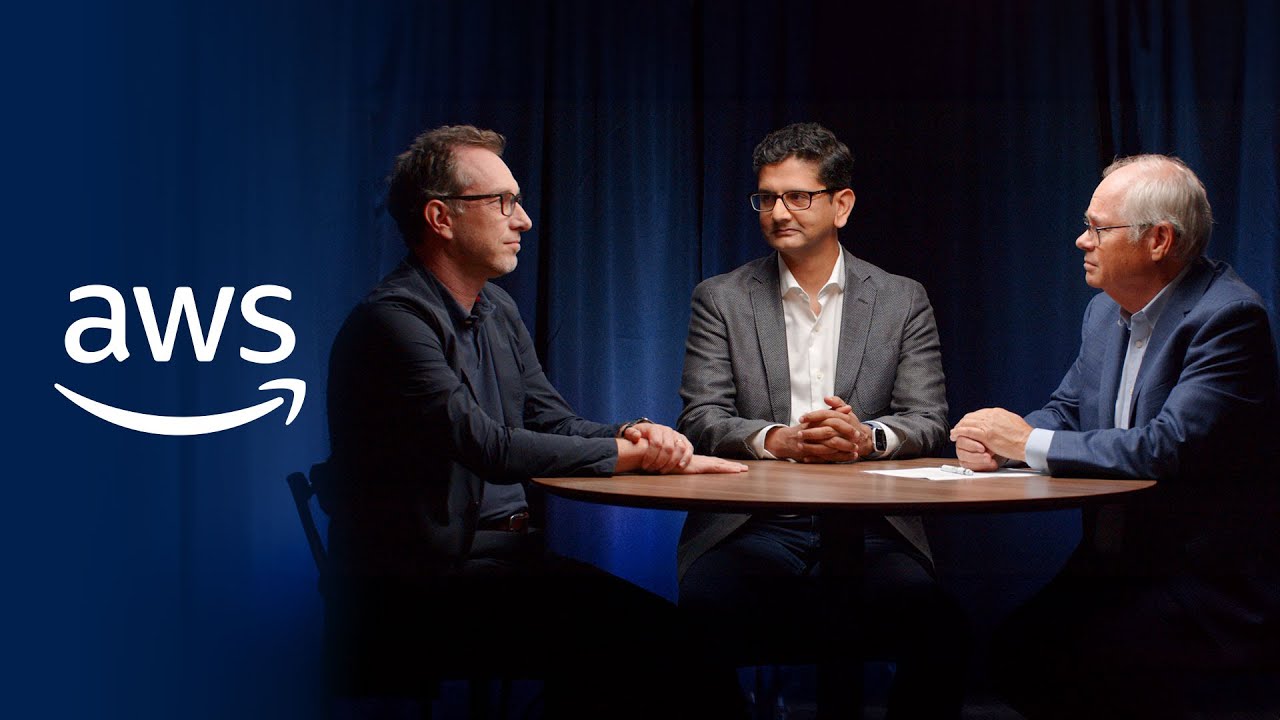
(upbeat music) - Well, my name is Tom Soderstrom, and I'm an enterprise strategist at AWS, and we're gonna have a conversation with leaders with a very, very innovative leader, Cheow Hoe Chan, Chief Digital Technology Officer of Singapore. - [Chan] Right. - And Cheow Hoe, can you tell us a little bit about yourself and your role?
- I basically was brought in to do the digital transformation for the Singapore government nearly 10 years ago. Well, this journey has been a incredible journey because at the end of the day, we all tend to think of innovation as something huge. Moonshot, things that's gonna shake the earth, but actually it's not about that, right?
Because digital transformation's all about innovation and it's constant innovation. And I think that therein lies the challenge. How do you start building an organization, a culture that allows people to keep doing that?
Especially in the government context. It's not natural. It's just not part and parcel of the government.
But bureaucracy prevails and red tape prevails. But our job was to really change the way we do technology in the government, and more importantly, is to create the impact for citizens and businesses out there. - I love that 'cause I've followed what you've done and you have so many success stories.
So I was at Chief Technology and Innovation office for IT at NASA's Jet Propulsion Laboratory. One reason that I came to AWS was to build its chief technologies organization and now enterprise strategist with a belief that the public sector can be at least as innovative as the commercial sector, if not more. And you have done some amazing things.
Can you give us a few examples of the things you consider amazing? - I think one of the biggest challenge in the very beginning was to bring in the right people. Because honestly, most governments don't have innate capabilities, especially given the fact that most government outsource like 95% of their projects.
So it's quite hard to be innovative when you really don't have the right people and the right culture, basically. - Right. - So I think the first thing we did was really to bring in people from all walks of life literally.
I mean, the private sector, different parts of the public sector, startups, big companies, small companies. Because I think there is a diversity that creates a culture of innovation because it's really about people talking to each other, people having different skills, different contexts that will produce the kind of culture. So I think that was really the first very important part that needs to be done.
And then when they come in, next challenge is that how do you create a unique culture that may or may not reflect what the government culture is? The reason why they may or may not is because it can't be 100% like the government. It cannot also be 100% like the startup, for example.
- That's right. - Right? - Both cases they're extreme whereby it will just make the whole team unsuccessful.
So that's really the second very important part. The third point was governments are inherently conservative, which is a problem in many ways, right? So if anyone sense that you're doing something that will blow up the government, no, nobody's gonna help you.
That's why I believe in one of the most important mantra, which is think big, start small, but move really fast. And I think that's really important as a starting point, how we started the innovation culture in the government. - That's strong, I'm gonna repeat it 'cause it's so strong.
Think big, start small and move. Move fast, but at least move. That we saw that 'cause the inertia sets in.
- [Chan] Oh yeah. - But once you start moving, you see successes. - Because Tom you must realize that governments are used to big projects.
- [Tom] Right. - Every project is $100 million, $200 million, $500 million. And when you have a project this big and it fails, it's extremely obvious, very conspicuous, right?
And the public will know about it. So these projects not meant to fail in the sense of what, but you and I know that innovation's about failing, right? If you can't fail, then everybody will be very conservative.
They'll just outsource the responsibility. And just will pray that they'll deliver it someday, whether it's three years or five years from now. And they probably rotate out of their position in the first place.
So I think that's really the context which inhibit innovation. - No, I think that's a super point. For us, at Jet Propulsion Laboratory, the risk of failing in space was huge.
- [Chan] Of course. - So that translated down to the risk of failing on ground was huge. So we had to kinda change that culture a bit.
But it's okay to experiment 'cause it's not actually a space project yet. How did you get that culture in that it's okay to experiment and experiment doesn't work right away? - Yeah, so it's back to this thing about think big and start small, right?
We know we had to do a bunch of things. We knew that if you look at the horizon, whether it's move to cloud, whether it's to try modernize all the legacy systems, et cetera. There are many things that we knew we had to do.
- Right. - That's thinking big, right? The question is how do you start?
So what I did was that I started an innovation fund in the very beginning. - Okay, good. - And it's really about getting people to come up with ideas on how to solve a problem and give them two constraints.
Very little money and very little time. The problem government's the other way around, right? You give them a lot of money and you give them a lot of time.
And both cases leads to catastrophic projects, for lack of better word, right? - No, I love it. I would always say the enemy's money and time.
- Yeah. - Too much money and too much time. - So if somebody comes to us with a good idea, they do a pitch to us.
We might giving like $50,000. You got three months, $50,000. Show me something.
- We used to give them two weeks, 10,000. - Okay, you are cheap. - I am cheap.
- So we do that and then they come back after about two treat months and then they pitch to us again. And if it's not working out well, we just killed it. - When you killed it 'cause we would do the same thing.
The intent of the experiment was to kill it. And we'd have to say why shouldn't we? 'Cause there were so many experiments.
When you killed it, what happened to the people? - Oh, one of the things that we wanted to do is that after you think that it's not gonna work. They actually have to do a postmortem.
What are the lessons learned, I mean, we don't just throw the money down the drain. But more importantly is that if that prototype or that idea has any kind of traction, then we will actually give them more time and more money. - Yes, very true.
- So that's how you progress. So you're kind of funneling it up whereby you have 30, 40, 50 projects, and then all of a sudden it goes to 10, 15. And it goes down.
And then the real proof proof in the pudding is when we reach a certain point after maybe about six to nine months that we think it's not a bad idea. They have a limited prototype. Looks pretty good.
Now your job is to find the agency that's willing to work with you. To actually implement it. This is the third part, which is very important, right?
Because a lot of times, many of these hackathons and everything don't see a light of day. - [Tom] No. - They look good.
Everybody's so happy about it. They great stuff. But that next step is the most important.
Would you find a buyer? Can you find a buyer? - I like the way you thinking of the government agency as a buyer.
- They're buying, they're to support it. They have to think that it makes sense for them. Because if nobody wants to buy their product, then big question, right?
So that's a really very important stage. And if they can find a buyer, we want the agency to co-fund the projects. The next part, you need skin in the game, right?
When you're skin in the game, people are a lot more committed to get things done. And then when they're successful, then comes the real ruling out to other agencies and kinda productizing it to a point whereby it becomes systemic sustainable. - And then that initial buyer is a hero.
- Yeah, it's a hero. We profile them. And I think one thing I learned very quickly, right?
When you're younger, you tend to be egotistical. When you get older, you realize one thing. It's not your idea, it's their idea.
- Exactly. Yep, give them credit. - Make them successful.
Give them credit, let them pitch to their minister. - It's a wonderful equation. You shared credit is double credit.
- Yep, exactly. - In the end. - So we did a lot of these things.
I think one of the interesting thing also is that you start listening to people. It's not always from the bosses. One of the biggest challenge I think in the government is it's always the boss that matters.
The more senior you are, your work carries more weight than somebody down the echelon basically. So I give one example. One really real example, which happened like eight, nine years ago, which is quite interesting, right?
One of the agencies which runs the emergency ambulance 995 line. So when you call 995, they dispatch ambulance for emergency services. Now these guys are really under stress because they get literally a lot of calls every day.
And then they came to us and say that they have a problem. So we asked them what's the problem? The problem is, is that ambulances can't get to the patients in time because they realized there was 70% of the calls will be with cardiac arrest.
You got 10 minutes. - Oh goodness. - Yeah, the guys on the floor, you got 10 minutes, you don't intervene, the guy's gone.
And then they say, why don't you do a mapping and say we are gonna have a very innovative way of deploying ambulances around the island. Because in the past it was like different centers, right? Like eight or nine, two centers and it's not optimal.
So my guys did a simulation to figure out the travel time ambulance doing peak hours, non peaks and all that stuff and map it out. And then the guy came back to me and said, "Oh my God. " I said, "Why?
" He said, "During the peak hour, 10 minutes by you like about two kilometers or two and a half kilometers, because your traffic light, you traffic jams doesn't get you far. " So the only way to deploy in thousands of ambulances, which you can't afford, right? So we say, oh no, this is bad news, right?
So we spoke to the head of the department. And then one young guy came was at the site. He said, "Why do we crowdsource life saving?
" So he say, "Okay, how do you mean that? " He say, why don't you get volunteers, we build a simple app, we get volunteers, people with Red Cross training, doctors, paramedics, et cetera, who are off duty. And if they're anywhere near that case, we will give them notification and they can choose to go and help.
So it's a very simple idea. - There it is. - Three person did the program in like, I think about four months.
Three and half, four months. And we launched it as like a pilot. Initially I was 21st because there was only like about a 100 volunteers because they were all our friends and families, right?
We called and said get in to volunteer. But then the first life was safe, which is very interesting, right? A man, elderly man was on the floor somewhere on the side of the road.
This university student had a notification, went there, did CPR and saved him. - Wow. - And it came on the papers.
And today that app has about 130,000 volunteers. So all of a sudden you are really blanketing the country. - That's fantastic.
- We have volunteers who can actually intervene first, I mean, stabilize the person before the ambulance comes. - And what an amazing thing for the person who came up with that idea. - Yeah, he's a young developer.
- What happened to him? - He's still part of the team. Young developer.
He wasn't the most senior. In fact he was the most junior guy. So I think that the value here is that when you start listening to people, actually the senior people normally don't have good ideas.
It's really the young guys on the ground who are more connected in a sense. - We find the same thing. So it's really important to fall in love with the problem, not the solution 'cause the problem persists.
And so many times we found that the original problem, the original solution, it's supplanted by better solution. What we found is we do that first prototype. Then get it into the end user's hands.
And they will improve it 100 fold in no time. - And the improvement part is very interesting, right? So the initial app was very simplistic, nothing much more than that, right?
In fact, the interface was terrible because it was done in three and a half months or something like that. Then we started learning that, hey, you know something, we should also put location of where the AED machine is. In Singapore, the electric AD machine.
So we put exactly where it is so that the volunteer can also find it. Right? - Makes sense.
- So another improvement, right? - [Tom] Yeah. - Then one improvement that shocked me the most was that they started putting a 995 button on the app itself.
And I said, "Why do you do that? " Again, user story, right? - [Tom] Okay.
- They realize that it's better to put the 995 button on the app and you call using that rather than the phone. Do you know why? When people call, they're panicking because something happens.
- Right, right, right. - And they give the wrong address. Or worse, you know what they tell you?
Oh, this man is by a big tree in the park and the park is really big and there are many big trees. Where the hell you're going to find that guy? So this allows us to geolocate exactly where the person is - Perfect.
and ambulance can go there. So these are ideas are important because you start with something small, but it comes something more complete as you go forward. And that's what agility is all about.
It's really not about going out there and building this huge application tomorrow morning and spend 50 million bucks doing it. - Yeah, no, it's amazing. The other thing I wanna dive into a little bit is the think big.
So I Jet Propulsion Laboratory came up with lots of problems that need to be solved. AWS solved them with various services. You've done the same.
So again, government can get solutions from their partners. In this case AWS. Do you wanna talk a little bit about this latest one, which I find fascinating?
- Yeah, before that I actually want to comment on your point. When we went to the cloud, it was a painful birth in a sense, right? Because it took quite a long time to get to the cloud.
Policies was not there. Governments don't use cloud and a whole bunch of things. When we finally got to the cloud, we were blessed by something very important.
After that the pandemic struck. - Oh yes, of course. - And it was amazing, right?
Because if you are not on the cloud, we would not have been able to do many of these apps like TraceTogether, which is our app for contact tracing. We did the app in like four weeks, huh, Tom? I mean it's like.
. . - Yeah, 'cause all the bureaucracy disappeared.
- Disappeared. - Yeah. - And we just got our guys focused on the cloud, did the app and just move.
We scale it like crazy, right? Because we didn't have to worry about scalability. - Right.
- And to me, that's really a blessing disguise because we were not in the cloud and we had to use on-prem, call the tender call a vendor, whatever. Oh my goodness. That would've been, what?
nine months before something comes out. - For us it was the one-way door and two-way doors. You're familiar with those?
- Yep. - So any experiment in the cloud was a two-way door. If it was in a data center, it was a one way door 'cause you had to bring in a bunch of service.
So we saw the level of experimentation go sky high. Now in Singapore you had other issues about latency and security. - You see at the end, the cloud is a journey.
- Yes. - It's not destination. - And then I was just explaining to someone just now, right?
That when we first started the cloud journey, we did something very simple. We took all the unclassified and content websites and we just created a commercial cloud. And it's simple, why?
Because nobody was against it. Because it's sensitive. - No, public, right.
- It's public information. - So what's a big deal? - And it's actually better 'cause you don't have to let people into your internals.
- Then comes the next set of workloads, right? That's where the tricky part comes in. Those will contain customer data or citizen data, et cetera.
Privacy becomes a problem. Then we evolved this thing called GCC, right? Government and Commercial Cloud.
But it's still the commercial cloud. But we had three or four restrictions on it, or four constraints on it. One was that the data must been simple.
But that was simple, we'd simply done, we just use the Singapore region, that's it. And the reason why data has been Singapore for those things is because one of the challenges of cloud is the total lack of transparency. So if your data is not residing in Singapore, let's see your data is residing in Tokyo, for example, because the cloud can push the data any way you want.
And when something happens, which law is it subject to? It's a big problem, huh? - Right.
- But if it's in Singapore, it's subject to Singapore law. So if let's say somebody wants to sue the government for breach or privacy or whatever it is, the law applies. So that was a very important consideration.
- [Tom] Good. - And it's not because we are paranoid about data, not. It's really about that, right?
It's about the applicability of governance and law and legal restrictions on data protection. So that's very important. The second thing we had to do was to make sure that you understand that most governance systems are still on-prem at the time.
The customer facing parts problem in the cloud. So question is how do you ensure that it communicates safely. And that's why we start building an API gateway and to be able to monitor the traffic and whole bunch of other stuff, right?
So that's again, very, very important. The third thing that was very important to us is that we were still using a lot of vendors and they are vendors and there are vendors, right? A lot of vendors are not cloud native.
So how do you ensure that there's the baseline security every time you implement? Because you and I know as cloud practitioner that the biggest challenge of security in cloud is misconfiguration. - Right.
- You don't configure it well, anything can happen. So these are some stuff we put in and that's why we brand it as Government and Commercial Cloud. But we are sitting on AWS Azure and GCP anyway.
With that, we were then able to move the next batch of workload onto the commercial cloud. Then comes the next batch. It just gets more difficult, right?
Whereby you start talking about highly sensitive data, machine critical workloads. We again, wanted another level of protection, higher transparency, more resiliency, survivability, security, right? - And by the way, every government shares these exact same issues.
- We are in touch with many governments, but at the same time, there's a challenge, there are a lot of prophets out there who was preaching the concept of a sovereign cloud. And the initial concept of a sovereign cloud was that you lock everything up, disconnect from the internet and build a cloud. to me it's a contradiction in terms somehow, right?
The law of physics supply, right? If you shut everything off, it ceases to become a cloud. So that was the challenge, right?
And the second thing is that you lose all the services of the ecosystem because you're not connected to the internet. But then the arguments will be, oh yeah, it doesn't really matter because he can move the services into this sovereign cloud. And I tell them, you know something, it costs a lot of money.
So these things are just cost a bomb by doing that. We wanted some mooting whereby we are working in edit somehow, right? We want the full cloud experience, the connection to the ecosystem, but at the same time with the transparency, the protection, et cetera.
And that's how we evolve into the Dedicated Local Zone. - So the Dedicated Local Zone is released and it's something that every government can emulate now. And I think that's thinking big.
And then iterating towards it. And I really admire the way you did that. - You see a lot of people tend to look at cloud as just a checkbox, right?
I'm on the cloud, but then you dig deeper and say, how much of your workloads on the cloud? Oh 5%, that's not being on the cloud. Today's Singapore is really about, we have really moved about 70% of the workload to cloud.
- Is it that much now? - Yeah, 70%, right. Significant, huh?
No one can claim that basically, right? And the reason is because we're serious about it. That's about thinking big.
But we started really small. It started simple and small and evolve. - And the third key action.
- Yeah, getting it done is actually the most difficult thing because I love all the strategy and policy papers. It's like reams of that. And the words about wine slides right there.
Like everybody is about wine slide. It's easy to draw the power wine slide, but the execution's important. - Yeah, no, I think it's fantastic.
Now, if you were going to give some advice to other leaders in government, and you've also worked in commercial. So what would be some of the advice to these future leaders and current leaders? - I think that the two things that's very important is, one is that are they even committed?
The digital journey or the journey in the cloud, et cetera. These are huge commitments. It's not something you do in one year.
So the commitment has to be there and the support from the senior leaders has to be there. Because if that is not there, then chances are it will fail. Quite high, that's number one.
Very important. I think the second thing then is really about the fact that you need to build capabilities. Governments today, most governments really don't have a capability.
And if your leaders and your managers or your people don't have the capabilities, you would not be able to make those decisions because technology is complex. Knowing the substance from the form is very important. - Oh, yeah.
- As you go forward, right? - Yeah. - So I think these are very important things that people need to do.
And that's what we did from the very beginning. - So with all of what you have accomplished, and we've only scratched the surface, what is the one leadership principle that you like the most? - I'm always a firm believer of leadership by example.
I don't think leaders should be managers. You don't manage, you do. You have to be with the team, you gotta do it right.
Because pure administrative management doesn't get you this far - No. in the first place. So you gotta show example, you got to be part and parcel of this whole thing.
I was very much responsible for the design of, for example, DLZ. So you really got to get your hands very dirty because that shows accountability, it shows commitment, which I think is so important. - No, that's well said.
As always, I'm sure we're gonna see some amazing innovations coming up from you that we haven't even thought about yet. - Hey, thanks for your time. It was a great conversation.
Enjoyed it. - Yeah, thank you so much. - Thank you.