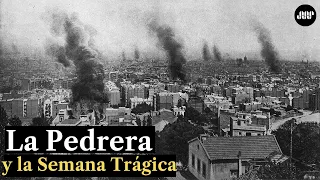
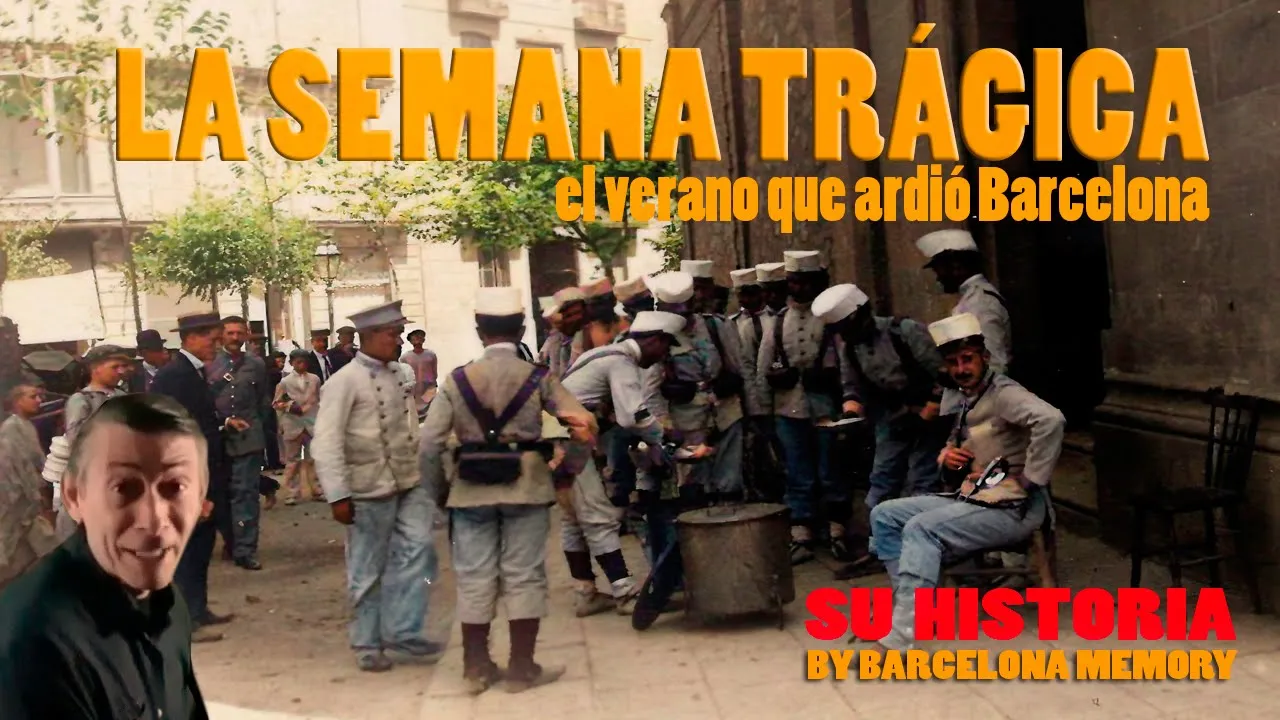
TRAGIC WEEK. The summer that saw Barcelona turn into a bonfire. Early in the 20th century Barcelona was clearly expanding It had half a million inhabitants, of which 41% were younger than 30.
In addition, more than 20,000 people arrived looking for a job every year. The oppressed working class was fully embracing revolutionary ideals like anarchism, socialism and communism and had already reared its head with several terrorist attacks against authorities and factory owners. The ruling monarch was Alfonso the 13th and Antonio Maura, a conservative, was President (the great-grandfather of Carmen Maura, the actress).
After the loss of Cuba and the Philippines, the industrial bourgeoisie of Barcelona, especially those who had made their fortune in the Americas, lost their foremost market, which had grown on the wings of protectionism. Additionally, as agreed by the Treaty of Algeciras, Spain had to take control of the northern part of Morocco. However, during the summer of 1909 a series of events happened that no one could have foreseen… Tragic Week.
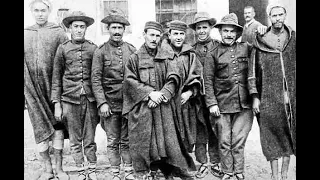
THIS IS ITS STORY. On July 9, 1909 citizens of Barcelona read a piece of news in the papers that would have a major impact: In the Moroccan Protectorate, tribes in the Rif were attacking Spanish citizens, miners and workers who were building a railway line… …for two companies, Sociedad Española de Minas del Rif and Compañía del Norte Africano that were mainly controlled by two of the wealthiest Spanish families, the Romanones and the Güells. Maura’s government had to call up to duty 40,000 reserve troops between 1903 and 1907.
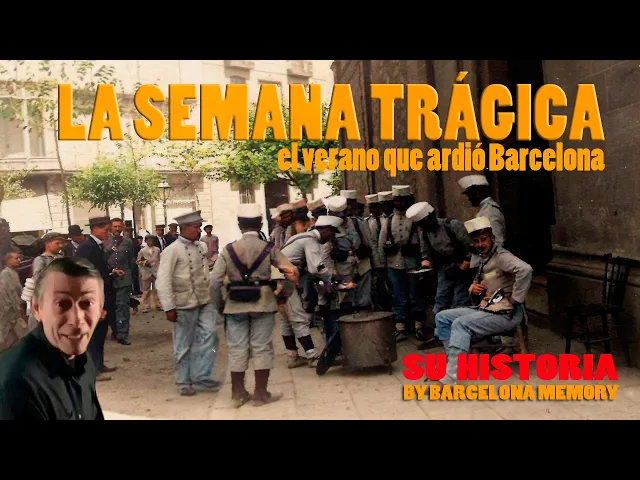
Many had already finished their military service, and were family men who could not afford the 6,000 Reales required to get out of service. The Combined Brigades of Catalonia, Madrid and Campo de Gibraltar were mobilized. The Catalan Brigade and all recruits were to set sail on the next day.
Socialist and anarchist agitators had organized anti-war rallies and demonstrations in Madrid and Barcelona, and they went down to the port to prevent the troops from boarding shouting: Down with war! Let the rich serve! Let the rich serve!
Down with war! Let the rich serve! On July 11 the first troops departed for Africa on ships that belonged to the Marquis of Comillas.
On July 12 the Royal Decree to mobilize reservists was signed. Republicans, socialists and anarchists protested. On July 14 the Hunter Battalion of Barcelona set sail, and after that Merida Battalion on the 15th, Alba de Tormes on the 16th and part of Alfonso the 13th Battalion.
The last troops departed on the 17th. On Sunday, Socialist leader Pablo Iglesias threatened with a general strike. In Barcelona, social tension was palpable.
Reservists from Reus battalion quartered in Manresa went down the Ramblas shouting: Down with war! Down with Comillas! Down with war!
Throw down your rifles! Let monks serve! Down with war!
Tempers flared when the reservists reached the port, where they brought down the fences protecting the steamboat “Cataluña”. Police officers fired several warning shots. To avoid making matters worse, boarding was temporarily suspended.
On Monday, there was more bad news from Africa: The press reported more casualties on mount Gourugou. Protests spread to Bilbao, La Coruña, Valencia, Zaragoza and Madrid. Barcelona’s Civil Governor, Angel Ossorio Gallardo, banned meetings and demonstrations.
On Sunday, Solidaritat Catalana organized a clandestine meeting and socialist, anarchist and anarcho-syndicalist leaders called a meeting on the next day. Catalonia’s Captain-General Luis de Santiago declared a state of war and Barcelona’s Civil Governor, Angel Ossorio Gallardo, resigned his position in disagreement. Picket groups made sure no workers could do their jobs.
There was a feeling of revolution and, as a precautionary measure and driven by fear, employers decided to close down their factories. The demonstration had the support of the press. El Poble Català, a newspaper that belonged to Centre Nacionalista Republicà, suggested that malcontents should wear a white ribbon as a form of protest.
Barcelona was isolated and paralyzed: Communication lines were attacked, trams and trains were stopped, and power supply and telephone and telegraph services were interrupted. In Sabadell, City Hall was burned, train tracks were destroyed and even the Catalan Republic was proclaimed. The rebellion spread to industrial districts in the outskirts.
In Gràcia, workers on strike set up 66 barricades to confront the soldiers. In the Clot, Atarazanas and Pueblo Nuevo districts police precincts and armories were assaulted to free up detainees, burn police records and snatch up officers’ arms. Incidentally, no attacks on employers, their factories or banks were reported, and the industrial bourgeoisie breathed a sigh of relief.
Factories, City Hall, the Courts and prison buildings were spared. The big demonstration that went down the Rambla towards Capitanía turned into an insurrection and had spread to other regions. The oldest in town could still remember Santiago’s day in 1835, when Barcelona’s inhabitants lost their heads and burned down the convents in the Rambla.
. . “Rosa de Foc”, the Fire Rose, was back.
To make matters worse, news spread about Spaniards being massacred in Barranco del Lobo, Morocco, with more than 150 troops dead and over 600 wounded. The anti-war uprising turned anticlerical. The Church, which had voiced its support for the restoration of monarchy, became the focus and victim of the uprising.
Churches, convents, religious schools, councils and welfare centers burned. The building that housed the Marist Brothers in Sant Andreu was the first to go down in flames, and then the district’s parochial church. The church of Sant Pau del Camp and the school Escuelas Pías of Sant Antoni were burned down as well.
More than 80 religious buildings in Barcelona, Manresa, Sabadell, Badalona, Sant Adrià, Granollers and Premià de Mar burned. Parochial cemeteries were desecrated and corpses of priests and nuns were exhibited on the doorstep of the city’s churches. The church of Santa María del Mar was attacked three times and barely avoided being burnt down.
The Strike Committees of Solidaridad Obrera and Solidaritat Catalana were overwhelmed by the situation. They stepped aside when they realized they couldn’t handle the insurrection and left the movement in the hands of Catalan and Lerroux’s republicans. 2000 troops and police officers were deployed against the malcontents.
The general strike had not spread to the rest of Spain, but it became an insurrection in Catalonia. The bourgeoisie’s mouthpiece, Lliga Regionalista, fully supported Maura’s government. La Veu de Cataluña refused to publish an article by Joan Maragall, “La ciutat del perdó”.
They did not call for mercy on the accused but the opposite: They had to serve their full sentences. Their only wish was to deradicalize workers so they could go back to work in the factories. The first reinforcements arrived in the morning, about 10,000 troops from Valencia, Zaragoza, Pamplona and Burgos that took position in worker districts.
More troops would arrive from Tortosa and Valencia the next day. Official buildings, banks and shops reopened in the morning, and in the afternoon troops occupied Horta to neutralize insurrectionist groups that were burning down the old church of Sant Joan. The tram service was reestablished in the morning.
Meanwhile, masses were held to redress matters and in the afternoon the wives of those arrested demonstrated asking for their release. On Monday, workers went back to work and employers payed their weekly wages as if nothing had ever happened. The conflict left 113 dead, 104 civilians and 9 troops, and more than 2000 people arrested.
Military courts accused nationalists, republicans, anarchists and Lerroux’s Radical Party of instigating the uprising. 5 people were sentenced to death, among them the prestigious anarchist and pedagogue Francesc Ferrer i Guardia, as the main instigator behind the rebellion. However, he had returned from England just a month earlier to see his sister-in-law and his niece, who were ill in Montgat.
President Maura refused to grant him a pardon; he was just a scapegoat due to his earlier ties to Mateo Morral. The true driving force behind these events was living in Buenos Aires at the time, Alejandro Lerroux himself. These events were not reported by the Spanish press, but left-wing European and American newspapers called for demonstrations in Brussels, Paris, Rome, Lisbon and New York.
These were futile attempts, and Ferrer y Guardia was executed on October 13, 1909 in Montjuïc Castle (see the corresponding video). In Spain there were demonstrations called by republicans, trade unions, socialists, anarchists and liberals to demand Maura’s resignation, who had no other choice but to do so. King Alfonso the 13th XIII immediately accepted and tasked the liberals with forming a new government with Moret, and months later with José Canalejas in charge.
To learn more about the consequences of Tragic Week visit our website.