[Music] gdg Cloud Boston and gdg Atlanta are pleased to present formal session number six this is the 12th meeting in a series of 12 meetings that cover the professional Cloud database engineer certification workshops and um I'm your host host Norbert Kramer at gdg Cloud Boston Jessica russes from gdg Atlanta We have also a guest presenter this evening Glenn Yu who um presented for one of our sessions um back in June uh Glenn's joining us again for the uh wrap-up ceremonies this evening and we may have um lianga Yung or Melody she's another organizer at gdg
Cloud Boston also women Tech maker Ambassador she's a data scientist for her day job and for our gdg group she does a lot of video editing and she makes um live stream video recordings that some of you may Have seen on LinkedIn and elsewhere she's very good at doing things on the Fly uh which I'm not as good at so she may join I don't see her online yet but she may join us at some point this evening so uh all of our gdg events are covered by code of conduct the spirit of that is
very simple it's just be nice respectful constructive collaborative participate to the extent that you can and um just be helpful and we're all here to learn the Official legal wording of that code of conduct is at a link here at this website all of the uh slides and the YouTube record uh the the vid the recording of this session this session is being recorded the recording will be posted to YouTube later this week there will be a link in that YouTube description to the slide so you don't have to grab these links in real time
you can just get them off the slide deck later okay few housekeeping Notes so the way that the sessions are named this is called formal session number six the original intent of the series was that Google gave us uh present slides for six meetings and we call those the formal meetings and we're going to have those every other week in between we have informal more informal sessions where it's more like office hours ask us anything and then I've done a few presentations on some other um topics That are not really part of the exam but
they're interesting for database practitioners so I've I've enjoyed doing those extra topics and I think some people have uh told me that they've learned something from them so that's great um as I mentioned as we transition out of the um let me back up a step so this is not actually uh today's session although it's called formal session number six it is not going to present any of very little of the Google Supplied slide content it's more of a just a wrapping up and it's meant to be a little bit festive and uh we have
a swag giveaway which I hope will be the high point of the meeting and um we're we're not going to do any heavy uh diving into um database topics this evening this is more of a uh a chance just to ask any questions you may have um give you a little bit more orientation about how the exam works if you have questions on that and then uh The swag giveaway at the end so it meant to be fun today uh as we transition off of the series um our slack channel will remain open but uh
we're using a free version of Slack the workspace will be maintained going forward but the older messages will scroll off right we because they're kept only for 90 days so it will become less useful for the links that were posted there you know in June they'll be gone soon and so uh likewise the links for YouTube and so forth will Will scroll off eventually so Jessica's been working on a Google Document all along she's been adding important links and the um the YouTube YouTubes can always be found if you go into the just go into
YouTube and search for gdg cloud Boston we have our YouTube channel there there is a playlist for this series that has about 10 videos in it now and we'll eventually we'll have 12 12 or 13 videos in there uh when the playlist is complete and Jessica will put all these Links into the Google Doc the Google Doc will eventually have a persistent home not on slack right now it's just uh exist a linkoln slack so we we plan to keep all this going for at least a year I can't promise you what happens more than
a year out I have no idea right uh but but but at least for a year we'll keep things keep things uh going so that you have a a reference to look back now likewise the skills boost access that you've all been using as Part of the workshop series here it may expire at the end of August I believe I think it's been rolling over month by month and uh automatically so as we transition from June to July to August I think everybody may have gotten an email as I did that said hey your skills
boost access has been renewed and it's good for another month I believe we're not having a meeting in September as part of the series so I believe that uh the skills boost access will probably expire At the end of August which is a couple days from now few days from now so what you can do is I know some of you are still wrapping up some uh courses here uh some some of the um lab materials are still working on them and that's fine you can you can actually use the skills boost uh in any
way that you see fit until it expires um you can even do things outside of the database learning path you can you can take a look at the Gen stuff or you can look at some of the Um PCA or pte tracks whatever you want to do you can do it until until it expires after that expires you know you're invited to join the Google Cloud innovators Community this is new program that was announced over the summer at Google IO there is available to everybody that has a Gmail account you can become a Google Cloud
innovator that gives you 35 credits per month on skills boost for free no strings attached how do you get a Gmail Account well that's also free as most of you know right so I recommend using the same if you can use the same Gmail account that you've used for skills boost here just transition it over and become part of the innovator Community that'll get you 35 credits per month on skills boost in perpetuity right you can just keep doing that and then if you join another Workshop series you'll get into another credit pool later on
you'll get additional credits through that Mechanism okay any questions about that you can check with us later uh or check on slack um post a query on slack and we'll get back to you about that so what are we doing this evening well we're celebrating we're done we've accomplished a lot I'll go into how I see uh the accomplishments I think it's been really wonderful uh wonderfully productive summer for all of us and uh we'll review some of that in a moment we'll have some exam tips from Google Very briefly then we'll have a uh
Q&A period which will also be fairly brief because we don't want to delay the great swag giveaway that is coming and then at the very end recordings with the group online so if any of you feel like um turning your cameras on at toward the end of the meeting love to have you do that just so you know we usually do a the gdg symbol with our fingers like this is the 2v v-shaped signs with your fingers is Represents gdg we're going to do a number of thank yous for our sponsors and I can tell
you that our sponsors are very appreciative of these videos even though they're only a few seconds long we post them in YouTube and we send them to the sponsors they just love them and um it's just it's just showing gratitude for the uh for the books and the skills boost access and the all the learning materials that Google has provided and so we're just uh expressing our Gratitude they they in turn are very happy happy that we do that and it builds our relationship and it means when we go to ask them next time for
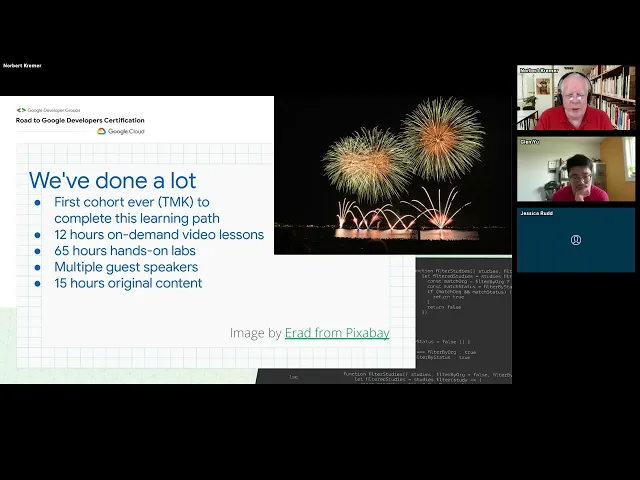
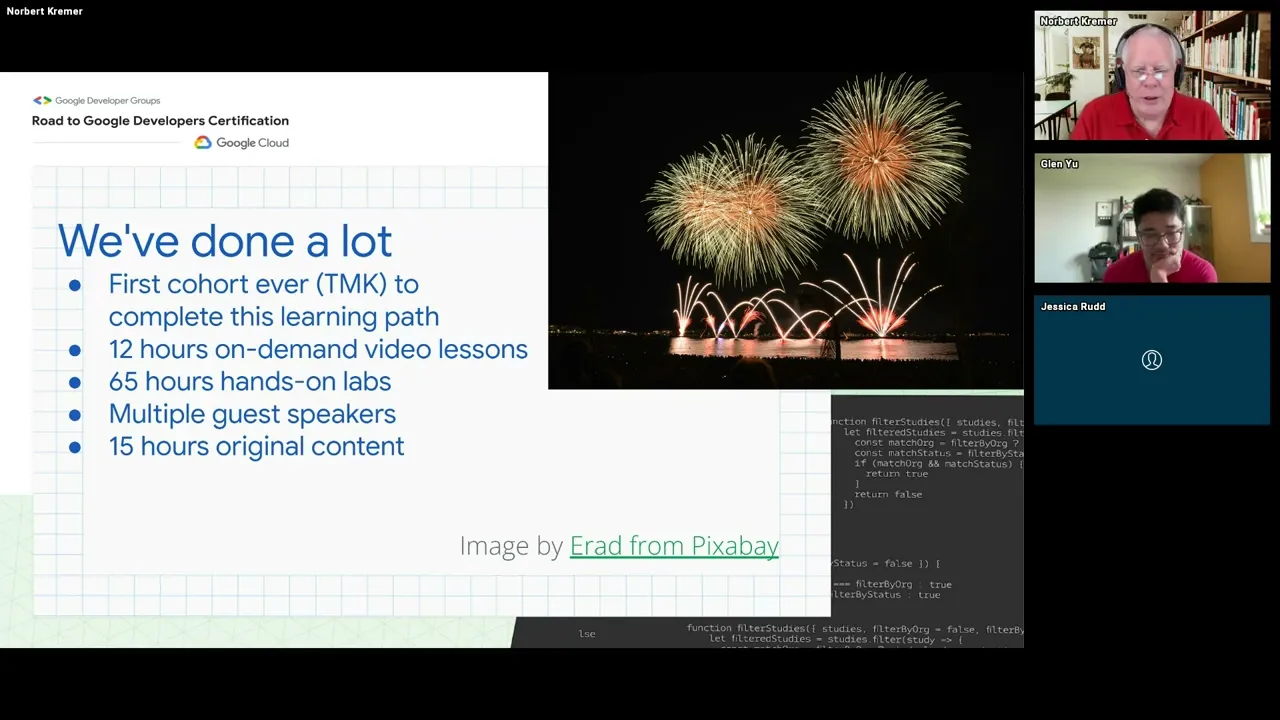
additional swag and books and things they will remember us and they'll be responsive to our to our requests so that's all all good right so we have done a lot to my knowledge this is the first cohort ever to complete this learning path so I think you should all think About that for a minute we're the first group to ever go through the cloud database engineer learning path it's been out available for about a year this is a relatively new certification relatively new exam and I was actually waiting for Google to provide the materials for
us to run this Workshop series when they did that I wasn't able to do it immediately when they when they released those materials but um I was able to start this summer so we are um Very pleased that we've gone through this and that's great so we had Google supplied us with through the skills boost um learning platform they provide us with 12 hours of on demand video lessons which many of you went through about 65 hours by my estimate 65 hours of Hands-On Labs related to Cloud database engineering that's an awful lot and covered
almost every product every almost every database product within Google Cloud Uh which is quite a few uh does not include big query as we've mentioned before big query is considered to be part of the analytics um part uh services within Google cloud and therefore it's covered in the data engineer learning path it is not covered in Cloud database engineering uh per se okay so um yeah we'll leave it there um we've had uh part of the series we've had multiple Guest speakers which has been uh very much enriched our program Glenn Yu is one of
those um volunteer speakers he came on as a Google developer expert or gde we had one other gde present for us uh that's Walter Lee he's not able to join us I don't think he'll be able to join us this evening um and then I presented about maybe 15 hours give or take of original content on a variety of topics both related to the Google skills boost And also some additional topics that I thought were of Interest so quite a lot quite a lot of um material to go through a lot of learning has taken
place over this summer um so I think we can all um reflect on that and be proud of our accomplishment um now this just shows you you know you've seen this every week it's just a quick review of all the completed courses that we've gone through I unfortunately I can't really read it too readily on on my screen but Um uh they've chosen a very light blue font there it's a little hard for me to read and um so we went through uh a lot of migration you know the database engineer path focuses in the
early part A Lot on migration how do you move data from on premises to the cloud to get to Google Cloud um the some of the comments I made earlier in the series are that Google provides you great tools for the technical details of actually moving data but they're a little bit light on How you actually manage those projects how you do the QA on the data after it's moved how do you actually get a migration done in a if you're in a very active situation where the database is in constant use and it cannot
tolerate any downtime there's a little bit of a gap there that Google doesn't give you all the answers so you may have to work out okay how do we actually we may have to run both systems in parallel for a while run the on-prem and the cloud System in parallel to make sure that everything's both systems are working well and then we have to choose our least active part of the work cycle maybe that's a weekend or some other slower period and we try to do our cut over during that time period so Google doesn't
give you too much advice on that that's where you really need to have the expert devel the expertise in house you have to have good project management to wrap around the technical tools that Google provides so that's the learning in that area we then moved on to look more in detail at relational database systems in Google Cloud so my SQL is available as a as a kind of cloud SQL in the Google Cloud environment also postgress is available as well SQL Server is available and under Cloud SQL as well as managed services so we talked
about the advantages of managed Services as opposed to creating your own database instance on a VM and managing everything Else managing all the patching security patches software upgrades all that stuff when you use cloud SQL a lot of this is taken care of for you and you can therefore have less Reliance on database administrators I think you always need some DBA knowledge as you also need some data architecture knowledge within your team to run these systems but it does lessen the administrative burden then we moved on to uh Cloud spanner which is still a Relational
datab base but it is a very interesting one in that it has multiple right nodes across the entire planet right so it's a globally available instance it we talked briefly about uh Brewers cap theorem and how um it's actually very difficult problem to have a globally consistent and globally available database system spanner has seemingly violate the cap theorum although it doesn't really because they've used something called true time Uh as a very uh precise mechanism for knowing exactly what the time is globally that relies on the GPS system to coordinate time across the globe that's
how they have achieved the um the very unique capabilities of cloud spanner without violating cap theorem so we discussed that briefly um we then had um we then moved into big table and uh we did had in in the context of big table versus um Cloud spanner we had a lengthy Discussion about exactly what makes a relational database relational what makes a so-called nosql database no SQL and I mentioned that I think the term in retrospect we might have been better as a field using the term non-relational data store that doesn't roll off the tongue
as easily as no SQL and uh I think no the the term no SQL got started in a blog post and it went viral and it's it's caught on and it's now just part of our language that we have to Deal with even though it's not a it's an umbrella term that covers very many systems that are very distinctly different from each other and so we went through um some of the details of how you should think about that and I would refer you back to either last week or the prior week if you have
any confusion on these points go back and review the sections on on those presentations that are on YouTube and make sure you have really clear so the the concepts you Need to have clear in your mind are what is relational what's relational database what is a row store versus a column store how's a column store different from a column family database they're very distinctly different if you have any uncertainty about that you will have trouble with those questions on the exam you will if you are ever interviewing with me for a job as if I
would have one at some point you know if I were a hiring manager at some Point I was interviewing people if you had any confusion about co uh column oriented or column store verse on one side versus column family database on the other side if you mix those two things together as many authors do many people on the internet do mix those Concepts together if you did that on my job interview you'd be out the door in the next two minutes right because that's just completely fundamentally important Concept you need to know so go back
to last week or the week before if you have any doubt actually two weeks ago is when I went into it in the greatest depth so please please please get that stuff correct we finally went on to alloy DB which is a Google's implementation of a version of post script essentially that has both um it's a it's a it's a better postgress than than the one that you'd find in Cloud SQL it's faster it's more Optimized so it's faster for transactional workloads it also has the capability of handling handling analytic workloads by having a both
a row store it has a row store for the transactional workload and it has also a column store built in for the analytic workloads so it's a it's what we call as a class of database systems we call them htap or hybrid transactional analytical processing htap um the one of the leading other commercial products in the Htap space is um sap Hana uh Hana uses um more of a memory based approach I think Google ldb also use is is um relies on building its column store it at least partially in memory but it can also
use dis as well as canana as well so it's a very interesting space um I tried to I focused in on the lab number five of the alloy DB course I think it's the fifth lab out of six uh is the one that I thought was The most important in terms of demonstrating clearly the difference between the row store and the column store so in other words you build a row store you put in some data using PG bench and then you get the query performance when it's a row store and then you convert you
also add the column store feature for that table and then see the performance on an analytic type query I'll say a little bit more about that in a moment because I was working up a demo last week um that I wasn't able to complete and I I still haven't completed it and I'll tell you why uh in a minute in a few minutes but interesting story there so today we're at the very end of this the part that's in yellow it's really just checking Readiness taking um stock of where we are um getting oriented towards
taking the exam and some final tips from Google on how to do that so there we go uh okay I hope we are we're ready for more right so where does this where does where does this leave us if this is your first exposure to Google Cloud you've had at least a solid introduction to Google Cloud itself right so as I said way back in the beginning in June the ideal path if you were starting from scratch and you had as long as six to nine months or even a year to embark on a longer
program I would recommend that you take the professional Cloud Architect training first and maybe the professional data engineer take one of those or both before you tackle this uh learning path the database engineer that's because this learning path is a little bit more specialized and the particularly uh procloud architect is more of an in introductory it's it's what I would consider the foundation all the pro level certifications now there are different Ways to do it I know some people are jumping right into the machine learning engineer learning path for example or some people have come
directly to this learning path the database engineer and um I think it's you can do that as well it's just there will be some gaps in your knowledge you may have to go back and fill those gaps in on your own or you may go back later and do the PCA track and sort of fill that Gap that that would be what I recommend as ideal Or if your job is very focused on database engineering you probably could just do this learning path on its own but in any case you certainly had a great introduction
to way to the way Google Cloud Works we've talked a lot about Cloud native architectures what it means to operate in the cloud versus on premises the advantages and some of the disadvantages as well so we've also given you good knowledge of database theory And practice both right I've tried to um some of the uh video lessons from Google discuss Theory uh they're mostly practice oriented the labs are obviously practice oriented I've tried to provide a little bit more context in some areas about the um the theory in certain areas so I think we're all
in good place to approach the exam with confidence uh you should have improved job skills maybe maybe the ability to take on new roles or prepare for a new Role or the in a you know when your next review cycle comes up maybe you'll be in a better position having this certification completed you might be in a better position to ask for more responsibility or ask for promotion or any of those things it's going to help you we hope that you will continue learning with Google skills boost you've had a great Introduction to skills boost
how it works um you you can continue after the workshop access to skills boost will expire at the end of this month you can continue your learning path using the cloud innovator program that gives you 35 credits per month on a um Perpetual basis so you can just keep keep learning if you join another Workshop uh you'll get again A Renewed access to new uh credit pools and the in The in the other Workshop series um we are in our local area we're running machine learning engineer Workshop but that's already uh about at least a
third of the way through I don't recommend that you join that one halfway through I think that would be pretty difficult I think it's difficult as it is even to do it from the beginning so um I don't know um just in general we we're definitely going to run Additional Workshop series I don't know when that's going to happen we probably won't run this one for a while we may do the data engineer uh workshops next but there are no promises based on that because it is uh quite a fair amount of work as you
can imagine and um I'm trying to coordinate with other people to see who might be able to help do that but anyway you're now part of the larger uh gdg Community you've joined your local gdg Or you're joining us remotely from um and just joining in as a remote participant that's great so you might be able to think about um understanding what your local resources are in terms of gdg community you could participate in their meetings you could volunteer certainly Whenever there are inperson of answers always need for volunteers to check people in just to
say hello to people um get the discussion going or You could possibly end up leading a gdg of your own at some point if that's what you want to want to do excuse me um here's the exam information from Google let's just step through this um I think that this just covers the exam itself you can take it either in person at an exam Center the exam centers are called Criterion KR y t r i o n Criterion exam centers for those in the Boston area um There uh at least North of Boston there's one
Exam Center in Malden that I've used myself it's um not a fancy place but it it's I've never had any problem there with any exam it's always been straightforward come in um as as I think Walter pointed out a few weeks back remember to bring your exam email your print out with your exam number on it because the exam centers are dealing with many different people everybody's taking a different exam so They won't know from your name alone they will not know which exam you're taking you have to bring your paperwork to the exam Center
I think almost everybody on this call that we've asked I know Jessica and I both feel that the uh in-person Exam Center experience is better than the one than than trying to do it at home it sounds like the at home would be easier um in principle I think right after covid when we're in the middle of The pandemic the in person the uh sorry doing it at doing it remotely at home was very attractive obviously we didn't want to get sick and so that was a very attractive option at the time I've had myself
had trouble with the Proctor on one of the remote sessions and I've heard that many other people have had difficulty with the um remote proctoring so um you're certainly welcome to try it uh we uh I think I think most of us are not fans of it because of the Frankly what it is there's so much um there's so many attempts to cheat so many people triy to cheat on exams that the Proctors have to be very careful to avoid cheating and so what can happen for example is that literally somebody can sign in with
their ID and then slip out of the room and then their friend comes in and takes the exam for them and then they so that's the kind of thing that they're watching out for um yeah Jessica I love your comment there yeah I I do understand why they have to do it but I find it very uh awkward and in fact this for me the software on one occasion did not work I tried to work with their help desk for an hour they couldn't resolve the issue and I eventually uh I just couldn't do I
couldn't spend any more time than an hour to debug it and I I just told them I said look I I want a refund they refused to give me a refund and I just lost my exam Fe so that that was my bad Experience with it personally so um definitely recommend the exam Center if it's at all convenient for you to do that so the exam itself is about two hours long it is uh 50 I think sometimes it might be 60 so between 50 and 60 multiple choice or multi select questions and then you
can register at this link I don't think I'll jump out to this link it'll be in the slide deck when you get these slides you can jump out there it's easy To find this will take you um if it's your first exam you'll have to set up an account with web web assessor and that will take you then ultimately to the Criterion website where you can choose your closest Exam Center and go from there now I'll I'll speak to the vouchers in a moment but um for if you do not have a voucher the exam
fee is $200 it's the same $200 whether you do it remotely or at an exam Center so you it's not a um There's no Financial motivation to do it uh remotely um let me go on the you know we've gone through a lot of the uh questions already we've discussed the strategy for um what I call dissecting the questions and understanding the structure of the question so typically what you want to do is um if there are four responses and only one is the correct answer often it'll be like a 2 by two there'll be
two Factors and the the answers basically break down into you can look at it as like a 2 by two Matrix right it's it's you know it's just different combinations of those two factors in other words and so even if you don't completely understand everything if you can want if you can knock out if you know if you're sure on one factor and you're unsure on the other one you're still in a better position for guessing Than if you just guess randomly at all four so in other words if you can eliminate half of the
choices and then um you left with two and you have to choose randomly between two you still have 50/50 chance instead of 25% chance of getting it right um as with any kind of structured exam like this you know take a look through H make sure you know at the beginning how many questions you have you have 120 Minutes Um there is some what when I do it I'm not a super fast exam taker myself so I tend to read carefully and then I spend about the right amount of time like 90 seconds per question
uh in that 100 seconds per question will be um sort of the right amount for me so I tend to look at them carefully I try to get it right on the first try um you do have the ability to flag a question for review so that you can at The very end if you have extra time at the end you can come back and cycle through and review things that you are unsure of I have found I almost never change my answer that I selected the first time because I don't want to second guess
myself and my strategy is to spend enough time on the first pass to do the best I can the only time that I would change an answer is sometimes when you're going through the exam you will come across a Question that gives you a hint about an earlier question okay or it triggers a memory it may trigger a memory in your knowledge that you didn't think of when you hit that earlier question but now in the context of thinking through the later question you remember something or discover something that that information that you didn't have
earlier in this hour right so in that case probably you would have flagged that one for review that's one Situation where I would actually change an answer it's like oh yeah okay now that I've gone through all the other questions I realize that's that's not correct but if I'm just like on let's if if I've gotten to that point where I'm 5050 and I'm going yeah I did a coin toss last time and I'm going to do a second coin toss this time and change my answer no I I just never do I mean it's
it's a little bit of strategy mostly you're going to pass by actually knowing Stuff right and being able to answer the questions but there is this you know maybe a a quarter of the questions you'll be or a third maybe you'll be unsure of and you may then go into these kind of strategic approaches into how to improve your odds of getting the right answer if you if you don't answer a question at all you have no chance of getting any credit for that so if you leave something blank at the end if you run
out of time and leave Something blank at the end there's no way you can possibly get credit for that so so that's that's definitely a bad strategy pace yourself um you usually when I'm going to the exam Center you're given you're asked to remove everything from your pockets your watch you won't have anything on you at all not even a pen or a pencil they will give you a blank sheet of paper and a pencil in my experience so you are allowed to write notes on that Paper on that blank paper you can write notes
or make little graphs or Doodles or whatever you want to help you you have to give that paper to them at the end and give the pencil back and so what you can do though is um um what I do is I Mark the time the time the expired the elaps time as I go through like at question 10 question 20 I'll put the timing on so that I make sure that my pacing is correct so yeah that's about I don't Know does anyone else have any uh I think we've talked through a lot of
this before but uh anybody else have anything to add to the strategy of exam taking I know Walter covered this a lot as well okay I'll keep going then um there is a link here to the sample questions I think many of you have seen these are the official sample questions from Google they're part of this Learning path so if you go to the this I believe that's a live link let me see um yes that's a live link so when you get these slide when you get the slide deck you'll be able to click
through to that link probably most you've seen this already we have Jessica and I've pulled out a few of these questions throughout the series and we've gone through and step through um the the both the strategy and also the answers and the reasoning to get to the Right answer on these exam on these questions the correct answers are provided for you at the end and also the logic that is used to arrive at the answer is provided for you so this is a really great Learning Resource if you haven't done this already you definitely want
to do this before you attempt the exam very helpful but at the end of the day it's already it's only 20 some questions and you've already seen some of them through our Series so there's not a whole lot of new learning here and there may be some gaps in the coverage on this so that's the only um concern I have with these sample questions is that it's a limited number of them um but they they do provide the answers and the logic for getting to the right answer so this is my material I wanted to
point out some topics that we did not cover at all during the series that could be on the exam that might be on the exam and I think the one Gap in The curriculum here is fir store and fire base now this is a little bit of a complex topic because there's newer versions and older versions so the current versions are called fir store and Firebase the older Services were called cloud data store and Firebase real-time database okay which were slightly clunky terms I think for the service names so now the new names are called
Cloudfire store and Firebase and again these are whatever is in green is a link so you can go look up the documentation on these products so a little bit confusing also is that fir store is really a database it's a document database so it's it would fall under the category of of a nosql database similar to mongodb being a document database and Just briefly a document database has somewhat like a key value database it has a key like like the row key in big table it also has a value the difference in a document database
is that you can actually put you can parse the components of the value as if it's a document so it could be a Json document or it could be an XML document and the you can put indexes on certain Fields within the Json or XML and then if you Establish those secondary indexes you can do efficient queries on parts of the document that are stored in the uh document store itself so that's the those are the features of mongodb and Cloud fire store and just again to remind you big table is key value but there
are no secondary indexes there's only an index on the row key so if you want to do an efficient retrieval in big table or or any key value data store you can only do it based on the row key and You cannot have any you cannot do an efficient scan on the values what the content of the values in the value part of the key of the K of the key Value Store okay so that would be if you had to do that you would be doing a full table scan which is um generally not
a good idea with you have large data volumes so I find it a little bit confusing that that the database is called fire store And then Firebase sounds like database but no Firebase is actually something else Firebase is a much larger set of products it's called um backend as a service so it actually lets you um build web applications that are used in Mobile and web applications and and what you think of as firebases when you have um an application where you could have multiple clients like you could have a like a mobile and a
web app at the same time and if you do a update on your Phone it immediately reflects that in the web application that's what Firebase is for and it also has a data store integrated in so think of Firebase as Bas backend as a service fir store is the database or document store um there's also to make it even more complex sorry about this the new fire store the new Cloud fire store can run in data store mode for legacy apps in other words the new product can be put into mode to make it look
like the older Product and that's obviously convenience for migrating to the newer version of this now I um there's no coverage I'm not sure why but Google chose not to cover this at all in this learning path I think it's a bit of a gap because I I think that I do remember one or two questions on this on the exam but I Glenn you had more recent experience do you remember I think there was a couple yeah I think there yeah I I think this Is a kind of a Miss on the curriculum here
in this learning path so you you take a look at this look at the documentation so that you at least know the difference between at a high level you need to know the difference between um the two products I think the what I think what anything that would be on the exam would probably be in about the new products rather than the old ones at this point however they might ask you a question about running fir store in data Store mode that's considered part of the new is running it in the old style for the
Legacy apps that would be still part of the news so I think you might get a question on that as well so I'm not sure why they haven't covered that in this series but that's how we understand it okay let me give you yeah go ahead please one one thing if you're gonna um for for a lot of the databases whatnot like like you can you can I mean I I would encourage you to try it out For yourself um the only thing is for for data store and fire store uh start start a new
um gcp project when you when you test it reason being once you once you set it as fire store or data store like there's the data you mentioned data store the the legacy mode or the native mode which is fire store uh you cannot change it afterwards and you cannot delete the database afterwards okay you'll you'll have to that's that's the one weird thing about this but yeah like If if you're that's on a that's on a project Bas I don't know why but um if you're if you're ever working on a project um and
you want to T Test out fire store dare store uh spin up a new spin up a new uh gcp project just testing there because you can't it's not like it's not like you know like like a cloud SQL instance where you just like spin up a Dev instance do your test there and like yeah that's good let's let's throw it Away tear it all down and then one it's yeah it's not it's gonna be it's gonna be tied to that project um you can't change modes so uh yeah that actually reminds me I should
have mentioned this earlier that in addition to the um Cloud innovator program so Cloud innovator program gives you 35 skills boost credit per month right that's just like the skills boost that you've been using all throughout those workshops right you go into lab environment you create some Resources you use them and then at the when the lab times out or you're finished and you close the lab all Google just cleans all that up and destroys all those resources that you were using now what Glenn was mentioning was maybe another thing you can do is you
can create a trial account within Google that gives you credit of $300 and you must use that now within 90 days it used to be one year but the current program is you can get $300 Worth of Google credits with within the 90 days you can use that for almost anything you want I think there might be some quota limits for trial accounts but um you can do a lot of these uh experimentation on your own so that's completely separate from skills boost right so the difference is whe when you do things in your trial
account they will not be destroyed at the end of any time period or they will not expire automatically so then if you Are finished using something you be sure to turn it off just as you do in a production environment on Google Cloud right whenever you're done using something turn it off otherwise if you just spin up a like if you start a big kubernetes cluster and you leave it running your $300 credit will just be burned up in two days and you will if you're not using it it will just be your credit will
be gone and then that will be unfortunate use of your of your trial And so okay so I uh was in contact with Roman jacz who is our leader at um gdg Lawrence which is another gdg close to us here in Boston he is a flutter gde he's a flutter expert um Glen you might be also flut GD right I forgot what your your GD no I'm cloud cloud cloud okay you're Cloud I I didn't want to overlook you if you're a flut gde but uh Roman recommend this particular skills boost here again that's a
live link here so you could go to that um skills boost and It's called build a serverless web app with fire base so remember fire it's the opposite of what you think it is so fire store is the database Firebase is backend as a service so this this application is more like the bigger picture of building a web app where if you do an update on one client it will automatically update to the other with low latency so that's really great if you just want to learn more about the document database Itself um you could
go back to the book that I mentioned earlier which is called No SQL distilled from selage and Fowler really excellent book it's old it's a 10-year old book but it's still really one of the best ones for getting a clear understanding of what is a document database and how's it different from relational how is it different from um a key value store and so there may also be on skills boost a lab that is specifically focused on the database I Didn't give the link I didn't look for that link because Roman was kind enough to
recommend this one for um to cover this area so we definitely think this could be on the exam um yeah okay great Glenn's putting some more comments there about the um fir store and Firebase so I'm going to move on there are a few topics that we did Cover because I was very expansive in my um coverage of some topics that I hope some of you Found interesting that to be fair they I I hope they gave you good context for how to use these database products in the cloud they these topics will not be
on the exam though because for various reasons because simply they're not covered by Google or the very newest features that I've called out in a few cases they're just too new the exam doesn't update that often and it's very unlikely that you'll see questions on these topics in the exam however note The little star we don't control the exam content so we really have really no idea when they don't it's not like we get an alert when the uh Google updates the exam it's like I don't get an email hey Norbert we've updated the exam
version you may want to go back and study again or whatever you don't you don't get that notice and um it just happens when it happens other than the the other than the formal like retooling of the entire exam which is when it goes Through a new beta period and all that that's very obviously called out because they will have a period when there's a beta exam that has many more questions that's different I don't know Glenn maybe you know do they change the exam questions between like within um before they uh there's like a
huge pool of questions so there's a huge pool of questions yeah right you may not get actually you almost certainly will not Get the same exam like two people sitting next to each other taking the same exam will not will be getting a different exam delivered to them and that's part of the um dynamics of the exam so they they will definitely be the questions will be in a different sequence a different order and you'll get a different group of questions every time you take this exam so there's definitely as you said a large pool
that they Choose from also then you don't get the uh feedback actually you do get a feedback now but there's no there's no specific cut off point like it's not like oh you have to get a 70% in order to pass it doesn't work that way it's more Dynamic it may actually be different people different for different people as you like every instance of the exam could be have a different score uh for past fail you do get immediate feedback On whether you did pass or fail you get that immediately while you're still in the
exam Center and they do recently on some exams but not all apparently they give you some feedback now on what areas you did well like they give you a percentage breakdown like on this area of databases you did 65% in this other area you did better you did worse they do give a little bit of feedback now traditionally Google has never given you any feedback whatsoever Just other than past fail that's it okay so of the things that I have covered throughout the last 12 weeks 11 12 weeks I don't think these will be on
the exam there will not be any there might be Cloud spanner questions but there will not be coverage of the graph DB or gql the graph query language features those are very new those probably will not be on the exam on the pcde exam the SQL interface on cloud big table that just came out a couple weeks ago that's not Going to be on the exam so you'll be using any question about big table will be in the context of the um the command line tools or the API calls that you make to big table
to load data and retrieve data likewise I don't think any of the Gen support features that have been coming in to GA this last quarter and this quarter like the support for Lang chain the support for Vector DB indexing things like that I don't those features Are going to be covered on the pcde exam at this point I'm sure they will be in the future at some point but not now but the exception to that might be that you might possibly get a question about PG Vector itself in postgressql because that actually predates by considerable
time the um the big explosion in gen that happened at the end of 2022 PG Vector was already something that people were using with with um I won't say pre but I'll say the pre Chat GPT explosion that happened in at the end of 22 PG Vector was already being used for things like word to VC and other things like that so you you could possibly get a PG Vector question but it will not probably cover this very latest um gen stuff that that is very currently um being pursued by a lot of people now
there are a few other topics I I mentioned earlier I was working on an alloy DB demo um I've I paused that I was going try to present something on This today I said well that's I don't want to do that today uh it's a little too I want this to be more of a festive meeting and so I didn't want to go into a heavy topic also I found that um here's let me give you the reason why I wanted to do a demo there is in lab five of the six alloid DB Labs
that are available to you on skills boost number five actually goes through a simple example of building a row store in ladb And then converting it up converting it to or adding a column store to that and seeing some way that it improves the performance of olap queries or analytic queries now what I did found a little unsatisfying about their PG bench example it's very simple it's only one table it's 50 million rows which is a modest amount of data it's not a lot of data but it's enough to show some effect of the Improvement
of the column store for analytic queries but it really is Doing a simple query that involves filtering an aggregation on one table is not very challenging for analytic Warehouse analytic database system or a warehouse system like bigquery the real challenges come in when you have joining of large tables to each other and I don't have time to go into all of that but this is my area of expertise and I teach about this at conferences so I'm very sure that I'm right about this that the the more challenging queries are More complex they have joins
that involve at least three tables or more so that's the kind of demo I was trying to build I was trying to put three tables together with moderate data volume moderately large data volumes and then I was trying to see like okay when do I get the benefit of the column store like which tables do I have to include in the column storage and so forth I'm going to work on that because it's something that I'm interested in doing it won't be on The exam at this depth certainly but to me it's a topic that
is very close to what I work on in in my Consulting work and so it's it's something that I want to explore or I'll probably write it up as a demo and publish it somewhere uh in the future but I didn't have it ready for today and I found a number of um challenges in actually generating the synthetic data I just I showed you some of the data last week and um it's it's pretty challenging to build uh decent Quality um synthetic data I was using the python Faker Library which has interestingly has a um
a unique flag and what happens is if it if it starts generating data and then it hits a a duplicate it just crashes that wasn't the behavior I was expecting so uh I thought it was a bit odd so it has a unique flag but all it does when it hits a duplicate is that it simply crashes and so um I can go into that if anybody's curious about that Just contact me uh uh either here on the slack on our slack or on LinkedIn I'm happy to discuss all that and at at Great depth
but anyway won't be out the exam for sure um I did run across just by chance I'd mentioned the um carnigan M university has a really excellent database program within their um computer science graduate school one of the professors there is Andrew Pavo who had worked with uh Michael Stonebreaker um I've mentioned in earlier sessions Mentioned these authors at at Great length so I won't go on about that but I just noticed yesterday that uh Andy Pablo has released oh he's just starting a new series this in Fall 24 called CMU database systems which goes
into a lot of the particulars of how uh particularly analytic systems work so okay that's my my 7 o'clock checkpoint there so we're good on time today um it is not relevant to this material that we cover in pcde but It is of extremely high quality and very interesting if you are interested in the analytic databases or data warehousing I definitely recommend take a look at these uh three sets of uh videos from Andy paavo it's just extraordinarily generous of them to put all of this online on YouTube and also with the slide deck and
he's a very um entertaining and very good speaker as well so you definitely would uh you may not want to do it if your focus is on Cloud SQL and postgress and things like that this um analytic systems may not be that interesting to you but definitely there's a lot here that he covers also on the transactional system so so have a look at that it's you will not be um LED astray by anything that he says there there will be not there will not be the uh the information is very high quality let me
just reiterate that so you won't be wasting your time there at all um so that's it sorry I kind of uh in the Guise of telling you what will not be on the exam I snuck in a few little extras there about the topics that I'm interested in so thank you for indulging me on that okay we have now time for Q&A uh we could um talk about I should have updated this slide a little bit we could talk about any of the courses or any question that anybody has about any of the topics I
don't know that we'll answer them here but we will at least acknowledge the question and Get back to you on those answers and then if you have any questions about the exam or the logistics or that kind of thing we happy to entertain those right now um I will be you could either open up your mic or turn your camera on or put something in the chat I'm not seeing a lot in the chat right now I'll give a few more seconds you can come back this is not your last chance ask a question but
I don't see any Burning questions coming right up to the Forefront so I'm going to move on to the great swag giveaway so let's have an overview of what we have from Google we got six exam vouchers for the from the criter well actually they're they're Criterion if you do them at the exam Center they're actually just exam vouchers that you can use either for remote proctoring or going to the exam Center so we have Six six exam vouchers as I mentioned earlier if you pay for the exam yourself it's it's a $200 fee so
this is basically um a way for you to get support from Google to take your exam and this is their way of saying thank you for taking this certification Workshop Series so uh we have six of those last week we went through we saw that there might be about six or seven people who want vouchers and my recommend oh let me let me continue with The overview and I'll get into the details in a moment we have an addition we have 10 books from O'Reilly which are called um architecting data and machine learning platforms so
this is not uh this could be a little bit straddling the two learning paths so it could be partly covered in the learning path that we're in which is cloud database engineer and it will cover some material also that is in the data engineer learning path so if You are I know one person contacted me Teresa I think said she was doing both learning paths and so she W she opted for this book because of the coverage of both sides of this um this is the closest book of all the O'Reilly catalog it's the closest
to our material so I selected this one and they were very kind enough to send us uh 10 copies of this book and I have a big box of them sitting here we will um prefer that you actually we not prefer we Require that that you live in the USA you have a USA mailing address in order to get this particular book because we are going to mail it out to you uh we're willing to do that for anybody in Continental USA I'm sorry we can't do it for anybody that is outside of USA however
we do have six eBooks from pack this is database design and modeling with Google Cloud this is directly squarely on the material that's covered in this learning path so it's a very Good match for our learning path here and pact has been kind enough to provide six ebooks and these can be sent uh this can all be done by email so we can uh connect you with an ebook no matter where you are in the world [Music]