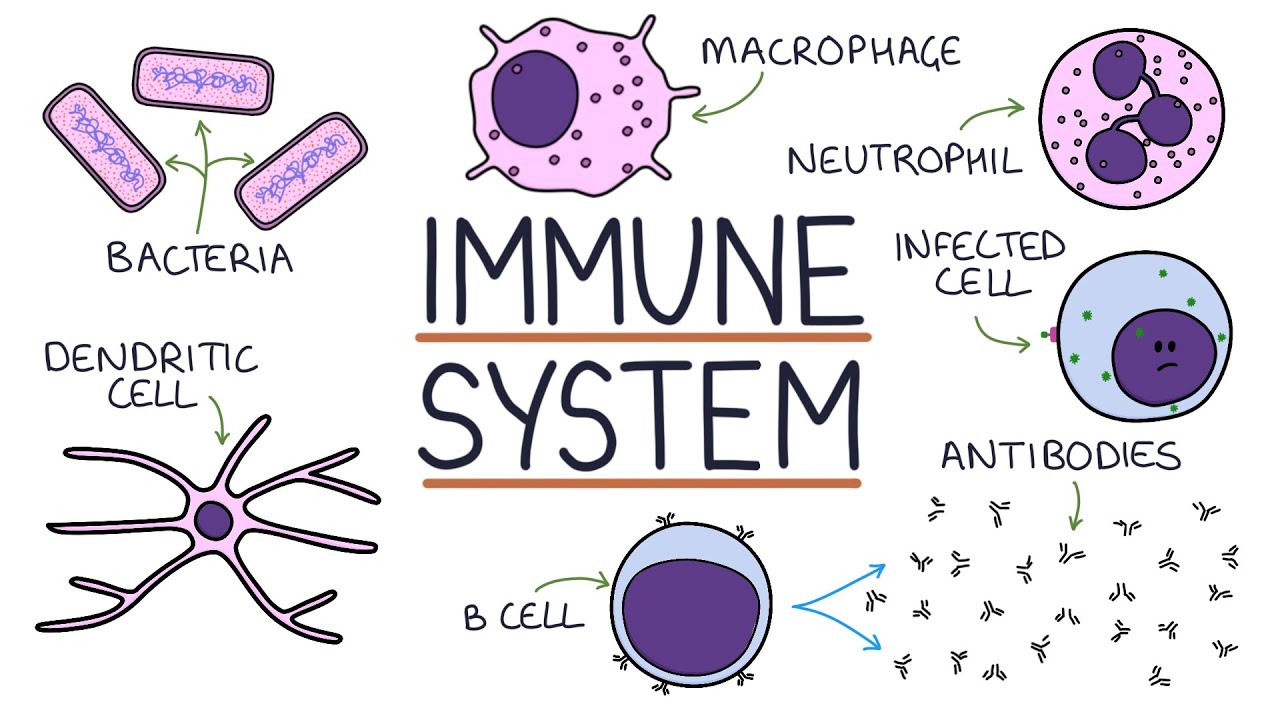
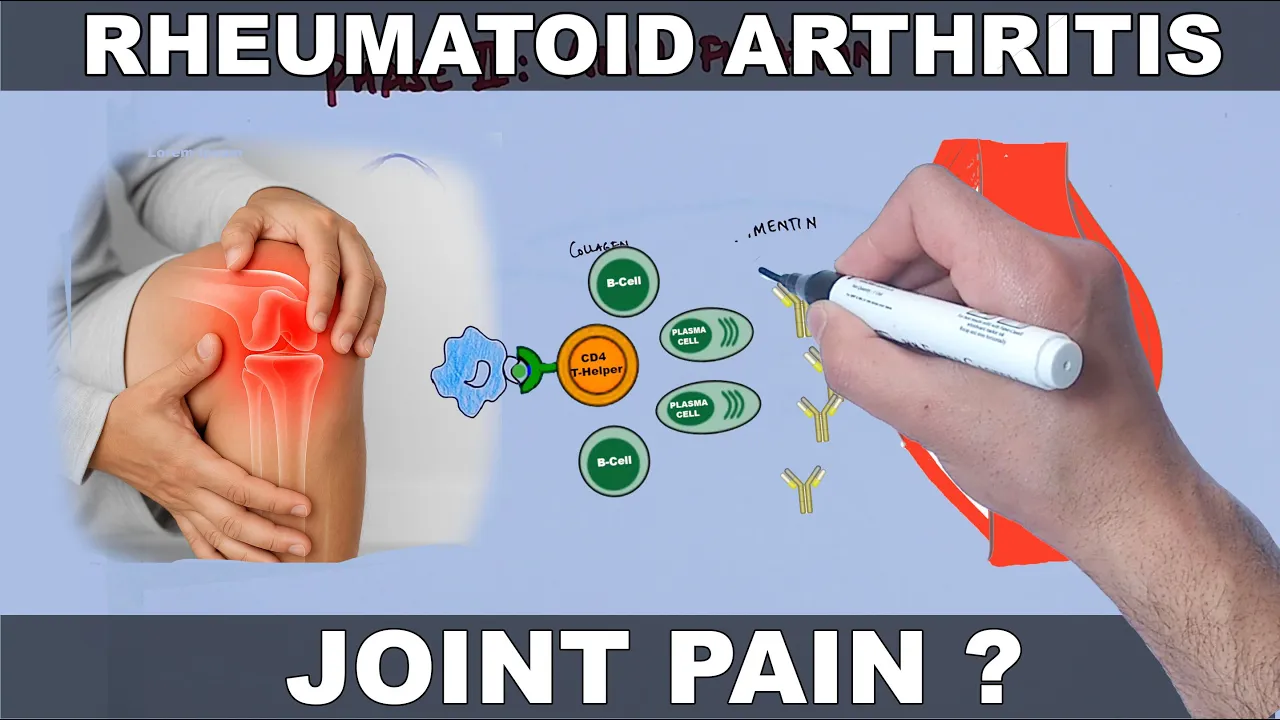
The remot arthritis is an autoimmune disorder of joints. It's a long-term disorder that primarily affects joints and it's kind of a chronic inflammatory disorder. Here the autoimmune refers to that the immune system produces antibodies that attack your own cells.
It results in warm, swollen and painful joints. It affects joints that includes wristus, hands, knees, ankles, elbow, hips, shoulders and cervical spine. We see the remot arthritis is divided into three important phases.
The first phase is insation phase that's non-specific inflammation. Second phase is amplification phase that occurs in sinovium and third phase is chronic inflammation. Let's discuss the initiation phase first.
This condition starts with two primary factors or risk factors. Genetic factors and environmental factors. The genetic factors includes genes that are involved in rheumatoide arthrit.
Whereas the environmental factors includes the cigarette smoking and pathogens. We see both HLA DRB1 and secrete smoking can lead to RF production independently. This RF can target other healthy cells and destroy them.
Then we have PTPN22 and P AI14 gene. The single nucleotide polymorphism in these genes are also the risk factors for hemotide arthritis. The PTPN22 P A14 along with HLAG GRP1 and secretreed smoking shows interactive effect where we get the ACPA production under these risk factors that's antiated protein antibbody.
This ACPA that's antiated protein antibbody targets self-modified antigens in our body which we are going to see later on in this video. Furthermore, we see in this remot arthritis the risk factors drive the citronation of proteins like type 2 collagen, womenin and fledin. Here we see in the citronination of proteins we have the normal amino acid chain of any protein having arginine at this position.
Then during the course of citronination the arginine amino acid is replaced by citrolinine. We see in type 2 collagen PP AD enzyme from P ginger drives citronination of collagen and we get the modified type 2 collagen. Second we have the womenin it's acted upon by pad2 enzyme and gets citroninated and third is pleasurine it's acted upon by pad3 enzyme and get stillinated.
Now these citrillinated proteins are kind of a modified proteins and ACPA which are also generated by some risk factors targets these citrinated proteins and launch the immune attack and in the meantime the immune cells no longer recognize these proteins. We see in this diagram we have the APC that's antigen presenting cell type 2 collagen and womenin and it must be noted here that type 2 collagen and womenin are modified or citroninated proteins. So we see the APC that's antigen presenting cell comes in and picks up the antigen from these proteins.
Then APC goes to the CD4T helper cells and presents the antigen towards them. So upon antigen presentation the CD4T cells becomes activated and these CD4T cells stimulates the B cells and drives proliferation of B cells as shown in the animation. So all these B cells are stimulated by CD4 T cells and gets differentiated into plasma cells.
These plasma cells generates antibodies for the cell antigens. So we can also call these antibodies as auto antibodies. Now moving towards the second phase that's amplification phase.
First let's have a look on normal sinovial joint as shown in the diagram. Now after insation phase the antibodies and ACPA have started moving in towards the sinovial joint as shown in the diagram. We see the plasma cell is secretreting auto antibodies remot factors plus ACPA.
All these factors or elements targets these citroninated proteins. Here in this diagram we can see the auto antibodies which is IgM. We have remot factor which is IGG antibbody and ACPA.
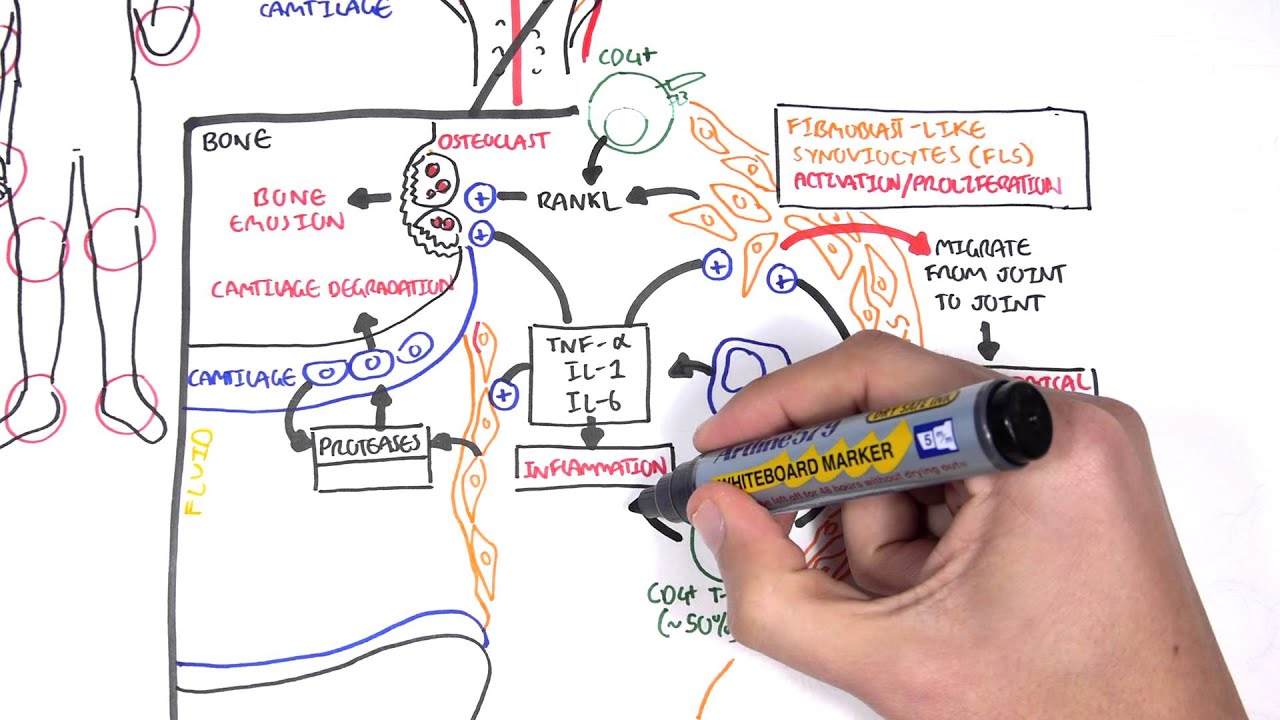
All these form an immune complex which drives complement binding that's activation of complement system which ultimately leads to intense inflammation in the joints shown in the diagram. Now moving towards the last phase that's chronic phase which starts with the T- cell secretreting cytochinise like inf gamma and IL17 which further stimulates secretion of TNF alpha and IL1 and six. So under these conditions the sinovial cell proliferates as shown in the diagram and there is a pawnus formation which means there is abnormal growth of tissue and we get the angioenesis also.
This is followed by cartilage breakdown and tissue erosion shown in the diagram. In these events we also have some signaling pathways getting activated abnormally like rankal pathway which produces osteoclast shown in the diagram. These osteoclasters in the syinoium drive breakdown of bone.
So all in all we see the sinoium joint has been degraded by these immune events and conditions. So this is what the remotey arthritis is and its pathophysiology. I hope you like the video.
If you like it, give it a thumbs up. Do consider supporting my work on Patreon or YouTube and make sure to subscribe this channel. Thanks.
![Rheumatoid Arthritis [Symptoms, Early Signs, Stages & BEST Treatment]](https://img.youtube.com/vi/CTtIMGqTwXQ/maxresdefault.jpg)