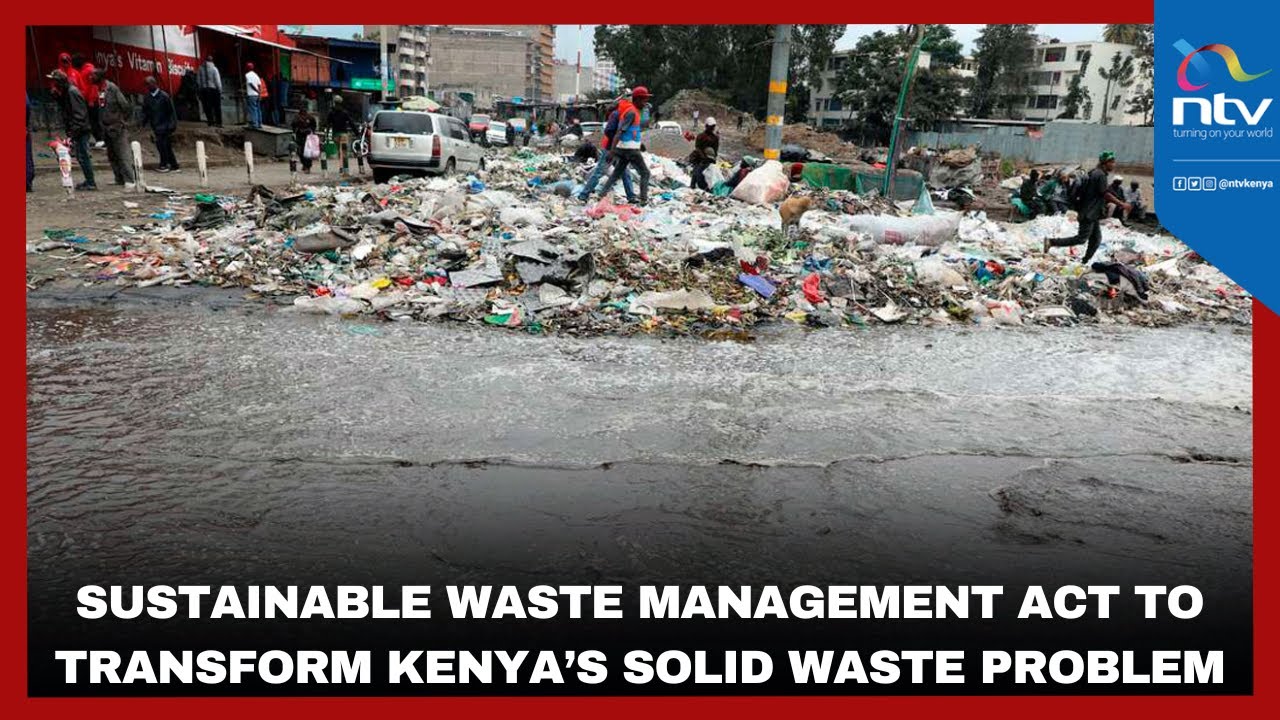
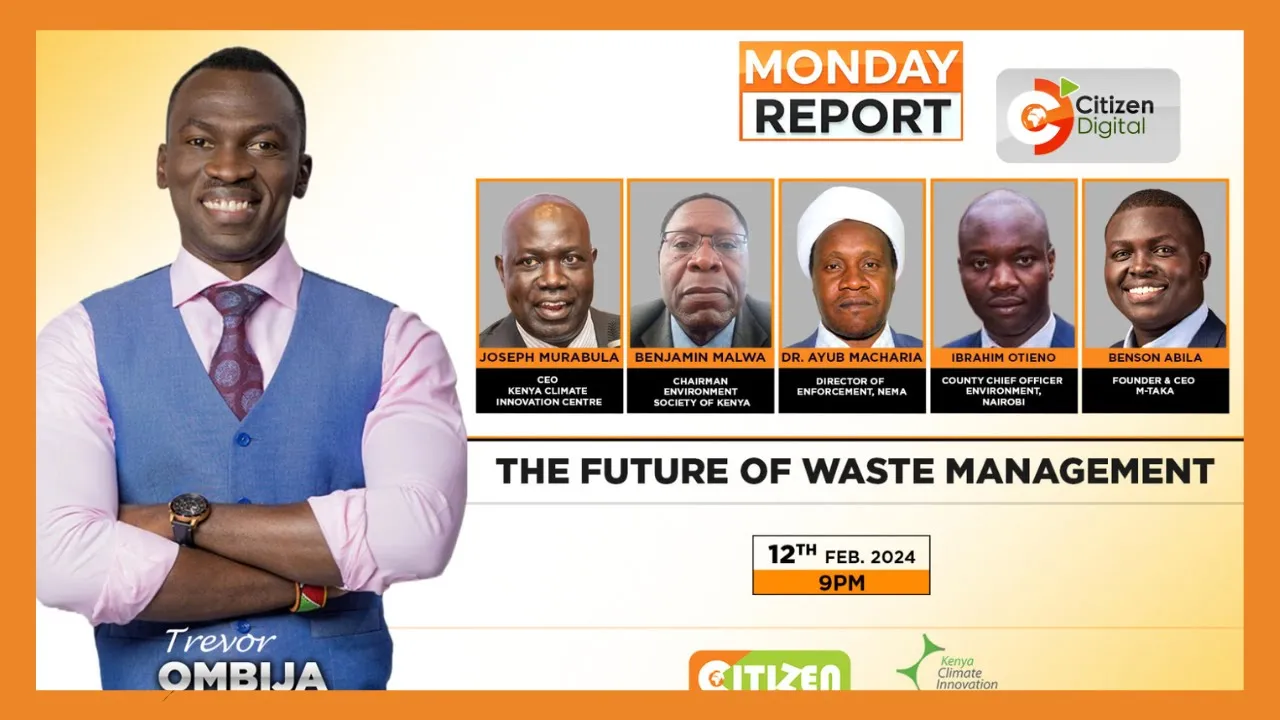
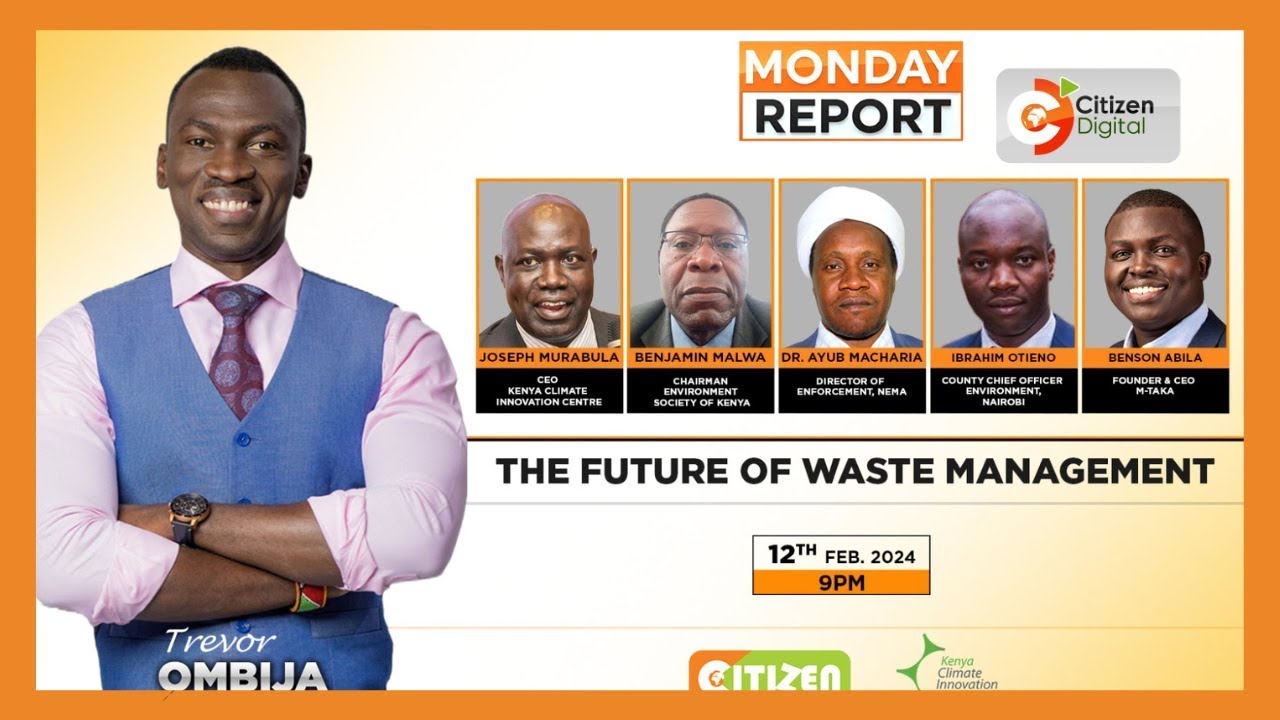
[Music] all right thank you for staying with the manday report just in time for the town hall session live at the stratmore University which holds the kcic that is the Kenya climate Innovation Center who enabled us to have this conversation it's a very important conversation we're talking about Waste Management in Kenya now the Aspen Network for development entrepreneurs says this is a proximated to be a 54 billion US economy here in Kenya we produce from about 3,000 to 4,000 tons of waste every day 70% of that being organic but how come we not benefiting from
waste where do the gaps lie this is the conversation we're having here on the town hall session let me start by introducing my guest from my immediate right Joseph muraba CEO Kenya climate Innovation Center thank you so much for making Time Dr aayu bashara is here director enforcement Nea thank you very much for making time ibraim Tino County chief officer environment Nairobi County thank you very much for making time Benson abila founder and CEO M taka Santana for making time and Benjamin maloa chairman environment Society of Kenya thank you very much for making time and
mul I'll start with you on this what is the state of Waste Management in Kenya today how would you despire it yeah thank you Trevor um as as you mentioned at the beginning um Kenya produces about anywhere between 3 to 4,000 tons of waste every day uh the bulk of this is in the urban centers the men aan NS of Nairobi Mombasa um Eldor nakuru kisumu but about half of that half of the 3 to 4,000 tons of West produced uh daily is actually Nairobi uh because it's the most urbanized City so basically what you
what we are what we are saying is that uh Waste Management appears to be an urban challenge uh a challenge that's mostly around uh cities uh for a very long time the model has always been that the waste is produced you get somebody with a truck to come and pick it and then dispose it off and then what happens Beyond there is um is is is a no or it's it's nobody's business but as you mentioned uh people are now seeing opportunities around Waste Management sector uh you just mentioned that the that the market opportunity
is about 54 billion uh dollars what you you didn't say and what that number shows is that probably that's the most promising sector of all the green sectors we have the 54 billion is probably a bigger Market opportunity than you have in Agri business than you have in renewable energy than you have in water or probably than you have in h in forestry uh what then that means is that a lot of people are beginning to see this opportunity and to find ways of accessing this um of accessing this opportunity so in terms of Regulation
we know that um uh first of all we have the Constitution uh which Pro which guarantees a healthy uh and clean environment to everybody uh that in itself is is a trigger to action but we have the sustainable Waste Management Act of 2022 which provides quite a number of things in terms of what we should do uh but ultimately the wte management is supposed to be a devolved function uh under schedule 4 of the of the Constitution and therefore what we expect is that the counties will be doing a lot more to to to to
enable Waste Management to happen to enable people to have a cleaner environment and basically to enable people uh get this opportunity quite a lot of the uh of responsibili given to counties under the law under the sustainable Waste Management act for instance it provides that every County should ensure that whatever waste is produced within its boundaries is processed within that with within that boundary uh so if you take that with logical conclusion it means that the counties have got to provide the infrastructure uh so the challenge we have then is not that we don't have
uh a a rate uh policies in place I think the challenge you have is one of enforcement and and I'm sure I here will probably be speaking uh to that the Second Challenge we have is that it is Waste Management has been left to the public sector largely largely because the efficiencies that the the private sector would bring are are still missing the other challenge you we we we then have is that we just don't have sufficient infrastructure in place especially at county level uh we don't have sufficient material recovery facilities we don't have sufficient
processing facilities to be able to uh to be able to take care of West and ensure a clean environment so I would say in in in in summary the state of wte management in this country is still nent is still growing people are beginning to discover their place so there's quite a bit of of of you know Discovery and EXP experimentation going on okay Mas what are you seeing as the gaps when it comes to waste management in the country you've been dealing with this for quite some time and muraba has mentioned some of them
thank you um I think we can say that Kenya has had the environment law since 1999 and so we may ask ourselves then why is the country still dirty that means there were some gaps and the main Gap was uh the the ideological Gap there was an ideological Gap where in the in the early years uh from 1999 to uh 2022 uh if if you manage to just put your waste in the bin and give it to a track and that waste is taken to the dam site you are okay you have complied with the
law and so the rest was we we kept complaining that hey the dam sides are getting bigger and bigger they require more land yeah they are speeding over to the to the neighboring Estates uh the the people are dumping in Long places but without a proper law then we could not address the matter because that is as far as we could go some people even tried to segregate waste at at their homes but the way when the track came it just got mixed up and they got discouraged however the rad scape has changed since uh
2022 actually 2021 2021 is when we finalized the government published the policy the sustainable Waste Management policy and then in 2022 parliament passed then the sustainable Waste Management act and that act marked a a radical shift in Waste Management yeah because waste was considered as a resource and therefore uh we are supposed to uh see waste as as as a resource that we can tap into and convert it back into a useful resource and that applies to all waste whether it is organic it was supposed to not go to the dam site anymore we was
we the government decided to put an intermediate facility in between what we knew as damsite and the homes and that is the material recovery facility even the name says it we want to recover as much as possible that is a radical shift in ideology that came in 2022 and so uh one of the gaps we had was segregation MH we didn't have a law to support segregation and what if you don't segregate there was no penalty of course the word segregation is there in in the waste management regulation of 206 but then there is no
there's no penalty the or the penalty is too too big now if you don't segregate waste at home there is a fine of 20,000 that that applies to everybody and then the other challenge is the counties uh not counties not that counties were a problem but they are also overwhelmed look at the kind of products that we that come to Kenya from Especial Imports they come to counties Counties have also never seen such kind of products we don't have such kind of Technologies in this country and so if we continued like that yeah we would
remain overwhelmed and so what the law said in section 13 is that Kenya is an open market you can bring anything you want so long as you are responsible for that product for that packaging until it is safely disposed safely removed from the environment and that was that was very important because uh being responsible means that you will contribute resources you Avil the resources to do collection to do transportation and to do uh recycling yeah and even final disposal that used to be left to the counties before and they didn't have resources now it is
the responsibility of The Producers to to provide these resources through extended producer responsibility and so what that what that has done to the counties and that is why the landscape has changed is that the counties are now only responsible for organic waste not for synthetics synthetics is the responsibility of the producer the person who brought uh those items into the country and so we have addressed uh the major Gap of course to the to the uh let me point this that the radical shift has also impacted on man because at home we are used to
you get your waste and put it in the beam now since the organ the synthetics are owned by the producer then we all need to think twice because we are the the waste management in Kenya will be driven by incentives so so there is already an incentive to be provided by the producer so that if you don't put your waste in the bean you can easily take it to the collection center to the material recovery facility and you'll be compensated for waste collection service so that you can go home with a roof of bread okay
or a packet of salt all right thank you let me bring in a on this are you overwhelmed as counties like Mas is saying Trevor thank you for having me I really I don't think we have Wellness counties or as a County government of Nairobi to deal with the issue of Waste Management of course there a lot of challenges asly been mentioned by my two colleagues earlier but we are also trying to address those challenges what mashar has also tried to allude to is that the the development of this PR so the producer responsibility organizations
that will be dealing with uh products that are coming into the country so that I think is very for formative stages and still of course the County government has to deal with that waste as a true day uh again uh we look uh back just before we came to the policy and the 2022 act on sustainable Solid Waste Management uh the County government actually had already started and I think mashar and quite a number of people that I've seen in this room were part of the people that developed the sustainable waste action plan for the
city of Nairobi so actually it is from that argument that we actually thought now this should be not just a buil Nairobi County but it should be thought at at national government level and therefore now we have the sustainable Waste Management act in place yes we have uh in fact one of the key challenges I think that has been mentioned here in in terms of Waste Management within the city and probably in in in in the entire country is that people don't segregate their waste and therefore when it's not segregated the value of that waste
comes down so that segregation part of it then under the solid waste management Act of 2022 we ensure that the value of waste that we have at the household level goes up and therefore there is value in that waste and there people will be willing to do segregation and because they will be able to get some resources from that particular waste when it's segregated in addition we also have seen in terms in Nairobi alone there's a lot of challenges that we have fac with illegal dumers waste because again there is no value in that waste
so somebody will just want to throw it away because at the end of the day it's a nu sense to them uh what has also been mentioned by my first speaker is that the amount of waste that is generated in this in the country in fact Nairobi alone and this is based on studies that were done by jaica in 2010 and of course we also did a study with UN abbit in 2019 right now in 2023 we generate 3,200 tons of waste within Nairobi loone so if you're generating there for 4,000 within the entire country
then it means almost 80% of that waste is in Nairobi uh the 3,200 tons that we generate about 60% of it is organic so it's wet and that is where when the waste is mixed then we have now the challenge of devaluing of recyclables within the waste and one of the interventions in the sustainable waste action plan that I mentioned that was developed with stakeholders um was to do material recovery facilities uh the County government of Nairobi has started to do two one is in mudura Market we are doing another one in kundo Road in
mm but actually we are getting support to do a third one with the inhabitat team in kogos because we also realized in areas where we have a lot of trouble with waste segregation is in the informal settlements which actually forms the larger part of the city so those are the kind of issues that we're dealing with and I think that was some of the challenges that I think we doing and the interventions that the County government has taken how come dealing with the dandora Dum site has been a thorn in the flesh for all the
county governments in Nairobi dandora Dam side of course has existed since uh some of us were not born it was a disused quar that started to receive waste from a population of about 2 million right now the the city of Nairobi has a population of maybe between four and six depending on the time of the day so it wians the waste generation of course has gone up and the only long-term solution for that particular place for us to be able to decommission the final disposal which is the dam site and get a better way of
dealing with the waste because currently what we're doing is open uh disposal of waste so the County government of course continuing what was started previously under the regime is to trying to do the waste to energy plant it is already a process that is on we at some stages and hopefully it will be concluded so that of course we can use part of the Legacy wte that is already existing in the Dum site and of course the fresh waste that will be brought in uh you remember that um of course dandora having existed within dandora
for a very long time uh and of course I think the governor's idea was these are the people that have suffered longer having this W here initially the plant was to be done in in ruai but he said no it has to be done where people have already suffered longer because of that waste and therefore they should be the first beneficiaries of that particular plant if it Mak to run okay do we have a timeline for this yes we have a timeline uh the construction period for that particular plant as proposed is around 2 and
a half years so of course uh we are still in the stages of procurement but once that is concluded then maybe within 2 and a half years we should be a plant up and running okay ABA you're part of the team that saw the opportunities in Waste Management what did it take for you to get to where you are and how what came to your mind when you're looking for these opportunities how did you just decide that this is the direction I want to take because it's only now that most of us are talking about
waste management and the 54 billion USD economy true true well well my My Story begins I I was passionate about Waste Management right from University but when I finished College I worked a lot with vulnerable groups so that was a street connected Youth and women um in kisumu and part of our work was to you know improve their livelihood and give them opportunities to sort of survive right and when we duag a little bit deeper we understood that 80% of this population are waste workers so we started understanding what are the challenges in this space
right and we understood that that the roles that they play Within the sector are bottom chain right they're scavengers they're literally is trying to survive from the wte sector so we wanted to understand why is it a challenge yet so many young people are unemployed so much waste is being generated over 3,000 tons and and and and and we wanted to understand how then can we shift this big problem into an opportunity right and if you look at the waste sector currently a lot of the stakeholders here will tell you that that there's a lot
of waste being generated and there's a big opportunity but they don't tell you the true picture of the Gap in people getting involved in West work it is not as rewarding as we want to put it across right and the people currently who are in the west sector it is considered undignified right is it how many times do you do you walk into a space where people are handling waste and you see a woman putting on a GU saying I am proud to be a waste collector it's not it's not an everyday sort of picture
right but where is that Gap right so so we understood that that even if you look at some of the opportunities that enable people benefit from which which is recycling yeah over 3,000 tons generated um 70% is collected of course 50% ends up in the dumpsite but only 20% is recycled so we want to understand why is recycling culture low if you look at Plastics alone 9% only 9% is recycled so we understand that the the the Gap really lied in people understanding Waste Management the consumer Behavior right so so he says that once you
mix once you mix waste and then and then you mix the organic waste and and and the dry waste then the value goes down right but why does then that why why does that happen it's because at the source where we have the households there's no separation so of the gaps we identified that then we built a solution for was that there was limited separation of West and Source there was undignified West sector that we had to then make it you know very attractive and very friendly for young people to get involved in and then
finally there was an issue of of of of course policy enforcement which which which is a gap in data so what we buil as an intervention is just uh we leverage technology yeah and and I love what Dr director talked about incentive vising action right we understood that the only way to make the sector as rewarding and as inclusive and as dignifying for the key stakeholder that does the work which is the West pi and the West collector was if we incentivized right so we built a tool that allows the household who is doing this
work to be rewarded so they able to separate at source we built a system that allows the waste collector to be trained to be given gears to be given the right tools to recover this resource and then we collaborated with the county you know cuz kisumu has done quite tremendous work and they've set up I think one of the first County established mrfs right they have about five right now and we collaborated with the county to then um um optimize this this facility and as we agregate to this facility and we able to get margins
on the recyclables are we able to then ensure that this can transfer back to the household to take action but most importantly give the worst collector the worst picker a fair wage right if you're talking about earning 15 Shillings or 20 Shillings can this go high up to to to 30 Shillings because plastic started at 10 15 Shillings when it started but right now in kisumu it's about 30 35 Shillings that tells you there a shift right so Our intention was that get the price higher get it fair reward the people involved in the process
and then it presents an opportunity so that's how we we were able to to build and I'm happy to say that having trained over 200 people having impacted over 4,000 community members with our work um we have women who now are proud to become M agents because then I I am rewarded to take time off my work to pick recyclables take it to the facility and earn from it great how big is your Workforce right now um so we have a team of five but then for the people that work with about 25 um um
we call them uh waste workers that support our work so it's also a source of employment from most people definitely and I think indirectly we've impacted over 150 you know people because you see recycling is a whole ecosystem you know it's Collective AC yeah it's a whole value chain and and for us to even operate a facility we ensure that you have to also buy from from small aggregators yeah so we are tapping as we introduce technology in the sector we also understanding that there's an existing value chain that existed and we just complimenting that
all right yeah Mal what do you see as the gaps here because it seems we are pushing this back to the consumer who doesn't seem to be able to segregate the waste and therefore devaluing their waste in the process uh TR I think let me start from the basic yeah so that people understand this magnitude of waste in this country and for people to understand it we Define waste as any material or substance that the owner has found no value at that particular time how many forms of waste do we have that is a problem
in this country we have Solid Waste we have waste water which is affluent and we have emissions under solid West we have two types of West we have what we call assadas West and we have now the normal which is nadas West the losss that we have in this country currently hasas West is being regulated by Nea national government and now under the mka 2022 they have given the responsibility of managing the nasas West which in quotes we are saying garbage to the counties so as a country you can see we have problems with garbage
basic what of hassard waste if waste is a problem garbage that we are generating what of influent that is coming from Industries what of emissions that is coming from Industries so we have a big problem in this country that we need really as a country to have a conversation on this and my friend macharia is talking of M 1922 we have gone through that law that law is not enforceable in fact it needs to be repealed it's not en forceable it gives a lot of responsibilities to the counties and there's no enforcement mechanism how will
you make sure that those counties will provide the various uh colle collection centers the various containers that you need to separate because they need to provide that who will enforce that so that law as far as we are concerned some of us especially for environment Society of Kenya that law is Not Invisible it needs to be repealed my colleague from Nairobi county is talking of turning Dora energy energy waste to energy that project is not sustainable why if you look at if you have to have an incinerator that converts West to energy you need to
look at the composition of the waste you are generating yeah the best wte that can give you what we call k k

![| MONDAY REPORT | Waste Management in Kenya [Part 2]](https://img.youtube.com/vi/MoEvcMuviLs/maxresdefault.jpg)