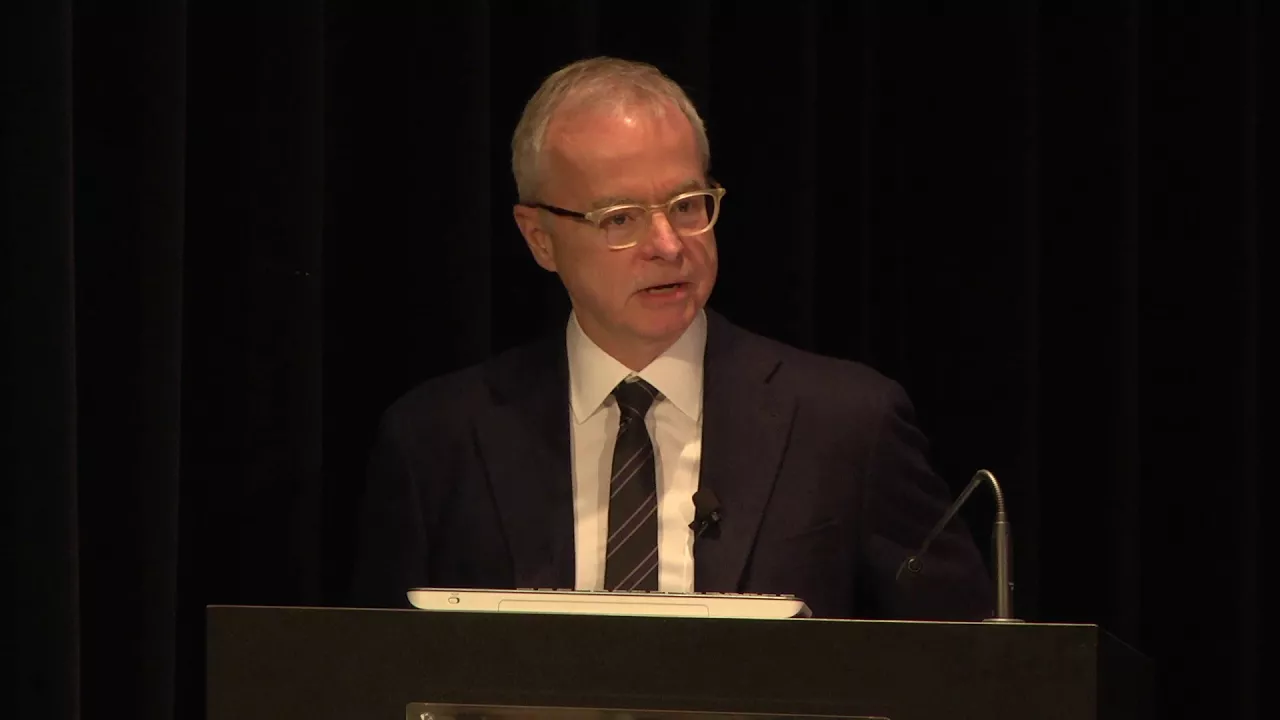
[Music] [Music] well thanks very much and good afternoon um it's it's really a tremendous pleasure to be here in Tilburg thanks Hans thanks Nick thanks to the Dean also for the kind invitation it's it really is an honor to be asked to give this year's Montesquieu lecture and I'd like to use the opportunity to explore law's role in some really puzzling aspects of Contemporary global political and economic life so the widespread sense that the post-war global order or system is somehow giving way to something more chaotic uncertain concern about the rise of expert governance our
technocracy in world affairs and of course also the astonishing persistence of injustice and inequality despite everything that we've tried to do to bring them to a better outcome and my hope is that by exploring law's role in all this will provide Something of an antidote to the frustrating feeling that for all their defects there are really no alternatives to our current political programs and institutional reforms and in fact argue that they're actually alternatives lying all around and attending to law maybe one way to help us identify them and pursue them so start with the post-war
order it's very hard not to be nostalgic for the idea of a global order centered in the North Atlantic vouchsafed by a Network of legal and institutional arrangements if you look back on it it seems pretty attractive but I think what many people see today is less that order than something chaotic more struggled really then stable order Power & governance capability are dispersed who has an overview maybe we imagine only some cadre of elites or experts or people at Davos something like that meanwhile whole regions of the world Seem to be coming unglued authoritarian rulers
seem newly empowered flaunting disregard for the values of economic liberalism democracy and human rights institutions that we thought were somehow central seemed disempowered the WTO the IMF the World Bank the UN European Union all are buffeted by economic forces and new political actors and our national governments are left somehow prostrate by financial constraint find themselves gridlocked And disempowered confidence in the rule of law seems to be a being in it since as its institutions and normative commitments are weakened in the north and instrumentalized for internecine political struggles across the world and then within the north
atlantic the establishment consensus seems newly fragile nationalism populism brexit Trump Italy it's no wonder the global commentariat is asking whether the center will hold now it's not clear what Happened whether the center began to wobble other powers began to rise the peripheries became unstable or people just stopped believing maybe all those things together but there's no question we've lost confidence and they've started to talk about the post-world War order in the past tense well looking back on it it's easy to see what made it seem so reassuring although I think it also does look too
good to have been true somehow indeed it was always Largely a dream a dream which I'm afraid also froze our imagination and stunted our powers of reinvention and as we wake up from this dream let's see if we can remember some things in the dream was a wonderful dream that we're waking up from I mean like any order one gets used to the post-war order seemed natural stable when we looked out the window we thought we could see a political equilibrium of roughly equivalent sovereigns reflected in diplomatic Routines and institutions all coexisting with a global
market that was moving resources to their most productive use as if by an invisible hand at the same time in our dreams to gap we thought it was a hard-won situation it wasn't natural at all the global market rescued national protectionism a legal order wrung from inner sovereign competition for political stability to replace war and great power conflict particularly here in Europe required enormous Commitment and effort as we constantly reminded ourselves and after all that effort there seemed there was no going back going back could mean only returning to an unattractive state of nature to
a much worse dream to World War two to the economic catastrophes of the Great Depression to colonialism to a world of religious wars although the post-war order had been many things in its short life a regime of capital controls inventive free Movement of national economic development and den of open economies of cold war division and then of triumphant universalism there was no exit it was like the Hotel California sort of the hotel could always be reformed but you could never leave and the order seemed remarkably resilient for all that it had gotten us through the
Soviet era absorbed decolonization the 1960s the oil shock it had survived repeated global economic crises and wars all Around the periphery of the system as well as dramatic changes in technology communication the structure of manufacturing and finance why wouldn't it also survive today's challenges after all it promised stability even stability in the interests of everybody a Europe for all Europeans a global order for all the world and if American or Western hegemony underwrote the whole thing this was less a worry than a relief at least somebody was paying attention to what Everybody would require a
kind of benign hegemony for which we should be grateful given the historical opportunities well if you look at all that together it's a fantastic picture and a wonderful dream a benevolent global order pragmatic problem-solving very difficult to give up what about inequality and injustice in this picture well more than comfortable stability the order seemed just even progressive the arc of history bending towards liberal values and Towards peace human rights the way things were at least here at least most of the time prefigured how they might be one day for the whole world that's why we
thought that working for the order and preserving what we built for ourselves was also to work towards a must adjust future for everybody else it's not the domination and unequal powers were altogether missing in the dream but they were somewhere at the margins outside the Order before the order beneath the order conditions to which the order responded we knew of course that they were stronger and weaker powers developed and underdeveloped societies leading and lagging sectors but these were not produced or reinforced by the post-war order on the contrary in our dream we thought the order
promised equality anybody could join catch up participate development or modernization was available to any country with the right Policy the global consensus and the institutional arrangements at underwrote were open to anybody with the right values the trade regime as well if you joined the WTO and made the necessary concessions the global financial architecture also if you managed your national accounts protected investor rights and joined the regime of bilateral investment treaties the European Union even the euro have passed a membership and even the rule of law Could be injected by the development agencies of the north
if Outsiders can't be assimilated and normally they're shot and US it's only because they present existential threats well this picture suggests a way to understand lagging regions and nations some of course are existential threats terrorists failed States deplorable but most are there are people in the global South who are not yet or people in the cities and rural byways of the global north who are no Longer suited for the rigors of modern life some are losers in capitalism's creative destruction and some have just been overlooked but each of these groups could be brought along with
sensible policies nudging people forward making sure the path to participation remains open and the social floor is not too far below the last rung on opportunities ladder the tools for doing this are known available all we need is political will to use them to keep doing what We're doing but perhaps more so of course many global problems are the unintended consequences of the North Atlantic doing what it's doing externalizing is pollution that security needs it's military campaigns and it's economic costs but here too the post-war order seemed to offer remedies another conference a treaty technological
innovations corporate social responsibility social justice activism the kind of thing that you could do on Your summer vacation or as a professional career and although it should have been clear that none of these remedies were quite up to it we could be assured by a shared recognition in lagging towns of the American Midwest as well as in emerging markets that where the North Atlantic center not to hold there'd be no reason to expect these problems to get any easier when the order was threatened by backsliding or Outsiders the solution was vigilance Security cooperation and doubling
down in the density of the institutional order you can see that actually quite strikingly here in Europe obviously the only response to an unsatisfactory Europe is more Europe reinforce the boundaries deepen the institution's well finally what about law in this picture we had and the short answer is law was everywhere if in 1918 people asked whether law was even possible among sovereigns a century later legal Arrangements had been dispersed across the world providing a common language for problem solving dispute resolution regulation and administration it had taken a hundred years of intellectual and practical work to
make law so ubiquitous in our in our world the legality of transnational law seemed plausible and along the way law was reimagined again and again the early 20th century notion of international law is a catalog of valid rules agreed by Sovereigns and interpreted by international jurists was modified and augmented by a series of new ideas first and move to principles and purposes where codified rules couldn't be settled juris could find solutions elsewhere in private law and allergies social observations about the nature of international society deductions from the idea of sovereignty itself and then a more
sociological turn less norms than modes of interaction Processes procedures for handling claims defining actors in understanding the normative implications of horizontal sovereign to Sovereign activity by mid-century norms could be found in social life and what were enforced as norms interpreted as norms seems persuasive as norms in a rough-and-tumble policy process underwritten by shared values and then we came to embrace a more functional problem-solving family of legal ideas Law is what works in a new focus on substantive results redefining the regulatory administrative and dispute settlement functions of a government as activities that could be done anywhere
by anybody governance new governance and our exuberant moments we might even have thought that wherever two are gathered in its name there's law and anyway maybe law is more symbol than substance a shared consciousness that could be shocked a measuring rod for legitimacy The expression of a universal civilization ok across the 20th century that's a lot of intellectual innovation the result was a grab-bag of diverse ideas about what law is how it functions and the role it can play in global affairs diverse even inconsistent ideas which can be picked up strategically by actors but along
the way some unfortunate notions about law were also dug more firmly into our consciousness first a forgetfulness of the kind that Often happens in dreams here of pluralism and diversity contradictions and conflicts were one imagines domesticated turned into contending principles or interests that could be balanced disputes to be settled and on that basis there was or might soon be something we could think of as an international order expressing the commitments of an international community and beyond that only outlaws and scary others now there were Different pictures of that order the way it balanced differences within
itself and excluded differences external to it was it a community of consciousness a set of networks with processes and interactions akan constituted whole in each case the law that made and enforce the order was its alfe imagined to be sufficiently orderly and coherent to hold it all together despite this hodgepodge of diverse ideas about law that had gone into creating it In the first place we had the professional techniques so affirmed the International Law Commission to manage dissonance and fragmentation unfortunately however a dissonance didn't disappear interests and perspectives diverge and increasingly so not only against
but within the order and the second unfortunate idea was that law however embedded in all those networks and institutions also somehow stood above them outside or beyond International politics and economics law was not only a fact after all but it was a norm rules of the road guardrails for political conflict in a platform for a global market we dreamed of law as a kind of air Zots global sovereign or reassuring father at once problem-solver and ethical lodestar but there is no global interest aggregator up there attending to the world public interest and third the idea
that law is good it's on the right side of things on the whole It protects the environment resolves disputes reduces the violence of war but sadly law also confront comforts the environmental Despoiler protects private right from public power and heightens the intensity of disputes when all sides believe their cause is legal and just looking back I think people credited law with so many magical powers because they felt they had to I mean it was calcine after all who most eloquently asked us to recognize to choose to recognize that Only what he called the efficacy of
the legal order under wrote the legal order we should choose as a matter of professional faith to see all that disaggregated political and economic activity as legal law abiding law creating after all we'd had politics in the 20th century and we knew where that led what was needed was law and to get there we needed to see it affirm it believe in it and we'd make it true well this project was very successful and we Do see law everywhere and law is everywhere but now we find ourselves be set by some very 21st century worries
let me mention just a few first a worry about the possibility not of law but of politics in our technocratic world where is the opportunity to contest things to participate in the making of winners and losers what happened to sovereignty sovereignty has decentralization local control ownership of decisions which matter if in 1918 one could yearn for Law and commit myself to intellectual activity to generate a feeling that it existed in 2018 the problem seems the reverse somehow an unbridgeable gap has arisen between territorial politics and a global economy a gap underwritten by law and all
the practices of elite managerialism it's so dispersed a system there's just no address see for complaint I remember the years I worked in Brussels wherever you went nobody'd ever decided anything the Commission Thought it all happened in the council the member states blamed the Commission the Parliament thought things had been precooked in the technical working groups and so on around the town and on a global scale the nominally public actors today seemed captured by private interests but if you ask corporate managers or investors they also feel constrained by regulation by their mandate by the competition
national governments seem displaced by global Institutions and commitments but if you go there they talk about the pressures of member states in national politics so that's a first or a second 21st century worry would be a worry about law itself really does coherence about coherence and somehow the persistence of pluralism does it all really add up the experience of pluralism of confrontation with an alternative one can't balance away or exclude as satisfactorily other has become ever more prevalent for all the Talk about systems and constitutions and professional techniques of interpretation and we'll worry about laws
effectiveness for all the talk about problem solving can the international legal order actually respond to the problems newly understood to be global environmental harm humanitarian crises permanent war around the borders of the old order terrorism all the challenges digitally connected and artificially Intelligent economic and social world the solutions and reforms seem meager apologetic promises the international community of village of Potemkin remedies and then a worry about laws virtue even virtuous projects do have dark sides human rights development humanitarianism pursuing these things keeps getting us in trouble in a world of unintended consequences and sharply divergent
national ethical visions and here I get to quote Montesquieu because it's the Majnu lecture even though sudden emergency building he did know this and his most famous quote at what you are with which you're all familiar is there's no tyranny more cruel than that perpetrated under the shield of law and in the name of justice well somehow dreaming we forgot that and finally a worry about laws roll in things we deplore law as a strategic asset in war law fair or taking equality people talk about Structural inequality inequality rooted in structures which reinforce power differences
in bargaining power patterns of honor and shame deserving and undeserving but what are those structures other than the very legal economic and political arrangements we were dreaming about it's not surprising that the study of colonialism should seem evermore useful today after all the promise that everyone can play is terribly misleading if you're a Powerful player a world with no center no logic beyond the continued oppressive interests across thousands of dispersed settings is great it looks like opportunity the opportunity to strategize across a very wide terrain to consolidate your market share promote shared values ensure the
security of friends and allies but if you're not a powerful player all those opportunities are your vulnerabilities from the periphery whether that's in Bangladesh Or a Forgotten region of England or Arkansas the global game is a lot more difficult to play so if you find yourself waking up now in the 21st century to worries like these let me suggest in the remainder of the time we have three habits of mind that might help us identify alternatives that are worth pursuing first a habit to encourage imagine the world less as a system than as a struggle
take a break from the idea That it's ordered although the social sciences often start with conflict a Hobbesian state of nature or the competitive market of Adam Smith they work really hard to explain how things nevertheless turn out well ordered through a balance of power or in a visible hand or something like that their equilibrium theories ultimately but much can be learned if we step back from this urge to systematize and think of international affairs rather as what Happens when people everywhere engage one another with little backpacks of power and entitlements and vulnerabilities and have
at it people struggle over political and economic arrangements because because they can be put together in lots of different ways I mean a couple of examples it's really easy to forget the international financial institution started off supporting capital controls in import substitution industrialization Before they became the voice of free movement and austerity the human rights movement led by Amnesty International started off as the name suggests favoring amnesty before it embraced criminal justice as the first response to deviation from its purportedly global standards although the EU has always been an order liberal affair of free movement
the meaning and strategy for social policy has shifted wildly with broader changes in membership in elite Ideology now I don't mean by this that everybody's always fighting most struggles have already been won or lost and you don't have to reengage that winners can simply press the outcomes on losers as facts about the status quo or the status of forces to stand on prerogative or principle is also to stand on a well consolidated victory even the turns and opportunities for collaborative activity will have been wrought in a prior conflict and Collaboration may itself aim to defeat
some third party and people today are just as ruthless about this as they always were when US Treasury Secretary John Connolly advised President Nixon was when I was a student to decouple the dollar from gold he's reported to have said my philosophy is that all foreigners are out to screw us and it's our job to screw them first well it's not only our current president and not only Americans who talk like This and this won't be new to those for whom the world order was always more struggle than system C people who never shared the
dream whose problems were not addressed whose conflicts were not being managed who always saw the global order reinforcing inequality and consolidating their vulnerability but here's the interesting thing nor will it be new to strategic actors right at the center of things in my experience if you ask leading businessmen or politicians to Describe the world they'll talk about order spinning an elaborate picture of how things work but if you ask them what they're doing about their projects about threats and opportunities system thinking fades away they start speaking strategically attentive to multiple overlapping overlapping institutions and modes
of engagement and savvy actors are always moving the goal posts transforming public into private interests and back Economics into politics local into global shifting affirming undermining or ignoring what have seemed systemic limits it's not that changing the game is easy actually it's quite difficult to be savvy and strategic and when you are people resist that's why things are so much more sustainable than many fear but it's surprisingly easy to underestimate opportunities to shake up the system and to be surprised when it occurs or to focus only on moments of dramatic change Revolutionary breaks and science
or political life rather than quotidian distributional struggles that actually alter things quite substantially if we can learn to see systemic regularities the way they once appeared to the strategic actors to establish them as opportunities for gain or moments of vulnerability as victories or defeats will avoid the sentence e to canonize the particular arrangements we have as order itself so how can we get better at Identifying and pursuing alternatives to figure that out we've got to understand how people struggle how they understand the terrain their modes of engagement the forces that shape their Authority or leave
to yield which takes me to my second theme in second habit of mine to encourage attention to the world making power of ideas that practices by which knowledge becomes power in struggle it's not that our managerial world has Replaced violence with arguments I'm sure people do get persuaded by argument sometimes but it seems pretty rare in my experience both in my family and also in my life nevertheless it's surprising how much political and economic struggle is undertaken by articulation and performance by asserting powers and rights attributing identities and responsibilities articulating reasons and necessities people in
struggle Neither talk one another into things nor simply bash one another on the head they bring leverage to bear a complex amalgam of assertions backed up by more or less tacit threats persuasion and coercion all right somehow impossible to untangle in a world when people drop bombs to send messages or transform economic power into market dominance through negotiation so George Kennan was a American diplomat in in 1946 he apparently said to students at the American Naval War College you have no idea how much it contributes to the general politeness and pleasantness of diplomacy when you
have a little quiet armed force in the background so we might imagine the exercise of articulate 'iv power as a kind of work as a practice explaining to somebody maybe standing right over them and looking at them like that what facts or norms require them to do or to decide and then interpreting what They did and pressing it back into the fabric of norm in fact for the next time and as such the operation look what sometimes fancily called power knowledge is an everyday experience somebody comes to you explains how things are and what has
to happen as a result they assert their authority or exercise entitlements and you yield or you respond and they yield and when the dust settles somebody's been put out of business closed out of a market prevented from Crossing a border by somebody else's claims and assertions as there are a lot of things we don't understand about the way knowledge becomes in our world but let me offer some preliminary observations more kind of hypotheses for further study if you like a first observation would be that the material people bring to bear in this work in their
struggles with one another is more loose agro than tight analytic struggling for gain people draw on a mix Of big ideas historical precedents principles rules cultural expectations and allegorical morality tales they deploy a kind of mash up of argument fragments rules of thumb that are only loosely tethered to various knowledge disciplines Wow but also economics political science history or Natural Science the norms in facts people invoke require interpretation moreover they're malleable open to disagreement they've been midwifed by earlier struggles which Could be rethought over their status and that's all why technical experts are so often
identifiable by national or ideological propensity and why we so easily see what we think of as the interests behind claims to represent ethical universals or simply to be stating the facts now there are a lot of places you can go to get professional training in these combative arts you can go to law school Business School schools of public policy but you can also learn A lot just by watching television and browsing around in your social media feed professional and laypeople share more than either group may realize in part because everybody is learning to engage iteratively
attentive to one another trying to be like and perform to the authority of the other there of course different styles which can be practiced and managed mastered insiders and outsiders hegemon x' and colonial elites each find ways to participate in Or resist the conversation human rights workers learn to oscillate between a kind of strategic pragmatism and ethical denunciation that's their style economic development experts blend ideas about economics society law and institutions into this weird mix of global recipe and deference the local context and political choice that's their stuff but in all these settings the knowledge
which becomes power is human knowledge blend of conscious semi-conscious and Wholly unconscious ideas full of tensions and contradictions the comforting idea that the people in power are bringing agreed norms or settled facts to bear on common problems screens out the human discretion in the way were governed and screens out the chaos in the ideas being brought to bear when people decry the advent of post truth politics or the erosion of a universal ethical vocabulary they're also congratulating themselves for normally Being rational objective reasonable in identifying and implementing pragmatic action in the public interest as if
norms and facts rather than real people were normally responsible for the outcomes as if what's going on is governance not rent-seeking or nest feathering not reinforcing some private interests against others not reinforcing inequality or consolidating social power while managing dissent not managing an entertainment spectacle but governance The interesting point is how a hodgepodge of human knowledge hangs together as a as a practice of power how contradictory and inconclusive knowledge has affects how it shapes and limits our governance culture and here there's lots we don't quite get yet but there for example I mean are there
patterns a kind of grammar holding so many diverse fragments into effective exercises of articulated power how does a governance vocabulary that seems so loose when you Look at it able to take anything and everything into account miss so much-- well two places to look well we might figure this out first in all that's actively unknown by people who rule what's framed out as insignificant or uninteresting in ways which make some lives matter and the sacrifice of many others an unfortunate matter of fact rather than the result of a choice and all the stuff that's taken
for granted Ideas which lie beneath technical or ideological arguments somewhere in common sense ideas like the world is flat making it unlikely somebody might try to sail around it at least until the ideas brought forward and contests somebody try something now although we know these framing notions are terribly important we rarely study them head-on yet people are always trying to put new stuff in our unconscious stuff like it's a flat world or globalization or the Necessities of a balance of power or a global market or global warming or the Anthropocene and we might understand the
human rights movement or neoliberalism for that matter as an effort to adjust our taken-for-granted notions of what government is and can do an effort to change our background consciousness or say you're interested in the relationship between polity and economy law school will train you to contest the thousands of technical issues of degree Which go into making the state a bit more powerful over this a bit less over that as well as the large ideological positions that can be dragged in to justify these technical differences politics and economics should be separated for these reasons should be
linked for these other reasons but all this ideological and technical work goes forward in the shadow of stories people tell themselves about the world stories about what an economy is what politics Can accomplish as well as stories about the purposes and potential of law that are harder to address or investigate head-on stories which make some problems visible some actors central and others invisible before we get to the choices embedded in technical and ideological disagreement a second place to look in the powers that create injustice the things you learn you really can't say in polite company
even the most malleable technical and Ideological material has limits follows pathways sets boundaries on public reason these days for example you can't say God has authorized your victory any more than you can just take things by brute force you've got to have a reason a reason a principle a reason of entitlement and appeal to the universal some professionally Forbes justification for your coercion now you can push against these boundaries and they're constantly being remade but to Struggle you need to know where the boundaries are and they establish a kind of bandwidth around what politics can
accomplish what economies can become my hunch is that a combination of semi-conscious common sense and the structured limits of even the most malleable material in the professional consciousness of those who rule accounts for the unfortunate sense that while everything's being taken into account everywhere we sees the issues that are Left out and problems which escape our grasp well one further observation about global articulated power and how it works in studying legal expertise I stumbled on a kind of weirdo axiom as law became ever more diverse or plural it also became more prevalent or widespread and
this seems true for many forms of global expertise the less decisive determinative or univocal and expert vocabulary the more prevalent it Becomes perhaps because poorest vocabularies can be harnessed in principle disagreement as readily as pragmatic settlement or because in a plural world people are constantly probing testing for facts that might be reframed as decisions maneuvering for authority to act on the basis of other realities and as they do the vocabularies they share become ever more internally diverse but this porosity helps explain the sense of pragmatic Disenchantment that's so common among global elites when you meet
them a kind of disbelief in all the details anchored by faith in the virtue and objectivity of the vocabulary as a hall as a whole it may be simply that over time people who use the available vocabularies come to grasp their plasticity their potential for strategic use and the vulnerability of even the firmest framing conventions but they continue to find them useful perhaps more useful and The result is a kind of doubled sensibility at once believing in strategizing which makes it easy to speak truth to power in the morning and then deal with them in
the afternoon more pragmatically or to imagine other people being persuaded by claims that you know and presumably they should also know are really just arguments much about the sensibility remains a puzzle we know the incidence of anti foundational pragmatics varies over time And among professions and its rise is not a one-way ratchet thinking like a lawyer once meant being able to solve complex cases by formal categorization and logical deduction a half a century later it was difficult to get an A in law school if you tried to do that thinking like a lawyer had come
to mean skill in establishing and unraveling the categories constructing and demolishing demolishing chains of deductive logic But then a generation later clear reliable rules are all the rage again economists psychologists scientists all have their own histories with analytic certainty in doubt consensus consensus and method war for some elites and in some professions in some institutional settings overt embrace of sophisticated pragmatic skepticism is a badge of honor for others that's only the sort of thing you could share with a friend over a beer and of course there's still others Who cling to their analytics doggedly all
doubts inaccessible between a persistent conscious certainty as a result the distribution of certainty and doubt of strategic flexibility and persistence bears further study if jaded sophistication varied with the distance from the commanding heights for example it would be interesting to know and it's certainly often imagined that people far from power are more gullible to its claims than those at the center Of things certain about that one certainly finds dogmatists in the corridors of power and people on the receiving end of authority who appreciate its plasticity it may just be that the hoi polloi are jaded
and sophisticated in a different way for one thing they've been trained in savvy listening by media talking heads explaining to them what's really going on when leaders make this or that claim heard in this way with the commentator Beside you telling you what's happening Alysse can sound cavalier about the gravest moral issues even when are particularly when they also sound self-righteous lecturing about values in world bankruptcy and stuff like that for all the sound and fury on television than in social media over lunch we people I think also realize it's somehow not serious that people
are just mobilizing and ideas strategically listening it's Easy to conclude the vocabularies for exercising power are a lot of nonsense you can learn to use them have to listen to it well you can also doubt that it's anything other than self justification it's hard not to think something else is going on and this is fuel for politics in a really paranoid style for the idea that Trump doesn't really mean what he emphatically came seems to keep saying and once you start thinking like that it's easy to imagine that the only thing That only the things
which can't be said which are politically incorrect are authentic important and what you really believe well this is also a kind of jaded sophistication if a really unfortunate one so let me now turn to the final third habit of mind I mean to encourage attention to laws role in all this in the ending the distribute your bic wa 'test distributive effects that they come about when people engage in Articulatory power law is actually a great place to explore the global exercise of this kind of authority the world is awash in legal name claims and norms
and procedures which are tools for distributive struggle records have past victories and defeats a vocabulary of assertion and dispute with its own blind spots and biases a blanket of legitimacy thrown over the whole thing rather than thinking of law as an ordering system structuring device we might study it by Focusing on what people do to one another by asserting rules invoking powers are developing legal justifications doing so would place laws losers alongside its winners and give us a really different picture of the losers they haven't been left out they've been defeated and it might make
visible laws darker contributions to injustice in disempowerment and strengthen our ability to identify legal changes that could alter the way wealth and status Are allocated we know that legal rules arguments and institutions make it possible for people to exclude somebody else capture and retain gains from economic or cultural activity legitimate the outcome is order rather than victory we know that although we imagine gains from trade for example to be distributed by fax fax like bargaining power the relative productivity of factors the competitiveness of actors what we call Bargaining power competitiveness depends on the legal and
institutional arrangements that affect things like cost of production barriers to entry and so on that's why people struggle over those things we know law is in the background of the distribution and of resources and in the reproduction of inequalities we find unsatisfactory I mean after all how is value distributed across a complex value chain multinationals readily assess such Things to lobby for rules that will consolidate their market power and close out rivals teams of lawyers work to identify levers to place in come here and losses there for all kinds of distributive purposes patterns of dynamic
inequality also have legal roots when law consolidates the relative powers of centers able to compound their advantage over lagging peripheries when legal arrangements speed or impede flows of capital goods and persons Accentuating the forces which leave some communities behind while others speed ahead as a result legal arrangements offer a kind of red thread to unravel the mystery of inequality if global inequality is structural that structure can be observed and contested in law a history of law's role in domination and distribution would illuminate the way regimes which seem impartial impartial even benevolent participate in making an
Unjust world the legal institutions of the European Union and London financial hegemony for example are not only avatars of peace and stability they establish hierarchies of haves and have-nots when monetary union becomes a recipe for debt bondage or when free movement from the periphery and social free movement for the periphery and in the periphery and social protection at the center becomes an engine for relative wealth And stagnation to figure out how this happens we're going to have to dive into legal details but from colonial governance to bilateral investment Ruiz treaties the arrangements allowing winners to
consolidate gains and establish dynamics of inequality between centers and peripheries are legal then as now legal institutions solidified the distribution of rents from global economic activity and consolidate the Political authority of those committed to the stability of that outcome law also distributes when it infiltrates our common sense about the world about the powers that be the distributions that are just that are natural and when the consciousness of legal professionals limits the arguments that can be made the interest that can be heard although our sociological tools to identify laws world-making effects are pretty rudimentary sometimes it's
very Straightforward when legal regimes transform past might into present right that can be articulated as fact easy example the UN Charter cemented the status of the post 45 victorious powers as the great powers for all kinds of purposes although legal work arranges time as much as space configuring who's up to date who's behind laws world making impact may be easiest to grasp geographically let me give you a couple of it king of examples Before concluding people use international legal materials and arguments to mark national boundaries make special spaces subject to special rules free trade zone
detentions enter and so forth once these spaces have been identified things proper to each can be ordered in a range and just as people become their legal status he is a refugee she is an economic migrant so place has become their legal regimes that is the high seas that is national Territory and so on the legal arrangements constituting the zones fade as the space has come to be taken for granted now laws roll in this can sometimes be obscured by the fact that law is so often also the tool for rendering borders porous or linking
otherwise distinct spaces and when this happens is really easy to imagine that the difference comes from someplace else but legal disputes about boundaries can also reinforce the notion that spaces They separate are distinct line between them wherever it settles a natural one and your example from Europe take take the boundaries of Europe European elites have established as you all know kind of complex crazy mashup of legal regimes to broaden and narrow what counts as inside and outside for different purposes the EU is now this pastiche of spaces the variable geometry of the eurozone the Schengen
area and NATO the European Stability Mechanism the troika its clients in Greece and Cyprus association agreements bilateral and multilateral trade agreements and so forth lots of boundary issues remain thorny relations with Turkey for example nevertheless or precisely as a result people across the world have come to take for granted that there's a space called Europe rooted in facts of history and geography which sets limits on elite political imagination in concentric Circles from Brussels outward the Benelux the Rhine the original members the older members well not written the Associated nations those on a pathway to membership
and so on so if Turkish relations with the EU are awkward it seems obvious that geographical facts and cultural differences make membership for Israel or Palestine or Tunisia or Libya impossible however beneficial that might be for everybody they're just not Europe but they could be Europe of Course just as Malta and small islands scattered all around the oceans are already Europe whereas Gibraltar is part of Britain in fact actually not that long ago all those places were part of Europe but for now however the facts are clear they are not and therefore can't be or
take the distinction between the global political order and the global economy we imagine the first territorially political order the second a kind of space floating above the Marked territories of sovereign authority but we know that the global economy is everywhere entangled with politics supported and impeded by all kinds of national institutions and legal rules the boundary between the political public and the economic private is constantly being remade nowhere do we find one without the other and most legal work about them concerns their links and reciprocal influences structuring transnational public-private Partnerships harnessing sovereign debtors to private
creditors establishing public regulation of private activity or bringing public power to the air in defense of private right very difficult to isolate this incorrectly but laws intense boundary work does seem to strengthen the common sense idea that international political and economic life are naturally different they take place in alternative imaginary Spaces they have distinct logics that's why we have to go through all this work to try to connect them up the difference is reinforced by limits which seem implicit in legal reasoning about the connections so in a world where private rights travel and public policies
don't just to take one example although you can organize labor globally it's really hard to do it just as you can get investors to take a haircut but that's also really hard to do So wherever spaces allocate power and privilege people have a reason to contest them the west and the rests north in the south and usually the struggle is over the boundary they're civilized in uncivilized spaces but my culture actually belongs in the Super Why side just so you know but sometimes however people also struggle to overturn the distinction the world is not organized
around levels of civilization all states are should be equal and it Can then be difficult to shift it from one mode of opposition to another a quick example again from Europe the history of center periphery struggle in the EU as it moved from east-west to north-south so after 1989 brussels elites created this kind of imaginary europe that went from Scotland to Slovakia by placing the East and the West in different historical times countries which had arrived in modern market Capitalism and those were just headed a long way to go to catch up and it seemed
clear that complex social protections natural in the West would be premature in Eastern economies that required the shock of free trade at market prices to jumpstart their modernization there was a lot of struggle about who was where on the pathway to full membership in the social welfare state but there seemed little room to dispute the apparent inevitability of a spatial and temporal Hierarchy between the people who had to survive and free trade and the people who could have a cosy welfare state but then the long struggle over austerity debt in the Euro which followed the
global financial crisis shifted the frame it began to seem to the difference between Europe's north and south at least lay not in a hierarchy of development in a political struggle between unmatched forces with different Priorities and as the crisis ground on national political elites in Spain Italy and elsewhere needed a strategy about the baseline should they do all they could to be on the right side of the line or should they join with Greece to overturn the framework of distinction ultimately they chose the former but not because the latter was invisible it was just a
greater stretch for them to figure out how to do it seemed liable to unsettle things in unpredictable ways so A better grasp of law's distributive significance might open the range of alternatives and reduce this sense of stretch when such kind of thing appears so what does all this tell us about the potential to change the world well it can be done so it's frustrating when the center claims are ready to have taken everything into account it leaves very little room for those who have other interests or concerns people who want to change things Even the
emancipatory potential of social movements feminism human rights and so on are routinely transformed into governance projects of their own and so what can you do if you want to change things well you can go back you can say let's go back to sovereignty and local control and the politics you remember and like brexit but there is no brexit there's only an endless negotiation of a thousand technical questions and eventually there might be Canada it can Seem we have only the current arrangements or the power of no of religion in a secular world of nationalism tribalism
racism against the cosmopolitan order well certainly true that the room for national initiative and experimentation has been eroded by globalization free movement of goods and services does make territorial regulation more difficult the erosion of the tax base everywhere has bound sovereigns to the service in service to Global investors but these things weren't inevitable they were made victories over alternatives within the post-war order and one of the tragedies of our contemporary situation is a collective amnesia about their very real alternatives lying around us an entire history of heterodox analyses proposals and real-life experiences after all wherever
there was struggle there were alternatives not just between the modest reform is Amelie Management and outsider agitation but alternative voices and perspectives and possible arrangements within what came to feel like an unchangeable order where money credit labor and capital political power and right have been legally constructed there was a moment when they could have been legally constructed differently had they been the legal boundaries between economics and politics or between public and private actors might be some other way and then That might seem normal and counterfactual we just take the gulf between a global economy flying
around in a national politics we doesn't have to be that way we know how to link economic life to territory and community just as we know how to distribute opportunities for political choice across institutions beyond the national capital and the professionals we call politicians it's been done before but to get there we would need to reorient Expert work from managing a separation of economics and politics to arranging their connection it's not that we lack the ability to arrange distribution in some other way when we want to I mean consider the very fashionable notion that every
country should become Silicon Valley where my uncle lives well I've heard this actually all over the place in Russia Kazakhstan Doha Mexico China it's astonishing they're never people who think they could be the next Silicon Valley maybe Tilburg is gonna be the next ability and in each case the tools people intend to use are legal and administrative changes reallocating opportunities to garner rent in the name of social transformation adjusting rules on credit education policy immigration intellectual property local autonomy expert export and import licensing turning the levers of state power and private authority to allocate gains
to those who would innovate as they'd once Been turned to those who would industrialize by changing the rules the good guys investors innovators entrepreneurs the Millennials national champions would be strengthened and the society transformed well we might learn to approach global order with a similar sense for its plasticity the machinery to link the dispossessed present productively to companies and nations which benefit from global markets mobilities and technologies isn't Mysterious those who have ensured their disconnection now how it could have been done just as we could disperse sites for political engagements we could reshuffle legal arrangements
to mitigate Julis dynamics think about local content employment technology transfer investment requirements that link firms benefiting from privileged market access or free trade zones to their periphery or corporate mandates that prioritize Links with communities or unions alongside shareholders lending requirements targeting credit to peripheral actors zoning practices linking an office tower downtown with the establishment of the shipping facility in the ghetto and so on corporations could be discouraged from offloading workers on national states for tax and transfer welfare and encourage more required to find something for these workers to Productively do capital fright could flight could
be restrained capital investment in developing nations required glose go-slow provisions could prevent rapid in-and-out flows of speculative capital and thin peripheral markets and so on by tracing the impact of legal arrangements on political and economic trajectories we might illuminate alternative directions for the routine work of managing the system adjusting the entitlements and Expectations that link people in relationships of relative privilege and vulnerability but first of course like strategic actors everywhere we need to understand and remember how law distributes now rearranging things and picking up these alternatives won't be easy we'll need to be savvy and
strategic people will resist rearranging the world will require struggle struggle on the terrain where inequality is established and maintained but this is In a matter of outsider populism nor of detached academic reflection it's a matter in machs vapers words of strong slow drilling through the hard boards of institutional arrangements where modern expert rule takes place I propose we get started thanks very much look forward to do [Applause] [Music] you [Music]