[Music] This episode of the HVAC School podcast is brought to you by our brand partners, Carrier and Carrier. com. Carrier has been a long-term sponsor of the podcast; they've made it possible, very early on, for us to do what we do, and they are the products that we sell day in and day out, everything from single-stage equipment all the way up to the Green Speed Extreme, one of the most efficient products on the market today.
Find out more about what Carrier has to offer and about becoming a Carrier dealer by going to Carrier. com. Copeland and Copeland.
com. Copeland's site has white papers about regional adaptations to see how CO2 refrigeration is taking shape in your market. Learn about transcritical booster systems, and learn about different CO2 system types, including secondary and hybrid systems, with easy-to-understand explanations, system diagrams, infographics, video series, webinars, and articles, all available on Copeland's site at Copeland Refrigeration Technologies at RefriTech.
com. And specifically, the new Viper Wet Rag Heat Shield, the revolutionary flame-resistant welding pad designed to be used either wet or dry. Find a Viper Wet Rag Heat Shield at a distributor near you or go to TrTechTools.
com and use offer code GET SCHOOLED for a great discount at checkout. Fieldpiece, Fieldpiece. com, and specifically the SR47 wireless refrigerant scale, the new heavyweight champion of digital [Music] scales.
You know that friend who keeps interrupting your great story to adjust your facts just slightly? He's like that! Here's Brian.
Or, why hello there! This is the HVAC School podcast. I'm Brian, and this is the podcast that helps you remember some things you might have forgotten along the way, as well as helps you remember some things you forgot to know in the first place.
And today, we're talking about vacuum. I got two questions on social media about vacuum, and so I'm just going to talk about vacuum again, and specifically some of the things that I think early on maybe I failed to say or failed to say as concisely. Of course, I'm not going to be that concise because this is a Q&A podcast, but I'm going to turn it into a full episode because I like to talk about vacuum.
So that is what I'm going to do. The first question is: in a refrigeration system, where should the vacuum pump ideally be located? And the answer is it should be located on a solid surface where it can't tip over.
I know that's not the question you're asking; that's a joke. The question is, where do you pull from? I think that's the question, and the answer is you want to pull from the largest volume locations that you can.
Sometimes, that's going to be if you have multi-position service valves on the compressor; it's going to be there. Basically, it's wherever ports that you have access to; sometimes they're going to be core max ports, in which case you can't pull the cores, but if you just fully depress a core max, it will be open enough that you have almost unrestricted flow. But essentially, the answer is wherever it's easiest to pull from.
Specifically, when you're dealing with refrigeration, though, there are a couple of big considerations. If you still are running a cold box, sometimes it's really helpful to heat up the evaporator coil with a heat gun. Obviously, if you're in low ambient conditions, you can heat up the compressor.
Anywhere that there's a potential for oil and refrigerant to have been present, that's where things really start to take time in vacuum, and this is what a lot of people will say after they learn my one hose method. And for those of you who don't know the one hose method, I'll cover it in a second, but for those who know my one hose method, they'll say, "Look, it works fine on a new system, but it takes forever when I'm doing service. " So if the system's been in operation, it still takes forever.
The reality is, yeah, vacuum still can take a long time when the system's been in operation and you have refrigerant that has been dissolved in the oil; that takes it a little bit longer because that evaporation happens at the surface of that oil layer—what we call the oil or liquid-vapor interface, right at the top—that's where evaporation happens. So in a system where you're, for example, pulling on the compressor itself, it's hard to get a really good vacuum in a compressor because you're not going to pull through the compressor. So it's really just pulling on the suction side.
The question that you asked here is: where should it ideally be located? It depends on what you're pulling on. If you are pulling on the entire system, then pulling on the compressor suction valve is one of the best ways.
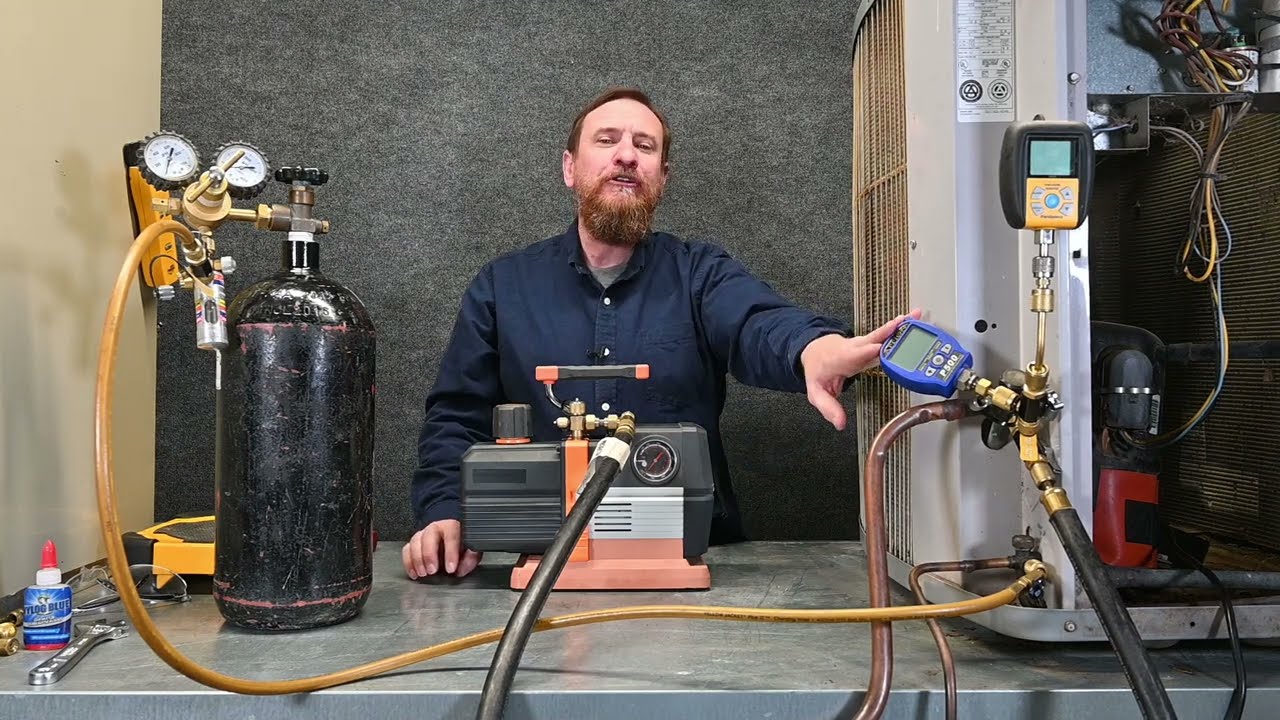
But the same rules still apply: wherever you're pulling, you want big hoses, and you want cores removed. Now, the other question that often is asked is: where do you locate your micron gauge? Whenever possible, I like to put my micron gauge on the far other side of the system from where I'm pulling.
Again, sometimes that's not practical because your points that you're pulling from are also the best points to pull vacuum. So you're, in many cases, left with leaving your micron gauge right at a location that you are pulling, but then that just means that you've got to give a stabilization period once you valve off because the lowest point of pressure is always going to be right at the pump, and then, obviously, at the end of the hose that you're pulling off of, is also going to be a point of low pressure. And when you valve that off, now all of a sudden, that pressure is going to jump up pretty quick.
I have to make sure that you can valve off, and that's quite important too, so the quality of your valves. I'm really a big fan of Appon ball valves. Appon Core Tools and Navak make some good ones nowadays too.
Just making sure that you can valve off and that the micron gauge remains on the system side of the valve, so you can see is that decaying. But you're always going to get that initial jump up when you have your micron gauge close to where your hose is connected. If you put your micron gauge on the far side of the system when you valve off, often those micron levels will continue to drop, and we see that in our one hose method, which I will cover now.
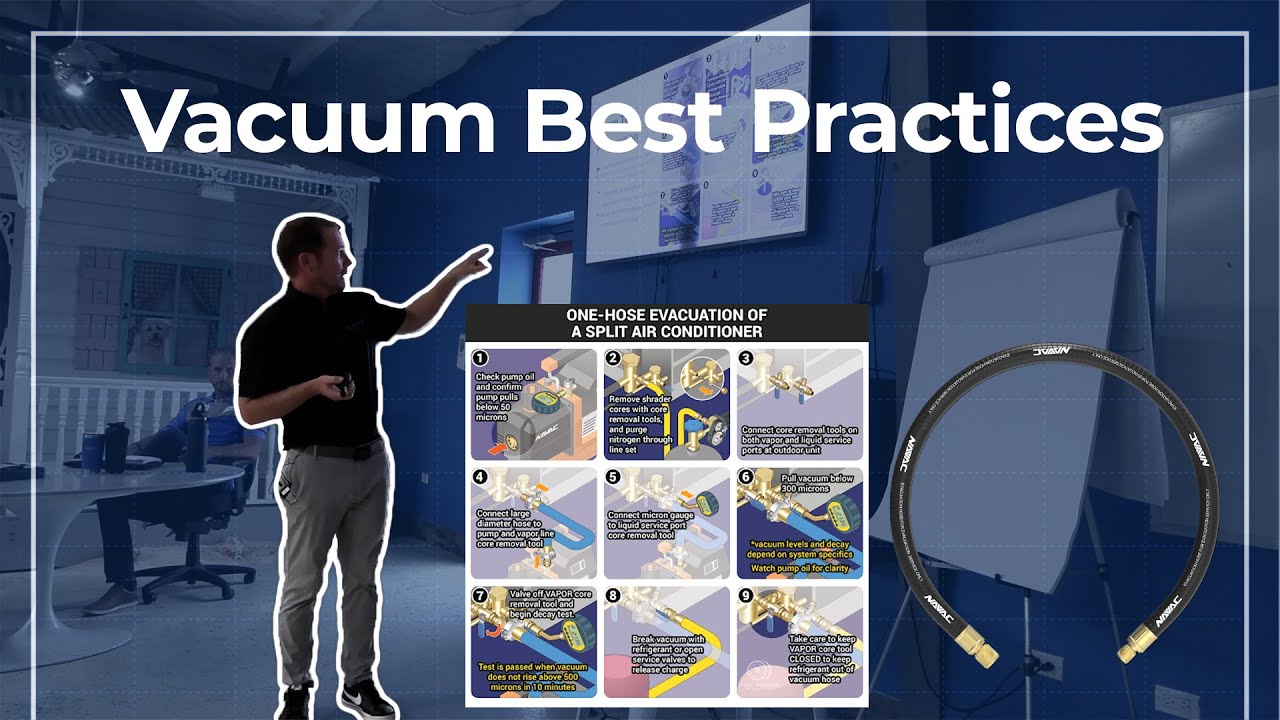
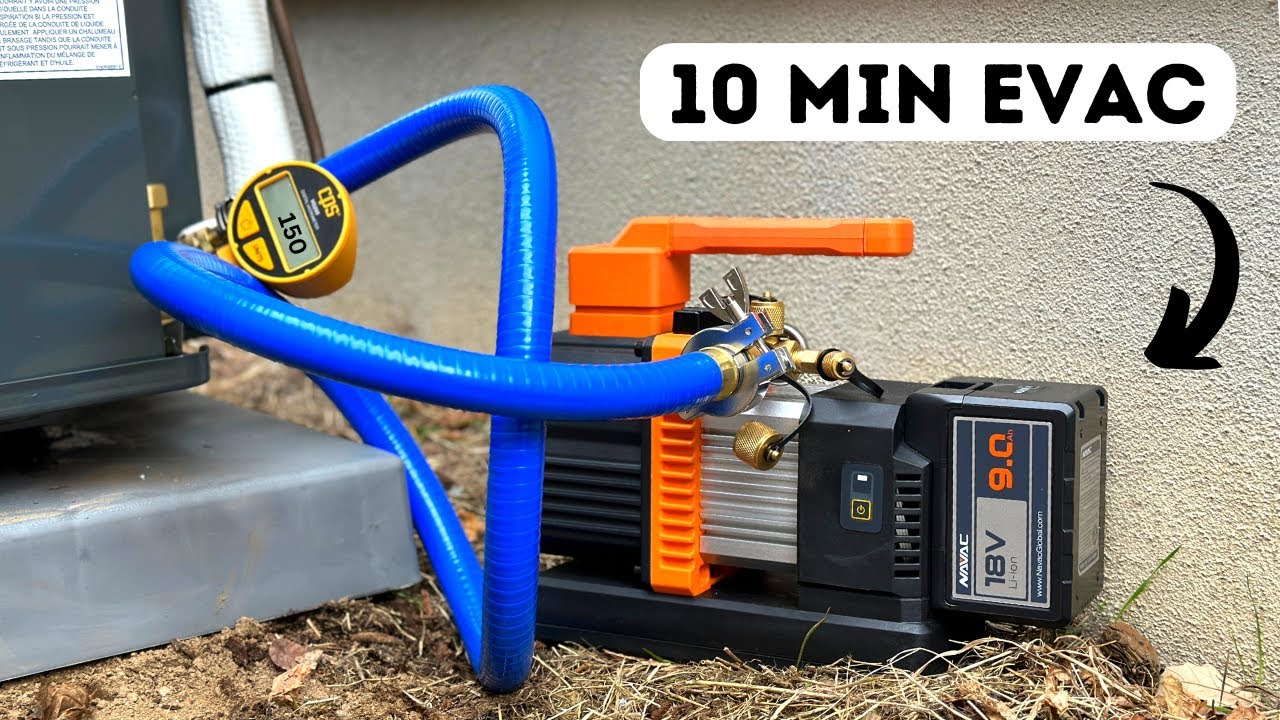
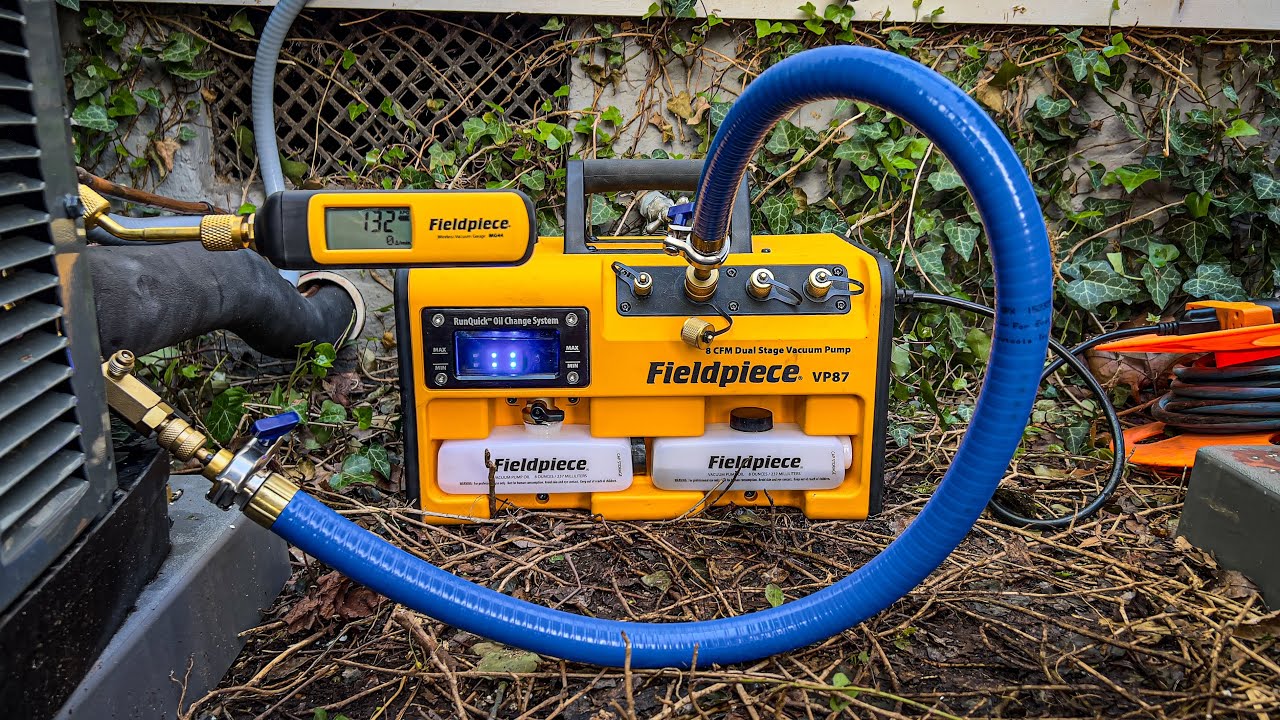
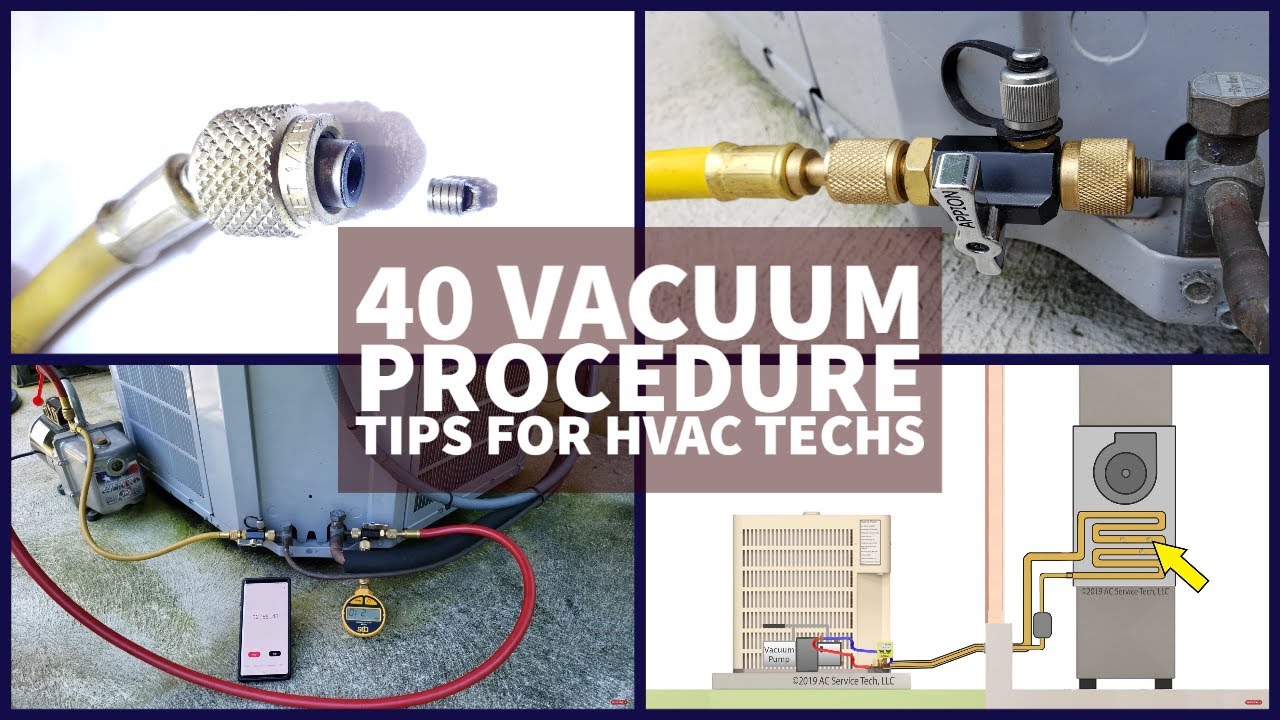
So, in the one hose method, we take one large hose, you remove the core from the suction side, you hook your micron gauge on the liquid side. We usually do it with the core still in on the liquid side, and we just leave that micron gauge in place until the vacuum is fully completed. We take that one large hose with the core removed on the suction side, and we just hook it straight to the pump, run our vacuum down until that micron gauge generally gets below 300, and then we valve off.
We just make sure our typical test is that it doesn't jump above 500 in about 5 minutes—5 to 10 minutes—but when you're at that deep a level of vacuum, you can have pretty good confidence even after a couple of minutes. Again, we're talking about a system that's brand new; you're just pulling on the line set, you're just pulling on the copper line set and the evaporator coil. You're not pulling on a compressor, you're not pulling on oil, you're not pulling on anywhere that refrigerant has ever been other than potentially if you're reusing a line set.
But that's also where we do a pipe wipe. We use the line set cleaner from Hillmore or the pipe wiper, and we really flush those lines out to make sure that all the old oil's out because that just helps you get a clean start, helps the vacuum go faster if you are reusing a line set. And we do sometimes run new line sets a lot, and we also reuse them depending on the condition and the situation.
But that is our standard one hose method. That one hose method can be applied to refrigeration as well if it's a small system. A lot of times in refrigeration, you have a standing nitrogen charge, and so you have to get that out as well before you can charge, and so it's a little bit of a different process there.
A lot of times they don't come pre-charged with refrigerant, and so you have to think about that—how you want to handle that. But again, anytime you're pulling on something that previously was operating and had refrigerant in it, especially when you're pulling on the compressor shell itself, you want to get maximum capacity. That means the biggest hoses you can get, cores out as many of them connected as you can, and good quality pumps.
Some people will say, "Well, don't use more than one pump because they'll pull against each other. " That is possible if you have one pump that's much stronger than the other; we could pull through the other pump. But if you've got good quality pumps and you've pre-tested them, and they both pull down to a similar range and they're both two-stage pumps, I've done it many times successfully.
Again, I'm not saying that you have to do that, but again, you want to get the maximum amount of pumping capacity on these things as you can. But for things like refrigeration, things like freezers, or if you're in low ambient conditions, adding some heat is going to really help. Using a heat gun, and in some cases, even using like a MAP gas torch or something—again, you can overdo that very quickly, and I'm not telling you this is one of these things where it's like somebody's going to yell at me because, "Don't you dare ever use a torch on it.
" Well, look, it depends on the situation. If it really is very cold, if it's freezing outside and you want to get that compressor shell temperature up, I absolutely have done it. But it's not like you're just sitting there with a torch on it; you're just brushing it.
That was probably a dumb thing to say; I probably shouldn't say that. But again, adding heat to the system really will help with vacuum. The other thing that you can do is use nitrogen.
Blasting nitrogen through the system will really help add some energy, some turbulence; it gets that oil moving. You do not want to just pressurize and depressurize; that's what a lot of people tend to do, and that's not the best way. It's better to shoot some nitrogen in it, blow it out, suit it, blow it out.
If it's something like a compressor, that's how you have to do it because you're not going to blow nitrogen through the compressor. But if you can actually just blast it through from one side to the other, that's going to help. It's not like you're blasting the water out per se.
What you're doing is you're just freeing up, by adding energy, you're freeing up the bonds. And usually what takes so long is actually to get the refrigerant that's dissolved in the oil out. A lot of people think it's always moisture; in a lot of cases, it's not moisture.
Moisture can make a vacuum take really long, but generally, if it's a lot of moisture, you're going to start to see that in your pump oil. I want to take a moment to introduce the heavyweight. the process more complicated.
The champ of refrigerant scales, the Fieldpiece SR47 wireless refrigerant scale, has a 14-inch platform that fits larger tanks with no problemo, and it can stand up to the rigors of the job with industry-leading accuracy. Here's the best part: it can support a maximum load of 252 lb. Hopefully, you're not overfilling your regular recovery tank to that level, but if you're using larger tanks, it really is quite impressive for a 7 lb scale.
Even I could stand on it if I really wanted to, without overloading it. The SR47 is built to go the distance. It's water-resistant, designed to work well for the long term, even in the rain or on damp grass, and it has an unreal battery life of over 200 hours.
This thing could work for a whole week on a single battery if you wanted it to—perfect for workaholics like me! It's so easy to use, with a raised power button on the base of the scale. It also has a wireless range of 1,000 ft and connects seamlessly to the Fieldpiece Job Link app.
You can also connect it to the digital manifolds S480V and SM380V. The Fieldpiece SR47 has it all: durability, longevity, and ease of use, and that's why it's the heavyweight champion of refrigerant scales. Get the Fieldpiece SR47 at a quality distributor near you or visit truetechtools.
com and use the offer code GETSCHOOLD for an awesome discount at checkout. So let's back up the basics: test your pump first. Have a good quality pump and make sure it can pull down to below 50 microns.
Usually, 30 seconds or less should pull down to under 50 microns with just the micron gauge connected to the pump. Make sure you have clean oil in your pump; look at the oil to ensure it looks nice, clear, and clean. If it starts off creamy, no bueno.
You've got to make sure your pump's working. You also need a good micron gauge if you're working on a system that has already had its oil exposed to refrigerant, and you're pulling a vacuum on that part. Using things like a heat gun, blasting some nitrogen through it, and doing that can be really helpful in speeding up the process.
If you start to stall out, you can blast some more nitrogen through it again. That's what they would formally call the triple evac, where you would actually pressurize it, then pull it down, pressurize it again, and pull it down. It's fine; it's basically the same thing, but I prefer to use a little velocity, which helps to do it a bit quicker.
Really, all you're doing is breaking up that vapor-liquid interface with the oil because it can only evaporate at that surface. By creating a little turbulence and moving that oil around, it helps break it up and get the refrigerant out of the oil mixture. Now, again, is refrigerant being in the oil that big of a deal?
Well, the answer is no, but you can't tell if it's refrigerant or if it's water, and that’s where it becomes a problem. So heat's your friend, nitrogen's your friend, and hooking up to as many spots as you can is a really good idea in order to maximize efficiency. Now, that brings us to the other question that got asked: the first question was, in a refrigeration system, where should the vacuum pump ideally be located, and how does the vacuum pump remove air and water vapor while leaving the evaporated refrigerants in the system?
Could you please elaborate on this process? Now, that question makes me think that maybe we don't understand because obviously, it's not leaving evaporated refrigerants in the system. I mean, a little bit of everything's in the system.
So, if you have a system that you pull down to 300 microns, there are still molecules left in there, and those molecules—some of them are air, and some are going to be refrigerant. If the system never had refrigerant in it in the first place, like in a brand new changeout of a residential system, with new copper and a new evap, you're not pulling on any refrigerant. If you are pulling on a system that previously had refrigerant in it, then there’s going to be some refrigerant in those lines, some refrigerant in the compressor shell, and some refrigerant that’s diluted and mixed with that oil.
That's the stuff that gets tough. Water and refrigerant that are mixed doesn’t need to be liquid water per se; you still have to get all that water vapor out. That's what we do when we pull a vacuum: we drop it below its boiling temperature, and we actually boil that out.
You're not going to get liquid out with a vacuum pump at all; it has to boil first. But why will evaporated refrigerants remain in there when they’re in a solution with the oil? Why will that remain there even when the water comes out?
Well, because there was a lot more refrigerant in there. I mean, this thing sat in there mixing with refrigerant and oil for a really long time, and in many cases, that oil and refrigerant are designed to be miscible. They are designed to mix; they're designed to create a solution so that they can carry the oil through the system.
Whereas water—and you know the old water-and-oil adage—especially with old mineral oil, they didn't really want to mix. Now, with modern oils that are very hygroscopic, they really like to hold on to water, which can complicate matters further. It is more difficult, but once that oil has been damaged via hydrolysis, it's actually changed.
You're not going to change it back by pulling a vacuum on it. Once you've actually changed the chemical compound of that oil, you're not going to change it back by pulling a vacuum on it. But again, we're not talking about it; it's not like it took all of the oil and changed all of it into an acid—it just did some of it.
So, you still want to get any moisture and any refrigerant out, so that way you can get that really deep vacuum. Over the past few years, we've seen a shift towards lower GWP refrigerants; you hear it all the time, and you're going to be hard pressed to find a non-toxic, non-flammable refrigerant more sustainable than CO2 in commercial refrigeration. But we all know CO2 is an odd refrigerant; it has all these strange behaviors.
Supermarket refrigeration systems contain thousands of pounds of refrigerant and can reduce their environmental impact by reducing the reliance on HFC refrigerants. That's where natural refrigerants like CO2 come in. CO2 systems are highly sustainable, with a GWP of one, and CO2 behaves differently from other refrigerants in its operating ranges.
This is why CO2 systems have these unique architectures that can be quite intimidating for techs. Trust me, if you've seen one, they can be pretty intimidating to look at. Copeland has a wealth of resources to help get you and your commercial refrigeration customers up to speed with CO2.
Copeland's site has white papers about regional adaptations to see how CO2 refrigeration is taking shape in your market. Learn about transcritical booster systems and different CO2 system types, including secondary, hybrid, or cascade systems, with easy-to-understand explanations and system diagrams that help you understand how they can be applied to medium and low-temperature systems. Things like how secondary systems pump secondary fluids like glycol throughout facilities and hybrid systems that use HFCs and CO2 together.
They include infographics, video series, webinars, and articles that are all available on Copeland's site at copeland. com. So, here's what you can do to learn more: sign up for some of the manufacturer classes.
Copeland, Hill Phoenix, and Hussmann all generously offer CO2 training. Check out trade events, and keep an eye out for the North American Sustainable Refrigeration Council's upcoming Natural Refrigerant Training Summit and the HR Training Symposium, which is coming up for the 2025 edition. There's going to be a lot of great information there from Copeland and others.
Find out more about Copeland's CO2 educational materials and download the ebook on how to CO2 with confidence for free at hvacrschool. com/CO2. That's hvacrschool.
com/CO2. So, again, the question is hard to know what exactly is being asked there, but it's important to keep in mind that sometimes vacuums take a really long time, even when you pull it down pretty deep. This is because, as you're still pulling that vacuum, those vapor molecules are coming out of that oil, and it just takes a long time.
That's where heat and nitrogen are your friends, versus doing a changeout on a residential system. The one-hose method always works. If that's taking you a long time, something's wrong.
Maybe you have a leaking valve or hose seals, or your vacuum pump's not working very well. Test your pump, change your oil, watch your oil—all that stuff in your pump—those are the things that you need to be doing. But if all of that is aligned, you get a good pump, you get a proper hose, you got core remover tools to get your core out, and you have a good micron gauge on there, that just works every time.
It doesn't matter if it's a 100-foot line set; it's still going to go very quickly because it goes very quickly when all you're pulling out is nitrogen and air. It's when you're dealing with water molecules, and when you're dealing with refrigerant that is contained in that, or that is mixed in that refrigerant, that it can take a really long time. All right, so that is my reminder on vacuum.
I can say it a million times: make sure you know how your micron gauge works; make sure you don't damage it with too much pressure. Different gauges are different in what pressure they can handle. If you get refrigerant in there, clean that out.
If you get oil in the micron gauge, that'll cause the sensor not to work. Make sure—I like to tell you to keep a little rubbing alcohol and an eye dropper—so that way you can clean the sensor on your micron gauge. Change the oil on your pump regularly; keep an oil pan in your vehicle, one of the sealed ones, so that you can change the oil on your pump regularly.
Keep extra vacuum pump oil; keep the vacuum pump oil canister sealed so it doesn't get full of moisture. Watch your oil; make sure it doesn't go creamy on you. If it does, and you have a wet system, then you need to really run it a long time.
Use a lot of heat, and keep your gas ballast open during that time if you're pulling down on a wet system. So on and so forth. For those of you who want to learn more about vacuum, just a reminder: Jim Bergman and I revised the review of vacuum for service engineers, which was originally written by Saunders and Williams in 1959 and last revised in 1988.
But we added in a bunch of new information—modern best practices—and you can get it at True Tech Tools. Go to TrueTechTools. com and just look for the Vacuum for Service Engineers guide.
I think it's like 25 bucks, something like that. They got a bunch of great resources. Them in stock!
I would highly suggest it, not just because I helped from Fiset—it's a really good thing. It's got a lot of old knowledge, a lot of new practices, and you can find it over at True Tech Tools. Use the offer code "GET SCHOLED" for a great discount at checkout.
And as always, thanks for listening; thanks for being a participant. It really matters, makes a big difference, and I appreciate you. So, a priest, a monk, and a rabbit walk into a blood bank to donate blood.
The rabbit says, "I think I might be a type O. " It should be a rabbi, but then it's like added to it 'cause then it was a blood. .
. okay, anyway, not that great of a joke, but I liked it. Anyway, thanks for listening.
We'll talk to you next time on the HVAC School Podcast. Thanks for listening to the HVAC School Podcast! You can find more great HVACR education material and subscribe to our short daily tech tips by going to hvacrschool.
com. If you enjoy the podcast, would you mind hopping on iTunes or the podcast app and leaving us a review? We would really appreciate it.
See you next week on the HVAC School Podcast!