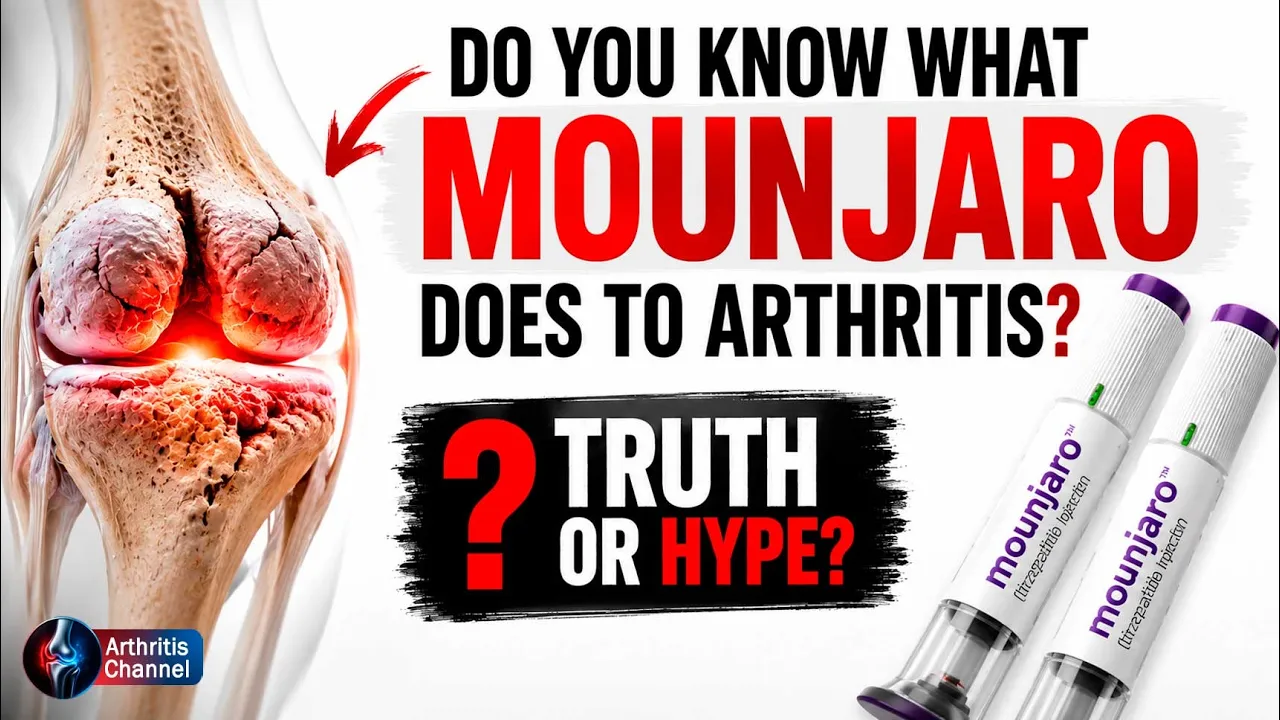
A major scientific study, just published in a top medical journal, brought a huge update for people dealing with osteoarthritis. And the craziest part is this. This was not a drug originally designed to treat osteoarthritis.
It's a medication that became famous for something else, helping people lose a lot of weight. But after researchers followed a very large number of patients, something started to stand out. People weren't just losing weight.
A lot of them were doing better with their joints. And that changes everything. Because if a medication helps reduce the load on the knee, improves inflammation, improves mobility, and may even help some patients delay or avoid joint replacement, then this is no longer just a weight loss drug conversation.
This becomes an osteoarthritis conversation. So, in today's video, here at Arthritis Channel, I'm going to show you what medication this is, why it is suddenly getting so much attention in the arthritis world, how it may fit into treatment, and the side effects you absolutely need to know before anybody gets excited and does something reckless. And if you have more advanced osteoarthritis, especially in the knee or hip, and you're scared of ending up with a joint replacement, stay with me until the end.
Because this may completely change the way you look at your disease. And before we dive in, subscribe to the channel, turn on notifications, and send this video to someone who has arthritis and is also struggling with weight gain. Because for a lot of people, those two problems are feeding each other every single day.
Now, what really got the medical community's attention was the growing evidence around a medication called tirzepatide. That's the drug many people know as Mounjaro. And yes, one of the studies that helped fuel all this attention compared tirzepatide with semaglutide to see which one led to greater weight loss.
Tirzepatide came out stronger. But let's get straight to the point that actually matters to the person watching this video with knee pain or hip pain. Why does that matter for osteoarthritis?
Because osteoarthritis is not just about cartilage wearing down like an old tire. That's the oversimplified version. The real disease is a lot bigger than that.
When a person gains weight, the problem is not just that the joint carries more load. But on top of that, excess body fat contributes to inflammation, worsens the environment inside the joint, makes pain harder to control, affects movement, and usually comes with a drop in physical activity. So now the patient is heavier, weaker, more inflamed, moving less, losing muscle, and putting more pressure on the knee or hip every day.
That is the perfect recipe for osteoarthritis to speed up. And this is exactly why so many doctors are paying attention to these medications now. Because if you can produce meaningful weight loss in the right patient, you may not just change the number on the scale.
You may change the course of the joint symptoms. You may reduce pain. You may improve function.
And in some patients, you may delay much more aggressive treatment. That is why this is such a big deal. Now, I want to keep this strong, but also honest.
Because this is where a lot of people start exaggerating. The strongest direct study showing improvement in knee osteoarthritis pain with this drug class was actually done with semaglutide, not tirzepatide. That trial showed that patients with obesity and knee osteoarthritis lost significant weight and also had significant improvement in knee pain and function.
So, the message is clear. When you treat the metabolic side of the disease, the joint can improve, too. And tirzepatide is getting so much attention because it appears to be even more powerful for weight loss.
That is why so many people in orthopedics, obesity medicine, and sports medicine started looking at it and saying, "Hold on. Are we about to change the way we treat osteoarthritis? " And honestly, that is a fair question.
Because for years, many patients with arthritis were treated like this. Take painkillers. Take anti-inflammatories.
Maybe get an injection. Come back when things get worse. And one day, when the joint is destroyed enough, go get a replacement.
That old model is exactly what is starting to crack. Because now we understand much more clearly that osteoarthritis is not just a joint problem. In many patients, it is also a metabolic disease.
And if you ignore that, you can keep chasing pain forever without really slowing the disease down. So, who are the patients doctors may think about when considering a medication like this? Usually, adults with obesity or adults who are overweight and also have related problems like high blood pressure, abnormal cholesterol, sleep apnea, type 2 diabetes, or other metabolic issues.
And if that same patient also has knee osteoarthritis or hip osteoarthritis, that is where this conversation gets very serious. Because that person is not dealing with just a sore joint. That person may be carrying one of the biggest drivers of disease progression every single day.
Now, here's where I need to say something very clearly. This medication is not a toy. This is not something to self-prescribe.
This is not something to buy from a shady source. And this is definitely not something to inject because somebody on social media said it worked for them. Because when used the wrong way, this can go bad very fast.
The dose is not supposed to start high. It is usually started low and increased gradually depending on the patient's tolerance and response. Some people do very well on lower doses.
Others need careful adjustments. And all of that requires medical supervision. But again, let's bring this back to osteoarthritis.
The real goal here is not just fast weight loss. The real goal is to make the joint suffer less. That means less overload, better movement, less pain, better function.
And ideally, a lower chance of the patient moving towards surgery. And that only works if the medication is part of a real arthritis plan. Because here's the trap.
A lot of people think, "If I to weight with the pen, that's enough. No, it's not. Not even close.
Because if the patient loses weight and also loses muscle, that can create a new problem. And that is dangerous in osteoarthritis. Muscle protects the joint.
Muscle absorbs force. Muscle stabilizes the knee and hip. So, if the person loses body fat, but also becomes weaker, the arthritis may still stay aggressive.
That is why these medications should never be treated like a shortcut. They have to be used inside a bigger strategy. Weight reduction, muscle preservation, strengthening, physical activity, and proper medical follow-up.
That is how you use the drug intelligently. Now, let's talk side effects. Because this is where people stop thinking clearly.
The most common side effects are gastrointestinal, nausea, vomiting, diarrhea, constipation, abdominal pain. And for some people, especially early on, those side effects can be rough. There are also more serious concerns in selected patients, which is why this medication must be prescribed and followed by a qualified physician.
So, let me say this as bluntly as possible. If you are thinking about using this kind of medication because you are desperate to avoid a knee replacement, do not do something stupid. Do not self-medicate.
Do not chase counterfeit products. Do not try to bypass medical supervision. Because trying to save your joint while damaging your health is not a win.
Now, does that mean this medication is overhyped and useless for arthritis? No. Not at all.
This is one of the most important shifts in the osteoarthritis conversation in years. Because for a long time, many doctors treated osteoarthritis like a purely local problem. A knee problem.
A cartilage problem. But that thinking was incomplete. The body matters.
Metabolism matters. Inflammation matters. Body weight matters.
And when you start treating those things seriously, the joint often starts behaving very differently. That is why drugs like tirzepatide have opened so many eyes. Not because they magically regenerate cartilage.
Not because they cure arthritis. But because they may help break one of the biggest engines driving progression in the first place. And that is a major shift.
And yes, this kind of medication is becoming part of the broader strategy for selected osteoarthritis patients. Especially those stuck in a vicious cycle. Pain leads to less movement.
Less movement leads to weight gain. Weight gain leads to more pain. That cycle destroys joints.
And when you break that cycle, everything can start to change. Pain. Mobility.
Confidence. Function. But let's stay grounded.
This is not a miracle pen. It does not replace strengthening. It does not replace movement.
It does not replace a real treatment plan. The patients who do best are the ones who use everything together. So if you are living with osteoarthritis and also dealing with weight gain or metabolic issues, this is a conversation worth having with your doctor.
Because this may be one of the first times we are not just treating the pain. We are going after what is actually driving the disease. Now, I want to hear from you.
Have your joint symptoms gotten worse during periods when you gained weight or stopped moving? Comment below. And if you want more videos like this, subscribe to Arthritis Channel.
Turn on notifications and watch the next video on your screen. Because the more you understand this disease, the harder it is for it to control your life.