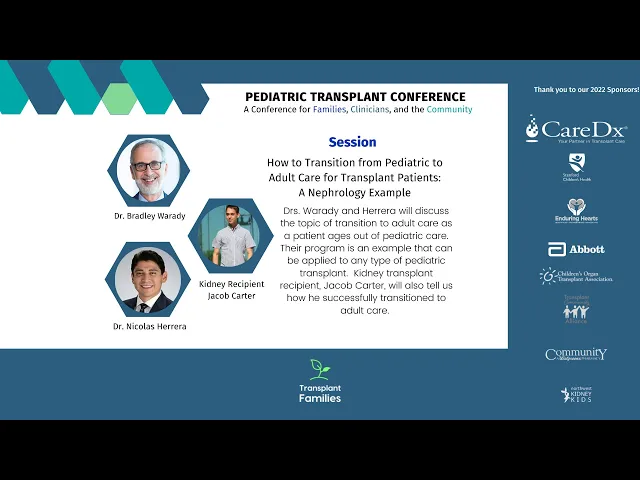
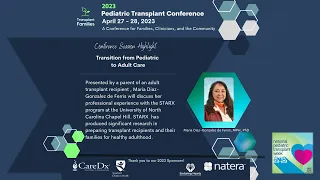
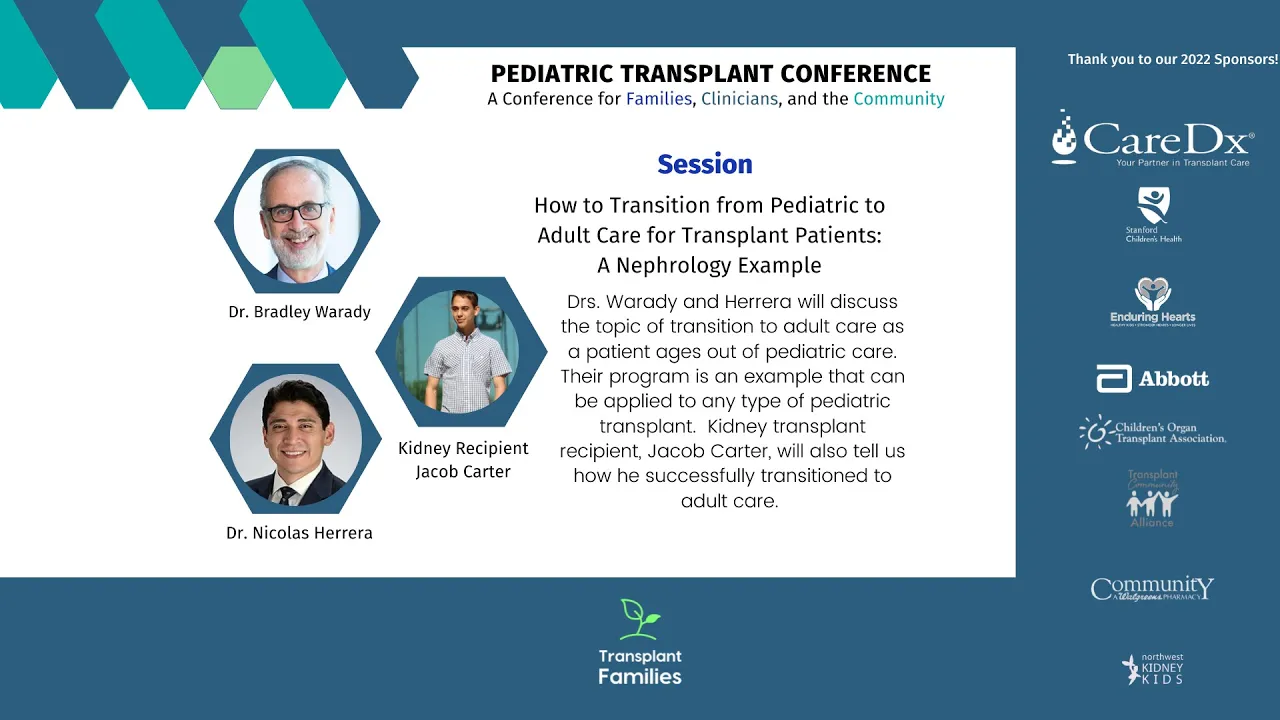
[Music] [Applause] hi i'm anne sarah pabanga and i'm the mother of two daughters my younger daughter had a combined kidney and liver transplant about 15 years ago and she's now 16 years old i've been her primary medical caregiver her whole life and honestly my biggest fear is that she won't take good care of her kidney and Her liver when she's an adult so we've been talking about this next topic for many years we're really excited to have you here today for this session entitled how to effectively transition from pediatric to adult care a nephrology example
i'm so delighted to introduce you to three people who will explain the components that are needed to successfully transition a transplant kid into a transplanted adult dr brad worthy Is a professor of pediatrics at the university of missouri-kansas city school of medicine he is the director of the division of nephrology and dialysis and transplantation at children's mercy kansas city he's also internationally recognized as a writer and researcher in the field of pediatric nephrology he is the principal investigator of the nih-funded chronic kidney disease and children's study dr wardy is also on the national kidney foundation
board And he is tirelessly advocating for children affected by kidney disease we're also grateful to have dr nicholas herrera with us today dr herrera is assistant professor in the division of transplant nephrology at the university of kansas health system and the division of pediatric nephrology at children's mercy hospital and finally we will hear from transplant recipient jacob carter jacob was born in 1998 with prune belly syndrome a rare Condition which included polycystic kidney disease he received a living donor kidney transplant at oklahoma children's hospital when he was only 18 months old in 2006 he received
his second living donor transplant at children's mercy in kansas city and then transitioned to adult care in 2021 jacob now works and attends college and enjoys sports and outdoor activities and without further ado i will turn it Over to dr rorty thank you and sarah well it's a it's a real it's a real pleasure to uh be here at the conference to speak with all of you um i'm honored to be amongst a list of some great speakers that you've already heard from uh in over the last couple of days uh and it's real pleasure
to talk to you about a topic that i really love to uh to talk about so if i can have my first slide in sarah there it is okay so we're going to talk About transition today and i'm really again pleased to have nick herrera and jacob carter alongside me because i think that'll give us an opportunity to really talk about the whole spectrum of transition now as we start again i want to wish everybody a happy national donate life months which is obviously extraordinarily important to all of you and to all of us in
the healthcare field and sarah has talked to you a lot about About my credibility as a speaker but this is really what she didn't mention in terms of credibility this is this is me and her daughter lauren uh who is that transplant recipient and i have uh had the opportunity to uh help the piobanga family care for lauren over her 16 years of life uh i think i've taught them something about transplant and they've certainly taught me a lot about transplant as well and one of the topics as an sarah Mentioned that we've been talking
about especially more recently is that of transition so transition has been something that's again have been important to me for a number of years this is a from an article uh that i published back in 2011 uh some 11 years ago with a friend of mine alan watson and alan was one of the real leaders in the transition education from nottingham england And in that article we used this definition for healthcare transition the purposeful plan process that addresses the medical psychosocial and educational needs of adolescents with chronic physical and medical conditions as they move from
child-centered to adult-oriented health care systems and then you'll see again a lot of different definitions of transition but they're All on the same theme as what is noted here now this is a really important slide because it it nicely gives you a visualization of what that transition process is in a very simplistic manner the transfer of care is the movement from the pediatric care center to the adult care center but the transition process which is really the education process begins in pediatrics and Generally continues through pediatrics and even into adult care because many of the
adolescents and young adults do not have the skills for independent self-management by the time they transfer care and thus we depend upon our adult providers to continue that transition to education after the transfer has occurred so this is the first slide that you're going to see that i'm emphasizing the collaboration between the pediatric care providers and The adult care providers that is so important if one is to have an optimal transition and transfer process now what can happen when the process doesn't work well this is again from dr watkins experience back in nottingham england this
is published in 2000 uh and in this situation the the adolescents young adults were basically given a letter a summary letter uh and then were sent off to the Adult care providers without any real preparation over time and what we're looking at here are the serum creatinine levels of the patients i don't have a pointer that works here but on the left side of the slide you see the creatinine and as the numbers go higher that means that the kidney function is poor and these are all transplant patients on the bottom of the slide there
you see t represents when they were transferred From pediatric to adult care the negative numbers represent prior to transfer and the positive numbers represent the months after transfer and what you can see by all those the lines that are going up those are individuals whose creatinine levels worsened and in fact out of the 20 individuals who are characterized here eight of them lost their kidney transplants within a period of 36 months after transfer so this is what can Happen in a worst case scenario in association with transfer now this is more recent data from the
united states renal data system this is a mandatory registry here in the u.s of all transplant recipients and here this is kidney transplant recipients but what i'm telling you today really applies not only to kidney transplants but the heart transplants and the liver transplants as well but so here what we're looking at is Graft failure rates and the bottom there is the age of the individuals and you can see by that curve the graft failure rates or the loss of the transplants are most common between about 18 years of age and 25 years of age
and this is the period of time when the majority of these adolescents and young adults are being transferred from pediatric to adult care so it's a very high risk period of time and we believe that this high rate of Graft loss is oftentimes due to non-adherence with the medical therapy now when we see this the question we asked was well why do they do that and this is a cartoon that sort of uh tongue-in-cheek emphasizes some of the factors that may be contributing to the non-adherence we may see in the adolescent patient so you can
see in this brain the the biggest part of the brain is addressing the birds and the bees or the memory for music or the Rebellion center or all the answers and in the front there of the brain and the lower portion of the brain you see the very very small judgment gland and that's sort of what we're dealing with in many of these individuals now from a more physiologic standpoint this is a brain again and the limbic region is that region of the brain that addresses reward immediate reward and this is fully developed in the
Adolescent individual and so that's why some adolescents will do things that we say aren't very smart but they're looking for the individual reward and they're not thinking about the consequences of their actions in contrast what's most important for an individual who is transferring care is to have a fully developed prefrontal cortex now i say that's important because in that prefrontal cortex of the brain you Have developed the executive functions an executive functions address the control of impulsive behavior emotional regulation reasoning learning from experience and planning all characteristics that are critically important if one's going to
independently self-manage their health care and if one is to have a successful transition and transfer of care the problem here is that the prefrontal Cortex is not fully developed is not fully mature until the mid-20s so we're taking individuals we're moving them from pediatric to adult care but in many situations they don't have the again executive functions that really lends themselves to a successful experience now the other thing i think we have to keep in mind as we're designing the successful transition and transplant program extremely transition transfer program is that doctor-patient family Relationship i think
that this is so important that we really get into what are the strengths and the weaknesses of the individual who's transferring of the family so we can build on those and try to optimize that transition and transfer process one size doesn't fit all we need to individualize the program that meets the needs of that adolescent young adult and that family and in my experience we have to start with the quality of life the quality of Life is so important to these young individuals that anything that compromises the quality of life is not likely to be
as successful as we hope and if you look at children with advanced chronic kidney disease this is what they tell us uh as their feelings in terms of themselves so you can see on this slide some of them feel inferior they have an impaired body image they're failing the expectations of themselves and others and they have a sick identity Others feel insecure that there's uncertainty in their life they feel vulnerable and again they have a doubtful future in their own minds and then others feel that there's been an injustice they're deprived of freedom because of
their medical complications they feel victims and they think they have lost opportunities that they might otherwise have if they were healthy now some of them certainly have resilience and maturity associated with Their chronic disease management but i find that that is really the minority of the patients overall and i think what we know oftentimes about our patients uh is really the tip of the iceberg and there's much below the surface that we really need to try to get to so that we best understand our patients before they transfer to adult care as one of my
patients told me in the past you don't really understand what we Go through because you've never had to go through it and they're actually absolutely correct and so we need to try to overcome that obstacle or that challenge and get to know our patients uh in the best way possible so that we can optimize the process for them to that note regular communication between the patient the family and the health care providers is an essential component of the transition and transfer Process and this is i i have this as an individual slide because i want
you to remember this that this really has a significant impact on the success of the transfer process now the individual on the right there is stuart cameron stuart cameron was a nephrologist from the uk who was really one of the leaders early on in understanding the need for a process as we move our pediatric patients from pediatric to adult care And he wrote about it back in 1985 you see here in this article entitled the continued care of pediatric patients with renal disease into adult life then he wrote on this same subject uh in 2001
and he said the following however it is disappointing to find that many of the points made about this process within nephrology when i first wrote about the topic 15 years ago remain opposite today in other words over a period of 15 years there had been very Little if any progress in terms of optimizing the transition and transfer process for our young individuals again this is referring to kidney disease but it holds true for liver and heart as well so what i want to share now with you is what we've learned over the subsequent 21 years
about this process first of all i think we better understand some of the barriers to Effective transition care this is again an article from 2014 and i've highlighted three very common barriers number one on the top of the slide the patient is emotionally attached to the nurturing pediatric unit we know that this is almost always the case we love our patients our patients love us thankfully and we have a relationship that nobody wants to see go away equally important is that second point The parent is emotionally attached to the pediatric unit and then lastly the
third one that's highlighted there difficulty getting parents to let go and allow the young person to self-care and this is difficult especially when you as parents truly have nurtured the development of your child with a chronic illness over years and now again we're asking you to let them be a bit more independent recognizing they're going to fall down Now they're going to get up as well but it's hard to see them fall down when you know that the way you would have managed it might be a bit different so these are again major challenges for
us that we can overcome but we must overcome if we're going to have a successful transfer process this is a slide from japan that looked at services again transition services from pediatric to adult care in 100 different Units in japan now interestingly only four percent of the units or four units actually had a curriculum a formal transition and transfer curriculum and the reason that these services were not enacted in these sites as you can see on the right part of the slide is that in 42 percent of cases there was a refusal of the patients
or the families to even want to transfer again the reasons they just talk to you about They're again hooked into their nurturing pediatric unit and then in a third of the situations there was actually a complete lack of concern about the transition or any or an inability to decide about transfer so this is what we don't want to see this is what again has happened in the past as dr cameron mentioned and we need to move forward and so to move forward there was this publication in 2011 this is from the American academy of pediatrics
and you can see it was a clinical report on supporting the health care transition from adolescents to adulthood in the medical home and in that publication of state of the following the goal of a planned health care transition is to maximize lifelong functioning and well-being for all youth including those who have special health care needs and those who do not this process includes ensuring that high Quality developmentally appropriate health care services are available in an uninterrupted manner as the person moves from adolescence to adulthood again emphasizing that collaboration from pediatrics to adult care now they
put together this algorithm in the algorithm in this publication you can see there's sort of four different components to it on the left part of the slide you can see that it starts at 12 To 13 years of age where the providers should begin to have a discussion about transition policies with the youth and their parents at 14 to 15 years of age they make sure step one is complete and then institute that joint transition plan with the youth and the parents at 16 to 17 years of age again make sure that step one and
step two have been addressed review and update the plan prepare for moving to adult care and Maybe here initiate a pre-transfer visit of that adolescent and young adult to the adult medical home so they can become familiar with those individuals who they will ultimately be cared for by and then finally at more than 18 years of age review all the prior steps uh and then move on to the adult care model so this is the algorithm uh that should be used uh not as a mandate but as a guideline uh for individuals that are Moving
from pediatric to adult care now this is a more recent uh algorithm and i really like this algorithm a lot it was just published this last year and again i don't have a pointer so i'm going to take it through take you through it slowly on the top you can see the arrow addresses on the left side of the slide pediatric focused transplant care in the middle it's the transition process and then there's the transfer of Care and then adult focused transplant care then if we go to the circles you can see if you focus
on the parent manager on the left part of the slide starting at 10 to 12 years of age there's the parent manager and the adolescent young adult participant and then it moves to the parent supervisor and the aya manager in training and more than 16 years of a late Transition the parent becomes the consultant and the adolescent young adult is the manager of their health care tasks and then post transfer after they've moved from pediatrics to adult care the parent remains a consultant and the adolescent and young adult is the ceo of their care and
i think this really nicely delineates in a in a cartoon if you will at how the the changes should occur in terms of self-management over time on the bottom You can see that the sort of management skills that should be developed at these different components of the transition process and in terms of outcomes we hope for a successful outcomes in terms of a number of them physical functioning health related quality of life adherence with their therapy health care utilization and allograft function now in 2011 there was also publications from the international society of nephrology and
the international Pediatric nephrology association again giving recommendations about transition and transfer and i want to emphasize again what they recommend here is applicable to all transplant recipients irrespective of which organ is being transplanted and they stated that transfer should be individualized for each patient after he or she has completed a transition plan there needs to be a plan that begins in a pediatric unit Transfer should be agreed upon jointly by the patient and his or her family in conjunction with the pediatric and adult care teams that collaboration young people should be introduced to the concept
of transition in early adolescence and very importantly transition should be directed by lead clinicians or transition champions in pediatric and adult units to coordinate and educate on transition issues it's easy to have a pediatric champion It's more challenging to have an adult champion and dr herrera will certainly talk about that very soon now also in the consensus statement the transition plan should include parents and other family members and even boyfriends and girlfriends young people should be offered the opportunity of an informal visit or visits to the nominated adult service before the transfer occurs just like
the aap said again make people uh more Familiar with the adult care providers and then a transition or transfer clinic in either the adult or pediatric unit with both adult and pediatric health care teams in attendance is the optimum minimal standard so again collaboration between the pediatric and adult providers now the optn in 2018 suggests that these are some critical milestones uh that the adolescent and young adults should achieve As they move to adult care they should be able to describe their original cause of their organ failure and the need for transplant they should be
able to characterize and describe the long and short-term implications of transplant on their overall health taking into consideration things such as infection risk cancer surveillance and vocational aspirations they should know the effect of the illness on their sexuality and Reproductive health they should have the capacity to provide most self-care independently not necessarily all but most self-care independently in turn they should have a sense of responsibility for their own health care they should express a readiness to move into adulthood they shouldn't be pushed out the door but have a readiness to move and then they should
own medical information in a portable summary themselves Now we can't expect these adolescents young adults to just become knowledgeable just out of thin air you have to you define you have to generate a curriculum to educate them over time this is our curriculum at children's mercy kansas city it's called the keys program and we've had this for a number of years but we've continued to enhance it over the years and key stands for kidney education for your success and we cover the gamut of information That these individuals need to know so that they can independently
self-manage themselves in terms of their health care when they transfer from pediatric to adult care i think one of the other components of this whole process that's critically important is a readiness tool having a readiness tool that you repeatedly review with the adolescent and young adult to make sure that they are educated on a number of different topics Topics that you believe are important for them to be educated about as they move from pediatric to adult care so our readiness tool as you can see here addresses chronic kidney disease but addresses medications addresses lab information
it addresses overall health as well as self-management skills insurance and ongoing support and one of the things i want to emphasize about this tool which i should Say we give it to these kids pretty much on a yearly basis up until they're about 19 years of age and then we do it twice a year we don't just ask questions whether yes or no answers we ask questions oftentimes where it requires an explanation so we know that they really understand it and can't just sort of say yes i i know that they have to explain it
to us and so i think that this is a key aspect of the transition education and i should Also add that if we get to a point where we have a young adult who is ready to move to adult care but is not fully educated on certain topics this readiness tool goes with them to their adult providers so that the adult providers understand what education still has to occur after they've transferred from pediatric to adult care now one of the questions that often gets asked as well what's the best age uh when these individuals should
transfer Care and there's not a lot of information and this is a busy slide but this was a slide done by beth foster who's a pediatric nephrologist in canada where she looked at data on over 400 children transplant recipients as they moved from pediatric to adult care and as you can see on the right side part of the slide some of them were transferred early and early means they were transferred before 21 years of age and others were Transferred late on the upper part of the slide at more than 21 years of age and then
they looked at how many of them had lost their kidney transplants between 21 and 30 years of age and as you can see on the bottom right the failure rate of those who were transferred early meaning before 21 years of age their failure rate was 12.9 per 100 patient years if we look at the top those who were transferred after 21 Years of age their failure rate was 8.7 per 100 person years so this data of which there is limited such data suggests that maybe at more than 21 years of age maybe when that prefrontal
cortex is more mature might be a better time to transfer these individuals prior to an earlier age okay very importantly what are the perspectives of the emerging adults this slide is what one individual saw When he first went to the adult kidney transplant clinic my fears were confirmed the environment was alien and much less comforting most of the other patients looked older than 60 years of age and there were new ways of checking in and taking blood posters of cartoon characters had been replaced by skin cancer alerts we have to recognize those concerns and address
them and allison tonga a researcher generated these major themes After talking to many uh adolescents and young adults who were transplant recipients who and who had transferred and this is what they told her number one in terms of timing the transfer it should not be determined solely by age it should be considered within the context of life events in terms of being sterile unwelcome they did say that the clinic appointments in adult care were short impersonal and cold they felt displaced isolated and Lonely in the waiting room surrounded by a large number of older patients
and it'll be again very interesting to hear what dr herrera has to say about that they felt from an independent standpoint that transition and transfer did facilitate an increased sense of maturity in terms of access to providers they thought that it was very important to have the opportunity to establish positive relationships with adult health Care providers prior to formal transfer patients need to be comfortable with the adult provider and to have ongoing access to their pediatric provider again that collaboration and then finally active involvement of parents facilitated preparedness for transition and transfer and indeed throughout
the literature we'll see involvement of a supportive parent may be the most important factor in successful transition And at children's mercy prior to covid uh we regularly worked with our adult providers in our community at two of our major centers who received many of our individuals who were moving from pediatric to adult care we work together we learned from each other and again we sat at the table and said how can we improve on what we're doing let's talk about our successes let's talk about our failures and enhance the transition program Together this is just
a slide that talks about what sometimes is not being able to be provided in adult units i know nick's going to be talking about that but again what i want to emphasize is although adult medical providers have the role of assuming the care and management of these youth they should not be expected to do so without supports that are more readily available to pediatric providers and in turn adult Providers should not expect a handoff from pediatric practices but rather a handshake again the collaboration is exceedingly important so the task for the adult team they need
to learn about the developmental stages of adolescence and about again chronic disease and the pediatric population they need to designate a transition coordinator to help facilitate the transfer process they need to develop a mechanism to Facilitate not only pre-transfer dialogue but post-transfer dialogue to continue to improve the transition process and then pediatrics and adults need to work together to develop these transition clinics the challenges of transition clinics number one defining transition champions in pediatrics and more so in adult units these individuals are a small percentage of the patients that are seen in adult programs so
this is a significant Challenge another challenge is facilitating these face-to-face visits between the patient the parents and the adult care providers especially when it's a freestanding children's hospital and there is no adult hospital just across the across the road developing transition plans jointly with adult providers that's key and then finally institution of that pediatric transplant program And celebrating the transfer when they move from pediatric to adult care recently actually right before the kovid we had a workshop for the national kidney foundation where we invited as you can see here a lot of people including healthcare
providers nephrologists nurses psychologists cardiologists as well as patients and parents to say how can we better care for these adolescents these young adults With chronic disease and as it related to the transition process these are the priorities a transition champion or leader at the pediatric and adult nephrology office was imperative a portion of each patient visit should be conducted without the parent or caregiver starting at age 12. i didn't speak to that previously but this is an important part of that independence that we're trying to generate progress with transition education Should be monitored with a
transition readiness tool the parents told us this themselves there should be a transfer letter put together with succinct summary that is shared with the adult provider but also shared with the emerging adult patient importantly patient and provider expectations should be discussed at the initial visit between the emerging adult patient and the adult nephrology provider they have to all each know What each is expected to do they have to be on the same page and then finally parental guidance and support during the child's transition and transfer to adult care is essential so in closing we in
pediatrics love to take care of our young kids especially those kids who have complex disorders and again ideally they all grow they all develop and again they move on to adult care and we should be celebrating uh When they move to adelcare and not being too over anxious about it because while it is the end of their pediatric experience it's just the beginning for these young emerging adults so thank you very much for your attention and uh and sarah i'll hand it back to you great thank you so much that was really great dr warwick
we appreciate that um we will have a chance for questions at The end of these presentations so please enter them into the chat um now i'd like to introduce uh dr herrera for his presentation hello thank you let me share my screen screen and share how's that oh perfect um all right so uh thank you dr worry for your presentation on the considerable process of transition from The pediatric world to the adult world uh thank you all for coming today i am nick herrera i am a adult and pediatric nephrologist i have my foot in
both worlds it is uh my dream job and my passion just like uh dr wardy's to help manage these very difficult patients uh with very complex and chronic illnesses move from the pediatric world to the adult world uh successfully uh for their best outcomes And so i'm sure by listening to dr warrity talk about uh the complexities and the time frame involved of uh the the overall process of transition from pediatrics i'm sure you can appreciate the process is a very difficult one and a very complex one but that complexity doesn't end in pediatrics the
hurdles exist in the adult world as well This meme aside um as an internist myself i understand that many other internists tend to feel very comfortable uh with many many diseases as we are trained throughout our residency programs and despite that being an overall mantra in internal medicine the truth of the matter is that many internists feel the need for Improved training for complex pediatric diseases you can find studies that go back well into the early 90s that describe internist comfort with complex pediatric diseases but in more recent time you know when when you talk
uh these most recent studies here published in 2010 2013 uh were some surveys sent out to internal medicine residents so trainees Before they graduate to become full-fledged attendings many of whom in these surveys have reported that their overall training in in complex pediatric derived diseases and illnesses uh that they're training is um not adequate to manage these these patients long term uh and i point out the second survey here in 2013 uh survey of more residents a Combination of internal medicine so basically those physicians that just manage adult patients and then also with med peds
or mp internal medicine and pediatric physicians like myself um the court the the difference between the two groups that med peas tend to have more comfort with these complex diseases because we see them in the pediatric world and after uh residency as these young physicians move over into the adult Primary care world that impact of their training and what they're comfortable with also impacts their overall patient diversity and patient background that they manage going forward you know this is another paper published in pediatrics uh in 2010 that looks at the overall likelihood that an internist
here in Dark gray here are likely to manage these complex pediatric illnesses in their primary care clinic the ones bolded here in red or boxed in red are very significant in terms of their overall comparedness to the pediatric the pediatrician so autism cerebral palsy behavioral developmental down syndrome cystic fibrosis many complex diseases which are now With modern advances in medicine many of these patients are moving into the adult world necessitating a transition process or transfer process like dr worry and myself are attempting to do in transplant even amongst nephrologists uh the comfort level um as
pointed out by this survey published in chronic kidney disease in 2005 showcases the overall nephrologist adult Nephrologist comfort in managing pediatric diseases and chronic pediatric illnesses the majority of the majority of nephrologists are not comfortable either somewhat comfortable depending on which disease process we're talking about to not comfortable at all and almost as many nephrologists adult nephrologists are not comfortable as comfortable managing these more complex patients and This is another slide and to be quite fair if you're going to steal steal from the bestest i took this directly from dr warri but i didn't actually
know this data existed until um we were kind of reviewing for this talk and and this is an excellent point that dr wardy has brought up in uh in lectures in the past but uh adult dialysis units support and support staff For patients with special needs if you look here all centers united states of america usa here centers with transition programs and centers without transmission programs in the usa you can see that the total number 12 total number of 26 but virtually none really have the necessary support staff or the support measures to address these
issues with these complex needs like special Developmental delay or adherence issues and that really is a shame you know it really does kind of support the need for additional resources in this field and so beyond the need for specialized adult provider experience and support for um and support for successful transfer from pediatrics to adult care as dr worry has pointed out in his talk many young adult patients who transfer feel very apprehensive about that Transfer process very anxious and so this is where i work here at kansas university medical center here ku and even though
it's a you know very pretty institution very nice and friendly looking i'm sure many of the young adult patients who transfer see my institution something more similar to this which is a little more ominous and a little bit more Uh intimidating uh to say the least but um but the reality of what we're trying to do both dr wardy and myself throughout this whole process of of transfer and transition our major goal is to essentially relieve the stress and anxiety to that experience and most of that process occurs well before transfer well before the patient
ever comes to me or meets me or introduced them to me As dr warri points out a lot of this transition process occurs years before um they actually get to the point where they may begin the the transition the transfer process and so even my part accepting the patient on the adult side begins before you may think before we actually have them in the adult center i actually meet with the children's Mercy team the patient and their support team their support person i introduce myself i tell the patient and and their support person what to
expect coming to my visit uh who their plan who they're expected to meet uh what kind of process that's going to be i answer any questions or hesitations they may have And really just kind of introducing myself as someone that's going to be managing them going forward and so at ku i accept all transplanted patients transitioning from children's mercy the first clinic which is um the first clinic uh after i see them as part of the children's mercy team is multi-disciplinary it has myself a Post-transplant nurse coordinator social work pharmacy and nutrition support people are
welcomed the first visit is really meant to be introductory this is where you get your labs this is what the office looks like where the building looks like where you park all those kinds of things but also importantly where i describe the Goals and expectations that i have as their up and coming physician that's managing them going forward but not only my expectations but also their expectations coming from children's what they want to see what they would like to do and what they would like to get out of this process but very early on just
like dr wardy said um in his talk that this is the time frame where i really sit back and i kind of Push the patient a little bit further in self-management self-care and more responsibility that plus the rest of the atmosphere of being over the adult hospital really begins to kick start that process in my opinion even further than already done in the pediatric world so after they see me they return back to children's mercy uh cmh um to see uh the pediatric team once more before um their final goodbyes or final uh Visit before
they come back to see me within about three months so that i can assume care and so all that process occurs no more than six months from when i see them in my clinic to when i see them again to assume care really just to make sure that no balls are dropped and that everything moves smoothly and consistently so this clinic is uh quarterly in nature every three months it's scheduled on thursday mornings it's very consistent And it's meant to be that way so it kind of relieves that pressure of what days do i need
to be here what days does uh dr herrera have open no if i am available if it doesn't matter what else is going on if it's the three month time period that's one on there to see these patients this clinics are staffed with consistent providers myself the the support staff i mentioned earlier Um these patients remain in this clinic for a minimum of one year so that's four visits after transfer and it's done that way specifically because i i felt the need that consistency is key with a lot of these patients and routine and so
once they get to a point after a year that they feel more comfortable in the adult world what to expect what Their labs look like how their insurance is going to change the people that they're dealing with then i may allow them to move to a general adult transplant clinic these appointments are 40 minutes long 40 minutes long uh and no less regardless if you're a new patient or a a follow up there is no overbooking allowed uh and i specifically keep this open space on this particular day because there are less Other clinics open
at that time frame so that burden in the waiting room of significant patient amounts that waiting for new visits are lower and so if you know anything about the adult world sometimes our clinic visits are very very short and that's not conducive in my opinion to this type of patient population and relationship that I'm trying to um establish um in these appointments i spend about one third of my time just addressing things that are not medical related so how are you you know how are things how's school going how's work how's your boyfriend or your
girlfriend and really trying to get a sense for how they're doing mentally emotionally spiritually not just medically and if there's any concerns whatsoever from any of those aspects i get them to the right Resources the right support whether it's social work pharmacy depression anxiety i either treat myself or get them to the right people and a shout out to dr carrie strumpf who is a psychologist phd i sent many of my patients to as a specialist in pediatric chronic illnesses she's been tremendous help and this is my team it's a very consistent team you're going
To be seeing one of these well all of these these uh individuals in your transfer process uh terry bloomer has been doing transplant for over 30 years in the adult world obviously but she is a mother hen and i couldn't do this without her she sees all of my adult patients and my transfer patients as well so it's very consistent me and her our social worker elizabeth kelsey dr strumpf our dietitian angela and ann are pharmacists Fantastic group great people very warm and affectionate if i didn't know any better i would say they're coming straight
from pediatrics they're they fit this mentality and energy as as any pediatric individual would and so this clinic is still in development you know this is a kind of a new process as a whole developing an adult receptive Clinic uh com you know at on a national level it's just one of these things that you need to have the right as dr wardy said champion on the adult side to kind of further these kinds of endeavors and so this is still a motion that needs development and needs to be flushed out further and further and
so surveys are constantly being utilized or we're working on a survey right now to try and improve that Process of transfer for both patients and providers and everyone involved and the goal for a lot of this like i said is consistency and familiarity for our patients and if you were to ask me what my personal goal is like dr wardy said you know when these patients come from peace to adult it's a different environment an alien environment as we say if we could just pick a chunk out of the pediatric hospital move it over and
put It down in my adult hospital with turtle and teddy bear paintings on the wall that's what i would do um but you know that that's kind of the mentality that i want to bring here but just a half step into the adult world and that's really the key to this but yeah that's what i would like to see done so that's the end of my talk and with that Like i said uh thank you for coming and thank you for listening thank you so much dr herrera that's really an incredible program to see the
connection between children's mercy and ku med that's it's a a wonderful example of how transition can can happen effectively and i think now we're um it's time to hear from jacob carter if we could add jacob to Hi jacob hello thank you so much for thanks for being here with us today it's wonderful to have you here we um we want to talk to you a little bit about your experience because you are an example of someone who's come from one program in pediatric and gone to an adult program and so we just want to
know a little bit more about your perspective so Um i have a couple questions for you and then we'll bring dr herrera and dr wardy on for a couple questions so mostly we're kind of wondering um you know was it a scary thought when you were thinking about transitioning into adult care um well so basically from like as long as as far back as i can remember being there at children's up until about 16 or 17 i was just Learning the basics about my kidney disease and learning what to do and what not to do
and uh and so i never really heard of like being transferred to adult care maybe like once or twice but then i got like probably around 16 or 17 i started assuming that i would be um getting out of Um pediatric care and dr wardy's care at 18 and so i was very very scared and unprepared to say the least about it all and but then dr wardy and his team definitely came to my rescue and immediately said it's 22 whenever you get out so i those four years of of definitely extra knowledge and preparation
set me on a course for success i think That's great that's really great you had a couple more years to prepare yourself but when we spoke before you told me that there were some things you were doing ahead of time um what types of things were you doing before that to take care of yourself to kind of get yourself ready for the transition process um i had learned to uh To definitely set an alarm whenever i needed to take any sort of medicine um i was uh taught at a very young age and still kind
of go by it by habit as uh just bring a water bottle with you wherever you go don't rely on like a water fountain like three three drinks of water gets you i don't know how much but um just Make sure you bring a water with you so that you can constantly fill it up and drink it and it's actually a really good uh measuring tool as well that's great so you're you're taking care of your kidney doing a good job doing that um jacob what can you tell us could you give advice to any
other kids who are going to transition into adult care what types of things should They make sure that they're thinking about or planning for in the future um definitely be prepared to um face many different aspects of life coming at you like uh make sure that you can definitely balance it out that's probably the main thing that you probably need to do like between work or college or school Relationships with people and then on the medical side of things as water taking your medicine right ordering your medicine and possibly insurance on top of that and
so just make sure that you're on the ball for every little thing and don't let any any slip-ups happen health-wise because health-wise slanty slip-ups could be pretty bad Right yeah that's those are all important things to do and so um what about for parents what about caregivers is what kind of did you have help in learning how to do all those things and what advice do you have for other caregivers to help their their families their patients uh yeah so i definitely had a lot of help from my mom she was definitely kind of like
uh Definitely a safety net and uh but she was basically just kind of supporting me she knew that i was learning it all along um as a parent to a um caregiver though i would say that you should always kind of be like one level above in knowledge about your uh your child's um disease and so and uh so over time your kid will um they're Kind of going to be comfortable with uh like in clinic questions if the parent definitely wants to ask questions and the kids kind of going to subconsciously be there and
already know the answer over time and eventually your one level of knowledge it's going to be kind of matched with your kids knowledge because your kid's going to learn a lot more that you ever thought that they would Because uh you're kind of just subconsciously uh asking questions and doing it for yourself but then you don't realize that your kid is also definitely uh getting up to your level of knowledge okay that's that's so interesting so you're saying that because your your parents were on it your mom was really learning about what needed to happen
you learned From that you heard your mom in conversations so that you learned that's a really important thing to relay to everybody um that's fantastic thank you jacob and i think if we could i know we're running short on time here but we have a lot of questions here if we could bring dr warrity back on and dr herrera please um great hi there thank you so much for presenting yeah i just want to say Jake i don't know about anybody else but i feel so good after hearing what jacob just said and i wish
i could take credit for it all but i can't take credit he's done a fantastic job um and and and next time i think you'll have an hour session we'll listen to jacob for 50 minutes and then dr herrera will come in at the end i agree right yeah yeah i know i think that's great um i think he has a lot to tell us and to share with us it's really wonderful um Okay but i think i should ask a couple questions we had here that came in um let's see at what age do
most hospitals no longer consider a transplant patient of pediatric age um dr wardy do you know or do you know you know it's certainly it can be 18 years in some centers i know in canada it's often 18 years uh in many other centers it's 21 you know we take we keep patients as jacob mentioned up to their 22nd birthday and you know we sort of Looked at that data like i shared that maybe maybe people are going to be more successful in that transition and transfer if they transfer after 21 years when that prefrontal
cortex is developed so but i think it varies between 18 and 21 years of age 22 based upon the center okay and we've got one here that a question is it possible that the increased rates of rejection once transitioned to adult Care is a reflection of the adult transplant management system my biggest unease as a parent is that my son will fall through the medical cracks once he's in the adult system dr herrera do you want to take that question i completely understand your uh point of view and um your tribulations about that to there's
no difference it's not like we use different medicines we we don't use a different formulation we don't do Medications on a different frequency or we don't aim for different goals you know there's nothing about the medicine portion of this that can incur a higher risk of rejection a lot of this has to do with how well this transition process is managed both on the pediatric and the adult side in particular slipping through the cracks as you mentioned is a very important fear that a lot of us adult nephrologists Have when it comes to accepting and
and um treating and managing these patients that come from the pediatric world i would say that um you know we think about it from the general internist or the adult nephrologist that mentality of how they manage the adult patients has a lot more responsibility on the patient than the pediatric patients may be used to and That may incur some element of this but i think that the overall difference between the adult and the pediatric program just comes down to how well we prepared the patient and then how well we continue preparing the patient after they've
come to the adult world okay thank you here's another question any tips for a transplant center looking to start a transition clinic any resources that Were instrumental in getting started dr wardy well i think the the first thing you have to have is that trans transition transfer champion you have to have somebody really on both sides of the road right both in a pediatric and adult who have a passion for transition and transfer and that's that's the first step once you have that they can sort of take the ball and hopefully run with it and
it's labor intensive you know i Don't it's not simple uh designing a curriculum having the the support both on the pediatric adult side from the psychologists and the nurses and the physicians it's not easy but you have to have that champion on both sides if it's ever going to be successful okay would you agree with this point 100 agree you know finding that one person like you said on the adult side that has that passion to run with it like you said is Like that's what makes this program possible i agree okay great thank you
um what about at what point should providers start training caregivers to start letting go well i mean i'll say a few words that nick can talk i mean as you know as i suggested in one of my slides uh the suggestion is that you should start having some time with that adolescent Alone in the clinic without the parents in the room you know 12 13 years of age and i think that's the beginning and jacob could speak to that as well um but i think that's how you begin to develop that independence uh to you
know begin to sort of stretch that umbilical cord a little bit uh and uh jacob what are your thoughts uh yeah definitely i um i don't quite remember like which clinic it was but i do remember there was one Clinic with you dr morty that um that i mean i know my mom came to every clinic and she was uh she had to step out for one of them and uh you guys were asking me questions that uh dr herrera would ask me and i couldn't tell you how i did but um i think i
think i did pretty good yes you did i'm sure you're dead and if i could add in one more little Thing about that is um even though that may be the case in preparing um you know caregivers to let go early it's never going to be gone uh i was talking earlier um i actually had a clinic the other day uh with one of my patients who was 50 years old after a kidney transplant brought his mother uh to the clinic at 72. so that kind of caregiver and and compassion for your child and thing
that never goes away so they're always good Resources to happen right and like the one slot i showed the parent is always the consultant the the young adult is now the ceo but that consultant is always valuable that's very true that was that's very true well i am so sorry but we are needing to wrap up now and we have so many more things we could talk about but i really cannot thank you enough for all three of you being here today and sharing this transition conversation With us um thank you so much we really
appreciate it you're welcome thank you everybody thanks my pleasure all right bye see you thank you bye [Music] you