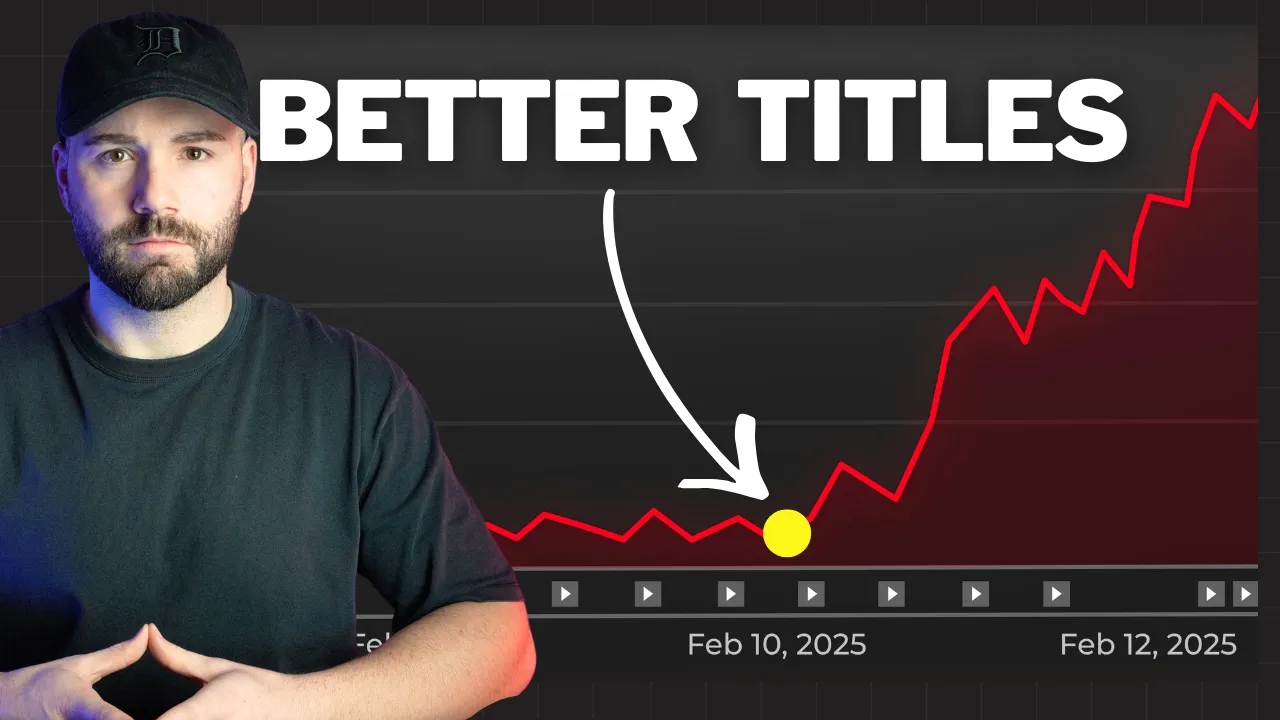
If your videos aren't getting many views, it's probably not your content. It's how you've written your title. Because on YouTube, just five to 10 words will decide whether people click on your video or whether they completely ignore it.
And one tiny change in how you write your titles can be the difference between 10 views and 10,000 views. So, in this video, I'm going to show you exactly how to write titles the right way. It's going to be a deep dive, so let's get into it.
Now, before we get into the tactics, we first need to understand what makes people click on videos in the first place. Because clicking on a video is never a logical decision. It's actually an emotional one.
Because when a viewer lands on YouTube's home feed looking for someone to watch, they're not sat there carefully comparing each video or reading every title word for word. Instead, their eyes are scanning incredibly fast, almost on like autopilot. And during that, their brain filters out 99% of what it sees until it latches on to the one thing that triggers a small emotional response.
So, if your title and thumbnail fails to create that small emotional response, the viewer's subconscious won't even register you. They'll just keep scrolling past. And think about it for a second.
When you open YouTube looking for something to watch, can you remember all of the titles you didn't click on? Of course not, because your brain instantly forgot them. And that's the key.
Now, your job as a creator is never to just describe your video. It's to interrupt the scroll of the viewer and to create like a tiny emotional jolt that stops someone's eyes midscan. And until you earn that click, your content basically doesn't exist.
You could have the most valuable video on YouTube, the best advice, the best editing, the best storytelling, but if your title doesn't trigger a small emotional reaction, it gets ignored. So, no, look, your title is not just a bunch of random words. It's a carefully crafted headline that competes with everything else on that screen.
So, I think that's enough for the psychology side of things. Let's now dive a bit deeper into all of the tactics and principles. So, now you're probably thinking, "How do I create that emotional reaction Dan keeps rabbiting on about?
" Well, let me explain. Now, almost every great YouTube title triggers one of three core emotions. That is curiosity, fear, or desire.
Okay, so first up, we have curiosity. The feeling of I need to know what this is. Now, curiosity is the most powerful emotion on YouTube because it creates a mental itch and it happens when your title hints at something interesting, but it deliberately leaves out the full answer.
So, the viewer's brain has like an information gap and the viewer's brain wants to close that gap, but it can only do so by clicking on the video. So, to show you what I mean, here are two examples. On the left, we've got a copyright strike killed my channel.
And then on the right, we've got I copied Mr Beast strategy and got more views. Now, these titles might seem okay, like there's not too much wrong with them at first, is there? But now, let's change them a little bit to include a bit of curiosity.
So, now instead, the titles are this one mistake killed my channel. Don't do this. And I tried Mr Beast, new strategy.
Here's what happened. And you can immediately see the difference because the titles on the left just explain the video. Like there's no reason to click on them and watch them because the titles have already explained what's going to happen.
Whereas the titles on the right tease the video with curiosity. They start a story but don't finish it. And the only way for the viewer to find out what happens is by clicking on that video and watching it.
So if your title gives everything away up front, nobody will feel the need to click. But if you strategically leave something unanswered, curiosity earns a click for you. Next up, we have fear.
The feeling of I don't want to miss out or I don't want to do something wrong. Now, fear works because humans are hardwired to avoid loss more strongly than they're motivated by gain. Now, on YouTube, fear-based titles usually revolve around mistakes, warnings, or missed opportunities.
Think of titles like stop making this silly thumbnail mistake or this is why your videos keep getting zero views. Now, these kind of titles basically trigger a subtle anxiety like what if I'm doing this wrong or what if this applies to me? And the moment someone feels that sense of fear, you've successfully triggered that emotional reaction.
So, they'll stop scrolling and actually start clicking on your video. Now, an important note here is that fear doesn't mean being really clickbaity or overly negative because that will turn someone off instantly. So, you do have to be careful.
And then finally, we have desire. The feeling of I want that outcome. Now, desire is all about results, transformations, and status.
These titles usually promise a reward. Things like more views, faster growth, a better system, or some sort of like insider knowledge. Now, examples could look like how I got my first 10,000 views on a small channel or the new title formula gets 10 times more clicks.
Now, desire works because it speaks directly to what your audience wants, not just what they're curious about. And these titles answer the question, well, what's in it for me? So, people can be confident that the video they're about to watch is actually going to help them.
So, they are the three most common emotions you can tap into. Now, if your title fails to spark any one of those emotions, then chances are it probably won't get clicked, no matter how good your actual video is. Now, I just wanted to let you know that if you are finding this video helpful so far, I actually have a titles and thumbnails mastery course that goes much, much deeper.
It has 29 different lectures and is designed to take you from beginner to pro. Now, hundreds of people have taken it already and the feedback has been incredible. The link to that is down below.
Anyway, let's get back to the video. So, now that you understand the emotions that drive clicks, the next question is, how do you actually trigger those emotions using just words? Well, this is where power words come in.
And if you don't know, power words are specific words or phrases that instantly amplify an emotion. They don't change what the video is about. They just change how it feels to read.
For example, compare these two titles. Number one, how to write better YouTube titles. versus the YouTube title mistake killing your views.
Like they're exactly the same topic, but they have a completely different emotional response. Now, the first one is just a bit informative. Like, it's a bit flat.
The second one, however, instantly triggers fear and curiosity. And that's the job of power words. Like, they act like emotional shortcuts for the brain.
So, instead of the viewer having to think, is this video worth clicking on? The use of those words makes them feel instantly like it is. Now, an important thing to understand is this.
Every niche has its own different power words. Now, for me, in my YouTube growth space, words like click-through rate, algorithm, zero views, subscribers, hooks, and viral show up over and over again because they speak directly to what creators care about, but yours will be completely different. But just to give you an idea, here are some generalized power words that can pretty much help in any niche.
Feel free to pause the video and note them down or just screenshot it if you wish to. But look, you can't polish a turd. Power words aren't magic.
So throwing a couple of words like crazy or shocking into every title won't suddenly make your videos perform better. Now, the best power words are the words that actually support the emotion you're trying to like convey, not replace it. So when you're writing a title, don't ask, "How can I make this sound more dramatic?
" Instead, you should ask something like, "Which emotion am I triggering? And what words strengthen that emotion? " Because when you're able to get the emotion right and the power words to reinforce it, trust me, you'll be on to a winner.
So, now that you know how to emotionally position your titles and what to include in them, the next step is making sure you get the length right. And by length, I literally just mean how many words you've included in your title. And there's two common rules here.
First is the 7 to11 words rule and second is the 55 character rule. Now a lot of creators completely overlook this, but it's actually really really important because as I said during the psychology section of the video, when people scroll through the home feed, they're not reading titles word for word. They're skimm reading and their brain wants information fast and with as little effort as possible.
So, if your title is too long or too confusing or too hard to read, people will just ignore it. That's why titles tend to perform best when they sit in the 7 to 11 word range. These are long enough to set context and spark curiosity, but they're short enough to like feel punchy, readable, and effortless to process.
Any shorter than seven words, and your title might become a bit vague, but any longer and it starts to become a little bit too long. Now there is actually a technical reason that this is important too because YouTube actually cuts off titles at around 55 characters. So if your title exceeds 55 characters then the end might be replaced by three dots depending on where the viewer is actually seeing your video.
Now this is especially the case on mobiles because titles get shortened all the time and over 70% of YouTube views come from mobile. So, you need to make sure things like your hook or your emotional trigger or your main keyword of your title is never buried at the end. Otherwise, it might not even be visible.
Now, yes, of course, long titles can still work, but only as long as they're structured properly. That's why word order matters. So, you basically just want to frontload your titles with the strongest words first.
So, include the emotion or the curiosity or the promise right at the beginning of your title. So, even if someone only catches the first half of your title whilst they're scrolling, they should instantly understand why they want to click on your video. But look, in most cases, shorter titles win because they're easier to read.
They're usually easier to remember, and they're more likely to trigger an emotion within like a second of reading it. Now, look, I know that some of you genuinely just really do struggle when it comes to writing titles. And if that's you, then you could consider using an hour tool to do it for you.
And the best tool that I found out there right now is actually one of 10 in their title generator. All you have to do is either type in a rough title idea that you already have or just type in a short explanation of the video you're making and it will automatically generate loads of different titles for you. Now, the titles you see on the left are all based on your own channels data.
And the titles on the right are actually based off other viral videos on the platform. And in my titles and thumbnails course, I have an entire lecture dedicated on how to use this tool properly. So, it could be something you might want to check out.
Now, the final thing you need to consider is this. What kind of title are you actually writing? And this is where most inexperienced creators go wrong because a lot of you guys don't know the difference between browse-based titles and searchbased titles.
So, let me explain. Basically on YouTube, viewers typically discover content in two ways. Either by searching for something specific or just by scrolling the homepage or suggested videos.
Now, these are two very different types of viewer behavior and they require two completely different title strategies. So, for instance, when someone's just scrolling through their home feed, they're not looking for anything specific. So, your job here, like I said, is to interrupt the scroll and grab their attention.
That's what browse-based titles do best. They lean heavily on curiosity and emotional triggers. On the flip side, however, searched optimized titles are written for people who already know what they want to watch.
These viewers are actively going in and typing specific things into the search bar, and then they'll click on the videos that come up in those results. So, the titles of these types of videos need to be clear, direct, and very keyword focused. Think of formats like how to start a drop shipping business in 2026 or best video cameras for beginners.
Like, these kind of titles tend to perform well over time because they're evergreen and they rely on search traffic. Now, one isn't technically better than the other, but you do need to know what kind of traffic source you're targeting before you create your title. For example, one of my videos titled, "How to start a YouTube channel in 2025 is optimized for search.
" And the analytics show that because most of the views come from YouTube search, but a different video titled, "If your shorts get under 1,000 views, do this," is clearly optimized for browse. and it got over millions of views even though nobody is searching for that specific title phrase. So again, you just need to make sure you know what kind of traffic source you want for your title before you actually write it.
Now, if all of this is starting to make sense, but you still feel a little bit unsure, my titles and thumbnails mastery course will help you take things to the next level. I built this short high impact course to walk you through step by step how to write high performing titles and also design scroll stopping thumbnails. It's packed with proven frameworks, real examples, emotional triggers, thumbnail practices, and so much more.
And as a thank you for making it to the end of this video, you can get the entire course for 50% off.