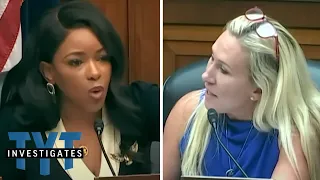
Tiffany Trump expected her position as the president's daughter would give her the upper hand in confronting the Democratic congresswoman. Armed with prepared talking points and the confidence of someone who had never faced real consequences, she anticipated humiliating the Texas representative on camera. But when Congresswoman Jasmine Crockett opened that Manila folder and began reading from internal documents about questionable funding, the next seven minutes wouldn't just silence the Trump Aerys, they would expose years of institutional manipulation that the family had tried to conceal.
What began as just another committee hearing would soon transform into a viral moment redefining the power of precise eloquence against institutional arrogance. When the president's daughter attempted to diminish the lawyer turned congresswoman with condescending remarks, the measured response from the Dallas representative didn't just dismantle the attack. It exposed the entire structure of privilege supporting it.
The Capitol hearing room was infused with that characteristic mixture of polished wood and political tension. The air conditioning blew with excessive intensity, creating that familiar artificial chill that seemed fitting for the climate of contained hostility. Fluorescent lights reflected off the dark mahogany of the central panel, while the low hum of live microphones created a constant presence of anticipation.
Occasionally, the distant sound of protests outside the building penetrated the walls, reminding everyone present of what was at stake beyond those imposing doors. Congresswoman Jasmine Crockett sat upright, her hands resting calmly on the folder of documents before her, her navy blue blazer deliberately contrasted with the golden scales of justice brooch on her lapel, a subtle reminder of her legal background before entering Congress. Her black framed glasses framed attentive eyes that didn't miss a single movement in the room.
In her hands, a silver pen rotated slowly between her fingers, a habit remaining from her days as a public defender preparing for crucial cross-examinations. Across the hall, Tiffany Trump had opted for a light colored designer dress, complimented by ostentatious jewelry that caught the light with every movement. Her posture conveyed rehearsed confidence as she repeatedly consulted her phone, as if the ongoing discussions didn't merit her full attention.
Around her, aids in dark suits occasionally leaned in to whisper in her ear, causing smiles that seemed out of place in the seriousness of the environment. The spatial arrangement of the room created its own narrative of power. The elevated panel where committee members sat formed a semicircle of institutional authority.
Below the witness table appeared deliberately small, positioned to create a sense of vulnerability. Television cameras were strategically placed to capture every reaction, transforming what should have been a deliberative process into political theater. When Congresswoman Crockett took notes, her movements were economical and precise.
Meanwhile, Tiffany gestured broadly when speaking with her assistants, occupying physical space like someone accustomed to having all attention. The contrast between the economy of movement of one and the expansiveness of the other established the visual tension that would soon translate into verbal confrontation. Jasmine Crockett hadn't arrived at this moment by accident.
Born in St. Louis, Missouri. The daughter of a teacher, preacher, and a postal worker.
She had learned early that the system rarely favored people like her. While her college classmates at Roads College talked about family connections that would secure their careers, Jasmine studied late, determined to earn her place through irrefutable competence. My father always said we need to be twice as good just to be considered equal.
Crockett thought as she watched Tiffany Trump check her phone again during an expert's testimony. The memory of her days as a public defender in Bowie County, Texas, returned vividly. The long hours defending people the system was programmed to ignore.
The extra scrutiny she faced as a black woman in courtrooms dominated by white men. Her transition to politics had been driven by the same determination. As the only black freshman and youngest black legislator in what was marked as the most conservative session in Texas history, she had introduced more bills than any other freshman and managed to form unlikely coalitions to pass criminal justice reforms in the House.
Across the room, Tiffany Trump carried a different set of experiences. As the only daughter from the president's second marriage, she had grown up primarily under her mother Mara Maple's care in California, geographically distant from the center of the Trump Empire, but still a beneficiary of all its privileges. Her education at the exclusive Viewpoint School in Calabasas and later at the University of Pennsylvania had been a path charted by privilege, not necessity.
As she observed the Democratic Congresswoman, Tiffany felt a mixture of irritation and incomprehension. Why was this woman always questioning the legitimacy of her father's administration? Why couldn't she simply get on the right side of history as so many others had done?
The growing frustration over what she perceived as personal attacks against her family had finally led to this direct confrontation in an oversight committee. The first exchange between them occurred 40 minutes into the session. Congresswoman Crockett, Tiffany began, leaning slightly toward the microphone.
I admire your enthusiasm in all these committees, but don't you think you're being a bit melodramatic about these allegations? My family has been transparent about all business dealings. A heavy silence fell over the room.
Those present adjusted in their seats, recognizing the condescending tone that so many had experienced in their own careers. That specific intonation reserved for diminishing a woman's expertise without appearing explicitly offensive. Crockett adjusted her glasses slowly, allowing the silence to work in her favor.
When she finally spoke, her voice was measured, calm, but carrying authority acquired in hundreds of court hearings. Ms. Trump, I appreciate your participation today.
However, I must correct your misunderstanding. We aren't discussing allegations. We're discussing verified documents that have been submitted to this committee under oath.
She made a deliberate pause. And as for transparency, well, that's exactly what we're trying to establish here today. The room noticed the first imbalance in power.
Tiffany had tried to use condescending familiarity, but Crockett had responded with professional precision. The contrast between them became even clearer to viewers. On one side, inherited privilege, on the other, hard-earned competence.
As the hearing progressed, tensions began to escalate. systematically with three initial confrontations that tested the waters of what was to come. The first came when Tiffany interrupted the congresswoman during a technical questioning about international financial transfers.
"Excuse me, Congresswoman," she said with a rehearsed smile, "but I think you're confusing normal licensing contracts with something more sinister. Perhaps it's a matter of experience in international business. " Crockett merely nodded, allowing the interruption to hang in the air for a moment before responding.
Actually, M. Trump, before becoming a legislator, I represented companies in international transactions as an attorney, but we're not talking about personal experience here. We're talking about specific documents that have been submitted to this committee.
Page 47, paragraph 3, if you'd like to follow along. She tapped the document in front of her, a gesture that drew all eyes to the evidence rather than the personalities. Several committee members leaned forward, suddenly more interested in the specifics than the spectacle.
You'll notice," Crockett continued, her voice maintaining that measured cadence that commanded attention without demanding it, that the licensing agreement signed with Meridian Partners lists a valuation of $24. 3 million, while the corresponding tax documents submitted to the Treasury Department show a valuation of only $8. 7 million.
I'm not asking for interpretation here. I'm asking for factual reconciliation of these disperate figures. The second tension arose when Tiffany commented on the congresswoman's tone of voice.
Congresswoman Crockett, we don't need to be so aggressive here. This is a civilized discussion, said Tiffany, appealing to the angry black woman stereotype without explicitly saying it. Crockett smiled slightly.
Interesting that you perceive direct questions as aggression, Ms. Trump. I'm simply following the standard inquiry protocol of this committee as established by your own father in 2017.
In fact, I'm being considerably gentler than the standard set at that time. She paused, letting that comparison sink in. Many in the room remembered the significantly more hostile tone of earlier committee hearings.
The contrast was not lost on anyone present. If I may, Crockett continued, I'd like to return to the question of the disperate valuations. The committee would benefit from understanding why the same asset was valued so differently in different contexts.
The third microaggression came in the form of a comment about Crockett's appearance. I must say, Congresswoman, I admire how you always manage to look so vibrant in these tedious hearings. It must be exhausting maintaining all that energy.
The room collectively held its breath, recognizing the attempt to reduce the congresswoman's seriousness to a matter of style over substance. Thank you for commenting on my appearance, Miss Trump. Now, can we return to the documents showing $17 million discrepancies in the licensing contracts I mentioned earlier?
Crockett didn't miss a beat, refusing to be derailed by the personal comment. She flipped open another folder on her desk, a visual reminder of the preparation gap between the two women. While Tiffany had come armed with personal jabs, Crockett had arrived with meticulously organized evidence.
This particular discrepancy, she continued pulling out another document, appears in at least seven different transactions between 2022 and 2024. It suggests a pattern rather than an isolated accounting error. Medium tensions began to develop when the president's daughter realized her initial tactics weren't working.
She moved to more aggressive strategies. Congresswoman, these documents you keep mentioning were illegally obtained and are being presented out of context. This is typical of the witch hunt my family has faced.
Crockett didn't take the bait. Miss Trump, these documents were obtained through legal subpoenas issued by this committee approved by both Republican and Democratic members. As for context, that's why we invited you today to provide any additional context that might clarify these discrepancies.
So far, you've chosen to question the process rather than address the content. She paused, allowing the point to settle. Several journalists in the press gallery could be seen scribbling notes furiously.
The contrast in approaches was becoming the story itself. For the record, Crockett added, "I'd like to note that these subpoenas were issued on March 15th with full compliance required by April 3rd. The Trump Organization's legal team requested and received a 2-week extension.
The documents were then provided by your own corporate council under oath certifying their authenticity. If you're suggesting they were illegally obtained, I would recommend consulting with your legal team about that claim. As the hearing advanced into the second hour, the strategy shifted again.
Congresswoman, perhaps this isn't the appropriate forum to discuss such complex matters. My father always says, "People who have never built anything try to tear down those who've built empires. " Ms.
Trump, this is precisely the appropriate forum. This committee exists specifically to oversee transactions involving federal interests. As for building versus tearing down, this committee is here to do neither.
We're here to ensure transparency and compliance with the law, regardless of who's involved. Crockett adjusted her glasses again, a gesture that had become familiar to regular viewers of committee hearings. It signaled her transition from defensive responses to offensive questioning.
Since you mentioned building, let's discuss the construction contracts for the Baku project. According to these documents, your family's organization certified to investors that construction costs totaled $72 million while simultaneously reporting costs of only $45 million to Azerbaijan tax authorities. Would you care to explain this $27 million discrepancy?
Tension reached new heights when Tiffany attempted a more personal tactic. Let's be honest, Congresswoman. Your opposition to my family has always been political.
From day one, you've been seeking the spotlight by attacking the Trump name. It was at this moment that Crockett's expression subtly changed. Her eyes narrowed almost imperceptibly as she placed her pen on the table with deliberation.
Ms. Trump, let me clarify something. My oath was to the Constitution, not for or against any family.
I've criticized policies, not people. And as for spotlights, she paused, looking directly at the strategically positioned cameras. I believe we're both aware of how they work.
The difference is that some of us are here for the responsibility that comes with them. She let the statement hang in the air for a moment before continuing. Now, would you like to address the $27 million discrepancy in the Baku project, or shall we move on to the undisclosed foreign lobbying activities documented in the emails from page 114 of the committee's exhibits?
The room felt the shift in the air. What had begun as small provocations was transforming into a significant confrontation about fundamental principles. The congresswoman wasn't just countering attacks.
She was establishing a moral contrast that transcended the moment. Throughout the exchange, Crockett maintained a deliberate rhythm to her questioning. Short, direct questions established tension.
Medium-length explanations provided context. Occasional longer statements delivered the moral weight of her argument. This triangular pattern of communication created a sense of momentum that proved impossible for Tiffany to disrupt.
A senior Democratic committee member passed Crockett a note. She glanced at it briefly before returning to her questioning. The momentary pause creating anticipation in the room.
Ms. Trump, I'd like to direct your attention to exhibit C in the materials before you. These are emails between your family's organization and foreign officials discussing what they refer to as alternative channels for approval processes.
Could you explain what these alternative channels entailed? Tiffany leaned over to consult with her legal counsel, their whispered conversation picked up faintly by the microphones. The attorney's expression reflected growing concern as he flipped through his own copies of the exhibits.
I'm not familiar with those specific communications, Tiffany finally responded, her voice having lost some of its earlier confidence. That's understandable, Crockett replied, her tone remaining professional and even. These emails were sent by senior executives in your family's organization.
However, they directly reference your presence in meetings where these alternative channels were discussed. Specifically, the email from March 17th states, and I quote, "Tiffany's involvement in the Singapore meetings opened doors that conventional approaches couldn't. The ministers were quite responsive to her personal touch.
" "Hey," she looked up from the document. "Given this explicit reference to your role, I was hoping you might provide insight into what exactly these alternative channels entailed. " Tiffany's face flushed slightly.
I attend many meetings as a representative of our family's interests. I don't recall the specific conversations referenced. Memory can indeed be selective, Crockett noted, the subtle dig delivered with such professional calm that it was impossible to object to.
Fortunately, we have written records to rely on. The tension in the room reached its climax when Tiffany, clearly frustrated with her inability to destabilize the congresswoman, decided to go straight for the attack. "Congresswoman Crockett," she said with a tone of finality.
"Let's stop pretending this is about documents or policies. We all know that you and your Democratic colleagues never accepted the legitimacy of my father's presidency. " This obsession with finding scandals where none exist is hurting the country.
Who do you think you are to question decisions made by people who actually understand how the business world works? The room fell into absolute silence. The question hung in the air, loaded with all the weight of privilege and presumption that had defined many political debates in recent years.
Cameras pivoted to capture Crockett's reaction. The congresswoman remained silent for exactly 7 seconds, long enough for everyone to feel the weight of the moment, but not so long as to appear without an answer. Her eyes never left Tiffany's as she mentally organized her response.
"Miss Trump," she began, her voice calm, but clear enough to fill every corner of the room. "Your question contains several premises that we need to examine. First, you suggest that we're pretending this is about documents.
Allow me to present them again. With deliberate movements, Crockett opened her folder and began arranging specific documents before her. Here we have licensing contracts signed in January 2023 that list different values than those reported to the IRS.
She placed the first document under the document camera so it appeared on monitors around the room. Here we have transfers to offshore entities that weren't disclosed as required by section 721 of the federal code. A second document appeared on the screens.
And here she continued producing a third document. We have internal communications specifically discussing how to structure these agreements to avoid regulatory scrutiny dated 3 days after the presidential inauguration. The strategy was clear.
Crockett was systematically transforming vague accusations into specific evidence, shifting the terrain of debate from perceptions to facts. As for your second premise about legitimacy, my oath is to defend the Constitution against all enemies, foreign and domestic. That includes recognizing the authority of the presidential office, regardless of who occupies it.
What I cannot and will not do is ignore violations of that same constitution simply due to the title of the person involved. Tiffany tried to interrupt, but Crockett gently raised a hand. Please allow me to finish just as I had the courtesy to allow you to complete your full question.
Tiffany backed down, momentarily surprised by the quiet firmness. Finally, about who I think I am. I am an elected representative of the people of Texas's 30th district, a former public defender who swore to uphold the law impartially, and an American citizen exercising the constitutional oversight responsibility that this committee was created to perform.
I'm not questioning people. I'm questioning specific documented actions that appear to violate federal law. If there are legitimate explanations for these discrepancies, I'm genuinely interested in hearing them.
Crockett then removed her glasses, looking directly at Tiffany without the barrier of her lenses. So, with all due respect, M. Trump, it's not a question of who I think I am.
It's a question of who all of us are obligated to be in a democracy based on laws. No one, regardless of their surname or status, should be above those laws. That's not a radical position.
It's the fundamental principle upon which this nation was built. The room remained in complete silence. Several committee members exchanged meaningful glances.
A senior Republican aid was seen leaning back in his chair, the body language indicating a silent surrender in recognizing the strength of the argument. What made Crockett's response so devastating wasn't just its content, but its delivery. There was no righteous anger, no raised voice, no emotional appeal, just the methodical presentation of facts delivered with unshakable composure.
It was the contrast between her measured precision and Tiffany's increasingly emotional responses that underscored the power dynamic shift happening before viewers' eyes. Tiffany Trump, for the first time since the beginning of the hearing, appeared genuinely at a loss for words. Her face oscillated between expressions of surprise and frustration as she quickly consulted her notes, clearly looking for a response that hadn't been prepared for this scenario.
Finally, she responded with an attempt to deflect. That's just your interpretation of these documents. Crockett smiled slightly.
No, M. Trump. These are the words written in the documents themselves.
I'm not offering interpretation. I'm reading directly what's written. If you have an alternative explanation for the meaning of these words, the committee would certainly like to hear it.
A subtle shift occurred among the committee members. A veteran Republican congressman who had initially appeared supportive of Tiffany was now studying the documents with newfound interest. his brow furrowed in concern.
Even partisan loyalty had its limits when confronted with such clear evidence. Tiffany leaned back to consult with her attorney again, the whispered conference lasting longer this time. The cameras captured the attorney's increasingly worried expression as they flipped through more documents.
My legal council advises that some of these matters are still subject to ongoing negotiations with regulatory authorities. Tiffany finally offered, her voice noticeably less confident. I appreciate that clarification, Crockett responded, not missing the tacit admission that there were indeed regulatory issues at play.
However, this committee's oversight role exists independent of any regulatory negotiations. Our constitutional duty is to understand whether federal laws have been followed, particularly when they involve potential conflicts between private business interests and public responsibilities. The confrontation had reached its turning point.
What began as an attempt to intimidate a congresswoman had transformed into a masterful demonstration of meticulous preparation and intellectual integrity. The moment that would completely transform the power dynamic occurred after a brief pause in the hearing. Cameras had captured Tiffany's expression as she frantically consulted her advisers while Crockett remained composed, calmly reorganizing her documents.
When the session resumed, Tiffany made one last effort to regain narrative control. Congresswoman," she said, her voice now carrying a note of barely disguised desperation. "You're deliberately focusing on technicalities to create a negative narrative about legitimate business.
Real people out there who voted for my father understand that sometimes you need to be creative to navigate a complicated bureaucratic system. They don't care about these insignificant details you're trying to turn into scandal. " It was at this moment that Jasmine Crockett delivered the phrase that would be replayed millions of times over the next 24 hours.
Looking directly at Tiffany without consulting any notes, she said in a voice so calm that everyone in the room had to lean forward to hear, "The law is not a suggestion for the poor and an inconvenience for the privileged. " The silence that followed was absolute. A committee member dropped their pen, the sound reverberating through the room.
Cameras captured the exact moment when the truth of that statement penetrated the collective consciousness. Crockett continued, her voice still calm, but now carrying an unmistakable moral force. When you call documented violations of the law, technicalities, and insignificant details, you're revealing exactly the problem we face.
For many of my constituents, these same technicalities resulted in prison sentences, separated families, and ruined lives. The idea that some people can consider them mere inconveniences to be circumvented through creativity, while others face the full weight of the law for minor infractions, is precisely what this committee should examine. She paused, allowing the weight of her words to settle across the room.
Every eye was fixed on her, the power of her argument creating a gravitational pull that even the most partisan observers couldn't resist. "I spent six years as a public defender in Texas," she continued, offering a rare personal glimpse that humanized the principled stance. "I represented people who received years in prison for amounts that wouldn't even register as rounding errors in these documents.
I sat with their families as they tried to understand how a system could be so unforgiving to them while so accommodating to others. For the first time, a trace of emotion entered her voice, not anger, but a profound conviction born of lived experience. It was this momentary vulnerability that made her strength all the more compelling.
That experience taught me something crucial about our justice system, something that transcends partisan politics. It taught me that true equality before the law remains an aspiration, not a reality. And it's precisely because I've seen the systems harshness toward the powerless that I cannot in good conscience ignore its leniency toward the powerful.
Tiffany opened her mouth to respond, but the words didn't come. For the first time, her face showed genuine understanding of the moral chasm Crockett had exposed. Ms.
Trump, Crockett concluded, I'm not interested in creating scandals. I'm interested in creating equality before the law. If these documents show what they appear to show, then we're not talking about negative narratives.
We're talking about basic accountability. The same standard that would apply to any citizen should apply to everyone regardless of their surname. A senior Republican aid was overheard whispering to a colleague.
She just took down the entire defense in 30 seconds. Cameras captured the moment when Tiffany turned to her own legal adviser, who merely shrugged subtly, the universal gesture of surrender in the face of an irrefutable argument. The balance of power had been completely reversed.
What began as an attempt to intimidate a congresswoman through privilege and condescension had transformed into a masterful demonstration of moral integrity and democratic responsibility. Several committee members who had remained silent throughout the exchange now sought recognition from the chair, eager to associate themselves with the moral clarity Crockett had established. The political calculations were transparent.
No one wanted to be on the wrong side of what was clearly becoming a defining moment. The committee chairman, recognizing the significance of what had just transpired, called for a 15-minute recess. As members filed out, their hushed conversations revealed the impact of Crockett's words.
Even those ideologically aligned with the Trump administration were seen shaking their heads in reluctant admiration of the congresswoman's precision and preparedness. In the hallway outside, reporters clustered around their producers reviewing footage and selecting the clips that would dominate the evening news. One veteran journalist was overheard saying, "I've covered hearings for 30 years, and I've never seen someone so thoroughly dismantled with such civility.
" When the session resumed, the dynamic had fundamentally changed. Tiffany's posture was more guarded, her responses more measured. Gone was the casual dismissiveness that had characterized her earlier statements.
Her legal council now intervened frequently, suggesting a newfound awareness of the serious nature of the questions being posed. For her part, Crockett maintained the same methodical approach, neither triumphant in her advantage, nor relenting in her questioning. Her focus remained squarely on the documents and the principles they represented, rather than on the personal victory she had clearly achieved.
Ms. Trump, she continued, I'd like to address the foreign agent registrations required under FAR for the activities documented in exhibit D. According to these communications, representatives of your family's organization met with government officials from five countries while explicitly representing both business interests and what they termed the administration's priorities.
Yet, no FAR registrations were filed for these activities. Could you explain this apparent oversight? The repercussions of the confrontation were immediate and far-reaching.
While the hearing formally continued, social media was already ablaze. The 7-minute clip of the exchange was being shared every second with Crockett's central phrase, "The law is not a suggestion for the poor and an inconvenience for the privileged," becoming instantly viral. Within the hearing room itself, the dynamic had completely changed.
Republican committee members who initially seemed ready to support Tiffany now maintained strategic distance, asking carefully neutral questions. A veteran conservative representative was caught on camera whispering to a colleague, "We need to end this before it gets worse. " Headlines began appearing before the session even ended.
Capital showdown. Crockett exposes privilege with surgical precision. Law isn't a suggestion.
The moment that silenced Tiffany Trump, seven minutes that exposed America's double standard of justice. In an adjacent room, White House aids watched the live broadcast with somber expressions. A senior strategist muttered, "This is going to cost us at least five points in polls on ethics perception.
Who the hell thought this confrontation was a good idea? " The exchange had tapped into a deeper current in American society, a growing frustration with perceived double standards in how laws were applied. It wasn't just Democrats celebrating Crockett's performance.
It was anyone who had ever felt the system was rigged against ordinary people. Meanwhile, ordinary citizens began reacting through social media and comments on live broadcasts. As a former public defender, I'm crying watching Crockett.
Finally, someone said out loud what we face every day in court. A justice fighter. Never seen someone dismantled with such elegance and precision.
No shouting, no drama, just irrefutable facts. At political junkie, my son is serving 5 years for marijuana possession while they call tax fraud technicalities. Decrockett is right on every word.
Burst middle America mom. Watch how she never raises her voice or gets emotional. That's power.
That's someone who knows exactly what she's talking about. A retired teacher. This isn't about politics anymore.
It's about whether we truly believe in equal justice or just pretend to independent voter. The responses crossed traditional political divides, suggesting Crockett had tapped into a truth that resonated beyond partisan identities. Legal experts began weighing in on the broader significance of the confrontation.
What we witnessed today wasn't just a viral moment, but a turning point in the discussion about legal equality. Congresswoman Crockett managed to articulate in clear and concise terms the fundamental problem of our two-speed justice system. Constitutional law professor, Colombia University.
The brilliance of Crockett's approach was enforcing a confrontation not between personalities or parties, but between principles and practices. She essentially asked, "Do we actually believe in the rule of law or just in the appearance of it? " Former federal prosecutor, I've trained attorneys for decades, and this was a masterclass in evidence-based questioning.
Notice how she never allowed herself to be baited into personal exchanges, but always pivoted back to documented facts. Director Georgetown Law Trial Advocacy Program. The impact extended beyond politics.
A renowned filmmaker tweeted that the exchange was the clearest example of integrity versus privilege I've ever seen, captured in real time. This is history happening before our eyes. A prominent business magazine published an analysis of the exchange under the headline leadership lessons from Crockett versus Trump, highlighting the congresswoman's preparation, precision, and poise under pressure as qualities that transcended politics.
As the hearing wound toward adjournment, Tiffany Trump was visibly shaken. Her aids formed a protective circle around her, blocking cameras as she quickly exited the room. In contrast, Crockett remained in her place, methodically organizing her documents while calmly answering additional questions from the committee.
The White House issued a brief and clearly defensive statement. The administration remains committed to full transparency and will cooperate with all legitimate congressional inquiries. Political analysts noted the absence of any substantive defense or denial of the evidence Crockett presented.
a deafening silence that only amplified the impact of her words. In the following 48 hours, the clip was viewed over 75 million times. Transcripts of the exchange appeared in law school classrooms as an example of effective questioning and principled argumentation.
3 days later, a national poll showed that 68% of Americans who had seen the clip agreed with Crockett's assessment of the double standard of justice, including 42% of those who identified as Republicans. Perhaps most tellingly, other congressional committees began adopting what staffers were calling the Crockett approach. fewer theatrical confrontations and more methodical evidence-based questioning.
The impact on political discourse was subtle but significant, a shift from performative outrage to substantive accountability. Two weeks after the historic hearing, Congresswoman Jasmine Crockett sat in her Dallas office reviewing correspondence from constituents. The volume had increased tenfold since the confrontation, with thousands of messages arriving daily, many from people who had never engaged with politics before.
One letter in particular caught her attention. Dear Congresswoman Crockett, I'm a 67year-old woman who has voted Republican in every election since 1976. I've never written to a representative before, but after seeing you speak that simple truth, that the law shouldn't be just a suggestion for people like me and an inconvenience for the powerful, something changed within me.
My late husband spent two years in prison for errors on our tax return totaling $18,000. Meanwhile, we see the powerful treat millions in tax evasion as smart planning. The pain of that injustice has stayed with me for decades.
Your words weren't political. They were true. And sometimes truth transcends parties.
Thank you for your courage. Crockett placed the letter on her desk and looked out the window at the Dallas skyline. The impact of her words had extended far beyond that hearing room.
Criminal justice reform proposals that had been stagnant for years suddenly gained new supporters. A bipartisan coalition was forming around legislation to eliminate sentencing disparities. Even conservative commentators were acknowledging the need to rethink how the legal system treats different classes of citizens.
What had resonated wasn't a partisan attack, but a universal principle articulated with uncommon clarity. In a political landscape often dominated by tribal identities, Crockett had managed to elevate the conversation to the shared values that transcended those divisions. Meanwhile, consequences for the Trump family continued to unfold.
Broader investigations into the practices revealed in the documents had been initiated by multiple agencies. The double standard that Crockett had so eloquently exposed was now under national scrutiny. In a reflective interview one month after the confrontation, when asked about the moment that had captured national attention, Crockett offered a broader perspective.
That moment wasn't about two women on opposite sides of a political debate. It was about a fundamental principle that transcends partisanship. the idea that justice should truly be blind.
When we allow certain individuals or families to operate under a different set of rules, we weaken the very fabric that holds our society together. She paused, reflecting, "What resonated with so many people, I believe, wasn't my specific words, but the recognition of a truth that many Americans feel deeply. We have a system that severely punishes small infractions committed by ordinary people, while treating larger transgressions by the powerful as mere obstacles to be circumvented with the help of expensive lawyers.
When pressed about her calm demeanor during the heated exchange, Crockett offered insight into her approach. In my years as a public defender, I learned that emotion can be a liability in the courtroom. Judges and juries respond to facts, to evidence, to logical arguments presented without drama.
The same is true in the court of public opinion. When you have truth on your side, you don't need theatrics. You just need precision.
The image of that confrontation, the lawyer turned congresswoman calmly exposing systemic inequality before a privileged Aayys had become a powerful cultural symbol. It wasn't just a political moment, but a turning point in the national conversation about privilege, power, and the true meaning of equality before the law. In classrooms and family dinners, in barbershops and corporate offices, people discussed what it meant to live in a society where justice applied equally to everyone.
The phrase, "The law is not a suggestion," began appearing on t-shirts, mugs, and even billboards. " For Jasmine Crockett, the most significant legacy wasn't in the headlines or momentary notoriety, but in the difficult conversations her confrontation had catalyzed, and in the tangible reforms that began taking shape in the weeks that followed. Dignity isn't measured by the volume of your voice," she reflected in the conclusion of the interview, but by the precision with which you speak truth.
And sometimes the most powerful truth is the one everyone already knows, but no one has had the courage to say out loud. Meanwhile, in living rooms across the country, women who had struggled for decades against systems that underestimated them watched and rewatched those seven minutes of testimony as a reminder. Some battles are won not with shouting, but with devastating eloquence based on irrefutable truths.
The final lesson wasn't about partisan politics or individual personalities, but about the enduring power of dignity under pressure, and how at critical moments, truth spoken with precision can change more than just a congressional hearing. It can change an entire nation's conversation. In the months that followed, lawmakers from both parties began referencing the Crockett standard when discussing accountability measures.
Law schools incorporated the exchange into their curriculum on effective advocacy. Grassroots organizations used the moment as a rallying point for justice reform initiatives. Perhaps most significantly, ordinary citizens who had long felt invisible to those in power began finding their own voices.
Inspired by Crockett's example, they discovered that speaking truth with precision could be more powerful than shouting in anger. A high school teacher in Iowa created a classroom exercise based on the exchange, teaching students about the difference between emotional appeals and evidence-based arguments. A community organizer in Detroit developed workshops on precision advocacy for local residents dealing with city hall.
A corporate trainer in Seattle built an entire program around dignity under pressure for women executives facing hostile workplace environments. The ripple effects continued to spread, touching lives far removed from Washington politics. A mother in rural Alabama wrote to Crockett describing how she had used the congresswoman's questioning technique to challenge a school board that had been ignoring concerns from lowerincome neighborhoods.
I brought documents, not just complaints, she wrote, and for the first time they couldn't dismiss me. For her part, Crockett maintained the same measured approach that had defined that pivotal moment. She declined most interview requests about the viral exchange, preferring to redirect attention to the substantive issues it had raised.
When pressed about her preparation for that day, she simply noted, "I've spent my life preparing to speak truth to power. " That day was just one more opportunity to do what I've always done. NI what historians would later note about the exchange wasn't just its immediate impact but how it had subtly shifted the parameters of public discourse before that confrontation discussions about unequal justice often devolved into partisan talking points after Crockett's precise articulation of the problem the conversation became more nuanced more evidence-based and ultimately more productive one evening months after the hearing Crockett received an unexpected visitor in her congressional office, a senior Republican member who had been present that day.
"I've been meaning to tell you something," he said after they exchanged pleasantries. "What you did that day? It wasn't just good politics.
It was something we desperately needed in our national conversation. " "How so? " Crockett asked.
You showed that it's possible to be both passionate and precise, to care deeply without losing clarity. In an era of shouting matches and gotcha moments, you demonstrated something different. The kind of dignified advocacy that used to be the hallmark of our best public servants, regardless of party, he paused, then added, "My own daughter watched that clip and decided to apply to law school.
She said she wants to learn how to speak truth that way. " Crockett smiled, recognizing that this, more than headlines or viral moments, was the true measure of impact, inspiring others to find their own voice and speak their own truth with precision and dignity. As the one-year anniversary of the hearing approached, a journalist asked Crockett if she had any regrets about how she had handled the confrontation.
Regrets? She considered the question carefully. No, but I do have reflections.
I think about how that moment resonated because it touched something universal. The human desire for fairness and accountability. It transcended politics because it wasn't really about politics at all.
It was about integrity. She continued, "What I hope people remember isn't the personalities involved, but the principle at stake. Equal justice isn't a partisan concept.
It's the foundation of any functioning democracy. When we start making exceptions based on wealth, power, or connections, we undermine that foundation. The journalist noted that the phrase, "The law is not a suggestion for the poor and an inconvenience for the privileged had become something of a cultural touchstone.
" "Words have power when they express truths people already feel but haven't heard articulated," Crockett responded. I didn't create that truth. I just gave voice to what millions of Americans have experienced throughout their lives.
As she prepared for another committee hearing, this one focused on sentencing reform legislation that had gained momentum since her viral moment, Crockett reflected on the strange alchemy that transforms individual moments into movements. She had never sought to become a symbol or to create a catchphrase. She had simply done what she had always done, prepared meticulously, questioned precisely and spoken truth with dignity.
Yet something about that particular exchange had crystallized a national frustration with inequality in a way that countless statistics and studies had failed to do. Perhaps it was the visual contrast between inherited privilege and earned authority. Perhaps it was the calm precision with which she had dismantled the architecture of exception.
Or perhaps it was simply that in a moment when she could have responded with righteous anger, she had chosen instead to respond with irrefutable truth. What Crockett understood, and what viewers had instinctively recognized, was that true power doesn't need to announce itself with volume or aggression. True power lies in the calm certainty that comes from knowing precisely what you're talking about and why it matters.
For viewers who had spent decades navigating systems designed to diminish their voices, the exchange had offered something beyond political satisfaction. It had offered validation, confirmation that the double standards they had experienced weren't imagined, and that someone with both the clarity to see them and the courage to name them had finally reached a position of influence. Many of you watching have experienced your own version of this moment, Crockett observed in a later town hall.
That meeting where your expertise was questioned. That courtroom where the rules seemed to shift depending on who was speaking. That classroom where your voice was somehow always the one that couldn't be heard.
She paused, allowing her words to resonate with the lived experience of her audience. What I want you to take from that exchange isn't just the satisfaction of seeing privilege momentarily challenged. I want you to recognize the tools that made it possible.
Preparation, precision, and unwavering focus on principles rather than personalities. The legacy of that 7-minute exchange continued to evolve, finding its way into graduation speeches, sermon illustrations, and even a Broadway play examining the concept of justice in modern America. But perhaps its most profound impact was in the quiet conversations it sparked around dinner tables across the country.
Conversations about fairness, accountability, and the courage to speak truth with precision. For Crockett herself, the most meaningful outcome wasn't personal recognition, but the subtle shift she observed in how people engaged with the political process. I've noticed more citizens coming to town halls with documents in hand, she told a colleague.
They're learning that preparation and precision are more powerful than volume and emotion. This shift represented something more significant than a change in tactical approach. It represented a reclamation of democratic engagement, a recognition that citizenship requires more than passion.
It requires the willingness to do the work of informed participation. As one political analyst observed a year later, what Crockett demonstrated wasn't just effective questioning technique. It was a masterclass in democratic citizenship.
She showed that holding power accountable doesn't require theatrics or personal attacks. It requires facts, focus, and the moral clarity to call out double standards wherever they exist. Oh, the confrontation that began as a seemingly routine committee hearing had become a touchstone moment in American political culture, not for its drama, but for its demonstration of how truth spoken with precision and dignity retains its power even in the most polarized times.
And for countless viewers who had spent decades navigating systems designed to diminish their voices, the image of Jasmine Crockett calmly dismantling privilege with irrefutable evidence offered something beyond political satisfaction. It offered validation of a profound truth they had always known that dignity isn't granted by position or power, but demonstrated through integrity under pressure. In living rooms and classrooms, in boardrooms and community centers, people continued to study those seven minutes as a template for effective advocacy in their own lives.
They learned that speaking truth doesn't require volume. It requires precision. That challenging power doesn't demand aggression.
It demands preparation. and that sometimes the most devastating response to arrogance is simply to hold up a mirror of facts and let the truth speak for itself. The real power of Crockett's approach wasn't in what she said, but in how she said it, with a calm certainty that came not from inherited status, but from meticulous preparation and moral clarity.
It was a reminder that in a world often dominated by bluster and bombast, measured words backed by irrefutable evidence still have the power to change the conversation. And perhaps that was the most enduring lesson of that remarkable confrontation. That in moments of high tension when facing those who rely on privilege rather than substance, the most powerful response isn't to match their volume or adopt their tactics.
It's to elevate the discourse through precision, preparation, and an unwavering commitment to truth. As Crockett herself put it in a quiet moment of reflection, "Respect isn't requested, it's demonstrated. " And sometimes the most powerful demonstration is simply to speak truth with such precision that it cannot be denied, even by those who would prefer not to hear it.
I could end it here, but what's really going to stay with you is in the next video. It's on your screen now, and honestly, it's the best thing you'll watch this week.