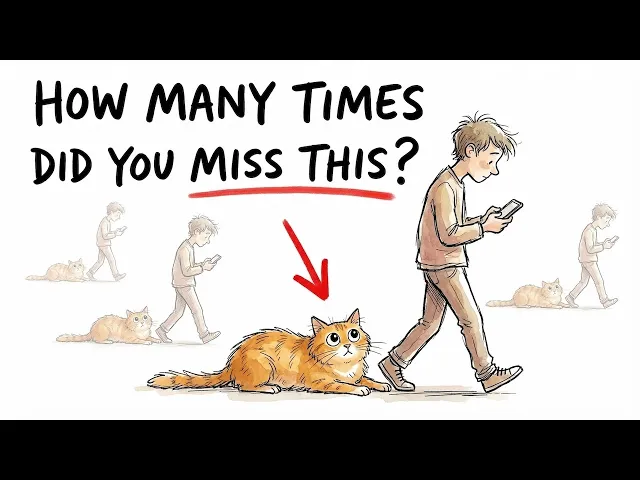
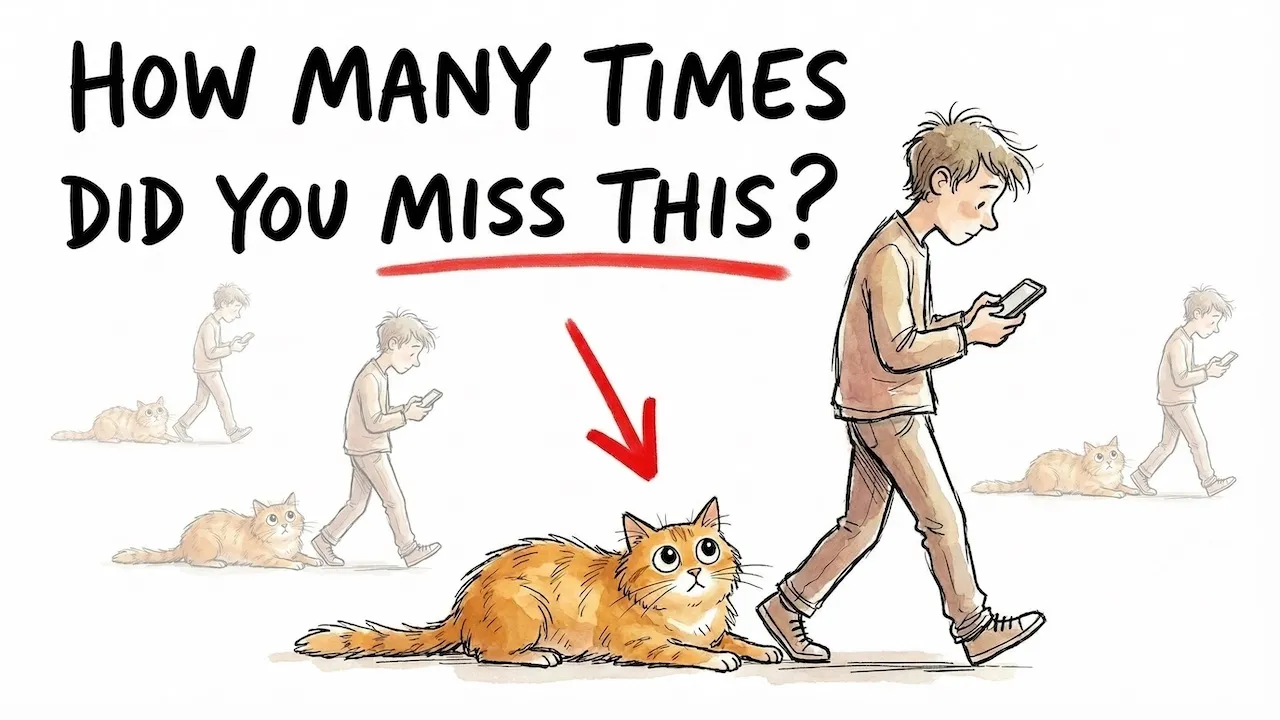
Your cat could lie anywhere. The couch, the window sill, that warm patch of floor by the heater. But they chose right here, right in front of you.
That wasn't random. It was a question. A very specific question.
And how you answer it, usually within 3 seconds, usually without thinking, is quietly shaping your bond every single time. One. The trust drop.
What your cat is actually saying to you. You know the moment. Your cat walks into the room, looks at you, and just drops.
Like their bones suddenly stopped working. One second they're standing, the next they're on the floor, legs loose, belly up, staring at the ceiling. It looks casual.
It is anything but. Behaviorists call this the solicitation flop, and it's one of the most loaded signals in a cat's entire emotional vocabulary. Here's why.
Cats are hardwired survivors. In the wild, exposing the belly means exposing vital organs. It's the kind of vulnerability that gets animals killed.
So when your cat does it in front of you, they're not being lazy. They're making a choice, a deliberate, considered, risky choice. Dr John Bradshaw, author of Cat Sense, notes that cats rarely expose their stomach unless they feel completely safe.
Not comfortable, not relaxed, but completely safe. That's a different bar. And here's the part that got me.
A 2019 study out of Oregon State University found that 65% of cats form what researchers call a secure attachment bond with their owners. The same type of bond they measure in human infants and their mothers. Not similar, the same.
When your cat drops in front of you, they're not just hanging out. They're telling you something most animals never tell anyone. Drp a one in the comments if your cat has done this to you.
I have a feeling a lot of us are watching this video for the same reason. Two. The roadblock that knows exactly where you're going.
There's a version of the flop that drives people a little crazy. Not beside you, not nearby, right where you're walking, dead center of the hallway, the exact spot you need to step through. Most people assume this is coincidence, or maybe their cat being mildly inconvenient on purpose.
But research out of Sophia University in Tokyo, published in PLOS One in 2021, suggests something far more deliberate is happening. That study showed cats mentally map their owners' location in real time, even when they can't see them. When researchers played owners' voices from unexpected directions, cats showed visible surprise.
They'd already built a model of exactly where that person should be. Which means when your cat plants themselves in your path, they didn't stumble there. They calculated it.
Feline behaviorist Pam Johnson-Bennett describes this as cats placing themselves at the center of your environmental flow, a way of asserting presence within the space you share. It's not obstruction, it's inclusion. Your cat wants to be part of where you're going, even if they're not going anywhere themselves.
What you do next matters. If you pause, step carefully around them, or acknowledge them for a second, your cat registers that as respect. If you walk past without a glance, they notice.
This is how cats quietly take attendance, checking whether they matter in the flow of your day. Three. The belly trap isn't a trap.
You're just speaking the wrong language. Here's the moment almost every cat owner has lived. Your cat rolls over, belly up, front paws curled, the whole display, and you think, "Invitation.
" So you reach in, and suddenly you're bleeding. It's been called the belly trap, and for years people assumed cats do it on purpose, that they bait you in just to punish you. But that's not what's happening.
And once you understand what actually is, you'll never fall for it the same way again. In cat language, showing the belly means vulnerability. It does not mean consent.
Those are two completely different things. Humans, wired by evolution to interpret open, soft postures as invitations for touch, consistently misread the signal. Either we see vulnerability and our brain says, "Pet that.
" But your cat's nervous system has a different read entirely. Research from the University of Pennsylvania's School of Veterinary Medicine found that cat bellies contain a high concentration of hair follicles that are hypersensitive to touch. Even gentle contact can feel overstimulating within seconds, especially from an unexpected hand reaching in fast.
And here's the statistic that should make every cat owner pause. A 2025 study published in Frontiers in Veterinary Science found that a significant portion of cat owners admitted to touching their cat even after recognizing signs of discomfort. Not maliciously, just because the belly was there and the signal felt like permission.
Four. The slow stretch. The compliment most people never notice.
Not every flop is dramatic. Some are quiet. Your cat eases down beside you, not across the room, not at a safe distance, right next to you.
And then they stretch. Long, slow, full body. Front legs extended, back legs reaching.
And then they just stay there. This one doesn't get nearly enough credit. Stretching into a fully extended position makes it harder for cat to spring up and move fast.
That delay is intentional. It takes a certain kind of trust to voluntarily make yourself slower in the presence of another creature. For a cat, an animal whose survival instincts are never fully off, choosing that posture next to you is a quiet but significant statement.
Research published in Scientific Reports in 2016 directly linked extended resting postures near humans with stronger social bonding in cats. Cats who stretched out fully near their owners weren't just resting. They were responding to emotional cues, making themselves emotionally available, not asking for touch, not demanding attention, just saying, "I choose to be here, in this position, with you.
" That same research found that cats adjust their proximity and posture based on their owners' emotional state. So if you've had a rough day and your cat settles in close and stretches out, they may not just be comfortable. They may be responding to you, quietly, without being asked.
Five. The drama queen flop, and why it's working exactly as planned. Some cats don't ease into anything.
They collapse hard, fast, with full theatrical commitment. One second they're trotting across the floor, the next they've hit the ground like gravity personally offended them. Rolling sideways, maybe throwing in a chirp, possibly followed by intense eye contact to make sure you saw that.
This is not the trust drop. This is a performance. And the important thing to understand is it works because you trained it to.
Cats are extraordinary observers of cause and effect. If a dramatic flop once made you laugh, or crouch down, or grab a treat, your cat filed that information away. According to behavioral conditioning research in feline psychology, your cats readily repeat actions that produce positive outcomes.
The dramatic flop gets attention, so it becomes a strategy, a reliable one. What's remarkable here is that this isn't instinct. It's learned.
Learned specifically from watching you. Your cat has been quietly studying your reactions and building a playbook based entirely on what makes you respond. The drama is calibrated to your personal threshold.
Not every cat develops this. Some are naturally more reserved, and a quiet trust drop is their entire vocabulary. Just as meaningful, just quieter.
But if your cat is basically performing a one-act play every time you walk in, know that you're not being manipulated. You're being communicated with by an animal who figured out exactly how to speak your language. Six.
Your cat can smell what kind of day you're having. Here's something the flop behavior gets tangled up with that most people never consider. Your cat often knows your emotional state before you've said a word, before you've sat down, sometimes before you've even walked through the door.
A 2023 study from the University of Bari in Italy found that cats can distinguish human emotional states through scent alone. Researchers collected odor samples from people experiencing fear, happiness, and stress, then presented those samples to cats in their home environments. The cats responded differently to each, measurably, consistently differently.
They were reading emotional information from sweat. Which means when your cat flops in front of you after a hard day, they may already know it was hard. The positioning, closer than usual, slower, quieter, isn't coincidence.
It's a response to data you didn't know you were transmitting. Animal cognition research has also shown that cats engage in what's called social referencing, looking to their owners to read how they should feel about something uncertain. In one study, 79% of cats looked to their owner first when encountering something unfamiliar.
That's not independence, that's attunement. Your cat isn't just lying near you. They're reading you, processing you, and adjusting to you, constantly, quietly, and with more accuracy than most people ever give them credit for.
Seven. Every flop is a question. Here's how you answer it.
So here's what's actually happening every time your cat lies down in front of you. It's not random. It's not instinct.
It's a question. The same question, asked in slightly different ways depending on the moment. Is it safe to be myself here?
Do I matter to you? The trust drop asks it with full vulnerability. The roadblock asks it with urgency.
The belly display asks it and watches carefully what you do next. The slow stretch asks it without expecting an answer. And that's somehow the most moving version of all.
Your answer, every single time, is building something. Researchers who study the human-animal bond describe it as accumulated trust. A ledger updated not in big moments, but in small repeated ones.
The pause before you step around them, the soft word when you walk past, the slow blink instead of the immediate reach. Cats aren't asking for grand gestures, they're asking for consistency, for quiet proof offered again and again that this is a safe place to be open. Most people go their whole lives thinking their cat is aloof, hard to read, but their cat has been speaking clearly the entire time.
Lying down in front of them, watching, waiting, asking the same question in a hundred different ways. The only thing that changes is whether you finally know what to say back.