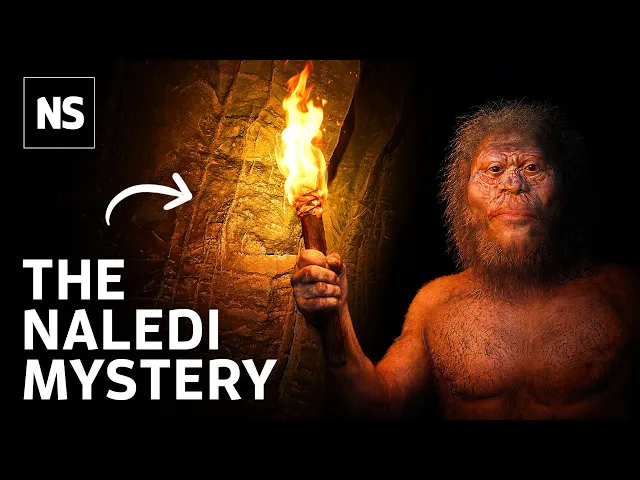
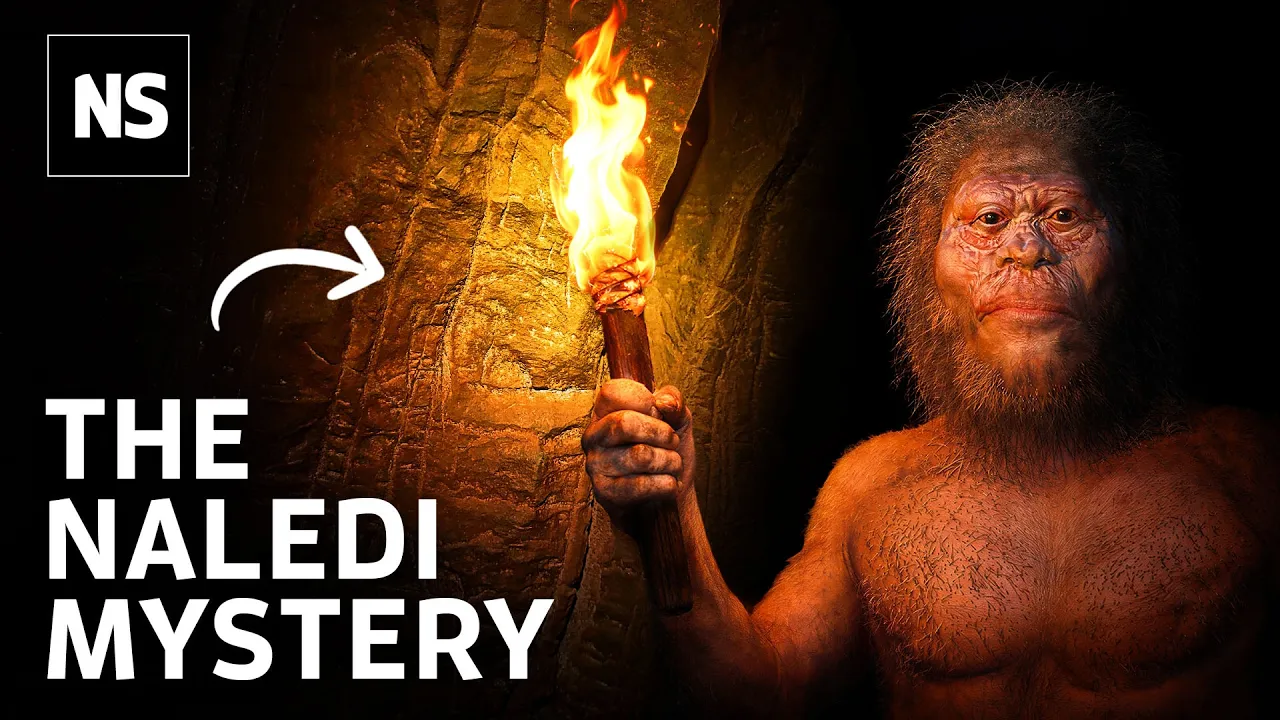
Deep underground in a cave so narrow you can barely breathe, scientists discovered something that may change what we think we know about death itself. Because hidden inside this cave were the remains of an ancient human species and evidence that suggests they may have intentionally placed their dead there. If that's true, it would mean grief, care for the dead, and perhaps even ritual behavior emerged far earlier than anyone thought possible.
At first glance, the idea sounds kind of impossible. The species found had a brain barely a third the size of our own brain. Many scientists still argue that what was discovered in this cave is being over interterpreted, that it's coincidence, not ceremony.
Now this discovery came at a really interesting moment in paleo anthropology because traditionally people thought that we had pretty much discovered all the major human species. However, there was a tricking trend of very significant discoveries that forced us to see our family tree as bigger and more complicated. And this was one of those discoveries.
Deep beneath South Africa's rising star cave system, everything changed. The fossils weren't found near the surface. They were found at the end of an almost impossible journey through pitch darkness, crawling through passages just centimeters wide, squeezing through a vertical chute so tight that taking a full breath could get you stuck.
At the bottom is the Denelddi chamber and covering its floor were remarkably intact skeletons of a previously undiscovered human species. We spoke directly with scientists who made this discovery and with experts who remain deeply skeptical about some of their conclusions. Our aim was to understand what was found in this cave, why it sparked global controversy, and what it might reveal about the origins of death rituals, grief, and what it might really mean to be human.
This is the story of homeowner Lei and of the ancient discovery forcing us to rethink how long our ancestors and relatives have been saying goodbye to their dead. This is 20 cm. That's it.
And somehow this tiny crack was the gateway to one of the most important fossil discoveries ever made in Africa. But finding the fossils was only the beginning. Every single bone had to be recovered in the darkness of a cave in stifling humidity.
Then carefully hauled up through a 12 meter vertical chute passing through that 20 cm gap. No elevators, no shortcuts, just humans, gravity, and a very small margin of error. It was incredibly dangerous.
So the question wasn't just what they had found. It was how on earth they were going to get it out. And finding volunteers for this particular job was not easy.
And remember, this is scientific research. So, not only did they need to bring the bones out, but they needed to do it in a careful and scientific fashion. Lee Burgerer, the professor behind this discovery, explains more.
How am I going to find people to do this? I mean, I have colleagues and stuff, but this is going to take not only people with PhDs and stuff that can actually work on potentially some of the most precious material, but they they have to fit. And so, I did what anyone would do in that circumstance.
I put a Facebook ad out. Now, you don't have to read the Facebook ad. Basically says, "I need skinny scientists.
I'm going to launch an expedition. I'm not going to pay you, but I will feed you, and I'm going to risk your life. " I just love this because so often we think that the biggest scientific discoveries, the most adventurous bits of exploration are kind of all behind us and belong to a different century.
But here these scientists were and they actually got nicknamed the underground astronauts which may sound like a stretch except that initially it was six young scientists who were all female trying to squeeze through that tiny little gap in very difficult and dangerous conditions while doing worldclass science. They weren't just trying to get into the cave to get into the cave. They were trying to get into the cave with high-tech equipment, very carefully lifting out these precious ancient fossils.
At one point, Leeburgger actually employed his son to help because he was 15 and slender and that's why you have kids, right? And boy did it bear fruit because this was one of the biggest fossil halls on the whole of the African continent. These scientists ventured through that 20 cm crack multiple times a day to discover more fossils than at any other site in the African continent.
A new human. We'd recovered well over 1,500 individual remains representing at least 15 individuals from a surface collection and a 1 mx 1 m by 20 cm deep excavation. The floor appeared to be literally made of these fossils and they were truly extraordinary.
Dozens of scientists arrived at Leeburgger's research site to figure out what exactly they had found because all these fossils were unlike anything they had ever seen before. These fossils were in fact so different from any fossil on record that they were sure it was from an entirely new species of homminin which they named Homo Nei which translates roughly as star man or man of the star. and a global superstar it certainly became.
It was a species that threw a wrench in so much of what paleo anthropologists thought that they knew about human ancestry and offered a tantalizing glimpse into human culture and ritual that predated our own. This was all so controversial that some experts were anything but convinced of the findings of the team. But before we get to all that, let's hear what they found about these fossils.
>> And it truly was a mystery to behold. It had a tiny brain about the third the size of modern human brains. It had bizarre apelike shoulders.
It had a chest like an ape, a spine that was tiny but resembled in some ways Neanderl spines. As you went down its arm, its arms became more and more and more humanlike until you hit that hand, which was incredibly humanlike in the wrist. The diet seems to have been very humanlike.
And yet, this is a small brain creature with a skeleton that combines some humanlike features in, for example, the legs and the feet, but also some much more primitive features, suggesting that the creature was still spending a lot of time climbing uh maybe up on rocks, but also up in trees. So this was a strange hybrid or mosaic of features. You had very advanced characteristics very similar to our own people living today but mixed in with very very primitive features.
Now those primitive features made scientists suspect that these fossils were very old about 2 million years. Advanced analysis revealed that the fossils were in fact 200 to 300,000 years old. That is a very very big difference and let me say mind-boggling because what that meant was that within the same species you were looking at very primitive and very advanced features all at once which really challenged our timeline of human evolution.
Before this discovery, scientists had by and large thought that large brain homins always replaced smaller hominins. It's kind of what we were taught at school, right? The assumption was that hominins with small brains would just struggle to survive alongside largered humans.
But now here we were with smallbrained hominins whose time stamp placed them directly alongside us and other human species also with larger brains in the same general area. It turned out they were our contemporaries. How do we explain that?
And the answer is we don't have an explanation for that right now. >> Super helpful but so incredibly exciting. We have no idea of our exact relationship to Homo Ni.
How were we related to them? Is it even possible that they were potentially ancestors of ours? Was my great great great something or other greatgrandfather perhaps one of the fossils discovered in the rising star cave system?
Everything is on the table. >> The questions that we all have is Homaly related to us? Is homonyi that elusive species X that interbred with modern humans in Africa around 200,000 years ago?
Is homonyi another thing that is related to us and not species X? And how is it related to us? Is homttleti not related to us at all?
That would almost be more remarkable. And yet homoi is so primitive. It would be remarkable.
There's no no answer that's not going to be striking within that. >> We don't yet know where Hermani sits in our family tree, but it sits somewhere. And it being species X is an absolutely intriguing idea.
See, species X is the name given to the unknown DNA belonging to a species that interbred with the ancestors of some West Africans living today. For clarity, that means that some West Africans living today have an ancient ancestor who we haven't identified yet because it was identified simply through its DNA. But some people have said, well, seeing as it's in West Africa and seeing as homei is a species in South Africa, might species X be hermoni.
Intriguing. And if all of this wasn't enough to stir up the scientific community, Lee's team noticed something even more peculiar about the site of the fossils. Through all of our research, we cannot find another entrance.
They appear to have been using the same chute we use to get in. And so when we published Homonyi, we came out with a hugely controversial hypothesis. We said there is only one reason we can think of why there would be only homonyi inside of this chamber.
>> Practically the only fossils in this cave were homei. Usually if you find fossils in a cave um you think right perhaps a predator brought these fossils in. But if it was a predator, you would also expect other species, other prey in there.
But there were no other animals in there besides some rodents and one owl. Just lots and lots of hominins. The cave also bore no signs that these fossils were deposited, say, from a flood waters actions.
And Burger's team concluded that the entrance that they used was the only entrance to the cave. So what does that all mean? It means that home and Alii had entered this cave system alive and on purpose.
And years after the first explorations, Bergus team discovered some evidence of fire which only backs these claims. These ancient hominins were navigating these dark, suffocating tunnels and leaving behind their dead. But why would a small brain species want to bring their dead here?
Burger hypothesized that the presence of fossils in a hard-to-reach location was evidence of a funeral tradition. Homei seems to have brought their dead into these remote chambers of the rising star cave system and left them there almost like some sort of burial, funeral ceremony even. Why else were there almost no other types of fossils in there?
The researchers even found an area where the fossilrich soil seemed to have been disturbed, which they think might be evidence of deliberate burial. Here they say a shallow hole was dug, the body positioned very carefully, and dirt was thrown back over the top. That's effectively the same as some of our modern burial traditions and rituals, just without such a deep hole and without the casket.
And if these chambers were truly burial grounds, it would predate the first known human burial by at least 160,000 years. That did not please many people. They said it was impossible.
They said it's a single occurrence. So, we found another one 110 m away in another chamber that we would call the Letti chamber. We found this remarkable skeleton and two other individuals.
except this time they're tucked into al coes in the walls of the cave. Exactly the same anatomy. >> One of these individuals was a young child that had been named Lety.
Burger's colleagues found fragments of the child's skull on a small rocky ledge inside an extremely difficult to enter fisher in the cave wall. An elevated place through extremely claustrophobic passages. Let's skull does seem to have been placed there intentionally because it's so difficult to get there.
The researchers think someone took great care to leave it there. Was it to honor Leti as we honor our dead today in funerals? Or was it perhaps simply a refuge for fleeing home in Ali?
There were so many theories put forward because it was so controversial. Another theory put forward by some scientists was that perhaps they were dumped there, but it was because the corpses were smelling and were rotting. And this therefore didn't rely upon a complex burial tradition.
But that theory does rest on the idea that at some point in history, the cave wasn't as difficult to get into as it is today. In some of the geology team's work, it is indicated that there would have been an easier access route into this cave at some point in antiquity. And then things shift, cadence happen, pieces of the roof fall in, and you end up with a much more convoluted route with the previous access point closed off.
And I think that the team from Rising Star has kind of modified this narrative in the last couple of years and they maintain very strongly that it has always been that hard to get into the cave despite some of their own team's previous publications indicating that there may have been another way. The primary points of criticism come through kind of the rigor through which the various hypotheses that have been put forth have been tested. If you dig a hole, take the dirt out, put something back in, and put the dirt back in, chemically, if it all is the same, you can't tell that the hole was dug, right?
Um, and so this was one of the main criticisms is that the team chose to use chemistry to try to tell that that pit was dug where a lot of people are arguing they should have been looking at the soil texture and the structure and the direction that the little particles are sitting. >> As of right now, there is clearly a lot of scrutiny applied to existing findings and not enough evidence to confirm any one theory. Through the controversy, Burger and his team continued to explore the cave system.
Then they made another discovery. Marks on the cave wall that the scientists say look like etchings. >> Here on this side, you've got like squares and you've got what appear to be kind of triangle type things and what look like ladders and there you're kind of seeing ladders or crosses.
I don't think personally uh the possibly one or two people who got into here before Rick and Steve would do something like this. This doesn't isn't kind of western graffiti that you see uh in caves. This is I think it's something else.
Something did that. The cave wall is dolomite stone, which is an incredibly hard rock that they say would demand great effort to carve into, to make etchings into, which suggests to Burger that these engravings were not by accident, that they were intentional. Everything about this cave felt intentional to him.
But the team published these findings and immediately faced backlash. the actual, you know, incisions that we're looking at in this particular cave system. It's it's not art in the sense that we can recognize what it is.
It's not depicting something that we can see in the landscape. If we see something like cross-hatching, you know, it could be art. It could also be a counting system.
It could also be a kid doodling on the walls while they're bored. It could be a way to extract dust and pigment out of that wall to be used for something else. So, I think we need to be pretty careful about what we attribute to the hommonetti consciousness based on what we have.
Personally, I'm not convinced that it's hominin made. Mostly because in that same cave system and all throughout that landscape, there is a type of rock called elephant skin dolomite that naturally forms these linear cross-hatched patterns. At this point in the story, intriguingly, there isn't an answer, and different scientists are reading the same evidence differently.
And it's exactly why stories like this fascinate us. They capture our imagination. And they do not end with a single discovery in a single cave.
New Scientist has been following questions like this for decades. Since 1956, their journalists and editors have worked with researchers across disciplines to explore not just what we know, but what we don't know yet and why that matters. From human origins and ancient cultures to breakthroughs in physics, space, and technology, we focus on the ideas that reshape how we understand the universe and our place within it.
If you want to go deeper than a single story, a new scientist digital subscription gives you access to all of this award-winning science and technology journalism that includes daily reporting on new discoveries as they happen and in-depth features that unpack complex debates like the one long after the headlines fade. To get a specially discounted New Scientist digital subscription, head to newcientist. com/youtube.
And if you're drawn to the kind of scientific discoveries that spark real debate and controversy, then you're going to love this next part. Could these fossils and cave etchings indicate burial traditions and creativity? Absolutely.
Was there enough evidence to prove it with certainty? Absolutely not. Scientists continue to explore alternative explanations as a result of this.
Perhaps the cave system was a shelter of sorts and over the years of its use some homei would die there and the cave naturally accumulated fossils. The debate is still very much ongoing and evidence is still emerging and thanks to some of that evidence interestingly Burger's team have managed to convince many experts of this burial hypothesis. Now that kind of movement within the scientific community is a big deal.
He might not have convinced everyone but it is a very very dominant theory. Now it may seem like an issue of semantics to some but this is a highstakes argument and here's why. Because prior to this discovery homei well no one really thought that smallrained hominins were capable of any ritualistic ceremonial or creative practice.
We're still arguing as to whether Neanderthalss who had the same size brains as us or similar sized brains certainly were capable of that kind of ritualistic burial behavior. So you can see how suggesting that a species whose brain was so fundamentally smaller than our own was doing that. Well, why that would be such a big deal?
Because if Nledi really buried their dead, what does that say about the origins of ritualistic behavior? Funerals are one of the ways we process our grief. We honor our loved ones with ceremony.
We reckon with our impermanence and with our feelings of loss. These are all deeply complicated emotions associated with human advancement. But where did they come from?
We do know that even some of our primate relatives show careful attention to their dead. Chimpanzees, for example, have been observed grooming and cleaning the fur and teeth of deceased members of their group. Though this does not come close to rivaling human rituals, it does show some amount of awareness of the importance of death.
It just doesn't carry the same symbolism. And chimpanzees aren't routinely moving their dead to a special site like Homeman and Eddie may have been doing. But some other early humans with large brains might have done this.
In northern Spain, paleoarchchaeologists found the remains of 29 distinct hominins, Neanderthalss to be exact, in a deep hole inside a cave. The hole is colloquially known as Sema de loses, which means the pit of bones. These fossils are dated between 430,000 years ago and 300,000 years ago.
Scientists hypothesized that these individuals died elsewhere and had their bodies dropped into the pit by other ancient humans. Another potential early burial ritual. This kind of advanced behavior though is so controversial that even at 75,000 years it's being heavily debated and the evidence is not definitive.
There is a very famous cave for paleo anthropologists called Shannidar Cave. It's in northern Iraq and within it are the remains of a number of Neanderthalss and pollen was found amongst those remains. So, one interpretation was that they were being buried with flowers, which is such homo sapien behavior, you'd think, right?
It's ethereal as well. It's it's moving. Except that other academics have suggested that the pollen while being there was actually deposited by rodents who had basically created a system of burrows.
Now having worked on that site, there are a lot of burrows in that site. But there is something else. If you look at Shannadar Cave from a distance or up close, it's cathedral-like.
It's huge. It's significant and dominant on the landscape. And so in some ways, as it catches your eye, you can understand why Neanderthalss might wanted to have buried their dead in what looks a lot to us perhaps like a mole.
Now, one of these individuals is Shannadar Juan. And Shannidar Juan was a man who survived despite devastating injuries and disabilities. He was missing one arm.
He had injuries to his face that were incredibly significant and affected things we think like sight and hearing. And he would not have survived with those injuries without the help of others. Imagine trying to hunt and create anything back then with those kind of injuries.
Without help, it just wouldn't have been possible. And so what that tells us is that he was being cared for by some members of his community. He was cared for and perhaps when he died he was also missed by the rest of that group.
Funerary behavior may have developed alongside with these more complicated feelings of love, affection, care, and dependence. Let me tell you about one of the most unusual patterns of the last 100,000 years. One of the most intriguing and actually emotive unusual patterns over the last 100,000 years is the over representation of children's remains.
At various homo sapien burial sites around Africa, researchers found only the remains of young children. Now, the mortality rate of juveniles in huntergatherer societies is and was exceptionally high and their deaths are more painful. Professor Paul Pettit, an archaeologist at Durham University, coined the term bad deaths to suggest that these were individuals who died unexpectedly and too soon.
Those who suffered a bad death may have been more likely to be buried because an elaborate burial ritual may have helped other family members begin to process that heavy emotional pain. Homoni may have conducted these kinds of bad death rituals as well because many of the remains in the rising star cave system were juveniles like Homo sapiens. Hermani also seems to have had a long childhood according to some scientists which means they were often exposed to death as children.
Perhaps burial rituals emerged to help the community come to terms with the death of youngsters. If this is all true, it means that Hermoni experienced grief and had to process loss just like biggerrained humans did and were doing it in a similar way to perhaps some bigrained humans. This completely decouples the idea that having a large brain is what is needed to experience these complicated sets of emotions and the behaviors that might go with them.
And it's worth pointing out that burial may not be about a belief in an afterlife or any kind of belief system. It may be simply about the living learning to say goodbye. >> There is a scenario where deliberate burial could be not existential in any way or symbolic.
Um it could be cultural. It could be part of a tradition, a group tradition, a a you know symbol of respect or some or reverence or something for the dead without having to invoke symbolism or existential cognitive stuff, right? And so you could just as easily make the argument though that it is some kind of conception of an afterlife or you know some of the more modern ways that we conceptualize burying our dead.
Making any claim with a 100% certainty is almost an impossible thing to do within the field of paleo anthropology. There are so many explanations for why an object or fossil is in a place. And unless anyone figures out a way to resurrect a fossil and asks them directly, it is difficult to say which of these conclusions is definitely correct.
While that might be frustrating, it is also deeply exciting. Any explanation could be wrong, but any explanation could also be right. You can't make any assumptions.
And the discoveries in the rising star cave system mean that we can no longer assume small brains rule out complex behavior. It no longer is a world of big brains are the only things that get us to big ideas. This calls into question our own uniqueness too.
Where do we get the stuff that makes us really human? What does it even mean to be us? How ancient and universal are our experience?
And how unique are we? Within the cold, dark, humid chambers of Rising Star, we discovered something that challenged us and challenged what we thought we knew. If these ancient humans buried their dead, then processing grief in this way may be older than we ever imagined.
This isn't a discovery that offers easy answers. It leaves us with questions that linger long after the evidence is unearthed. That's why we sat down with paleo anthropologist Lee Berger for a longer conversation about what else he's found, the other human species still hiding in the fossil record, and why he believes our past was far more crowded than we ever imagined.
Are these beliefs any less controversial? That's for you to decide in our next video.