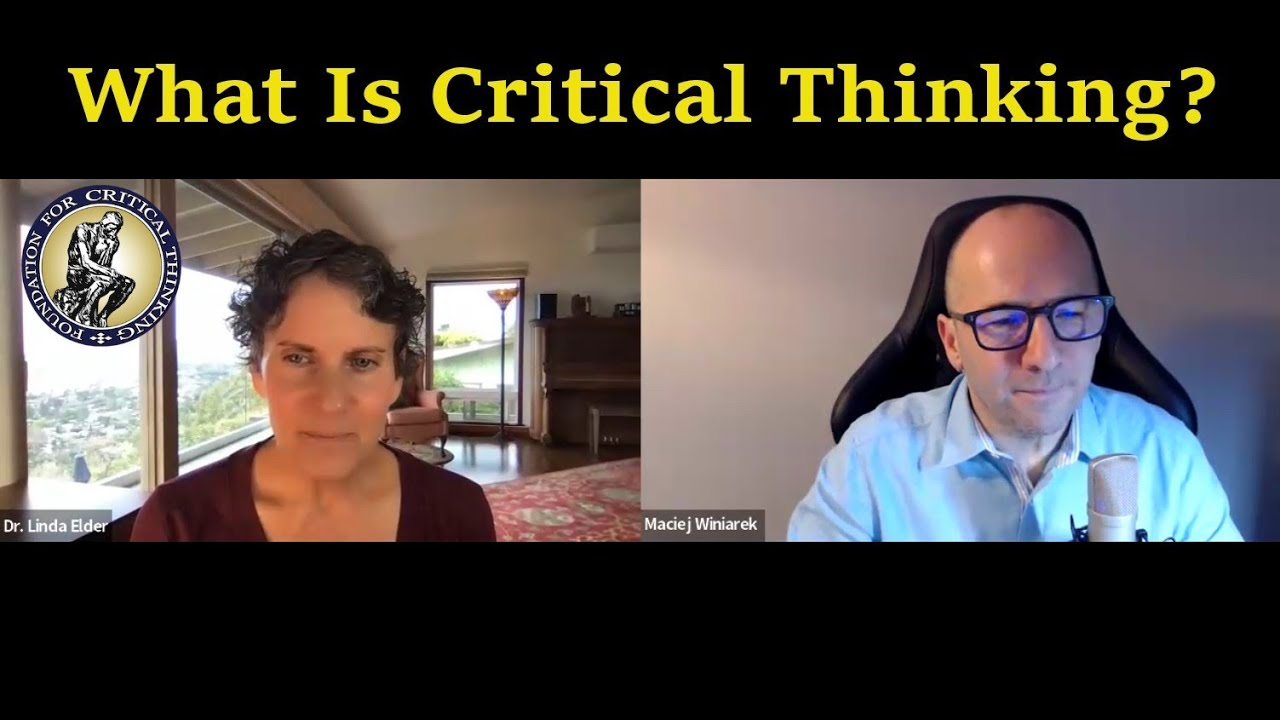
Hello I'm Linda Elder the president of the foundation for critical thinking I'm here with my colleague Dr Gerald noich who is a senior fellow with the foundation for critical thinking welcome Gerald thank you Linda I'm glad to be with glad to be talking with you again we are coming to you from the as I've said foundation for critical thinking which is a 501c3 nonprofit organization in California this is January the 28th 2022 we are focused in this series on the analysis of reasoning going deeper and in this particular session we're focused on questions questions and
reasoning part two and in a minute I'll remind you of what we did a bit in part one of the question series in the in the overall series we're asking ourselves how do we better understand this this part of reasoning how do we go deeper in this part of reasoning and I will point Out here that no one has fully explored the analysis of reasoning no one has fully plumbed uh purpose in reasoning no one has fully plumbed questions and reasoning information implication so there a lot of theory that could still and should still be
developed Within These elements in the in part one of the series we focus just briefly on uh the questions that emerge from each of the elements of reasoning themselves so we We we explored that a bit and we explored uh questions that emerge from intellectual standards a bit and we began to explore questions that emerg from intellectual virtues and we'll go back to that when we focus on our later series on intellectual virtues in this session we're going to explore other ways of uh of using the concept of questions and reasoning and we are going
to see how by uh making certain conceptual moves Within questions we have more power in our thinking now before we begin to explore these different angles or some of these different angles further I want to point out that questions is is unique as a as an element of reasoning as they all are unique but it's Unique in that for one we don't have developed theory of questions and in the in I believe 1965 it might have been 64 Richard Paul was writing his first dissertation and He focused on questions Gerald you'll you'll know this of
course and because we've worked with that dissertation in in working with Richard and I wanted to start with that because you will remember in working U with that material that first dissertation which by the way was rejected and it was rejected by the disser Richard's dissertation committee basically I think because they didn't understand it but it was also because it was highly exploratory and Richard was Trying to figure out you know how do you categorize questions in different ways and what what what moves can you make within questions that will help you reason better and
so he for example he was talking there about clusters of questions he was pulling together what we already knew theoretically about questions and I remember when we worked with Richard on that dissertation Jerald you'll recall this it was difficult for us because it was Very complex and in somewhat um maybe as I said exploratory it was a it was highly detailed and we didn't really have categorical moves at that point uh that were easily made based on the detail he was working in but one of the things I remember clearly was clusters of questions so
if you so we could start there so we can think that questions we can realize that questions occur in clusters and we can we can categorize these clusters in different ways but one Of the examples I was I was thinking of was for example when you think about your health you if I say think about your health um your physical health what are the questions that you ask about your health and when you answer that we're going to have a cluster or some clusters of questions right that are interrelated so clusters of questions are interrelated
the way that clusters of concepts are Interrelated and you could say couldn't you say clusters of perp of purposes and clusters of information and clusters of implications so that's this one uh early move I was thinking of go ahead yeah no I was just going to say yeah there I guess what makes them clusters primarily is relevance relevance to in this case health for the for example uh I mean that's that that strikes me just off the top of my head as the as the thread that made makes that makes the cluster a Cluster um
it's not just Association uh oh this brings up another thought yeah yeah right and note the qu and note the concept of your I as I was saying I was sort of becoming more and more clear so I meant physical health so that's a concept so the concept when I when I when I ask the question the larger question focused on that concept we have clusters of questions that emerge yeah and what what one other thing I can say about the clusters of questions it it's Uh different much more psychological or pedagogical or something like
that and that is um in my classes I often had my students work kind of extensively on asking questions and uh many times students would have no questions at all to begin with and even if I gave points they they some of them couldn't come up with a question at all but then what happened is once questions started to come other questions emerg and other questions emerge and that prompted other Questions oh yeah well let me ask about that I never thought about that before so that the the Clusters is kind of developed out of
the process of questioning it's not just out of the process of questioning it's the promoted process of questioning meaning this is what our inquiry actually is about is about asking questions it's not about taking notes on the information that's being given in class um yeah that's why it's a bit it's it's very sad that we Don't when we look at young children look at a four or five-year-old that's been um appropriately raised let's say let's say given the basics you know had its basic needs met this is a child that's going to have a lot
of in asking a lot of questions right has not been told not to do that yet it's just asking questions asking questions and asking questions and asking questions ask and then uh so the Mind naturally does that you see we know that from from that that Data of which we have much and so therefore we know the human mind is perfectly capable of doing that and if you can do it very well when you're a four-year old whatever your IQ level right why why can't you do that well I mean many times better as an
adult and um yeah and and one of the things that goes against it this is now not about clusters or The Logical question so much as uh it's the kind of the culture of Education um probably not just education but we as students students mostly are I was uh students are mostly acculturated to taking down information to listening at least in the sense of writing the writing the lectures down in the notes and it's a it's a it's a culture that where questioning just doesn't arise I think it doesn't even arise in your own mind
unless you're unless you're primed for that ahead of time or unless that's promoted yeah right that that's why but Once we do promote it actually it it promote it not just say that we're promoting it actually promote it in the classroom and for that matter anywhere else when promoted it does it does begin to generate and begin to generate and begin to generate right new ideas and new questions right so this is very much related to internal motivation but also external conditions for questioning for allow the allowance of questioning right so there are a lot
of things we don't Ask because we're really not allowed to ask them in our societ right and um and in some my my uh understanding is that in some cultures that the there's a definite prohibition against asking questions I had a a Liberian student in in my class an older gentleman and uh he just he just had a very hard time because it just it was considered very disrespectful to ask a question of the authority and and I have also worked with at least one group of d Americans I've been told that other Native Americans
have the same kind of thing but where questions are seen as disrespectful um and um and I I have to confess I don't know quite what to what to do about that because you can't within your culture safely go around being disrespectful even if by my lights the actual activity you're engaged in doesn't show any disrespect at all um well the the sad thing is that to the degree that you're not able to Question fully you're not able to think right right if you cannot ask questions that you actually are seeking the answer to right
you don't have the answer right and you're not allowed to ask it so how are you going to you know how are you going to get a satisfying answer if you get no answer right how are you going to grow and how are you is your mind going to expand right yeah and and and uh I mean I mentioned Liberian and and a a group of Uh Native Americans but this the same thing holds for people in uh in our in the culture uh in a classroom uh as well um in that um in my
in my webinar the other night uh we were talking about questions and um the importance of raising them and everything and and one of the participants said that she's one of those people who asks questions and and she'll ask a question say in a classroom of of the instructor and then she'll have another question and she'll Ask that one and pretty soon she starts being looked on by the other people in the group as what are you doing this for they just massive disapproval and sometimes that comes from the teacher as well because the teacher
wants to cover the material and here you are taking up Time by asking your questions and um and so there's this uh it's it's not formally enshrined in our culture to frown on questions in fact we say the opposite but in in practice it often is Frowned upon to ask ask questions or to ask too many I could say one of my favorite illustrations of this or something like it is U if you watch war movies or police drama movies um so in the war movie The Colonel will stand up in turn front of third
30 soldiers and says they'll say we're going on this operation and your group goes over here to the left you circle around behind you go up over here you do this and and the the C Colonel will talk for 15 minutes About the plan and then he'll say are there any questions and no one raises a question I'm sitting there thinking I got a ton of questions I my life is on the line about this so are the lives of all these others what if it doesn't go right what if what's our plan be what
if I mix up left and right I mean um and um and I've asked actually talked to people in the military and the and some a few police and they say that's not just movies that's what actually happens when Someone tells you when the colonel gets up and tells you the plan um so uh I think that it would I think it would take a great deal of intellectual courage in a meeting of being one of 30 soldiers where the colonel is giving you the plan to raise the question well what what do we do
if this goes wrong I think that would be seen often as obstructive as not being part of the team whereas to me it Mak a better part of the team this is why intellectual autonomy is so Important yeah right so if we again if we encourage the intellectual the development of intellectual character then a person is is in a situ in a situation like that is able to first of all say okay here's my real question and second is it safe to ask it yes and right and so and that's right so you have to
be able to make both of those moves and you've got to make them well right so then I think so that students asking Questions of the teacher is what is um in in the in a kind of situation like the one you were mentioning class few minutes ago is is it eliminates for me one of the problems one of the reasons why we're not advancing critical thinking very much in education is because we're not placing questions at the heart of teaching and learning we are still placing content undigested content at the heart of teaching and
learning so We still have massive amounts of lecture going on decades after we've known it doesn't work right and I mean the the research has proven it we KN we've always known it for hundreds of years if you were paying attention but some people need the the actual you know scientific data okay it's been for decades but we're still thinking that we can just cram ideas into students heads so my point is that until until students are generating questions regularly in The teaching and learning process um we're not going to be able to um move
very far in in human societies because we not we don't know how to ask good questions we wouldn't know we don't know when we do have a good question we don't know how to break that down into other questions we don't know what moves we can make with that question we don't weren't using the right standards for approaching the question and questions is just you know 2400 years after Propertise has just been swept under the rug yes Socratic questioning we like that but what what does that mean to you and how are you engaging in
it all right so I'll let you in I'll let you to come in to get a word in edgewise here J no I wanted to say um I think in many ways that lecture is is the opposite of questioning in pedagogical terms and so I wonder how it is that so many people could believe in lecture or uh engage in it so completely given all the evidence That it doesn't work and the evidence be even before we did empirical analyses of and it's a and as I think about it it's because lecture does sometimes work
the way it works is if it's something you already know a huge amount about and now you hear somebody else who also knows a huge amount about it but as a some different point of view and you're able to think your way through it and I think that's the role that most professors are in most instructors are in that is they Know they know their area really well and so it seems as if just explaining it clearly conveys it to the other person whereas in fact what conveys it to the other person is having a
question having the question answered or responded to at least partially and then raising another question and working out your difficulties or your or your misunderstandings or the gaps um so I think there's a mechanism that makes lecture so still so prominent yeah yes I'm glad thank you for that that that um qualification so there are certain cases where a lecture is um perfectly appropriate but these are going to be areas and now connecting it to questions where as you've implied if not stated the people involved in those high level uh lectures are asking when they
walk in a whole host of questions right got these questions going on in the back of our mind now what do you add to that okay I'm making I'm making that move I'm Making this move I'm making that move lecture still may not be the best way to even teach in th those situations it doesn't mean that it's the best way but it's it's but you so oh that's very important for people to see so if you if you're if you're lecturing to students without these skills right then they're not making any of these moves
right and they don't know how to make them so how are you teaching how you going to connect these great ideas that you have To this these students that are asking no questions and just are asking when this class is over right right um yeah so this is connected to the idea the important idea again that thinking is driven by questions if you have no questions there can be no understanding you you are if you have no questions you're not asking any other related questions because you don't have the first question right you're not in
the room of learning in this in this content If you don't have any questions so that is why Richard always opened his classes with what are your questions and that doesn't mean I'm going to answer them it means I want to know what they are right and because when you tell me your questions then that I can assess to large degree where we are in in the content so go ahead no I was gonna say and there are many mechanisms for that because sometimes students just don't Want to say the questions out loud in class
but I I can I think I may have gotten this e either this technique or the idea for a similar technique from Richard and that is just pass out a very quick survey um which of which of the concepts in class are clear to you which of them are unclear which of them are in the middle and in effect it's it's generating questions because now they have to say okay is this concept clear is this concept not clear and uh and They can just they can just check so I can get a quick rundown of
what of what they're understanding and that's related to questioning yes right because every time you have one element you have the others that's that's why if you're really focusing on well let's say you're focusing on Concepts in other words what are the concepts you've learned at this point in the classroom in the class um then when you T when you articulate those Concepts then that th your articulation implies questions right right yeah okay so so we've talked just a little bit about the the complexity of questions we we just just touched on the concept of
clusters of questions and that that idea has not been fully developed but and but you get the idea um like you could say you could say here's an assignment for for you for for all of us so you could say what are the cluster questions most prominent in your Life so then I could say let's go back to M so let's go back to uh physical health so if if your physical health is important to you and you spend energy on that so you exercise you have an exercise plan that's welld developed or somewhat developed
or whatever level you are right and then you really think about the food that you eat you think seriously about it you you know you have my body is my temple kind of mentality about what you bring into your body you See so all of these These are these particular L I'm talking about now are would be personal to a given individual right and so I could but I could say so so that's so that's one part of your life potentially that is a entails a cluster of questions that you're asking and that you're pursuing
and then what's another one let's say your your your career another example and then your Intimate Relationships or your parenting right so you have these these rooms in The house of your mind and in those rooms are question clusters yeah and and I want to say just the just the move you just made I was looking a way to write write it down you said you began by saying if health is something that's very important in your life what are the clusters of questions around it and uh uh stepping back from that just one step
it just seems like a very good question to ask so what are the most important ideas in my life the Most important Concepts in my life you then went through a number of them and um but that's a very unusual question for a person to ask about about her life right um what are the most important parts of it that I can question what are the most important concepts for that I revolve my life around and now what questions do I have about those yeah it's a that's a very that's a that's a deep sort
of question um goes deep into our un our understanding of things and It's these deep and really foundational questions right that we often if not not usually as you said ignore but that are guiding the quality of our lives and our quality of our future and the way we look at life and you see the big questions say what is the what is the big question cluster of your life meaning what are the big the big questions that are driving most most of what you do and Because at the end of your life you want
to be able to look back and say I lived the life that I would have hoped I could have lived and that means asking the right questions yeah yeah or not the right questions but the better the better of the possibilities right right uh yeah best we can come up with at the moment given the the level of our knowledge abilities and emotional well-being at the moment something like that Right um yeah the way I might the way I might obsess about how to get about a scratch on the side of my car or something
like that and um and uh if I step back from that if I if I could emotionally set back from that as well I don't have a scratch in my car but my car it wouldn't notice but I'm hypothetical example um if uh if I could step back from that I could I could say that's really a very minor question as far as the import the Important things in my life it really is just incredibly tiny um right yeah you know you I think once you you mentioned to me this this research that shows that
humans are very poor at um at giving the proper level of weight to a problem in their life right yeah that that's always that that's always sort of stuck with me I remember one time I had my uh I think it was my purse stolen from a car and that as soon as I realized what had happened I started telling myself really Strongly this is not a problem oh just an inconvenience right this is not a problem uhhuh that's right somebody is using your credit cards right now that's not a problem right you're going to
have to get a new driver's license it's not a problem got your you're going to have to get a new window it's not a problem it's not it's not you know but it was feeling like it was gone feeling like it was I can't say No it's not no it's not no it's not it's an inconvenience right and or a set of inconveniences but but not a problem right but that's not the way it feels at all putting things putting things in perspective Ive keeping things into proper perspective is a very powerful concept yeah and
illuminated by the question how important is this in my life how important is this exactly exactly so then let's turn so we could obviously get into further uh discussion On clusters of questions but now we each have an assignment we could think about the all the main areas of our lives and the main questions we're asking and then uh we've talked about the importance of asking questions and we've talked about the importance of encouraging the asking of questions and this is an open-ended encouragement it's not just okay now is a question and answer session okay
that's it no we're not asking questions Right now we're only asking them here no we mean that we can ask it whenever it's appropriate you know the time has come and I'm you know allowed and and I can then I can ask freely right and the more we ask questions the more we um become comfortable with asking questions we also see that um that we we really can't learn without asking questions right I want to give just a very quick example I had a personal example for me when I was a Graduate student and I
was taking a statistics class my professor was really trying at critical thinking but he didn't quite have he didn't have the concepts he so he came in and he and he read um something from um I forgot exactly it was essays that were totally unrelated to statistics so we didn't know why he was doing that and then he sat on the his table his desk and he just sat there he didn't say anything and what he wanted We figured out you know bit later is that he wanted us to ask questions m and he but
he didn't know how right to say that and maybe he finally said you know so nobody has a question all right so then I I was looking around I statistics is not really my thing I mean I can do it if required and you know math is fine if I have to but you know I don't really love it but I I uh so it wasn't really my favorite class and I didn't really want to be you know like Putting my heart and soul into it but there he was asking for questions and nobody had
one so I thought well I've got at least one and I'm sure that somebody else in here probably has that same one so I'll just ask that one and you know so I asked that one question and then people around me going yeah okay so the W in the answer so you see they had the same question so and then nobody's asking me question so I asked another question and So you see from that I learned just go on and ask it you know because of course I learned it a lot earlier that if you
if you just participate if you just sort of push yourself forward a bit and say you know okay well here's a question I have then suddenly you you can ask questions so you ask it once you can ask it again you're gonna keep asking so it builds this these skills build this confidence builds when we just go ahead and take the chance right and I want to Make a little Proviso in it uh about asking questions and that is sometimes people ask me um or sometimes people draw the conclusion that it's always good to ask
the question and there's a sense in which that's true but it's not always good to ask the question out loud that is there's the question of safety right I mean if you're in stalinist Soviet Union there are questions you you should not be asking out loud it it's probably very It's probably good to have them in your mind mind but even there even having them in your mind you might blurt it out at the wrong occasion but so uh so there's nothing about asking questions that dictates that those should be asked out loud and that
also includes in class um I I once as a fellow professors took a sat in on a course in 20th century music composition and the we were engaged in spelling chords and and the teacher said okay you got to ask me About this the exam's coming up if you don't ask me right now about what you don't understand you're not going to do well on the exam nobody asked the question so he repeated it more stridently you got asked the question and student said okay so how do you how do you spell a be flat
in a cord and and the professor went oh if I've told you once I've told you a thousand times oh my [Laughter] Goodness so I'm sure he didn't do it consciously right he set the person up the question yeah yeah those are good those are good caveats and I I I implied that earlier but I didn't absolutely stated in other words we need our critical thinking with us all the time right and that includes when no helping us know when to ask a question and also when I say you should be free to ask questions
whenever you want that doesn't mean to be obnoxious With your question asking either right right right and I've learned for my part in my classes that I've been in as a student because I've I've learned that it's e it's you learn more when you when you do participate when you do ask questions I've learned to sometimes just keep my mouth shut and let somebody else talk right so you just because you have this great question doesn't mean now is the time for you to ask it because maybe you're the only one has that's had a
Chance to ask anything so you you know I I was I was talking about the spirit of questions question generating right mainly we're not generating good questions indeed right and so we KN we need all these nuances and caveats that bring in so now we can turn to some other theory that we have developed uh in our school of thought the Paul and school of thought beginning with the work of Richard Paul and we can Um we can burrow in a bit to let's say um any one of them so let's let's focus on what
we call three types of questions and now Gerald would you like to just briefly explain what that means well there are uh it's we say it in different vocabularies at different times but one is that there's a a kind of question question call we call a one system question and that is uh typically those are kind of matters of fact or the kinds Of things that you could just look up somewhere um what's the boiling point of lead is is an example of a one system question I don't have to do uh the only critical
thinking I have to do with respect to a question like that is figure out where to look it up uh it's just a straightforward question one system another kind is um is a no system question and that is it's a question that doesn't really have exactly a logic to it at all sometimes it's like um What's your favorite Opera well and or I in a joke I used to tell long ago is what's your favorite color orange wrong you can't be you can't be wrong I mean it's just your favorite color and somebody even says
well why is orange your favorite color there just doesn't quite make sense you you might make up a story from from childhood or something like that but it can just be your favorite color so there's no systemat there's no system to it there's I don't Have to figure anything out is another way of putting it where I think of figuring out as a Rough and Ready synonym for reasoning it out but then the most interesting type of question from a critical thinking point of view is multi-stem questions and that is where we have to think
through relatively complex questions and we have to approach it from using different ways of thinking about it if I'm a if I'm a medical doctor at least two systems I Have to bring is first my medical knowledge that I'm bringing to bear and the whole systematics of the medical knowledge I'm bringing to this patience problem but then another system I have to think in terms of or I should think in terms of is that patience psychology the how the patient is going to take what it is I'm going to be saying what they're going to
be doing about it or not doing about it and those are very different systems um and that happens Very prominently when we combine disciplines with one another um when we have a sociological question which has a biological Dimension to it for example we have to think it out in terms using different systems and that gives rise to judgment and judgment answers where judgment answers can be correct or incorrect but much of the time there're there're multifaceted answers with multip with multiple parts and there may be no hard and fast single right Answer let me say
let me say one more thing about the one system questions are often just classified as factual questions I like thinking them as one system more than as factual but even though those are one system questions meaning I don't have to engage in critical thinking about them once upon a time they were critical thinking questions that is people had to figure out and experiment to find the boiling point of lead so before that was known That was a multi-stem question how do I go about finding it out how is it related to other similar elements in
the periodic table though they couldn't have said that because there was no periodic table then um so people had to think in terms of multiple systems to come up with the factual answer it once upon a time did involve critical thinking um though it's so well established that it doesn't need that now so um let let me let me um come back To that if I could and just if I could just then recap what you said please do and then and then come back to that in other some few other examples okay so the
way I understand this is that c questions all questions can fall into one of three categories according to the scheme either it's a as you said one system question you mentioned questions of fact we might also say our questions of procedure procedure right right so it may be a complicated procedure but the Procedure is agreed upon by educated users or specialists in the field depending on the the case or educated thinkers rather than us educated thinkers or specialists in the field so if you ask what is the boiling point of lead and somebody says well
you know I think it's like 28 degrees somebody else say well I I think it's you know and they just start throwing out numbers and somebody says well let's just you know vote on it then obviously They don't understand the question they don't understand that that is a scientific question and it's answered in a scientific way using scientific procedures and those procedures are agreed upon by let's say mainstream or the best scientist in the field depending on the case so we we um for for syst of one questions we're looking for the right answer or
the right procedure for finding the answer and when we have the question then we know What will be uh whether we need to to consider a specialist Viewpoint or what the question will determine how we find that answer we don't have to find it ourselves in other words it's it's found for us right it's been found right now although I want to just give a slightly different view from the one that you gave I I don't think that every category one question falls into the category of that it was want a complicated question so for
example who Is your mother so that I know who my mother is I've always known it and that is a question of fact and now if somebody said later well Linda you said it was a question it was you knew who your mother was but here's your birth certificate showing that that's not actually your mother right um but um I could say well when I met when I met mother when I Thought of mother I I was thinking the one who raised me so that's my mother no matter what paperwork he show me but anyway
my point is that there are a lot of questions that don't have to be didn't have to be proven by someone they were questions that we know by implication and these fall into category one some of these are category one questions right and and uh I think I would approach it a little differently though I do take your the case uh the the motherhood one but uh one system questions that have let's say a right answer um giving the wrong answer they're still one system questions yes right so so if you in fact uh had
a concept of mother that meant the person who raised you the woman who raised you if you in fact had that ahead of time then I'm saying you're exactly right but for many people they have just a concept of mother which doesn't distinguish Biological from the person who who raised me so there's a way in which the concept of mother is kind of ambiguous but either side of the ambiguity biological or the person who raised me has a single right answer yes which can be established yeah yes once you say that this is the use
that I intend by this question right then the system right right right yeah so then but then also I want to just build on that so where where your point is very important About um questions of fact first needing to be treated as questions of judgment take question like what is the cure or the best cure or what is a cure for AIDS right right so there may be a cure there has there hasn't been a cure yet I don't think but where you know that basically it's yeah much better but let's just say right
so um so I don't I'm not sure exactly the status I know there are medications that make it so that people can live maybe a Normal lifespan if you have AIDS but that's not the same thing as a cure right right so what I'm saying is if you take the question what is a cure for AIDS let's say eventually there is going to be one and when that comes to be then it will be clearly a category one question indeed yes but right now it has to be treated as a question of judgment because you
don't have the answer right right we have to try this and that and This and that and a lot of other things right done that then and you could say well it was always a category one question oh yeah but then that's sort of that's to miss the point well if it's a category one question then we have an agreed upon answer so what is it we don't have it so it's not can't be a crtical one question right it can be in the future well I I don't know there seem two issues one is
and I'm not sure these Are distinct one is whether it's a categoric one question that is a qu whether it's a question that has only one has one and only one right answer right versus how do we tell so it seems to me is there life on other planets is a yes or no question fully how do we figure out if there's life on other planets is a different question that involves figuring it out and thinking in multiple systems but the answer is going to be all or nothing yes yes yes that in That particular
case yes so is there life on other planets um that's what makes it a little tricky because although it is a category one question that is there it's right but we don't if we don't know the answer then we're we're still have to right to basically treat it as a category three or question of judgment until get the answer and and and and I would think abstractly that there's no reason to think that all that we would know the Answer to all category one questions right I mean there could right there could I I I
can't see why we would automatically assume that so it's a kind of question that's kind of independent of what the actual answer to it is well I think in that case it has to be it has to be treated as a category three questions so because if we're if we take a question and we're going to categorize it and we ask this question the as these Questions first do any facts bear upon the question that a reasonable person would have to consider and then if the answer is yes and it's not a question of of
preference so we can't just say what we like right just well I think it's orange no so you have to so are are there any facts that bear upon the question so the answer is yes it's not a category two question or a question of preference so it's either a question of fact let's say or Procedure or judgment and now do the facts the next move is do the facts converge into one agreed upon right way of looking at the facts right if the answer is no then it's a category three question indeed judgment question
you're right yes it's question of judgment right right and the one two three don't matter right those are just arbitrary it's just a it's just an easy way to once you've T once you've studied the theory to be say the category one to Three category one is one system category two no system category three multi system so or a question of judgment we're moving in and out of this language so hopefully that's not too confusing right so th those moves that I just made are are essential because if you if you if if if there's
not an agreed upon way of looking at the facts and you say what do you mean agreed upon well I'll go back to what I said earlier if it's if it's having to do with Ed Educ ated usage then we ask well how do how do educated persons look at this not how does anyone look at not not not what is any any view however vulgar it may be no how do educated persons look at this or how do Specialists look at this not not um disregarding how educated persons would look at it right so
that is very important so then um do you want to did you want to I was gonna say I like the I Like the the word convergent in there in that if I ask a question like uh how can I best get along with my brother-in-law that's inherently a multi-stem question meaning it it's not agreed upon is probably not going to enter in because it's about me but there's not going to be any one definitive answer I'm going to be uh I I can do this on this occasion and this at this occasion but it's
not even occasion oriented it's going to be a multifaceted approach Which isn't going to be a question of procedure or a question of fact so it's it it's never going to converge to a s to a single point whereas many questions like the AIDS one might in the future converge to a single point if we do find sure for it right yes so then to kind of to to sort of recap then the whole and move a bit more to preference and judgment so questions can fall will will fall into one of these categories so
a question of factor Procedure a question where you can just say your preference or question of we're requiring reason judgment somebody might say well wait a minute are you sure that covers all the questions what are what other questions are there that don't fit and I would say well you could add if you want to stretch this you can add metaphysical questions right yeah so um but then you you could just say that a metaphysical question is a multistem question too Right yeah right so a metaphysical question is not a question of preference or fact
because it's being metaphysical it's beyond the beyond our understanding right right so in any case questions beyond our understanding if you want that category we can add a fourth but questions beyond our category well I mean beyond our understanding well what do you do with those so go ahead Gerald can I ask you for an example of what you mean by a metaphysical question um is is Um the is everything uh um well you could you could you could take the ultimate question of how did we get here like anything how did anything arrive in
in the world in in the universe so then you go to the the uh established sort of arguments everything either everything came from nothing everything always was or everything came from a supreme Being so which is which is another way of saying everything came from nothing I think anyway everything came from nothing everything CA always was or everything came from a Supreme Being none of those make sense logically so you could almost say well it's just any Min miny mo but people come up with reasons to believe any one of these right indeed yeah so
it's not just any me myo it's not just a it's not Just what happens to come into mind but it's not as if yeah I don't know what else to say except to say that it's not as if we get we get some Enlightenment about about the question but it's not as if we advance very far toward answering it what we often find is that there are incorrect answers but but but as with almost all questions I mean sometimes people say there's no right or wrong answer to this too but I think that's wrong there
almost always As far as I could tell wrong answers to questions even if there's not only one only one right answer so um yeah so well what what people and now you're bringing another big subject and that is the said the concept of relativism uh and uh in other words um people who believe basically that all questions are questions of preference in other words you can just say anything you like right right right you have your opinion Gerald I have mine so we just s Disagree okay then well well depends on the case you know
so so we going to disagree on whether the world is round or flat so okay you think it's flat and I think it's round so let's just toss a coin or yeah disagree yeah no that that's that makes it makes no sense so there and people let's just take the way that people treat um the co9 vaccination you see they're using this argument well you got your opinion I've got my opinion and one of them one of these opinions is Deadly and the other one is basically benign right but you see and there people aren't
able to make basic moves like to say look I don't know anything about vaccinations but start there except that we've all had them and they've kept people from dying in many cases you know I mean these people have vague knowledge of vacc we get our animals vaccinated we get our children vaccinated we were vaccinated as children but beyond that It's you know a vague way of thinking about it in many cases so then now there's a lot of propaganda out there about uh vaccinations being dangerous and being pushed by the politicians who or that they're
Bill Gates is trying to put a microchip in all of us it's going to come through the vaccination I mean lots of people believe that sort of thing yeah and so then what but but these people cannot make these basic moves they cannot say again I know Nothing about vaccinations again about said this little bit I see all this stuff this you know it's floating around here all this information but it seems to me that this question should I get a vaccination is fundamentally a scientific question yeah right so if if the politicians are as
are saying this and they're saying that that shouldn't really be relevant to me if this is a scientific question why why should I be asking what the politicians Think any of them I'm GNA ask what do the best scientists think who know something about vaccination now even then we have to have some trust I mean at some point but you see these are very fundamental moves is a scientific question or not if it is is there agreed upon answer now the vaccination was a little messy in its rollout because we had people die that shouldn't
have had to die and some of the vaccines were better than Others yeah well um as you know I I very interested in history and it's just uh interesting that when Jonas came up with the first polio vaccine and and uh it started sweeping through the country I don't I don't know if you know who Walter Winchell was but he was the most influential media person in the United States on all the radio programs during the F 40s and 50s and on television in the 50s extremely influential and even if you don't know who he
is uh you might Recognize his voice he had a kind of staccato voice and he said of the polio vaccine of sock polio vaccine this vaccine may be deadly and he and a lot of people refrained from getting the vaccine because they trusted Walter winshill they trusted him on other matters so much and um a big difference between that and covid is that one of the reasons his scare did not inhibit the polio vaccine as much as the current Vaccines are inhibited is that everybody was already aware of polio I mean they were terrified of
polio whereas now there's a lot of denial of covid or of it of how bad it is um even though they're all all these people have have died from it but there's another thing I wanted to say about this and that is um to me uh I don't want to call it brilliant because it's so pernicious and horrible U but The tobacco companies in the late 70s invented this advertising technique in order to say to defend uh cigarettes as not causing cancer and the it's a single phrase experts disagree and to do that they can
find an expert somewhere who says something else and now that's spread all over the place experts disagree so um so notice that that that that first it's completely irrelevant of course experts disagree they're humans they're going to be some People in any field who don't believe in climate change um even though the vast vast majority of them do um but it gives people a a kind of hook to hang their their disagreement on in the face of SC science conclusiveness yes yeah yes that's true so relativists can always find some angle to justify their their
absurd relativistic positions yeah now there are times when relativism is relevant so if you say well are you short Linda are you a short person well Relative to most other people yes I am you see so that's relative to you know one another one is short and one is taller or a bunch of them are taller so that's that's a concept that has use but it's been misused and it's been misused to collapse these categories that we're focusing on here and if you collapse if you collapse these questions together and and people can just make
any move and they feel that that's as good as any other move then the game is up so to Speak yeah and the reasoning goes out the window yeah and relativism is I think inherent in one system questions in questions of preference questions of preference are always relative to me to what I prefer and so what it does is it takes multi-stem questions and assimilates them into no system questions yeah yeah now just so just again to help people understand so when we take we think of the one system questions Gerald gave what is the
Boiling boiling point of Leed and let me give just a few others so what is the size of this room what is the differential of this equation what is um the sum of any number and any other number um and so these are just some examples and in every field they're going to be questions of of procedure or fact so let's just take the field of psychology so they're going to be you could say what is Uh what is um a reasonable way of explaining Albert Ellis's primary Concepts that he uses in his reasoning so
because he had Core Concepts he used them over and over again you should be able to articulate this and we should be able to say that's accurate and um you could say well that's really a question of judgment I could say well you might stretch it a bit but you know if Albert was standing over my shoulder and I answering that I think he'd be asking is She accurate and if he's not I'm G to say no that's not a question of judgment that's a question of whether you understood what I was saying when you
read my books right right so uh I don't want people to think that these are just questions like in math and science they're questions that wherever you haven't agreed upon a way of articulating it or procedure or answer where where you can apply the standard of accuracy and it's another Move you can make and then questions of preference again just so people are clear these are questions in which you never have to give your reasoning when you answer them right so if somebody says to me well why do you do you like to wear a
red shirt so I say yeah I think I like to wear red why do you like to wear red so or Justify Your uh wearing red all the time so and why do you wear that scarf that color uh you know so these are questions Of preference do you like to wear your hair in a certain way do you want to be tattooed do you want to wear jewelry uh now notice I didn't say in that last one I said do you want to wear jewelry I didn't say do you think humans are justified in
mining gold and silver to make jewelry for people that's a different question right and I just said do you want if I say do you want and you say so if the teacher says what did you Like about the field trip and you say not a damn thing you can't you can't further judge them you asked them what they liked about it they liked nothing right if if you said what did you learn from the experience and that's not a question of preference right well and one thing that may makes this uh confusing I think
is that people in certain Fields like like literature um Often a are asking for a question of judgment but they phrase it as a question of preference like what's your favorite Shakespearean play and then they ask why and the question both questions kind of make sense it's just they don't really mean what's your favorite they they mean something much more um judge having involving much more judgment than that and uh I think that's quite that's quite prevalent so it does so yeah Um yeah so it just has to do with phrasing something as a question
of judgment but one that one that in fact isn't um fact asking what are the reasons for thinking that play is more effective than the others it could be a question that's kind of like yeah so this is why the way we ask questions is so important if you ask for something what someone liked they don't have to say anything they can say nothing and if you if you Say what did you learn from that what do you think is valuable in this which is the most important of Shakespeare's plays and why then I have
a guide for my reasoning if I'm the student then you then you've given me some something to work with but so we we we need to make sure that we mean um when we say do you want and when you ask a question do you want this you should be able to produce that so in other words like if you ask a child do you want to go to school today And they say no you want to get ready right now no then you should be able if you ask them if they want then you
should that be able to follow through on your you know let them do whatever they want to do as a result you see but if you mean uh you've got 10 minutes to get ready and get in the car then that's yeah yeah you should say yeah and it it it brings up that that other thing the parental voice just Influenc me about this about how we try to soften things by making them into questions when they're really not a question um yes don't you think you should try got along with your teacher better than
you do now honey no no I don't think so at all out of that school I'm coming home at noon no I considered that question and I I decided no I don't have any good right so this is you know this just Shows the importance of using language with with Clarity and precision and as it were accurately in context depending on what you're driving at so and I might add that you know people will often impose their wants on other people this often happens in a marriage when it begins to dissolve right so the the
the let's just say uh the the woman wants to wear a certain dress to a party and the man starts saying you know that's not Appropriate I don't want you to wear that I don't like that dress and so she's chosen something that she wants to wear that she would enjoy wearing and it's a question of preference and in her mind and then you know the other person is constantly imposing or in this case imposing let's say it's a habit and it can go the other way as well that's just one case right right yeah
so if somebody says I don't like your hair that way Linda my answer My question is well who asked you what yeah right to you know impose your your views on me and this it's also important be to cultural um the the cultural Arena because often again cultural relativism of course is a problem where we're not dealing with just a a culture's preference right but an ethical dimension of human life so so in other words people have um a right to do all kinds of things Culturally they want to do what do you like to
wear do you want to wear anything do you want to wear nothing do you want to um wear your hair this way and all these things that you might want to do that're just having to do with your preference in terms of style a lot of sexual behavior falls into this category but not all and so that's why ethics is so important in knowing when you're dealing with an ethical question or where you're dealing with a cultural Question yeah indeed yeah ve yeah very very much so um yeah and and what it's uh okay to
do meaning accepted to do in one culture can be very different from what it is to do in another culture and and indeed even two of the things we mentioned before if if you're in that culture that question may never arise in your mind because you're just so used to dressing the way they do in their their culture or the way we do in our culture I mean I Can't imagine wearing a speedo to teach my class um um uh so if people know what that is yeah one of those abbreviated swimsuits someone told me
thought um yeah so if you walked into a class so I'm imagining you walking into a classroom with 30 to 40 students and you're walking into the front of the class with only a very slim swimsuit on right that would not be conducive to education at all no I don't think that would be acceptable in that context Right and unless something comes up for me I it would it would never I would never raise the question so should I wear a swimsuit to class today I just I just wouldn't so culturally thing uh the thing
the question often doesn't arise and then the other one has got to do with safety or an implicit unconscious idea of safety and that is to a certain extent I need to as the swimsuit example shows I need to accommodate myself to the expectations of others I can't just Be I can't wanly be uh offending people I don't want to say you can't uh I mean there they're problems in wanly offending people um even if it's even if it's legal and ethical um well if this gets into social social conventions let's say and Customs right
so now I was thinking when I was explaining what you were trying to what I heard you saying I was imagining now a different scenario where a person is teaching a scuba diving Class and everyone's got swimsuits on and it's perfectly if you walked out there with a suit on right or you see they look at you like so you crazy so the context is to a large degree determining what what rules we have to apply to ourselves right in that situation so in this in this dialogue for example where there are certain rules that
apply so we have to dress in a certain way and um like We're not eating while we're talking right we're I'm trying to think of obvious examples we're trying to make sure that everything's quiet on the outside so we can have this discussion you know so and I've got lights here so now I work with my lights quite a bit I don't know if they're working perfectly but you see so yes we're we're trying to make this situation conducive to learning on the Part of the listener or the viewer right and if we come in
with shock Behavior or offensive Behavior according to social rules and they won't be able to learn but I've been we've been in i' I've taught workshops for say like for example in Hawaii if you teach Workshop there one of the things that people do they bring in a lot of food so they bring in food for everything you know and so during the workshop you there's Just piles and piles of food on all the tables and I'm thinking of you know working with the content yeah and and that's a cultural thing so that so that's
um and also people there you know dress in certain ways right they they they wear uh the professional people tend to wear more relaxed Hawaiian type clothing that's very common there and so that's these are all questions of preference and and they are appropriately so so you know like to Have a lot of food while you're working in a workshop why not you know that was wrong with that that's not going to violate any standards of ethics and and and and uh with me personally I I think this is true for most other people but
it may not be and it's that uh I mean I kind of think of myself as a as a critical thinker as a relatively rational person who who kind of shouldn't in my mind shouldn't be uh shouldn't have these cultural norms Deeply embedded in me and that's and I think that's just self- delusion on my part because I too was raised in a certain culture and there are there are things to wear or things to do or ways of acting that that uh are very difficult for me when I go into another culture now it's
aided by the fact that I've visited a lot of places and stayed in a lot of places so I've gotten much more accustomed to it um but but just people eat foods that I can't I can't Can't bring myself to eat fat spiders yes the way they the way they do in Cambodia I mean it just uh and and I know it's completely cultural um right that doesn't get me out of it yeah yeah that's that's interesting yes I think it's good when you place yourself in that situation so I remember once eating um in
was it Singapore an area that was the Indian area India where you know had their shops and a lot of restaurants and so People were eating you know with their hands and I was looking at my hands and I was thinking these are really gross and I'm G to put them in my food and I'm put that in my mouth and I'm gonna be it's G to be squishy and I'm GNA be putting it in this sauce and I'm gonna be like that seems so you see all of that sounds like that's like that feels
like sort of disgusting and then I realiz of course Linda this is all cultural they're all doing this they're All very comfortable so you know that if you had been raised in that culture you would be not thinking any of these thoughts right now right you have to that's very important to be able to make those ex executive moves where you you look at your thingy and you sort of start laughing at it that's right Lind you're you're being ridiculous right now you know come on what you're showing how provintial you are yeah yeah that's
right and and um a question that often Arises for me a kind of a for me a deep background or foundational question is how many of the things that I do or think or engage in um or believe are cultural uh without my knowledge that without my realizing that they're they're they're either cultural or have a large degree of of cult cult cultural uniformity behind it um and uh I get a counter for that by going to other cultures but also by reading about different times in History yes so that's that yes let me uh
just before uh We've end this discussion on the El the three types of questions we've talked a little bit about questions of procedure fact and we talked a little bit about questions of preference and we've talked about cultural preferences and we've talked a little bit about relativism now um questions of judgment I'd like to just narrow in on that category for a few Minutes in schooling we tend of course to focus on questions of fact so we give students Fact one fact two fact fact fact fact fact fact fact fact so we have we give
them a lot of um facts and of course all these facts ENT relate but we usually don't help them see the inter relationships and often teachers themselves don't know what these are so um and sometimes we confuse questions of fact with questions of pref preference or judgment as we've Mentioned um so questions of judgment are almost entirely ignored not only in schooling but also in societies yeah and not why I I don't mean that we're not engaging in questions of judgment we are engaging in them very frequently right but we're not we're not doing it
in a disciplined way we're not aware that it's a question of judgment necessarily um and we don't really know how to approach questions of judgment in a disciplined way so let's just take a Question like this is should euthanasia be legalized now to answer that question um and to come up with the better a better answer of the possible answers uh then we're going to have to make a number of intellectual moves we're going to have to consider the Viewpoint of the person who would want to engage in such a practice so the person who
wants to basically have the right to kill Themselves and we've got to with intellectual empathy understand the thinking and the feelings and the pain of such a person coming to such a point and we have to do that in good faith and we haven't done that then we cannot say we've adequately answered the question right and now another dimension so once we've done that we've got to consider the legal Implications uh because we're not asking is it Justified we're not asking is euthanasia justified in this case we're asking whether it should be legalized right you
believe that's Justified and not want it to be legal because you're afraid that the legal system can't manage it properly right manage that process you don't trust the legal system so you think that family members are going to easily be able to kill someone in their family what you know there Moves that you could make here and legal systems are better and worse depending on the countries that we're talking about so once you make something into law you could you know someone could argue then you've got a whole lot of Co cluster of problems or
questions that you face right so you've got to these are just some some early easy moves that we've got to make if we're going to answer this question should Ethan Asia be legalized uh adequately yeah and uh Let me say about uh education uh stressing fact fact fact fact facts um and uh and the role of facts so I'm I'm uh I'm uh suspicious I'm not suspicious of facts of course but I'm suspicious often of the role facts play in D dialogue in that that's to the the extent of my understanding I I see very
few substantive questions which are ever answered by stating a fact or even a Group of facts um and often what people do is they say a fact as if that settles the matter right like the question of euthanasia you can say but the per a person can say you anasia that's killing someone and that's a fact but you can't settle the question of whether youth in Asia should be legalized or is okay by stating a fact like it's killing someone or people sometimes so I'm not going to be saying anything about whether Abortion is Justified
or not but people sometimes will say abortion is taking a life well of course that's true but that doesn't settle the question of whether it's Justified or should be legal or anything like that and and as far as far as I can see people use resort to questions as a way of not having to confront what's really going on I'm not saying always but often it's a way of stepping out of the of the actual issue that you're Discussing right and it in in a way what they're doing is they're saying I'm unwilling to think
about think through this question in a disciplined way right so I'm going to make a move that will just knock you down right here here's another one My Religion thinks it's wrong so it's over so if I ask a student on a let's say in a class that I'm teaching I ask the question should euthanasia be legalized the answer no because my religion says it's wrong Right and that's a fact yeah and and the grade is f because the person is trying they're making a move that they think think means that they don't have to
make any other moves right right and actually their religious views are not relevant because this is not a religious question no right yeah and they can say well yeah because our religion says it's wrong again to kill yourself um but then how does that take into account the Suffering of the person who wants to die the person who wants to die Who be able to get it it done in a legal system is going to have to be suffering to a very high degree and have to be uh cognizant of what they're doing fully cognizant
so you're saying to me you don't have to think through that you don't have to even consider that because your God says it's wrong or report the report of what your God says exactly so where are we getting Those thoughts right from that that are attributed to God see and then suddenly it's like well somebody wrote them well who wrote them well the hand of God wait a minute what hand of God as it turns out it was actually a human being hold soon as you say that then it's wait a minute somebody wrote that
down using their ideas out of their head and you're telling me that that's going to Trump a person suffering a Horrifying disease and as I say that when I say that horrifying disease I'm trying to be there I'm trying to imagine that feeling of wanting to die because you're in so much pain and if you can't do that when you answer such a question then you are not um you're you're not in good faith right approaching the question right and and I think kind of related to that the way uh the way questions of factor
procedure one system questions And and question questions of judgment multi-stem procedures I I think that in many cases it's not all or nothing it is about the boiling point of lead but the role of experimentation shows that some things tend strong to become much more strongly questions of fact without necessarily going all the all the way toward that I mean Aristotle and Freud believed that watching violent films uh made or tragedies uh gave you Catharsis and you were purged of your feelings of for Aristotle pity and fear but that it it helped you as uh
become more accustomed to your life and uh there have been lots of now experiments on that where it's been shown fairly conclusively that nothing like that happens that in fact watching something that's that's violent produces a greater amount of violence in the person who watches it so what that does for me it means that Catharsis which was originally a multi-stem question let's think it through how does it work out but that the experimentation doesn't quite doesn't refute the idea of C of catharsis happening but it gives a strong fact-based reason to doubt it um so
and I think it doesn't have to be the catharsis one but I think there are a lot of such questions as you do more experimentation it doesn't get doesn't always get things all the way to yes or No but it gets things all the way to well 90% of our evidence is on this side um so if you take the question does violence let's say viewing violence uhuh or in arisa's case may be reading about violence if you're if then then you are then that's kind of good for you because you're catharin that's one view
right right and yet so in other words if the question then was does does um viewing violence lead to violence the answer for them was no but The answer in fact is yes yeah or or probably tends to be yes which it yeah exactly so not necessarily obviously you see that's one of the problems with studies it doesn't mean that every person who engages in watching something violent becomes violent right it means that there's too much of a tendency in that direction to be comfortable with just allowing this anyone who's ever had a child and
allowed them to watch violence on TV and usually it's in Cartoon form they they can see their child engaging in the violence I abely yeah especially um well I'm hesitant to say especially boys because I'll get into trouble if I say that but uh I do think that there are certain tendencies that can be called out in people and right there it's all right and but not necessarily in other people so so then um the important thing here for me or one important thing is That is that the is that questions of judgment are essential
for us to be able to reason through and um we there are better and worse answers to these questions right and then I think we could begin to wrap this up and and really go back to our earlier discussion on clusters of questions in the assignment that I gave which was um if you if you if you ask the Question how should I live my life that's a that's a question of judgment and I think I think that all of the all critical thinking theory and discussions should lead us to live better somehow and so
we could ask well what are the big questions driving my life what are the big questions I face in my life and are these questions of judgment and if so how well is my judgment Here and and then really use these these questions to get gain leverage in our thinking so if we're if we're in a discussion with someone and they're raising there let's say you start to suddenly you're arguing about category one question it's a question of fact that you're arguing about is there any is there are there any apples in the refrigerator well
I think there are four now the last time I looked there were three I'm pretty sure there were four Why not just wait until you well we don't really know we're on the way to the store so we have to well we don't know the answer so let's just say that we're gonna have to count them when we get home people get into you know big fights over things like this you know whether there's there any apples in the refrigerator so if you're dealing with the question of fact you can say wait this is a
question of fact can we just wait and answer this later why are we Discussing this when we don't have the facts and then or is this a question of preference wait a minute are you imposing your preferences upon me am I imposing them upon mine on you or is this really a question of judgment where we and we have enough data to answer the question so in other words questions of judgment by the way presuppose questions of fact because if we're dealing with a complex Question of judgment then they're going to be questions we need
to answer before we answer those questions and they're we're going to have to have data so if if we're if we're asking the question should let let's just go back to should euth in Asia be legalized and let's say that we agree that that people should be allowed to end their own lives all things being equal let's just say we think they should have that right but then we think but then we say but you Know I don't really know how the legal system would handle this in other words I don't even know how this
would work in the legal system how would this how would this become law and what would it look like you see then now I'm out of my realm of knowledge so I can't maybe at that point I can't really say whether the legal system is going to be uh able to handle this indeed yeah right issue we can say I understand this in Dealing with this question I I can answer this part of it but I really can't answer that part of it uh yeah it's uh so I'm gonna say something very speculative right now
um but you said I think exactly right that uh questions of judgment presuppose prior questions of fact and I'm wondering if the reverse is true that questions of fact presupposed prior questions of judgment so that's a That's a that's a an interesting question you could probably say yes if you say at some point they had to be researched again ask questions of you know because we didn't know the answer right but even as but even aside from historical investigation I mean our our most mundane uh mathematical procedures rest on five axioms of arithmetic and axioms
are assumptions uh they're not ever proved So and and um what we say about physics kind of hard and fast kinds of things rest On's Laws of Motion which turn out not to be quite right have to be adjusted by relativity Theory so they rest on these reason judgments which are themselves not proved but are aaic for what follows so yeah I see how that yeah that definitely I could see that yeah um but I so I think for practical purposes to wrap that up we ask are there any facts That we already know are
agreed upon if there are we can count on those as facts right then do we is that as far as we have to go or do we have to go further and now get other facts having to do with other parts of of the question and or other points of view that have to be considered in answering this question and that by the way is one of the Hallmarks of the question of judgment there is more than one way of looking at the the facts so there's more than one Point of view relevant here and
we have to think within all of the relevant viewpoints with all in all of the relevant data to answer it and if we leave any of that out then we really can't just our answer unless we just I just don't know the part I don't know I don't know that if you don't know it and you can't find it or it's not reasonable to think that you should find it in context right then you should just make that move that's the part that I don't Know right indeed indeed yeah so I think Gerald uh we
should now wrap this up we we had intentions of covering more of course and we can continue the question series uh We've in this session mainly been focusing again on clusters of questions we've talked a little bit about student application to the classroom and we've really been focusing primarily then on going deeper in three types of questions and we'll we'll go into prior Questions and conceptual questions in our next session so Gerald thank you thank you yeah thank you I've I've enjoyed I've enjoyed it very much it's been interesting and uh I I'm just very
pleased that we got to go into three types of questions in a much deeper way than I have before uh and in conjunction with one another um it's always it's always enjoyable the time always flies by and it's um it's just thrilling to be able to build on One another's understandings and to explore some ideas that we don't always get a chance to explore in working in our introductory sessions so I'm going and exploring them with you together is different from exploring them in my own mind when I'm sitting all by myself it's quite different
yeah much much more fruitful yes yes this is why working together with people who are trying to develop their thinking is so Important and so with that will say goodbye for now thank you everyone for joining us and thank you again Gerald bye Linda thank you bye