Just imagine this for a moment. You get into your car early in the morning. The sky is still dim.
The cup of coffee in your hand is still steaming. You plug in the charger and exactly 5 minutes later, the battery gauge jumps to full. Not 30 minutes, not 1 hour, 5 minutes.
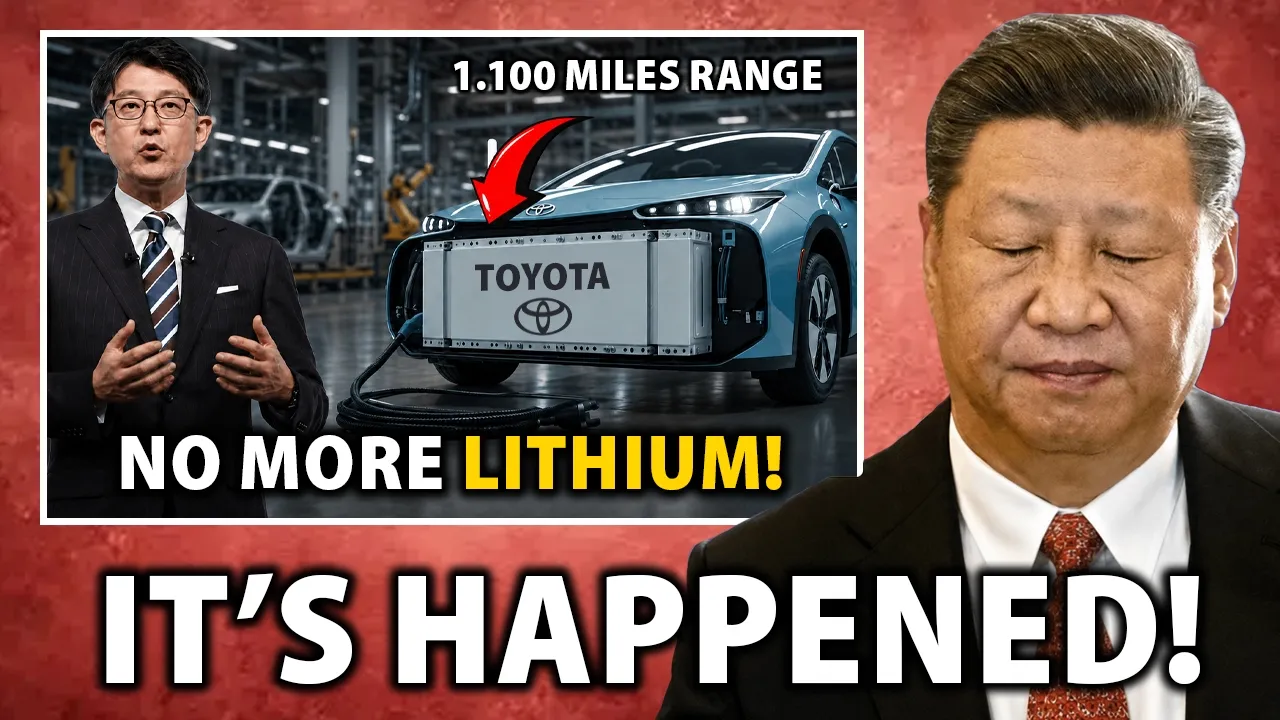
Then you drive away. And you do not need to stop and charge again, even if you are driving from Los Angeles to Seattle more than 1,100 m without stopping. Sounds like science fiction.
That is what most of the world still thought, at least until a few weeks ago. Because for years, people believed that solidstate batteries, the technology often called the holy grail of the electric vehicle industry, were still at least a decade away from mass production. Too many problems remained unsolved.
Too many technical barriers stood in the way. Too many promises had never become reality. Every year, analysts pushed the timeline further away.
Last year they said 2030. The year before they said 2035. And over time the industry learned not to trust big claims anymore.
But then Toyota spoke. Not through a flashy launch event with a glowing stage. Not through a live stream watched by millions of people.
Just a closed dooror meeting in Toyota City, Japan with a few dozen senior executives, selected investors, and engineers who had spent an entire decade working in silence. No performance, no special effects, just numbers. And those numbers froze the entire auto industry.
1,200 m on a single charge, a full charge in under 5 minutes. No cobalt, no nickel, no dependence on geopolitical supply chains. And most importantly, not a laboratory prototype.
This is a battery that has already been tested on real roads in real conditions across four continents. Within 72 hours after the information leaked, more than 46 billion dollars was wiped from the market value of traditional automakers and battery manufacturers. Electric vehicle startups that had once been hyped to the sky suddenly lost their shine.
The biggest corporations in America and Europe quietly called emergency meetings. And the biggest question right now is no longer. Are solid state batteries possible?
The question now is how did Toyota do this without anyone seeing it coming? Is this truly the turning point that changes the entire game? Or is it just another wave of hype waiting to collapse?
And if Toyota really succeeds, what does that mean for the rest of the electric vehicle industry and for consumers own wallets? That is what we are going to explore today layer by layer. Before we go deeper into the story, if you enjoy technology and electric vehicle analysis videos like this, hit the subscribe button right now.
We release new content every week, and this is a topic you really do not want to miss. How long has the lithium cage kept us trapped? To understand why Toyota's announcement caused such a real earthquake, we need to go back a little, not too far, just about three decades.
In 1991, Sony introduced the first commercial lithium-ion battery. At the time, it was seen as a miracle. compact, rechargeable, higher energy density than anything that had come before.
Within 10 years, it was inside laptops, mobile phones, digital cameras, and eventually electric vehicles. Tesla, Nissan, GM, and then the entire world began building on that foundation. Giant factories were constructed.
Supply chains stretched from cobalt mines in Congo to factories in South Korea and China, then back to the United States. An industrial ecosystem worth hundreds of billions of dollars was built around one single battery chemistry, lithium ion. But lithium ion is not without limits.
And after 30 years, those limits are starting to show more clearly than ever. First is the energy density problem. The best lithium ion batteries today store about 250 W hours per kilogram.
That number may sound abstract, but its consequences are very real. For an electric car to travel 300 to 400 miles, you need a battery pack weighing up to 1,000 lb or more. That is why most electric cars today are heavier than gasoline cars in the same segment by 500 to 1,500 lb.
All that weight affects how the car drives, real world energy consumption, and production cost. Second is charging. Even with the most modern fast charging technology, 350 kowatt direct current fast charging stations, you still need around 20 to 30 minutes to charge from 20% to 80%.
And that is under ideal conditions. In reality, with very hot or very cold weather or with an older battery, that number gets much worse. Compared with a 3minut gasoline refill, this is still a huge psychological gap that many consumers are not ready to cross.
Third, and this is something people talk about less, but it is extremely important, is safety. Lithium ion uses a liquid electrolyte, which is flammable. When the battery is damaged, overheated, or punctured in an accident, it can catch fire through a chain reaction called thermal runaway.
a fire that is almost impossible to put out with normal water and can completely burn down a vehicle in just a few minutes. These electric vehicle fires do not only cause property damage, they also create a serious crack in consumer trust. And fourth is raw material supply.
Cobalt, an important component in the cathode of lithium-ion batteries, mainly comes from the Democratic Republic of the Congo, where mining conditions have been widely criticized for human rights violations and child labor. Lithium largely comes from the South American lithium triangle and Australia. Nickel comes from Indonesia and Russia.
These are supply chains stretching across unstable geopolitical regions and any disruption can bring major consequences for the entire global electric vehicle industry. This is the lithium cage. The industry has lived inside for the past 30 years.
No one wants to be locked in it forever. But no one knew where the key was until now. But to understand why what Toyota just announced matters so much, we need to look at exactly what they have built and why it is completely different from everything that came before it.
Inside Toyota's secret laboratory, Toyota is not the first name you think of when people talk about bold technology breakthroughs. For years, the electric vehicle world looked at Toyota with skepticism, sometimes even with pity. While Tesla was stunning the world with the Model S, Model 3, and Cybertruck, while GM was committing to fully eliminating gasoline engines by 2035, while Ford was pouring tens of billions of dollars into new battery plants, Toyota seemed to be watching the crowd from the sidelines, still selling hybrids, still saying that pure electric vehicles were not ready yet.
Many analysts called it the stubbornness of an aging giant. But that was not the truth. That was camouflage.
While all the spotlights were shining on Tesla and rising electric vehicle startups, Toyota was quietly running one of the largest battery research programs in the history of the auto industry. Thousands of engineers, billions of dollars, and one clear goal, not to make lithium-ion batteries better, but to replace them completely. The technology they bet on was the solid state battery.
At its core, the idea is not new. Scientists have long known that if you replace the liquid electrolyte in a lithium ion battery with a solid material, you immediately eliminate the risk of fire and explosion while also greatly increasing energy density and charging speed. The theory is beautiful, but the reality is extremely complicated.
The biggest problem with solid state batteries has always been the interface, the contact point between the solid electrolyte and the electrodes. At the atomic level, solid materials expand and contract with temperature in uneven ways. After hundreds of charging cycles, tiny cracks appear at that interface, causing the battery to gradually lose its ability to operate.
That is why dozens of companies and laboratories around the world have tried to commercialize solid-state batteries for the past 20 years and all of them failed at this step. Toyota did not solve that problem by improving old materials. They bypassed it completely by developing an entirely new material, a proprietary ceramic polymer matrix that combines the properties of advanced ceramics with the flexibility of organic polymers.
The result is a solid electrolyte that can withstand thousands of expansion and contraction cycles without cracking, without degrading, and without losing ionic conductivity. This is the foundation of the entire breakthrough. On top of that foundation, Toyota added a second layer of technology, a graphine infused anode.
Traditional anodess and lithium ion batteries are usually made from graphite. When charging, lithium ions move into the anode and accumulate there. But over time, they form tiny metal branches called dendrites.
Almost like little mushrooms growing inside the battery. Dendrites are the number one enemy of lithium ion batteries. They reduce capacity, cause internal short circuits, and in the worst case, trigger thermal runaway.
Toyota's graphine anode almost completely eliminates dendrite formation. Not just reduces it, almost removes it entirely. In internal testing, these battery cells endured more than 2,500 full charge discharge cycles while losing less than 8% of their capacity.
In real life, that means your electric car could travel more than 1 million miles before you notice any meaningful drop in range. The combined result of these two breakthroughs is that energy density jumps from around 250 W hours per kilogram in the most advanced lithium ion batteries today to nearly 450 W hours per kilogram. Almost double in the same space with the same weight.
You get nearly twice the energy. And this battery pack is also 30% lighter and 15% smaller than the BZ series battery packs Toyota is currently using. But the most impressive number is still operating temperature.
Under extreme fast charging conditions or long periods of heavy load driving, the battery pack temperature barely changes. It runs cool. And that is something no commercial lithium ion battery pack today can do.
At first, this may sound like just a technical improvement, but this small detail, this seemingly harmless ability to run cool, is exactly what opens the door to everything that comes next. supercharging, super safety, and the production machine. When a battery runs cool, you can push electricity into it much faster without worrying about damage.
This is the principle behind the charging system. Toyota calls Hypercharge of 55. Let's put the numbers into context so they're easier to understand.
Tesla's Supercharger V3 direct current fast charging stations provide around 250 kW. The fastest charging stations currently on the market. The latest stations from Electrify America reach up to 350 kW.
That is already the peak of today's technology. Toyota's Hypercharge of 55 system delivers 2. 2 megaww.
In other words, 6 to n times more powerful than the strongest charging systems currently available. Through a new generation liquid cooled cable, that mass of current can fully charge a Toyota solid state battery pack from 0% to 100% in under five minutes. Not from 20% to 80% like the numbers automakers often use for marketing, but from completely empty to completely full and the amount of time it takes you to step out of the car, go to the restroom, and come back.
But of course, the question immediately appears. The current power grid was not designed to handle massive energy spikes like this. If hundreds of cars plug into 2.
2 megawatt stations at the same time, what happens to the local grid? Toyota has thought about this. Their answer is to pair each hypercharge station with an independent energy storage unit, large solidstate battery packs installed on site, slowly and continuously charging from the grid throughout the day, then discharging rapidly when a vehicle plugs in.
Technically, the grid never sees the 2. 2 megawatt spike. It only sees a steady, smaller, continuous electrical load.
The real surge comes from the storage unit at the station, not from the grid itself. This is an elegant solution, and it removes one of the biggest arguments against electric vehicles, that true fast charging would overload the national power grid. As for safety, Toyota has turned it into a real competitive advantage, not just a checkbox to tick.
When the solid state battery pack was punctured in crash testing, it did not catch fire. It did not explode. It did not release dangerous heat.
It just sat there intact. In the most severe fire simulations under Japanese safety standards, Toyota's solid state battery released less than 90% of the heat produced by a conventional lithium ion battery. That is not an improvement.
That is a complete change in the nature of the risk. On top of that, Toyota integrated the battery pack directly into the vehicle chassis structure called cellto-frame integration. Instead of being a separate module mounted under the vehicle, the battery becomes part of the vehicle frame.
This not only saves weight, but also increases structural rigidity and protects passengers in a crash. Toyota's solid state vehicle is 28% lighter than the current RAV 4, but stronger and safer. But no matter how good a technology is, it means nothing if it cannot be produced at scale at a price consumers can actually afford.
And this is where Toyota's story becomes truly different. Right now at the Moto Machi plant in Japan, two automated solidstate production lines are already operating. Not a pilot, not a test, they are running.
Initial capacity is 250,000 battery packs per year with a yield rate of 91% while most competitors cannot break 70% in smallcale trials. Automation is the key. Ultra thin ceramic electrolyte sheets are handled by robots inside a fully sealed moisture-free environment with artificial intelligence quality control systems tracking every micrometer of every battery sheet.
Labor cost per battery pack has been reduced by 60%. Production speed has doubled and human error is almost zero. Meanwhile, in Thailand, a new gigafactory is being built with one sole purpose, producing solidstate batteries at global scale.
No old lithium ion production lines, no hybrid system. From design to operation, everything is being built from scratch for the new technology. Toyota's goal is that by 2027, 80% of all solid-state components will be produced domestically, creating a fully self-reliant energy ecosystem.
And the vehicle designed to run on that platform already has a name, Toyota X1. Not a normal electric SUV, not a cheap hatchback. The X1 is the first vehicle in Toyota's history built 100% from the ground up for solid state architecture.
More than 1,200 mi of range, a full charge in 5 minutes. A starting price under $30,000. And thanks to cellto-frame integration, it is lighter, stronger, and safer than any electric vehicle on sale today.
Inside Toyota, people expect the X1 to surpass the Corolla and become the bestselling model in the company's history. A bold claim maybe, but looking at the numbers, it is not hard to understand why they believe it. What Toyota is not telling you.
At this point, you might be thinking, "This sounds too perfect. So, where is the catch? " Good question.
And the honest answer is there are quite a few things that still need to be verified. First, the 1,200 mile figure is based on testing conditions, not realworld driving by actual customers. [music] Right now, most automakers report range under EPA or WLTP standards.
And in both cases, real world numbers are often 15% to 25% lower than the official figures depending on conditions. Highway driving, air conditioning, cold weather, all of these reduce range. Toyota has admitted that the realworld number under mixed American driving conditions may be closer to 958 mi.
Still an unimaginable number, but not 1,200. Second, even though the production lines are operating, the scale is still far from what is needed to serve the mass market. 250,000 battery packs per year sounds like a lot until you remember that Toyota currently sells around 10 million vehicles per year.
The plant in Thailand will greatly increase production capacity, but that is still a multi-year expansion process, and it could face obstacles such as shortages of skilled technical workers, special ceramic supply chains, and the learning curve of manufacturing. Third, the $30,000 price for the X1. This number has not been officially confirmed.
It comes from internal sources and leaked reports, not from an official Toyota press release. Large-scale ceramic electrolyte production is still a more expensive process than liquid electrolyte lithium ion manufacturing. Toyota is confident that costs will fall through scale and automation, but that is a projection, not a verified reality.
Fourth, and perhaps most concerning, realworld lifespan under everyday use has not yet been verified by an independent third party. Toyota has announced 2500 cycles with less than 8% capacity loss in internal testing. But internal testing is always more controlled than realworld environments.
Variables like uneven charging, long-term exposure to extreme temperatures or real users overnight charging habits all require more long-term field data. We need to say this clearly. None of these points are reasons to dismiss everything Toyota has announced.
Quite the opposite. But an honest story requires looking at both sides. The electric vehicle industry has already seen too many big promises that did not arrive on time.
From silicon anode batteries to sodium ion batteries to affordable long range electric vehicles. Each time the initial excitement slowly gave way to a more complicated reality. Toyota has a better history than most when it comes to moving technology from the laboratory to real roads.
They did it with hybrid technology. The Prius arrived in 1997 and is still selling well today. But hybrids used lithium ion technology that had already been proven.
Solid state is a much bigger leap, and this is exactly where the race becomes more intense because Toyota is not the only one trying to dominate the future of batteries. Where is the real battery war happening? You cannot talk about Toyota's breakthrough without looking at what is happening around them because this race is unfolding on many fronts at the same time.
In China, CL, the world's largest battery manufacturer, currently holding more than 37% of the global electric vehicle battery market, is not standing still. The company already has its own solid state battery program, targeting commercialization in 2027. CL's advantage is enormous manufacturing scale and deep relationships with most major automakers in China, Europe, and increasingly the United States.
They also have a cost advantage. CL engineers are paid significantly less than Japanese or American engineers, and China has overwhelming control over the raw material supply chain for batteries. But CL is still using a traditional NMC cathode architecture, nickel manganese cobalt, meaning that even if they move to solid electrolytes, they remain dependent on cobalt and nickel.
Toyota has cut out both. In South Korea, Samsung SDI, Samsung's battery division, has partnered with Stalantis, the parent company of Jeep, Ram, and Dodge to develop solidstate batteries. Samsung has a strong materials background and long experience producing consumer batteries, but so far their program is still in smallcale testing, not yet at mass production.
In the United States, QuantumCape, the solidstate battery startup heavily backed by Volkswagen and Microsoft, has announced breakthroughs many times, but has also missed timelines many times. Its stock has fallen more than 80% from its peak. Solid Power, another startup working with BMW and Ford, is also still in the pilot stage and has not reached the market.
In the world of solid state battery startups in Silicon Valley and Detroit, promises are always years ahead of reality. What makes Toyota different [music] need to raise money through an initial public offering? They do not have venture capital investors they need to convince every quarter.
They have $250 billion in annual revenue, 70 years of car manufacturing experience and hybrid battery production lines optimized over two decades. That manufacturing foundation cannot be created in a startup boardroom. As for the American side, GM, Ford, and Stellantis, all of them are facing a difficult situation.
They've committed tens of billions of dollars to next generation lithium-ion battery plants. GM has Ultium. Ford has Blue Oval City.
These investments cannot be cancelled overnight. But if Toyota succeeds with Solid State, those factories could become outdated assets before they even reach full capacity. That is why in Detroit, the first reaction after Toyota's announcement was not a loud public statement.
It was silence, followed by closed- dooror emergency meetings. Volkswagen, which once called its solidstate battery program its number one strategic priority, now has to face the reality that its timeline already delayed several times, suddenly looks like a leftover from another era. Powerco, VW's battery company, is racing to reassess its entire development road map.
The race is not over. It is just accelerated to a new level that many players are not ready for. But in the end, the biggest question remains.
If everything Toyota announced is true, what does it mean for the wider world out there? For consumers, for the energy industry, and for the lives being shaped by energy problems every single day. If Toyota is right, how will the world change?
Let's start with the simplest thing, you, the consumer. If the X1 launches in 2026 with a price under $30,000 and realworld range close to 1,000 mi, that is a lower price than the Tesla Model 3 and almost three times the range. Range anxiety, the biggest psychological barrier stopping Americans from switching to electric vehicles disappears.
Worry about charging time disappears. Worry about battery fire safety disappears. According to a JD power survey, the top three barriers preventing Americans from buying electric vehicles are range, charging time, and price.
If Toyota solves all three at once, the electric vehicle industry does not just grow, it explodes. But the impact goes far beyond the car itself. Toyota has clearly stated that by 2026, solid state battery technology will also expand into home energy storage systems.
Think about this. A rooftop solar panel combined with a Toyota solid state battery pack could store enough energy to power your home for nearly 2 days without drawing electricity from the grid instead of less than one day with current technology. For many families in remote rural areas, in storm-prone states with frequent blackouts like Texas or Florida, or in places with high electricity prices like California, that could mean real energy independence.
At a larger scale, Toyota is researching industrial storage units using the same solid state architecture. Grids scale battery farms using solid state technology would be lighter, safer, and have twice the lifespan of today's lithium ion systems. That makes renewable energy more reliable.
Because the biggest problem with wind and solar is not generating electricity. It is storing that electricity when the sun is not shining and the wind is not blowing. And then there is aviation.
Inside Toyota, the aviation division is evaluating solidstate ceramic versions for next generation drones and even high alitude platform aircraft applications where the energytoe ratio is a matter of survival. If solid state battery energy density can remain stable at 450 W hours per kilogram over the long term, then for the first time in history, medium-range electric aircraft becomes a technically realistic proposition, not just a science fiction idea. There will also be a major shift in raw material geopolitics.
The cobalt market currently dominated mainly by Congo and China will face strong downward pressure if cobalt-free solid state batteries spread widely. The same is true for nickel and to a lesser extent lithium. Countries relying on exports of these materials will have to adjust.
Meanwhile, Japan, a country without major natural resources, suddenly holds a new geopolitical weapon, technology. And on an even larger level, if Toyota really scales solid state production to millions of battery packs per year, it will no longer be just a car company. It will become one of the most important energy suppliers in the world.
The kind of role that used to be described with names like Exxon Mobile, BP or Saudi Aramco. That is the scale of the story unfolding right now. Now, let's look back at everything we have gone through today.
For decades, the electric vehicle industry has been trapped inside a lithium cage. A technology good enough to start the revolution, but not powerful enough to finish it. Short range, long charging time, hidden fire risks, and dependence on unstable geopolitical supply chains.
All of these created an invisible wall, preventing electric vehicles from truly becoming the choice of the masses. Toyota did not try to break through that wall. They built a completely new road around it.
Solid state batteries with proprietary ceramic electrolyte. A graphine anode that eliminates dendrites. A 2.
2 megawatt charging system that does not overload the grid. Automated production with a lower defect rate than any rival. No cobalt, no nickel domestic supply chains.
And a car priced under $30,000 designed to bring this technology to millions of people. That is the full picture. if everything goes according to plan.
But, and this is important if we do not want to get swept away by excitement, the history of electric vehicle technology has taught us an expensive lesson. The gap between proven in the laboratory and widely sold at dealerships is always larger than we think. Large-scale production always brings unexpected surprises.
Real costs are always higher than early estimates. Consumers do not always react the way engineers expect. Toyota knows this better than anyone.
They went through it with the Prius, with the Mi, and with early generation hybrids. And because they know it, the way they are approaching this this time, quietly building, testing in the field across four continents, running real production lines before holding a big press conference may be the most reliable sign that this is not ordinary hype. But in the end, we still have to wait and see.
The next few years will be the real test. Will the X1 launch on time? Will real world range come close to the announced number?
Will the price really be under $30,000? And most importantly, after 3 years, 5 years of real use, will the battery hold its performance as promised? Those are questions that no press release, no engineer, and no YouTube video can answer today.
Only reality can. But one thing is already clear right now. The race has changed in nature.
It is no longer a question of are solid state batteries possible. It is now who will master them first and under what conditions. And Toyota against every prediction is sitting in the lead with a significant gap.
That can change. Technology always changes. But right now, this month, this year, Toyota is rewriting the rules of an industry that thought it was safe under the old game.
So, what about you? Do you believe Toyota has truly pulled the future into the present? or are you still skeptical about those numbers?
Leave your thoughts in the comments below. We read every comment and really want to hear your perspective. If you found this video worth watching, hit like to help more people discover this story.
And if you want to keep following Toyota's journey, solid state batteries, and the energy revolution now unfolding, subscribe to the channel and turn on notifications.