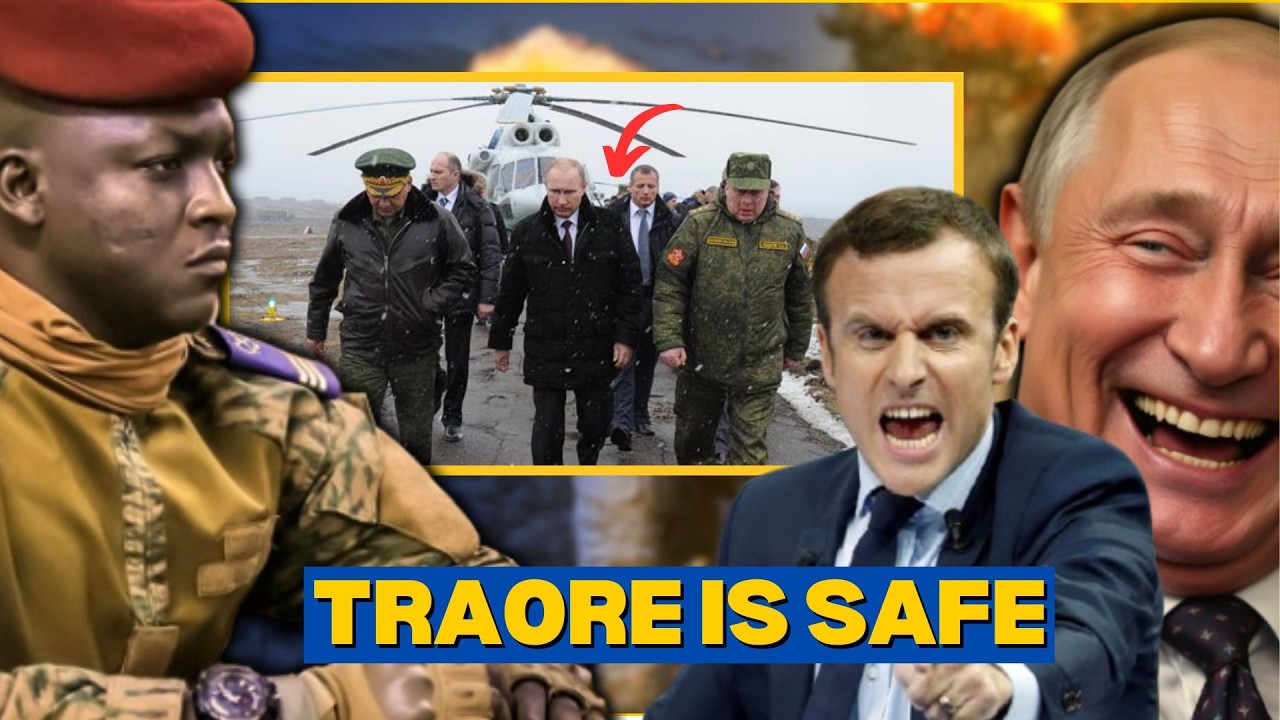
In just six minutes, one woman silenced an entire international summit, not with anger, but with truth. A black US congresswoman looked straight into the camera. She exposed the truth about Africa's fight for dignity, and left the president of Bkina Faso speechless.
What did she say that shook the world, enraged American politicians, and inspired villages halfway across Africa? And more importantly, why are some people trying to bury her story today? And it all started one morning before.
In the capital city of Wagadugu, Burkina Faso, President Ibrahim Trareore was thumbming through the day's schedule with half a cup of lukewarm tea in one hand and a red pen in the other. His team had stacked the day. Infrastructure meetings, rural education updates, a briefing with defense officials, and somewhere between the TDM, a 20-minute virtual dialogue with a US Congresswoman.
No urgency, no special alerts, just a line on the calendar. 10:30 a. m.
Diplomatic conference call with Representative Jasmine Crockett, USA. He sighed, rubbed his temples, and nodded it through. Just another check-in with the West, he thought.
Thousands of miles away in Washington, DC, Jasmine Crockett was rushing into a small studio set up by her staff. Her assistant had warned her that the Wi-Fi might glitch again, and her microphone had been acting up all morning. She gave a half laugh.
"Perfect," she said, sipping the last cold drop of coffee from a chipped mug. "This is how democracy collapses, because my mic won't work. " Her staff chuckled politely, but Jasmine wasn't trying to be funny.
She was nervous. Not because of Trareay, but because of what she intended to say. She had rewritten her speech five times the night before, crossing out line after line of diplomatic fluff.
"This isn't just about foreign policy," she had muttered to herself. "It's about truth, and I won't waste this moment. " The screens blinked to life.
Ibrahim Trereay appeared first, seated plainly in his study, wearing a cotton tunic with stacks of government reports behind him. Jasmine appeared next, framed by the muted blue of a congressional backdrop. Both smiled politely.
The translator checked in. The protocol officer confirmed the agenda. And just like that, the meeting began.
For the first two minutes, everything was exactly as expected. polite acknowledgements, empty affirmations, the kind of talk that fills time but says nothing. Jasmine nodded through the formalities, but inside her chest was tightening.
She was known for being bold in the US, but this was something else. Speaking truth in front of a domestic audience was one thing. Doing it before an African president, diplomats, and a global audience, that was risk.
Real risk. She reached for the pre-written notes in front of her and then stopped. Her fingers froze.
She took a breath. She slid the script aside and then she looked directly into the camera. Mr President, she began, her voice steady but charged.
I know I was supposed to speak about economic cooperation and mutual trade frameworks today, but if I may, I'd like to speak about something deeper. Trrowé looked up slowly, curious. I'd like to speak about dignity.
The translator hesitated for a second, as if unsure whether to go on, but he did, word for word, and suddenly something shifted. The air in the room, both in Wagadugu and DC, felt heavier. Jasmine continued, her voice now firmer.
Over the past few weeks, I've been studying the history of Burkina Faso, not as a lawmaker, but as a student, a student of courage. And what I saw in your leadership, Mr President, moved me in ways I didn't expect. On the other side of the screen, Troure's fingers stopped moving.
He had been reviewing documents absent-mindedly, like many heads of state do calls, but now he wasn't glancing. He was listening. And it's not just about policies, Jasmine said, leaning forward.
It's about the fact that you, against incredible pressure, refused to let your nation become a puppet. You put your people first. And that, sir, that is rare.
Nobody moved. The protocol officer stopped taking notes. The translator, now visibly drawn in, slowed his voice, savoring each word as though the world needed to hear it twice.
And maybe it did. A moment of unexpected gravity had just descended on what was supposed to be a routine call. In the quiet, something undeniable took root.
What Jasmine had just done wasn't in the manual. It wasn't in the plan, but it had pierced through politics like a blade, sharp, clear, and impossibly sincere. And for the first time in a long time, a president known for his poise, was left utterly speechless.
Jasmine's eyes didn't waver from the lens. Her voice, while calm, carried a weight that made every syllable feel like it belonged in history books. Mr President, I want you to know I didn't come to this meeting unprepared.
I didn't skim over your biography like a rushed aid. I studied. I sat down and read about the sacrifices your people made for freedom.
I read about Thomas Sankura, about the days when Burkina Faso dared to say no to colonial leftovers. Dared to dream of independence beyond slogans. The camera feed flickered slightly, but the connection held.
Ibrahim Trrower's expression changed subtly but unmistakably. He blinked once, then leaned back in his chair, fingers interlaced. No one had ever opened a diplomatic conversation like this with him.
not a western politician, not even an African peer. Most meetings were transactional. Jasmine's words, they were reverent.
You refused conditional aid from those who only saw your people as numbers. You broke from decades of financial dependence. You invested in health clinics in the villages.
You put books in children's hands even when the media said you were radical. I read about all of it and it inspired me deeply. Trrowé lowered his eyes for a moment, not out of shame, but in a kind of quiet disbelief, like someone unexpectedly receiving flowers on the battlefield.
Jasmine's words weren't just recognition. They were redemption. Then, with the softest smile, Jasmine did something that caught everyone offg guard.
She laughed, just a short, self-deprecating chuckle. You know, she said, when I was a little girl, people never expected me to stand where I do now. I was the quiet one in the back of the class, the one who spoke too softly, who dressed too differently, who didn't come from the right part of town.
Even in Congress, there are rooms I walk into where I can still feel it. The weight of invisibility. Her tone was light, but the room didn't laugh.
They listened. One time when I was in high school, a guidance counselor told me, "Jasmine, maybe try something easier than law. Maybe nursing or clerical work.
" "And now here I am," she said with a warm shrug, giving lectures to presidents. That line drew a few smiles. Even Trrowé cracked the faintest grin.
But before the warmth could settle in too comfortably, Jasmine pivoted. But that's not the story, she said, the smile fading. The real story is what happens when someone chooses to be seen, to see others.
And Mr President, that's what you've done for your people. You've seen them not as statistics, not as tools, but as citizens, as souls, and that that changes everything. The mood in the room changed once again.
What started as a light anecdote had spiraled into something raw and piercing. Jasmine had invited the world into her vulnerability, only to hold up a mirror to a leader who had once done the same. She paused then for a second, maybe two.
Her fingers brushed the corner of the desk. She closed her eyes briefly and exhaled. "When I first got into politics," she said slowly.
I was told to chase titles, power, applause, and there were moments I almost lost myself in that game until I read about you, Mr President. The emotion crept in, not loud, but unmistakable. A soft quiver in her voice.
You reminded me that leadership is not power. It's not status. It's not fame.
It's service. It's showing up when no one's watching. It's doing the right thing even when it costs you everything.
Now her voice cracked. She didn't try to hide it. You showed me that dignity isn't just a value.
It's a fight. And you're fighting that fight. Not for headlines, not for legacy, but for the farmer in the village, the girl with the book, the mother trying to find medicine for her child.
The line went quiet. Not a single cough, not a breath. Even the translators forgot to whisper on the screen.
Trare sat frozen, his eyes once steel, now softened, glassy. Jasmine's message had hit somewhere no policy paper ever could. She had come to speak diplomacy, but instead she delivered truth.
And now the whole world was listening. For a moment that seemed to stretch across continents, President Ibrahim Trare didn't speak. He didn't blink.
He didn't shift in his chair. His hand resting on a folded policy briefing remained still. The pen beside it uncapped, abandoned.
His eyes, once analytical, hardened by years of negotiations and betrayal, now held something else entirely. Vulnerability around him. His advisers exchanged uneasy glances.
They weren't used to this. Not from him. Trore was the one who always had the right phrase, the counterpoint, the strategy.
But right now there was no strategy. There was only silence. And that silence spoke louder than anything else in the room.
He slowly turned his head toward his chief of staff, then to his translator, then back to the screen where Jasmine Crockett waited. Not with smuggness, but with respect. She wasn't trying to impress him.
She wasn't angling for approval. She had simply seen him. Not as a president, not as a symbol, but as a man carrying the weight of a nation that history had tried to erase.
For once, he wasn't being judged through the cold filter of Western interest. He was being understood. He stood up slowly.
No fanfare, no formal gesture, just a man rising as if something inside him refused to stay seated any longer. He took a breath, rubbed the back of his neck, and then finally spoke, but not to the cameras, not to the media, just to her. "You reminded me why I started this," he said, his voice low but firm.
"Why I left behind everything I could have had, comfort, privilege, safety, and chose to lead a country where nothing is guaranteed except struggle. " The room remained frozen as though everyone feared even the sound of a cough might disrupt something sacred. He walked toward the window of his office, hands behind his back, looking out toward the dusty courtyard below.
People often say we fight for independence, he continued. But what they don't understand is we fight for dignity, and that's not a headline. It's a sacrifice every day.
He turned back to the screen, his eyes now glassy with emotion. You saw that in us. You saw that in me.
And for that, I don't have words. Jasmine leaned closer to her microphone. She could feel the shift.
The kind of moment no publicist could script, no speech writer could manufacture. It was pure. It was real.
She didn't want to break it. But she also knew this was the time to say what had been burning in her chest for weeks. Her voice dropped to a near whisper.
"Mr President, Africa doesn't need saving. It needs to be heard. " The translator paused as if the sentence itself had stunned him.
He repeated it slowly, reverently, as if trying not to damage it with his own voice. Trare didn't flinch, but something behind his eyes seemed to soften, then ignite. That's what you're doing," she added, her voice steadier now.
"You're forcing the world to listen, not to its own echoes, but to the voices it's ignored for centuries. And I want to say thank you because hearing your people has made me hear my own in a way I never did before. " The connection didn't cut out.
The screen didn't freeze. No one was speaking. No one dared.
Because in that stillness, the world was being asked, maybe for the first time in a long time, not to respond, but to reflect. And in that rarest of silences, a president stood tall, a congresswoman stood bold, and a global audience finally listened. By the time the video conference ended, the world had already started to react.
Within minutes, clips of Jasmine Crockett's speech were circulating across Twitter, Facebook, and WhatsApp groups on both sides of the Atlantic. One particular moment when she said, "Africa doesn't need saving. It needs to be heard," was clipped, subtitled, reposted, and dissected by influencers, journalists, and everyday users alike.
The hashtags began to trend. Your national crockett speaks. Crashan dignity is diplomacy.
And in Burkina Faso, we are being heard. In the United States, reaction was divided. Civil rights leaders and grassroots organizers hailed the moment as revolutionary.
Finally, someone spoke truth without apology, one activist tweeted. But the political establishment less generous. Cable news anchors debated the appropriateness of Jasmine's remarks.
Comment sections flared into ideological battlegrounds. Some said she was brave. Others called her reckless.
But one thing was certain. No one was ignoring her. And that perhaps was the greatest shift of all.
For once, a black congresswoman's words weren't being buried under bureaucracy. They were breaking through. It didn't take long for the backlash to find its loudest voice.
Representative Klene, a seasoned politician known for his polished condescension, appeared on a popular evening news broadcast. The host played a clip of Jasmine's speech, then turned to Klein for comment. He smirked.
"It's emotional," he said. "It's passionate, but let's not kid ourselves. This isn't foreign policy.
This is romanticizing strongmen. These kinds of gestures, they're naive. " The studio lights gleamed off his silver cufflings.
He was composed, dismissive, and smug, but Jasmine wasn't watching quietly. The next morning, during a live interview with an independent media outlet, she responded directly. No script, no filter.
Representative Klein thinks I'm romanticizing a dictator, she said, eyebrows raised. Maybe the real problem is that we've spent too many years romanticizing silence, romanticizing inaction, romanticizing the kind of diplomacy that ignores real people. She leaned forward.
I didn't praise Traé because he holds power. I praised him because he uses it to serve, to build schools, clinics, futures. And if that makes people uncomfortable, maybe it's time they ask themselves why the clip went viral again.
Meanwhile, thousands of miles away, President Ibrahim Trouore found himself far from the capital. He had requested quietly to visit the village of Tambaga, a modest farming community hours from Wagadugu. No press, no entourage, just him, a driver and a security aid.
When he arrived, the people were stunned, but not unprepared. Word travels fast in Burkina Faso, especially when it carries hope. Under the shade of a baobobab tree, Trare was approached by Miam, a local farmer in her early 50s, with soil still on her hands and wisdom in her eyes.
She stood tall in her faded headscarf and said with a quiet conviction, "Mr President, I heard what that American lady said about you. " He looked at her gently. "And what did you think?
" Mriam didn't hesitate. "She's right. You gave us our voice back.
" The words hit him harder than any headline. He nodded slowly, but before he could respond, a young boy emerged from behind the crowd. He held a small wooden object wrapped in cloth.
A gift. Trare knelt as the boy stepped forward and placed the sculpture in his hands. It was two figures carved from dark wood holding hands.
On the bottom, etched carefully in French were the words, "Lajant unite lemon, kindness unites worlds. " For a few seconds, Trrowé said nothing. He simply held the sculpture close as though trying to memorize its weight.
This wasn't ceremony. This was soul. And in that moment, far from microphones and critics, he realized something Jasmine had already known.
The real power of words isn't in how loud they echo. It's in whose heart they reach. The boy couldn't have been more than eight.
His name was Tano. A wiry child with wide, thoughtful eyes and the kind of quiet composure that made him seem older than his years. He approached President Ibrahim Trareore slowly, cradling something in his small hands wrapped in a faded piece of cloth.
The village elders stepped aside as Tano moved forward as if they too understood that what was about to happen was not ordinary. When the child finally reached him, Trareay bent to meet him at eye level. There was no fanfare, no ceremonial announcement, just a boy and his gift.
Carefully, Tano unwrapped the cloth to reveal a small sculpture carved from dark rosewood. It was smooth, delicately detailed, and surprisingly heavy for its size. The figures, two people, one larger, one smaller, stood side by side with arms extended, their hands clasped at the center.
It was a gesture of unity, but not symmetry. One figure was bowed slightly, the other lifted as if sharing weight. At the base, crudely but lovingly etched, were five words in French.
Laanti Utni Lemon, kindness unites worlds. Triayor stared at the carving for a long time, his fingers tracing the grain of the wood. This was no souvenir.
This was a message, not scripted by aids or filtered through politics. It was a child's interpretation of the moment, raw, real, and honest. Later, as the sun hung low over the hills of Tambaga, Tray sat beneath the same Beaabab tree, sculpture still in hand.
His security team had backed off, giving him space. The villagers had resumed their day, some returning to the fields, others tending fires or gathering water. But Trrowé remained still, eyes locked on the carving.
He wasn't admiring it. He was absorbing it. For him, this wasn't a photo op or some pleasant rural visit.
This was affirmation, a rare and sacred kind. In this one object carved by small hands in a place most foreign dignitaries couldn't find on a map, lay the proof that his work mattered. Not in headlines or international praise, but in the eyes of a child who felt seen and safe enough to give him something made with his own two hands.
It struck Traer harder than any diplomatic victory. It was legacy, not in theory, but in practice. He remembered what Jasmine had said just days ago.
Leadership isn't power, it's service. And now with Tano's sculpture resting on his lap, those words returned to him like a promise made silently to the future. Later that afternoon, Traare joined his small team in a modest community center.
Lunch was simple. Grilled yam, rice, peanut sauce, and sweetened tea poured into metal cups. As his ministers recapped policy updates, Troure leaned back in his chair and chuckled.
"Imagine," he said, shaking his head. All this from a video call. His communications officer laughed.
We didn't even expect the call to last more than 20 minutes. Another aid joked, "Next time, maybe let her give all our speeches. " They all laughed together.
The kind of easy, genuine laughter that only comes after a moment of real connection. But as the laughter faded, Tray's hand drifted to the bag beside him where he had carefully tucked away Tano's sculpture. He didn't take it out.
He didn't say anything about it. But he touched it gently as if to remind himself that what had happened in that village and what Jasmine Crockett had sparked across the ocean was not over. It was only beginning.
It didn't take long for Washington to come knocking. Days after Jasmine Crockett's speech to President Trareay went viral, she was back on Capitol Hill, seated at a long mahogany table under the harsh lights of a Senate oversight hearing. What was supposed to be a routine session on foreign aid strategy quickly turned personal.
Senator Hunt, known more for his temper than his diplomacy, interrupted Jasmine just as she began to reference Bkina Faso's refusal of conditional loans. That's enough, Congresswoman. He snapped, leaning into his mic.
Let's not turn this into another emotional outburst. The room tensed. Jasmine looked up slowly, a half smile curling at the corner of her lips.
With all due respect, Senator, she said smoothly. I think what you're calling an outburst is just what change sounds like when it finally gets a microphone. The chamber froze for a beat.
A few aids tried to suppress grins. Hunt turned crimson, fumbling through his papers. Jasmine didn't raise her voice.
She didn't need to. Her tone carried more weight than his authority ever could. And in that moment, she wasn't just defending her speech.
She was defending the idea that dignity, especially when spoken by black women in halls of power, was not a disruption. It was a reckoning. A week later, Jasmine stood at the front of a crowded school gymnasium in southeast DC.
The fluorescent lights buzzed overhead. The smell of cafeteria pizza lingered faintly in the air, and folding chairs squeaked as dozens of students, mostly black and Latino, leaned forward, eyes fixed on her. No podium, no teleprompter, just Jasmine, a wireless mic and a story.
I met a man, she began, who said no to power and yes to his people. She told them about Burkina Faso, about a president who defied the odds and about a little boy who carved a sculpture that now sits beside her books at home. He didn't ask for permission to lead.
He listened. He served. And in doing that, he gave his people something we don't talk about enough.
Belief. The room was silent. A teacher in the back wiped her eyes with the corner of her sleeve.
One boy in the front, probably no older than 10, stood up. Then another, then another, and suddenly the entire room was on their feet, clapping, cheering, chanting her name like she had just scored the winning point in a championship game. But this wasn't a game.
This was something deeper. They weren't applauding a politician. They were celebrating the feeling that someone like them could rise and take them with her.
That speech didn't end in that gym. It followed the kids home. It followed the parents into dinner conversations.
And within days, it reached the inbox of community organizer Nina Fields, a former educator turned activist who had been looking for a way to reignite her movement. Jasmine's words struck her like lightning. Nina launched we First, a grassroots initiative focused on dignity-based leadership and community restoration.
The idea was simple. Start local, think global. Create spaces where people feel seen, supported, and powerful in their own right.
At the first gathering in an empty church basement, Nenah taped a quote to the wall. Africa doesn't need saving. It needs to be heard.
And underneath it, she wrote in marker, "Neither do we. " From DC to Detroit, from Oakland to Atlanta, the phrase caught fire. It wasn't just about foreign policy anymore.
It was about the dignity of every overlooked voice in every forgotten neighborhood. Jasmine hadn't just sparked a conversation between nations. She had ignited a movement, one that was no longer about politics, but about people choosing to rise together.
The heat was dry and unforgiving as President Ibrahim Charé stepped into the open courtyard of a rural school on the outskirts of Kudugu. Dust swirled in the breeze, catching in the folds of his tunic. But the children didn't notice.
They were too busy staring in wonder. For many of them, it was the first time they had seen their president in person, not in a picture or on the evening news, but here on their turf in their town. Among them was Ila, a girl no older than nine with bright eyes and a notebook hugged tightly against her chest.
Her dress was faded, her sandals worn, but she stood with the quiet confidence of someone who had something important to say. When Tray approached, Ila stepped forward, clutching the notebook even tighter. "Mr President," she said softly, holding it out.
"I just got this last week. " The teacher said it came from the new program. Trrowé nodded, smiling gently.
"It did? " he replied. It's for you to write your future.
She grinned, flipping it open to show him the first page. A single sentence scrolled in careful handwriting. One day I will be a teacher.
Then she added shily. Like you? The president blinked.
Me? She nodded. You teach the whole country how to believe in itself.
And just like that, the leader of a nation felt as if a child had given him a diploma of the highest honor. Later that same day, the convoy made an unscheduled stop at a community clinic supported by one of Trroway's rural health initiatives. He didn't expect to stay long.
It was just to check on supplies, maybe thank a few nurses. But in the corner of the waiting area sat a girl named Nema, no more than six, playing alone with a cloth doll pieced together from old fabric scraps and twine. Her dress was torn at the hem, and one of her braids had come undone, but she rocked the doll in her arms with a care so tender it silenced the room.
Trroway approached, crouching down to her level. "What's your doll's name? " he asked softly.
Nema looked up startled, then whispered. Hope. The president smiled.
That's a good name. She looked down at the doll again, then back up at him. Before, I didn't know what to wish for, she said.
But now I can dream. It was such a simple sentence, so small, so quiet, and yet it cracked something deep inside him. He nodded, swallowed hard, and gently placed his hand over hers.
In that moment, the applause of parliaments and praise of media couldn't compare to a single truth. This this was the purpose of power. Standing off to the side was Marcus Ellison, a freelance journalist from Atlanta who had been following Trouay's work for months.
He had seen speeches, followed policy briefings, sat through hours of panel discussions on Africa's new political awakening, but nothing had moved him quite like this. Watching the leader of a country sit cross-legged in the dirt beside a girl and her handmade doll. Marcus didn't raise his camera.
He didn't reach for his phone. He just watched. And later in the margin of his notebook, he wrote a single line he would use to open his article.
Today, I saw a continent daring to love itself again. It wasn't just Burkina Faso that was changing. It was the narrative.
The story no longer began with pity or ended in corruption. This was something new. And it was fragile, yes, but undeniable.
In the softspoken courage of Ila, in the quiet dreams of Nema, and in the leader who chose to kneel in the dust beside them, there was hope. The kind that doesn't shout, the kind that waits, the kind that builds a future, one child at a time. The sun hung high over Wagadugu, casting long golden rays across the city as drums echoed faintly in the distance.
In the heart of the capital, a crowd of over 700 had gathered at the civic plaza for a day long in the making. The first official ceremony honoring the Bridges of Tomorrow initiative, a sweeping education and empowerment program born from President Trrower's vision. Banners waved.
Students clutched new books and wore uniforms they had only dreamed of months ago. Farmers, elders, local artists, and foreign observers all packed into folding chairs beneath canvas canopies. It wasn't a government event.
It was a people's celebration. President Trareay stepped onto the stage wearing a simple handwoven tunic in the national colors. No suit, no security flanking his sides, just him and the podium.
The crowd quieted as he began. "Today," he said, scanning the faces before him. "We don't gather to celebrate numbers or statistics.
We're not here because a budget was passed or a milestone checked off. " He paused, then added firmly, "We are here because belief was restored in ourselves, in our children, in the idea that dignity is not a luxury, but a right. " Applause erupted, loud, sustained, and heartfelt.
He stepped back, letting the noise carry, then returned to the microphone with one last line. We didn't just build policy, we built belief. Midway through the ceremony, a large white screen was pulled down across the stage, and the hum of a projector began to fill the plaza.
The organizers had prepared a surprise. As the image sharpened, a familiar face appeared. Jasmine Crockett beaming from a pre-recorded video taken in her congressional office.
The moment her face lit up the screen, a wave of recognition swept through the crowd. Applause broke out before she even spoke. "Hello from Washington," she began, her tone warm, her eyes glistening.
"To the people of Burkina Faso, you've done something extraordinary. You've proven that when leaders listen, entire nations can rise. and to the students holding their first notebooks, to the mothers who now believe their children have a future.
This is your victory. " Her message was brief but stirring. And when the screen faded to black, the crowd stood on its feet in thunderous applause.
Young girls wiped tears from their eyes, elders clasped hands in prayer. Trare looked up at the now blank screen, the image of Jasmine still etched in his mind, and nodded as if she could somehow see him standing among those she'd inspired from halfway across the world. Trare returned to the podium one final time.
He waited for the applause to settle, then turned slightly to the screen where Jasmine's image had just been. "My friends," he said slowly. "This is not about borders.
" His voice was calm, almost reverent. Now, it's not about east or west, black or white, powerful or poor. It's about what happens when kindness becomes policy.
When empathy is not treated as weakness, but as strength. He paused to let that sink in. That woman you just saw, she didn't send us money.
She didn't make us promises. She gave us something more dangerous. She gave us respect.
And when someone believes in you, it becomes much harder to believe in your own limits. The crowd was hushed again, not out of silence, but reverence. No marching bands, no fireworks, just a growing understanding that something rare was unfolding.
A new kind of diplomacy, a new kind of leadership, one that didn't speak down, but stood beside. And in that quiet, Burkina Faso didn't just feel seen by the world. It saw itself.
The ceremony had ended, but many people lingered. Children played near the edge of the plaza, some practicing songs they had learned in class, others chasing after the fluttering corners of a fallen banner. Tano, the quiet boy who had once given the president a wooden sculpture, stood near the foot of the stage, gripping the strap of his satchel with both hands.
He looked up at Trrowé who was stepping down from the platform and hesitated before speaking. "Mr President," Tano asked softly. "Will Jasmine visit us someday?
" The question was so pure, so earnest, it stopped Trareay in his tracks. He looked down, kneeling so their eyes were level. He didn't laugh.
He didn't deflect. Instead, he placed a hand gently on the boy's shoulder and said, "She already has in your heart. " Tano blinked, unsure what he meant, but nodded slowly.
It wasn't a political answer. It was a truth spoken in the language of dreams, the kind children understand best. For all her distance in miles, Jasmine's presence had crossed oceans, entered minds, and planted something lasting in the soil of young hearts.
Back in Washington, Jasmine Crockett sat across from a well-known journalist during a nationally televised interview. The backdrop was sleek, the lighting immaculate, but Jasmine looked tired, not from defeat, but from the emotional weight of carrying a conversation that had shaken two continents. The interviewer leaned forward and asked the inevitable, "Would you still say those things, Congresswoman, knowing the criticism that followed?
" Jasmine took a breath and smiled. Not the polished grin of a media trained politician, but the relaxed smile of someone at peace with her choices. Yes, she said every word.
Because Ibrahim Trareore reminded me what leadership looks like. Not in sound bites, in service, in sacrifice, in choosing people over politics. She paused, eyes slightly misty now.
You don't forget a man like that. You don't forget a country like his. The interviewer nodded solemnly, sensing the gravity of her words.
The screen cut to a still photo. Jasmine speaking during the virtual call. Trare frozen midexpression, eyes locked on hers.
No need for narration. The image spoke for itself. The interview was nearly over when the journalist leaned back and asked half- jokingly, "Would you do it again, Congresswoman?
" The unscripted speech, the backlash, the media frenzy. Jasmine laughed and this time with full energy, eyes sparkling. In a heartbeat, she said without hesitation.
Besides, she added, tilting her head with a playful smirk. Who else can say they made a president speechless on live international television. The studio erupted in soft laughter.
Even the crew behind the cameras couldn't help but smile. But beneath the humor was something deeper. A kind of pride rooted not in ego but in purpose.
Jasmine hadn't just made a speech. She had made a dent in policy, in perception, in the invisible wall that had long separated Western power from African dignity. And as the screen faded to black, one thing was clear.
She had done something few dared to do. She had spoken and the world had listened. It began with a phrase, five simple words carved by a child.
Kindness unites worlds. No one could have predicted what those words would become. First, they showed up on handwritten posters in village classrooms, then painted on the sides of school buildings and eventually across sprawling murals in city squares from Wagadugu to Dar.
Artists took to the streets reimagining Tano's wooden sculpture with bursts of color and movement. Two figures holding hands, one small, one tall, standing over a blooming tree, their shadows stretching out into the future. Musicians composed songs inspired by the moment.
One track titled Lemon Lea Palantias was played on local radio and quickly went viral, making its way to streaming playlists across the continent. In Washington, high school students performed spoken word tributes to Jasmine's speech. Activists in Nairobi launched a campaign under the same phrase, advocating for youthled diplomacy grounded in empathy, not ego.
It was no longer about a meeting between two leaders. It was about a message that had resonated beyond borders because it was never political to begin with. It was human.
The phrase lived on walls, on t-shirts, in songs, on tongues. It lived in people. Some weeks later, President Trrowé returned to the quiet of his personal study.
No audience, no press, just silence. The sculpture from Tano sat neatly on a table beside his books, its polished surface now slightly dulled by time and touch. He picked it up slowly, holding it in both hands, as if it had become heavier, not in weight, but in meaning.
He walked to the window, the late afternoon light casting long shadows across the floor. Outside the sounds of a growing city hummed with life, children laughing, vendors shouting, a country breathing with cautious hope. And then softly to no one but the sky, Trareoray whispered, "We did it.
" It wasn't a boast. It was a release, a recognition that his work had traveled further than policy ever could. That dignity, once treated as intangible, had found its voice through a little boy's sculpture, a congresswoman's courage, and a country that dared to believe in itself again.
Far from the capital, in a newly constructed school nestled between dry hills and rows of cassava fields, a girl named Adama sat down at her desk for the first time. She had never owned a textbook before. As she opened the cover, the pages crackled with newness.
And there, stamped inside in thick, bold ink, was a dedication to those who believed dignity could change the world. She read it once, then again. She didn't yet know the full story behind those words.
Not Jasmine, not Trrowé, not Tano, or the sculpture. But one day, she would. And when that day came, she would understand that she wasn't just reading history.
She was living its legacy and the world finally was listening. In a world obsessed with noise, recognition, and power, this story reminds us that true leadership, the kind that leaves lasting change, doesn't come from dominating others. It comes from seeing them, listening deeply, speaking truth, even when it's uncomfortable.
Jasmine Crockett didn't use power to make history. She used empathy. And President Trare didn't fight for praise.
He fought for his people's dignity. The most profound transformations often begin not with grand actions, but with small, sincere gestures, a conversation, a child's drawing, a brave sentence said out loud. This story teaches us that when we choose to treat each other with kindness and respect across borders, race, and status, we do more than create peace.
We awaken possibility. Because in the end, it's not titles or applause that shape the world. It's the courage to see and the humanity to be seen.
This story is a work of fiction. The characters Jasmine Crockett and Ibrahim Troué as portrayed in this narrative are entirely fictional and do not represent any real individuals, events, or governments. Any resemblance to actual persons living or dead is purely coincidental and used solely for the purpose of storytelling, reflection, and inspiration.
If this story moved you, inspired you, or made you think, please subscribe to Morgan Shroy's Your support helps me continue writing meaningful emotional stories that highlight justice, humanity, and the quiet strength that lives within us all. Let's keep telling the stories that deserve to be heard.