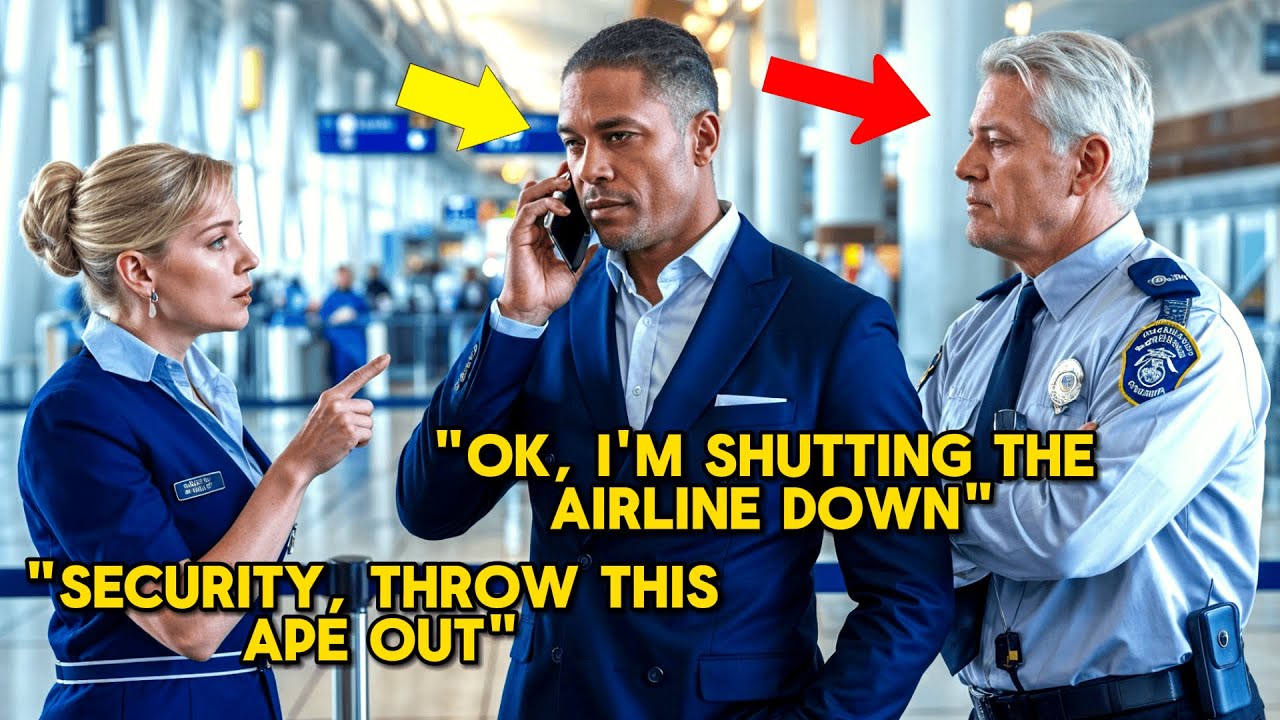
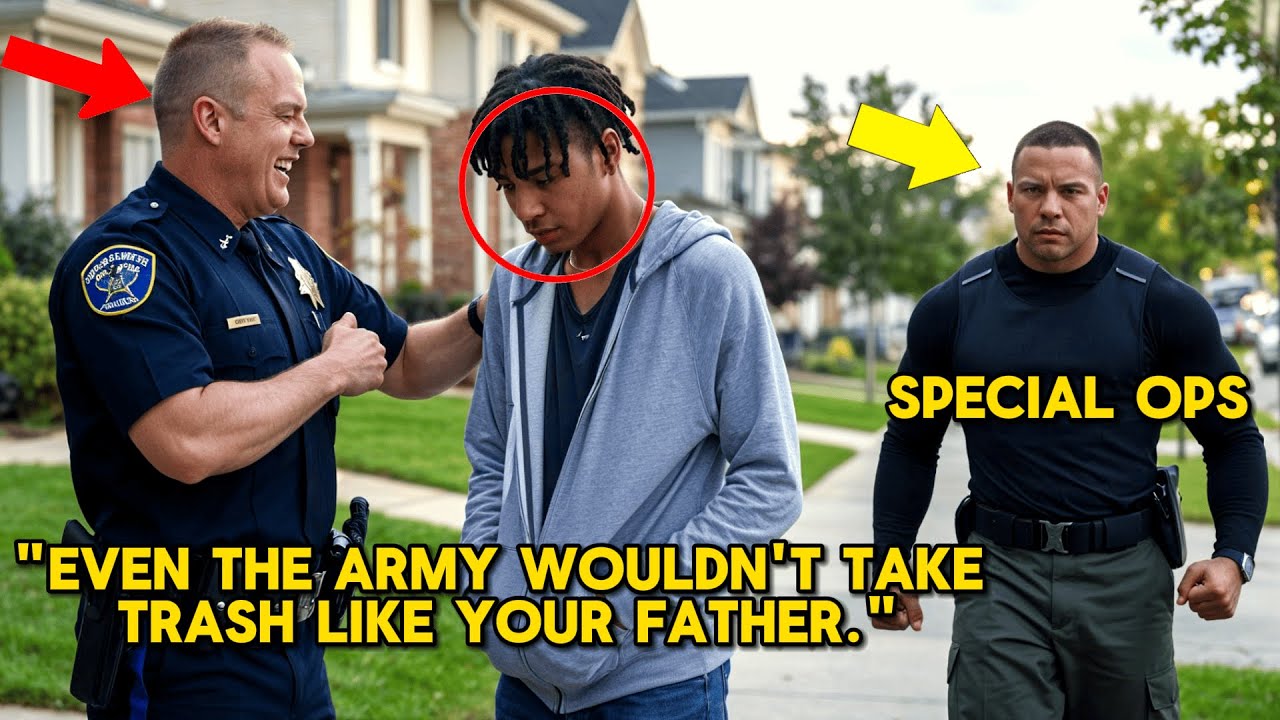
He was stopped by two policemen. The reason was a vague report of some suspicious person. Their eyes, their tone, everything was tinged with judgment and prejudice.
He tried to keep his cool, to respond with reason, with his civil rights, but his calmness only seemed to add fuel to the fire. The insults began to pour out, aimed at his skin color, at his inadequacy in their eyes. They did not accept resistance.
even the most mild words. They only saw a stubborn black man who needed to be educated. And then the worst happened.
Amidst the screams and shocked looks of the people around him, he was violently restrained. The cold sound of handcuffs was heard tightening around his wrists. A successful, respectable man now being treated like a dangerous criminal in public.
The two policemen were gloating, thinking that they had just achieved a feat and taught the other man a lesson. Little did they know that they had just made a fatal mistake. They had no idea who the man they had just insulted and handcuffed really was.
What shocking secrets are about to be revealed? What terrible consequences await the two abusers? And will justice be served when the truth is revealed?
Let's listen to this dramatic story to find out the answers. The Chicago night was drawing to a close as the United Airlines plane touched down gently on runway 28R at O'Hare International Airport. Elias Vance let out a soft breath, a gesture almost invisible to those around him in the sparse first class cabin, but a significant relief after a nearly 4-hour flight from Washington DC.
His unscheduled trip to a closed-d dooror security conference in Europe had gone on longer than expected, and now all he wanted was to get home to the rare piece he could find amid his hectic schedule. He waited patiently until the seat belt sign went off and the plane came to a stop at gate B12. In his late 50s, Elias Vance still had the tall, lean build of a man who had spent much of his life in law enforcement and intelligence.
His gray hair was neatly trimmed, his face was rugged, but his eyes were sharp, calm, and his observation almost instinctive. He wore a well-tailored but understated suit, his dark blue tie loosened a little by the long flight. His appearance was one of quiet professionalism and authority without being particularly conspicuous, a skill he had honed over years of working in the shadows and the political spotlight.
He carried only a black leather briefcase containing classified documents and a small satchel for his personal essentials. There was no entourage, no visible secret service escort. That was how he usually traveled on unofficial or highly confidential trips, avoiding attracting unnecessary attention in public places.
Airports with their crowds and potential chaos are always a highly vigilant environment, even for the head of America's most powerful investigative agency. As the plane doors opened, Vance joined the stream of passengers wearily disembarking. He pulled his small bag, his briefcase tucked under his arm, and walked at a steady pace, his eyes scanning his surroundings as a deeply ingrained professional habit.
He noted faces, gestures, abandoned objects, an automatic reflex to assess the environment and detect signs of abnormality. The terminal 1 waiting area was crowded despite the late afternoon, the loudspeakers announcing flights, the wheels of suitcases clattering across the floor, and voices of all tones and tones created the cacophony typical of international airports. Vance kept a safe distance from the people around him, quietly heading toward the transfer area to catch his next flight to DC.
He had no checked luggage, a habit that saved time and minimized risk. Meanwhile, not far from gate B12, two Chicago Police Department officers were on routine patrol in the airport area. Officer Gary Peterson, a white man in his 50s, his face deeply lined with fatigue and discontent, was leaning against a pillar, his eyes absent-mindedly watching the people passing by.
Next to him was Officer Ryan Hayes, much younger in his 30s, also white with a somewhat energetic appearance, but lacking the confidence of experience. Peterson muttered something about long shifts and inadequate pay. He had been doing this job long enough to be bored and cynical.
Racial and class prejudices were ingrained in him, turning security into an opportunity to take out his personal frustrations on people he deemed out of place or suspicious. Suddenly, the walkie-talkie on Peterson's shoulder squeaked and then went silent, replaced by a message on the screen of his handheld device. a report from some airport security officer about a suspicious individual moving through gate B12.
The information was extremely vague. Male, black, wearing dark clothing, looking nervous, moving alone. No specific behavior described, no obvious signs of foul play, just a subjective sense of suspiciousness based on superficial factors.
Peterson skimmed the message, a knowing smirk slowly spreading across his rumpled face. His gaze swept over the crowd pouring out of gate B12 and stopped immediately on Elias Vance, the only black man in sight who fit that ridiculously generic description. "Hey, Ryan," Peterson nudged his young colleague.
"Looks like we have a potential client. Exactly as described. " There was a hint of gloating in his voice.
Hayes followed Peterson's direction and saw Vance walking calmly. He hesitated for a moment. The other man looked perfectly normal, even had an air of authority about him.
But Peterson was the more experienced man, and Hayes was used to following orders and trusting his judgment, even if that judgment was sometimes tinged with prejudice. It fits," Hayes said hesitantly, trying to show that he had noticed the suspicious thing, too. Peterson needed no further confirmation.
He pushed himself away from the pillar, adjusted his cap, and stroed toward Vance with haze, his bearing trying to be authoritative, but hinting at arrogance. They stopped Vance so abruptly that he almost stopped. "Sir, stop!
" Peterson's voice rang out, dry and disrespectful. Elias Vance stopped. He turned to face the two policemen, his face showing no surprise or fear, only a small flicker of annoyance in the depths of his eyes.
He had encountered this situation before, though not as often in recent years, as his status had changed, but he knew the feeling of being scrutinized, judged simply because of the color of his skin. Is there a problem, officers? His voice was low, even, and controlled.
It was the voice of someone accustomed to dealing with stressful situations and keeping his cool. But to Peterson, that calmness was interpreted as defiance. Officer Peterson approached Vance, his gaze scanning the man from head to toe.
He was standing closer than necessary, a gesture intended to exert pressure and influence. We have a report of a suspicious person matching your description in the area. Peterson said his tone as matter of fact as if it were an undeniable fact.
Please show me your identification. Elias Vance remained calm, but he did not accept such a request without reason. What is the specific report, officer?
He asked, his voice even but with an underlying sharpness. May I know what I am suspected of? I believe you require reasonable suspicion to stop and demand a citizen's papers.
He used legal jargon casually, not to show off, but to remind them of the limits of his authority. Vance's precise words and calm demeanor seemed to irritate Peterson even more. He hated know-it-alls, especially blacks, whom he considered his inferiors.
"Don't ask so many questions," Peterson snapped, his voice impatient. "This is an airport. We have the right to search anyone.
Just show your papers. Do you have something to hide? His gaze turned hostile.
Vance realized that arguing about the law would probably only make matters worse. He sighed discreetly, then quietly pulled his wallet from his inside pocket, took out his Virginia driver's license, and handed it to Peterson. He knew that the address in Virginia, far from Chicago, would be another reason for their suspicions.
Peterson snatched the license, glanced at the information, then looked back up at Vance with contempt. Elias Vance, all the way from Virginia, he smirked. What the hell are you doing in Chicago dressed like you're going to a meeting at the White House?
You don't look like you're here to visit family or on vacation. His tone was sarcastic and judgmental. Officer Hayes, seeing that his senior was in the ascendancy, boldly interjected, trying to show that he was also sharp in criminal identification.
Or are you on a mission, transporting contraband or tracking a target? These speculations were completely baseless, uttered based only on Vance's skin color and outfit, along with the vague report as a background. Anger began to simmer in Elias Vance's chest.
He had spent his life serving this country, upholding the law and justice. And here he was enduring humiliation and unjust accusations from the very men in uniform who were supposed to protect that very thing. But decades of experience and discipline kept him in check.
He knew that losing his temper now would only lead him right into the trap they were setting. "I'm on business," Vance replied, his voice cool but controlled. and I repeat, my job or my attire is none of your business.
It is certainly not a legitimate reason for you to stop me, question me this way, and make insulting innuendos. " Peterson sneered a cruel laugh. "Oh, business trip?
What kind of mysterious fertive business trip or some shady business deal that people like you get involved in? " The phrase people like you was uttered with a malicious emphasis. Unable to conceal the deep racial undertone, this time Vance could no longer remain silent, his gaze fixed on Peterson, becoming as cold as a knife.
"Officer," he said, his voice low, but powerful. "Your words were not only completely inappropriate, they were blatantly discriminatory. I demand that you cease this attitude and language immediately.
Your conduct has crossed the line of what is acceptable. Being directly accused of discrimination by a black man was like a slap in the face to Peterson's sick pride. He exploded, his face turning red.
"When did I ever discriminate? " he shouted, swearing and switching to a rude, disrespectful tone. "You're the one in question here.
Don't lecture me. Who do you think you are? " Vance stood tall, his eyes unwavering in the face of the officer's fury.
I am a citizen of the United States and I have the right to be free from harassment and abuse by law enforcement. I have no obligation to answer your irrelevant and personally offensive questions. If you do not have probable cause to arrest me based on concrete evidence, then please move aside and let me pass.
With that, he shifted slightly, intending to step past them. That action for Peterson was the final straw. It was a direct challenge to his authority.
"You dare walk away! " Peterson roared. Resisting an officer, "You must have something.
" He turned to Hayes, his eyes beckoning. "Get him! He may be armed.
Restrain him! " The blatant lie was used to legitimize the violence to come. Hayes, though momentarily hesitant as he met Vance's steady gaze, was caught up in Peterson's stern command and caught up in the escalating tension and instinctively obeyed.
He lunged forward trying to grab Vance's arm. Elias Vance, with reflexes honed over years of exposure to danger, reacted instinctively to defend himself. He didn't attack, simply spun away and swatted Hayes's arm away.
"Don't touch me! " he shouted, his voice finally betraying the pent-up anger. That act of self-defense was immediately interpreted by both officers as aggressive resistance.
"See, he's resisting," Peterson shouted, also rushing to Hayes's aid. A brief but violent struggle broke out in the middle of the airport lobby. The passengers around them panicked and moved away, some taking out their phones to record the chaos.
Vance, despite his size and self-defense skills, knew that fighting back would only escalate the situation and put himself and others at risk. He tried to keep his balance, defending himself while also speaking out against their violence, but the strength of the two younger, stronger, and more aggressive policemen finally prevailed. They wrestled him to the floor, the impact momentarily stunning him.
His briefcase and bag fell to the ground, spilling out a few personal items. Hayes seized the opportunity, pulling out a pair of shiny handcuffs and violently twisting Vance's muscular arms behind his back. The cold metal clanged as the handcuffs tightened around his wrists.
A sharp pain and numbness shot up his arms, but the physical pain was nothing compared to the humiliation and anger that surged through him. being treated like a dangerous criminal in public, all because he dared to stand up for his rights in the face of injustice and prejudice. Peterson stood panting, looking at the handcuffed Vance with a crooked grin of triumph on his face.
"See," he said, his voice dripping with glee. "I told you, stubborn, pretentious type. Now you'll have to talk nice at the police station.
" He bent down, picked up Vance's driver's license, waved it in front of him mockingly, and stuffed it into his pocket. Let's see if you can hold your tongue there. Elias Vance gritted his teeth, trying to suppress a groan of pain and frustration.
He closed his eyes for a moment, took a deep breath, and tried to regain control. This fight wasn't over. It had just begun in the worst possible way.
Two policemen lifted Elias Vance by the armpits. His expensive suit was now disheveled. His jacket was a skew, and one knee of his trousers had a faint stain from his fall.
But his eyes, when they opened, were not filled with fear or despair. They were cold, deep, and contained an inner strength that made people weary, even though he was in a completely vulnerable position. Peterson, still angry and intoxicated with his newly demonstrated power, looked at the handcuffed Vance with open contempt.
He moved closer, his voice full of malice, deliberately trying to further humiliate the black man who had dared to oppose him. "Okay, Vance," Peterson gritted his teeth, emphasizing the name he had read off the driver's license, as if mocking the name itself. You like to be tough, don't you?
Like to talk your rights to the cops? Now what? Who do you think you are to oppose us?
The question wasn't a question seeking an answer, but a vicious challenge, a lastditch effort to break the spirit of the subdued prisoner. Vance, his wrists throbbing from the tight cuffs, stood as straight as he could. He looked Peterson straight in the eyes, red with anger, and there was no wavering in his voice.
His voice rang out clearly, strangely calm over the surrounding noise, cutting through the murmurss of the curious crowd. I'm Elias Vance. The answer was simple, direct, and without any hint of submission.
Peterson smirked, a superior smile. I know you're Vance. So what?
That name doesn't mean anything here. You're just a rebel. Vance did not reply to the insult.
His eyes remained fixed on Peterson, a cold, judgmental gaze. Then he continued slowly, each word distinct, the weight of each word like an invisible hammer blow through the tense air. Manager.
There was a short silence. Peterson and Hayes looked at him, waiting. Federal Bureau of Investigation.
The last three words were spoken with absolute certainty, without a moment's hesitation. director, Federal Bureau of Investigation, FBI. Silence suddenly fell over the small space where they stood.
The noise of O'Hare Airport seemed to be sucked away. All that remained was the ringing in their ears and the look of utter shock on the faces of Officer Gary Peterson and Officer Ryan Hayes. The smirk on Peterson's lips froze, then dissolved into a look of utter bewilderment.
The angry red on his face quickly faded, replaced by a deathly white. His eyes were wide open, staring at Vance as if he had just heard something unbelievable, as if the man standing before him, his hands cuffed behind his back had suddenly become another entity. Cold sweat began to form on his forehead and temples.
His mouth opened, trying to form a sound, but only incoherent, meaningless gibberish came out. You You said what? Peterson finally managed to form a complete sentence, but his voice was broken and trembling uncontrollably.
The director of the FBI. He staggered, taking an involuntary step back, his eyes filled with terror as he looked at Vance as if he had just faced a terrifying supernatural force. Officer Ryan Hayes, the younger of the two, reacted even worse.
When he heard the last three words, he froze, his face drained of color. The hands that had been holding Vance's cuffed arms dropped reflexively. He stared at Vance, then at Peterson with a desperate, pleading look, then down at the cuffs on the most powerful man in federal law enforcement whom he had just helped subdue and arrest.
Absolute terror gripped his mind. "Oh, God," he moaned, his voice trembling. "No, it can't be.
It can't be true. " His legs went weak, his knees shaking. The sudden change from the two policemen's arrogant, aggressive attitude to panic and extreme fear happened so quickly and so clearly.
The people around, even though they couldn't hear the whole story, could sense that something extremely serious had just happened. The whispers stopped, replaced by curious and surprised looks directed at the three people. The phones continued to record, capturing this incredibly dramatic moment.
Peterson was the first to break free from his stuper, driven by his instinct to survive. The fear of the terrible consequences, job loss, prosecution, jail, overrode all other thoughts. He rushed toward Vance, almost kneeling before him, his voice changing completely, pleading, urgent, desperate.
"Mr Mr Director, oh my god, please, please forgive me. " Peterson stammered, his face pale, sweat pouring down his face. "This This is just a terrible mistake.
A terrible mistake. We don't know. We really don't know who you are.
He turned sharply to Hayes, who was still standing there and shouted in a voice shaking with panic, Hayes, you idiot. What are you standing there for? Take the handcuffs off.
Take the handcuffs off the director right now. Hurry. Do you want us both to go to jail?
Hayes jumped as if he had been electrocuted. He fumbled to pull the keys from his belt, but his hands were shaking so much that they clattered to the floor. He bent down to pick them up, his face blank, fumbling for the right handcuff key.
It took him a few precious seconds of tense silence before he finally inserted the key into the lock. There was a dry click as the handcuff slid free, freeing Elias Vance's deeply scarred wrists. Throughout, Peterson pleaded, his voice filled with tears and belated remorse.
We We're so sorry, director. It's just that the report, it was so vague. We were just trying to do our job.
Maybe we went a little too far. Please, please forgive us. Please don't ruin our careers.
We have families. Elias Vance slowly reached forward with both hands, gently rubbing the painful marks on his wrists. He said nothing.
He did not respond to the desperate please. Did not express anger or forgiveness. He simply stood there silently watching the two cowering men with a cold, deep, judgmental gaze.
The silence of the director of the Federal Bureau of Investigation was a thousand times more terrifying than any accusation or threat. It signaled the coming storm. Just as the air thickened with Peterson and Hayes's panic and Elias Vance's eerie silence, a deep, steady, authoritative voice rang out from the slowly dispersing crowd.
What the hell is going on here? Lieutenant David Miller, the CPD officer on duty at O'Hare, walked quickly over. He was a white man in his early 40s with a serious professional demeanor.
He must have heard about the disturbance over his radio, or perhaps one of the passengers had called in quickly. He was accompanied by two other officers ready to assist if needed. Lieutenant Miller's eyes scanned the scene and immediately took in the unusual situation.
Elias Vance, a black man in a suit with red wrists, stood facing his two subordinates, Peterson and Hayes, who were in a state of near collapse, pale-faced, sweating, and stammering incoherent apologies. Miller might not have recognized Vance immediately, but he knew enough to know that his two officers had done something extremely serious. Peterson, Hayes, stand at attention," Miller ordered, his voice unyielding.
"Report the situation immediately. " Peterson and Hayes jerked, trying to stand up straight, but still looking shaken and frightened. Peterson tried to explain, but his words were incoherent and contradictory, blaming false reports and misunderstandings.
Lieutenant Miller, however, was not so easily fooled. He looked at Vance, who remained strangely calm. "Sir," Miller said to Vance respectfully, sensing an unusual aura from the man.
"I am Lieutenant Miller, overseeing this area. It appears that an unfortunate incident has occurred. Could you tell me what happened?
" Elias Vance spoke now, his voice still low and even, showing no signs of agitation or fear. "Lieutenant Miller," he began. I am Elias Vance.
He paused, letting the name sink in. I was unjustly stopped by your officers on a false report. They questioned me with insulting and discriminatory questions.
When I demanded to know the reason and refused to answer inappropriate questions, they charged me with resisting arrest, used excessive force, and placed me in handcuffs. Miller listened intently, his face growing more serious. He recognized the name Elias Vance, but couldn't immediately make the connection.
Vance continued, his voice unchanged. I believe that the actions of Officer Peterson and Officer Hayes were a serious violation of my civil rights and the professional standards of the police department. He looked Miller straight in the eye.
And just so you're clear, Lieutenant, I'm the director of the Federal Bureau of Investigation. The last statement struck Lieutenant Miller like a thunderbolt. He froze for a moment, looking at Vance, then at his two stunned subordinates.
Now he understood why they were so frightened. He had heard of FBI Director Elias Vance, but had never met him in person. This was far beyond anything he had ever dealt with.
Miller's response was quick and professional. He turned to Peterson and Hayes, his voice sharp. You two surrender your weapons badges and radios immediately.
You are suspended indefinitely pending the outcome of the investigation. These two officers, he pointed to the two men with him, will escort you to the security office. Peterson and Hayes did not dare to resist, silently following orders in despair and fear.
Their futures were almost decided at that moment. After Peterson and Hayes were escorted away, Lieutenant Miller turned to face Director Vance, his expressions solemn and apologetic. "Director Vance," he said, his voice sincere.
"On behalf of the Chicago Police Department, I would like to extend my deepest and most sincere apology for the completely unacceptable behavior of the officers under my command. This was an extremely serious and shameful incident. We are committed to conducting a thorough, transparent internal investigation and treating this incident with the utmost seriousness.
Vance nodded slightly, accepting the apology, but his expression remained cold. Lieutenant, I appreciate your professionalism. I request that this entire incident be officially documented immediately.
And most importantly, I request that the entire video and audio footage from both Officer Peterson and Officer Hayes's body cameras be preserved intact and unedited. That will be the core evidence. Your request will certainly be carried out, Mr Director Miller affirmed.
We will provide all necessary cooperation with any further investigation, including federal. He understood that this case would not stop at the local level. Soon after, information about the shocking incident was quickly reported to the highest levels of the Chicago Police Department, the mayor's office, and of course, the FBI and Justice Department headquarters in Washington, DC.
A real earthquake was spreading through the law enforcement community. The investigation was conducted at breakneck speed and in close coordination between the CPD's Internal Affairs Bureau and the Department of Justice's Civil Rights Unit and the FBI. The body cam footage of Peterson and Hayes became irrefutable evidence revealing the entire course of events.
From the vague report excuse, Peterson's racist and offensive words, Hayes's complicity and violence, to the moment of panic and pleading after learning of Vance's true identity. Peterson and Hayes's work records were also thoroughly reviewed. As expected, Officer Peterson had a troubling history with numerous previous complaints of brutality, abuse of power, and discriminatory language.
However, for some reason, these incidents were often handled lightly, dismissed, or swept under the rug. Officer Hayes, while not as egregious as Peterson, was noted to lack independent judgment and to have a tendency to blindly follow orders from superiors, even when they appeared to be wrong. The investigation went beyond just two individuals to look at systemic issues within the police department.
Whether there was cover up or tolerance for similar misconduct, the FBI director's case inadvertently became a powerful catalyst to expose the dark corners. The results of the internal and federal investigations were inconclusive. Both Gary Peterson and Ryan Hayes were formally fired from the Chicago Police Department for serious violations of ethics, professional procedures, abuse of power, and racial discrimination.
But the consequences don't stop there. Based on the seriousness of the incident and the clear evidence from the body cam footage and testimony from the FBI director, the US Department of Justice has decided to prosecute both former officers under federal law. They are charged with deprivation of rights under color of law 18 US code section 242, a serious federal crime that targets officials who abuse their power to deprive citizens of their legal rights.
In addition, they may face additional charges under Illinois state law for assault and unlawful detention. The trial of Gary Peterson and Ryan Hayes has attracted a great deal of media and public attention. It is not only a case of two errant police officers, but also a test of law enforcement accountability and the fight against racism in the justice system.
The atmosphere in the courtroom of the Northern District of Illinois Federal Court in Chicago was tense. Peterson and Hayes sat at the defense table looking decades older, their faces gaunt, their eyes filled with worry and despair. They were no longer the brash police officers they had been at O'Hare airport.
On the prosecution side, the Justice Department's attorneys presented their case in a sharp and persuasive manner. They emphasized that the two defendants acted on racial prejudice rather than concrete evidence and abused the public trust and power they had to humiliate, assault, and illegally detain a citizen. The full body cam footage was played with every word and action of Peterson and Hayes clearly visible, causing murmurss and shocked expressions on the faces of the jury members as well as those attending the trial.
The highlight of the trial was the testimony of FBI Director Elias Vance. He appeared in a formal suit and took the stand with absolute calm and professionalism. He recounted the entire incident objectively and accurately, focusing on the violations of law and civil rights that he had suffered.
He did not show any anger or seek personal revenge. His calmness, clarity, and charisma gave tremendous weight to his testimony. He was not just a victim, but also an icon of law enforcement testifying against those who had tarnished the image of the profession.
The defense tried their best to minimize their client's charges. They argued that it was just an unfortunate mistake during a stressful day at work, that the defendants acted on false information from initial reports, and that they deeply regretted their actions. They tried to downplay the racial element, saying that it was just words said in the heat of the moment and not a reflection of the defendant's character.
However, these arguments were weak and unconvincing against the ironclad evidence of the body cam footage and Director Vance's testimony. After several days of intense trial, the jury retired to deliberate. The wait dragged on in silence, tension permeating the courtroom.
Finally, the door to the deliberation room opened. 12 jurors took their seats one by one, their faces expressionless. The jury foreman rose and read the verdict aloud.
For the defendant Gary Peterson, on the charge of civil rights violation under color of law, we the jury find guilty. For the charge of assault in the third degree, we find guilty. Each guilty sounded like a hammer hammer on the fate of the two former police officers.
Both Peterson and Hayes were found guilty on all the main charges against them. Peterson bowed his head toward the table, his shoulders shaking. Hayes closed his eyes, tears streaming down his cheeks.
The dream of a fragile reprieve was shattered. A few weeks later, the sentencing hearing took place. The federal judge who presided over the case read the verdict in a stern voice.
She emphasized the seriousness of police officers who are entrusted with the duty of upholding justice and serving the community, abusing their power and betraying their oath. She made it clear that racial discrimination is not just a personal affront but a threat to the foundations of a just society, eroding public confidence in the entire legal system. The defendant's actions not only harmed the victims, the judge said, looking directly at Peterson and Hayes, but also damaged the reputations of thousands of other dedicated police officers who risk their lives every day to protect the public.
Discrimination based on race is a cancer that must be eradicated from law enforcement. After a series of tough words, the final verdict was announced. Gary Peterson and Ryan Hayes were each sentenced to 6 years in federal prison.
A harsh sentence that sent a clear message that abuse of power and racism will not be tolerated, especially by those charged with upholding the law. Peterson and Hayes broke down when they heard the verdict. They were led away by marshals, ending their careers and beginning a long period of paying the price for the terrible mistake they made in just a few short minutes at O'Hare airport.
Elias Vance, present at the sentencing, watched silently. When the verdict was read, he nodded slightly, not in gloating, but in acceptance that justice, however belated and painful, had finally been served. The late afternoon sun shone through the large windows of the FBI director's office in the J.
Edgar Hoover building in Washington DC. Elias Vance stood there silently looking down Pennsylvania Avenue, the traffic rushing by below. It had been months since the trial in Chicago, but the echoes of the incident still lingered in his mind.
He felt neither joy nor victory. Justice had been served, and the two wrongdoers had paid the price. But a heavy, complicated feeling still hung over him.
He knew better than anyone that the reason his case had been resolved so quickly and thoroughly was largely because he was the FBI director. His power and position had become both a shield and a sword for justice. But what if he had been just an ordinary Elias Vance, a middle-aged black man traveling for work?
well-dressed, but without the title of authority that came with it. Would his words have been heard? Would the body cam footage have been considered fairly?
Would Peterson and Hayes have been fired, prosecuted, and sentenced as harshly? Or would the case have been swept under the rug, dismissed as an unfortunate misunderstanding, with him receiving only a cursory apology, if any? The answer he didn't want to admit but always had in the back of his mind was probably not.
The O'Hare incident, while a bitter and humiliating personal experience, became a harsh reminder of a larger, more painful reality. The problem of racism and abuse of power is still deeply entrenched even in the law enforcement system of which he is a part and even the head of a key branch. His case is just the tip of a huge iceberg where countless other ordinary people, especially people of color, face unfair treatment, unreasonable suspicion, and even violence every day without a voice or protection.
He sighed, turned away from the window, and headed toward his desk, cluttered with papers. The responsibility on his shoulders was heavy. Not only to run the FBI, to deal with national security threats, organized crime, but also to lead by example, to promote change from within, to fight to build a law enforcement system that was truly fair, respected human rights, and did not tolerate any form of discrimination.
His personal case was over, but the larger fight continued. It required perseverance, courage, and unwavering determination. Elias Vance sat down in his chair, picked up a file.
His eyes were steady. He would continue his work, carrying the weight of his personal experience and the weight of his national responsibility to help build a future where no one, regardless of their color or status, had to endure what he had endured. True justice should not depend on who you are.
Thank you for taking the time to listen to this story. If you like this content, please click like and subscribe to the channel so you don't miss the next meaningful stories because tomorrow we will have another meaningful story for Do you?