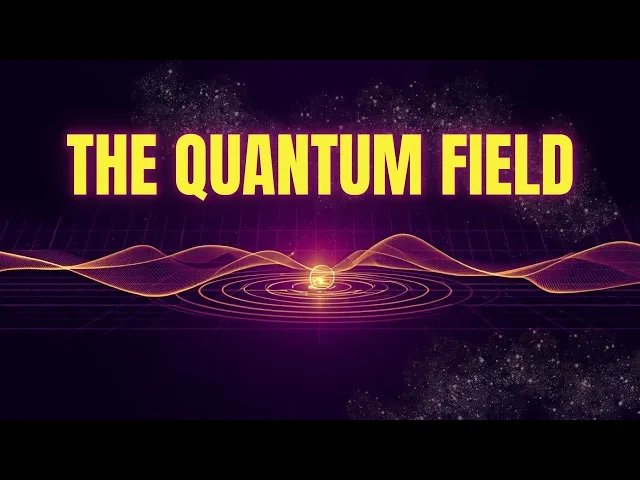
[music] What if empty space isn't empty at all? What if right now you're swimming through an invisible ocean, a quantum field that gives you mass, holds atoms together, and contains more energy than all the stars in the universe combined? What if this hidden fabric isn't just where reality exists, but what reality is? Welcome to Sleep Entangled, where Quantum field theory, vacuum energy, and the deepest mysteries of spaceime merge into bedtime voyages through the fabric of reality itself. If you find wonder in understanding the 0 point energy field that underlies all existence, remember to subscribe and
let curiosity about the Higs field and quantum vacuum guide your nights. Now settle in, breathe slowly, and drift with me into the hidden ocean where particles are born. Forces emerge, and The universe dreams itself into being. Chapter 1. The fabric of reality. What space is really made of? For centuries, we imagined space as emptiness, a void, a vacuum, a nothing through which matter moves. Isaac Newton pictured the universe as objects moving through absolute space, like actors crossing an empty stage. The stage itself did nothing. It simply provided room for the real action. Planets orbiting, apples
falling, light traveling. This view felt intuitive. After all, when you look up at the night sky, the darkness between stars seems like pure nothingness. Remove all the galaxies, all the dust, all the radiation, and what remains? Empty space. Or so we thought. But this picture of reality, comforting in its simplicity, would not survive the 20th century. Albert Einstein shattered the concept of empty space with his theory Of general relativity in 1915. Space, he revealed, is not a passive container, but an active participant in the cosmic drama. It curves, bends, and warps in response to mass
and energy. Imagine a trampoline. Place a bowling ball on it and the fabric dips creating a depression. Roll a marble nearby and it curves toward the bowling ball not because of some invisible force reaching across emptiness but because the fabric itself Is curved. This is Einstein's vision. Spacetime is the fabric and matter tells it how to curve. Suddenly, space became something. It had geometry, structure, properties. It could ripple with gravitational waves, expand with the universe, even tear at the edges of black holes. But Einstein's revolution was just the beginning. In the 1920s, as Einstein reshaped
our understanding of large- scale spacetime, another group of physicists was discovering something Equally strange at the smallest scales. Quantum mechanics revealed that particles, electrons, photons, atoms don't behave like tiny billiard balls. They behave like waves smeared across space in clouds of probability. But waves in what? Water waves need water. Sound waves need air. What medium carries these quantum waves? The answer slowly assembled over decades by physicists like Paul Derrick, Richard Fineman, and Julian Schwinger was Radical quantum fields. Not particles moving through space, but fields filling space. Every particle is an excitation, a ripple, a vibration
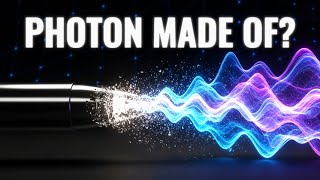
in an underlying field that permeates all of reality. The electron isn't a little sphere orbiting the nucleus. It's a disturbance in the electron field. The photon isn't a particle of light. It's a wave in the electromagnetic field. Even empty space stripped of all particles still contains these fields humming with potential Never truly empty. This shift from thinking in terms of particles to thinking in terms of fields is one of the most profound conceptual revolutions in physics. It means that what we call particles are not fundamental. Fields are fundamental. Particles are just what we see when
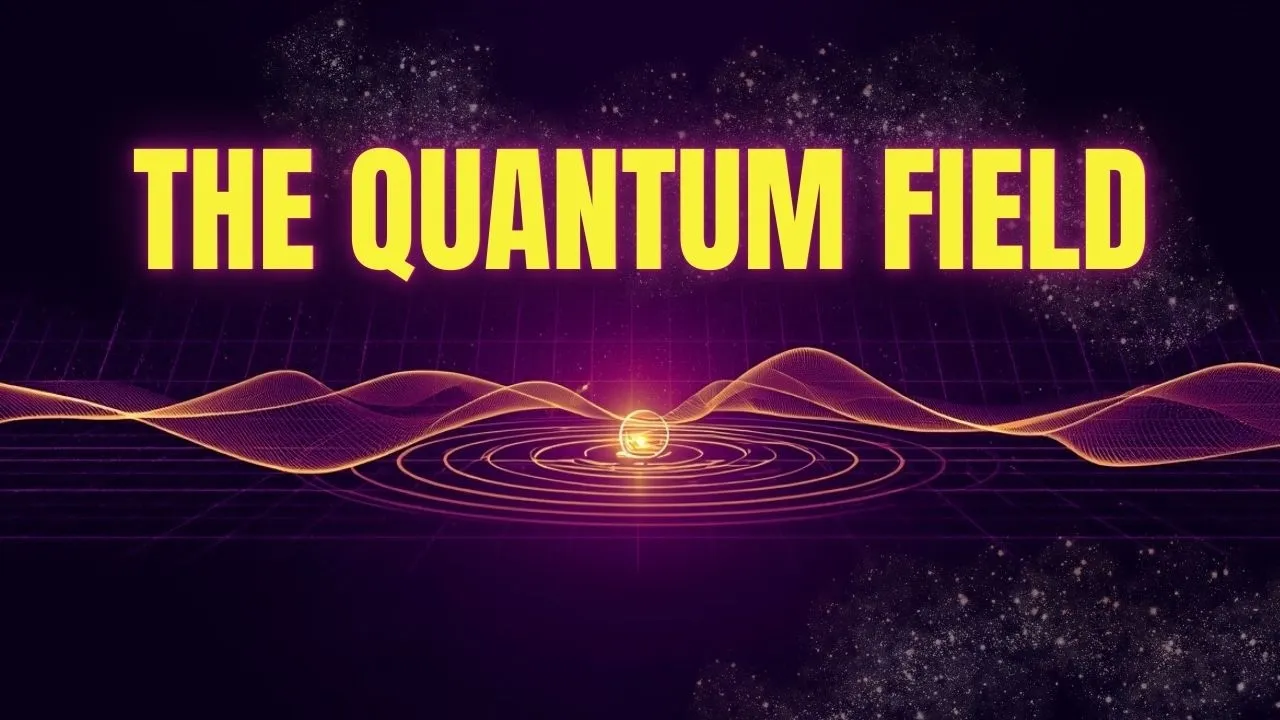
fields get excited enough to be detectable. Think of it this way. Imagine an infinite ocean, perfectly calm. That's the quantum field At its lowest energy state. Now, imagine a wave rising on that ocean. The wave isn't separate from the ocean. It is the ocean temporarily taking on a localized form. That wave is a particle. When the wave subsides, the particle disappears, but the ocean, the field remains. This is quantum field theory, and it's the most successful scientific theory ever devised. It predicts the behavior of matter and energy with astonishing precision, explaining everything from The glow
of atoms to the interactions inside particle accelerators. But here's where things get truly astonishing. If fields fill all of space and particles are just excitations of those fields, then what we perceive as the material world, solid, tangible, substantial, is actually patterns of energy rippling through an invisible substrate. Your body, the chair you're sitting in, the air you breathe, all of it is vibrations in quantum fields. Remove the vibrations and the fields remain silent but present. waiting for the next excitation to bring matter back into being. This means that space is not empty. It never has
been. Even in the darkest void between galaxies, quantum fields exist, stretching infinitely in all directions, carrying the potential for particles to emerge at any moment. So, let us reframe our question. Empty space isn't the absence of everything. It's the presence Of everything in its quietest form. A hidden ocean of fields, each one capable of producing the particles we see. The electromagnetic field gives rise to photons, the particles of light. The electron field gives rise to electrons. The quark fields give rise to quarks, which combine to form protons and neutrons. Even gravity, Einstein's curved spaceime, may
ultimately be understood as a quantum field, though we don't yet have the mathematics to fully Describe it. This ocean is not metaphor. It is reality. And you're not in the ocean. You are the ocean temporarily taking the form of a human being. a complex pattern of field excitations that has learned remarkably to ask questions about itself. So as you rest tonight, imagine yourself not as a solid object in empty space, but as a wave, a beautiful temporary disturbance in an infinite field. The ocean beneath you is always there, silent and vast, holding You in existence.
And when you dissolve into sleep, you do not disappear. You simply quiet, sinking back into the depths, waiting for the morning to bring you rippling into form once more. Now, let us descend deeper into this ocean and ask, what exactly is a quantum field? Chapter 2. What are quantum fields? The universe's operating system. To understand quantum fields, we must first Unlearn something fundamental. The idea that particles are the building blocks of reality. For over 2,000 years, from Democrus to Newton to the early 20th century, physicists believe that if you zoomed in far enough, you would
find tiny indivisible particles, atoms of matter, irreducible and fundamental. But quantum mechanics revealed a stranger truth. Particles are not the foundation. Fields are. A quantum field is a mathematical And physical structure that exists everywhere in space and time. It has a value at every point, a number that describes the field's strength or state at that location. When the field's value changes, when it oscillates or vibrates, we perceive those vibrations as particles. Think of it as the universe's operating system, the invisible code running beneath the visible interface. You see particles, but the reality is fields Executing
programs of energy and probability. For every type of particle, there is a corresponding field. The electron field permeates all of space. When it vibrates in a particular way, we detect an electron. When it's calm, no electron exists at that location, but the field is still there, a latent potential. The same is true for photons. The electromagnetic field fills the universe. Light is not emitted particles Traveling through space. Light is waves propagating through the electromagnetic field. Turn off a flashlight and the photons vanish, but the field remains waiting to be excited again. Quarks, the building blocks
of protons and neutrons, arise from quark fields. Gluons, which bind quarks together, come from the gluon field. Nutrinos, muons, W and Z bosons. Each has its own field, each a layer in the vast invisible architecture that underlies reality. In total, the Standard model of particle physics describes about 17 fundamental fields. These fields interacting according to precise mathematical rules give rise to all the particles and forces we observe. Here is where our central analogy becomes indispensable. Imagine an infinite ocean stretching in all directions. The ocean represents a quantum field. The surface of the ocean is mostly
calm, but occasionally a wave rises, a crest of water lifting above The average level. That wave is a particle. The wave is not separate from the ocean. It is the ocean temporarily taking a localized form. When the wave subsides, the water doesn't disappear. It returns to the smooth surface. Similarly, when a particle is absorbed or annihilated, the field doesn't vanish. The excitation simply quiets. This analogy captures something profound. Particles are not objects moving through Space. They are disturbances in an underlying medium. And just as multiple waves can exist on an ocean simultaneously, multiple particles can
exist as excitations in the same field. When you see two electrons, you're seeing two ripples in the same electron field. They are not separate entities brought into contact. They are regions of the same continuous structure, vibrating in slightly different locations. Fields are Everywhere, always. One of the most challenging concepts in quantum field theory is omnipresence. Fields are not localized. They do not begin or end. Every quantum field exists at every point in space from the center of the earth to the farthest galaxy extending infinitely in all directions. This means that right now as you lie
in bed the electron field, the photon field, the Higs field and all the others pass through your body. You are not Separate from these fields. You are made of them. Every atom in your body is a complex pattern of excitations in multiple fields, all vibrating in harmony to create the structure you call you. It also means that even in the deepest void of intergalactic space, regions where no particles exist for millions of light years, the fields are there, silent and patient, holding the potential for matter to appear if sufficient energy arrives. Quantum field theory describes
these fields with remarkable precision. Each field is governed by a mathematical equation that dictates how it evolves over time. For the electromagnetic field, it's Maxwell's equations combined with quantum mechanics. For quarks and gluons, it's the equations of quantum chromodnamics. For electrons and photons interacting, it's quantum electronamics or QED. A theory so accurate that it Predicts the magnetic moment of the electron to 11 decimal places. These equations reveal that fields are not static. They fluctuate constantly. Even at their lowest energy state, what we might call empty space, fields are never perfectly still. Quantum uncertainty forbids it.
There is always a jittering, a seething, a background hum of activity too subtle to observe directly but real enough to have measurable effects. This leads us to one of the most Important distinctions. The difference between the classical fields of the 19th century and the quantum fields of modern physics. Before quantum mechanics, physicists like James Clark Maxwell and Michael Faraday described fields classically. The electromagnetic field, for instance, had a definite value at every point. If you measured it, you got a precise answer. The field was deterministic. Plug in the initial conditions and you Could predict its
behavior forever. Quantum fields are different. They are inherently probabilistic. The field doesn't have a single definite value at a point. It has a wave function, a cloud of possibilities. Only when you measure does the field decide what value to take. And even then, the measurement doesn't reveal the field itself, but only the particle, the excitation that emerges from it. This proper ballistic nature is why quantum Field theory is so strange. Particles don't follow predetermined paths. They emerge from fields according to probabilities, appearing and disappearing, interacting and transforming in a cosmic dance governed not by certainty
but by likelihood. If fields are fundamental, what does that mean for reality? It means that the universe is not made of things. It's made of processes, ongoing vibrations, excitations, and interactions within Quantum fields. You're not a collection of particles arranged in a clever way. You are a pattern of activity in the fields, a localized symphony of vibrations that maintains its coherence for a brief span of cosmic time. When you move, you are not pushing particles through space. You're shifting the pattern of field exitations from one region to another. This might sound abstract, but it has
profound implications. It means that at the Deepest level, there is no separation. All matter and energy are expressions of the same underlying fields. The distinction between you and the world is not fundamental. It's a matter of where the excitations are most concentrated. Imagine for a moment that you can see these fields, layers upon layers of invisible oceans, each one stretching infinitely in all directions. The electron field shimmers with the positions of electrons. The photon field Glows with light. The quark fields hum with the matter inside atoms. And at the intersection of these fields, where they
all overlap and interact, there you are, a temporary convergence, a meeting point of forces and energies, a conscious excitation in the universe's vast operating system. Let that image settle gently as you breathe. The fields are always there beneath and within, holding you in being. Now let us turn to one of the most Famous fields of all. The Higsfield, the ocean that gives you mass. Chapter 3. The Higsfield. The ocean that gives you mass. The mystery of mass. Why do things have mass? It's a question so basic that for centuries no one thought to ask it.
An apple has mass because it's made of atoms. Atoms have mass because they contain protons, neutrons, and electrons. And those particles have mass because, well, because they do. But Because they do, is not an answer. In the 1960s, physicists realized that the standard model of particle physics, the theory describing all fundamental particles and forces, had a problem. According to the equations, particles should be massless. Electrons, quarks, even the W and Z bosons that carry the weak nuclear force should all zip through space at the speed of light, weighing nothing. Yet, they don't. They have mass.
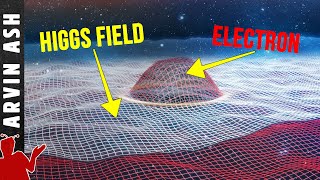
Something was missing from The theory. In 1964, several physicists independently proposed a solution. Among them was Peter Higgs, a British theoretical physicist working at the University of Edinburgh. He suggested that a new field, now called the Higs field, permeates all of space. Particles gain mass by interacting with this field. Imagine walking through an empty room. You move easily, encountering no resistance. Now imagine the room is filled with water. Suddenly, every step Requires effort. You feel heavier, slower, as if you've gained mass. The water hasn't added matter to your body. It has added resistance to your
motion. The Higsfield works similarly. Particles that interact strongly with the Higs field, like electrons and quarks, experience more resistance. They acquire mass. Particles that don't interact with the Higs field, like photons, remain massless, traveling at light speed forever. This interaction is not a force in the traditional sense. It's more like a property of space itself. The Higs field has a nonzero value everywhere, even in the deepest vacuum. You are at this very moment moving through the Higs field. And that interaction is what gives the particles in your body their mass. For decades, the Higs field
was theoretical. It explained the data beautifully. But no one had detected the Higs bosen, the Particle that would prove the field exists. Detecting it required enormous energy, the kind found only in the most powerful particle accelerators on Earth. On July 4th, 2012, scientists at CERN's Large Hadron Collider announced the discovery. They had found the Higs Bosen, a particle with a mass of about 125 billion electron volts, roughly 133 times heavier than a proton. The discovery confirmed that the Higs field is real. In 2013, Peter Higgs and Francois Anglair who had independently contributed to the theory
were awarded the Nobel Prize in physics. It was the culmination of nearly 50 years of theoretical and experimental work, and it completed the standard model. The media called it the God particle, a nickname Higs himself disliked. But the hyperbole was understandable. This field is what allows matter to exist. Without it, particles would be massless, unable to slow down, unable to Clump together into atoms, molecules, stars, planets, or people. Let's deepen the analogy. Imagine the Higs field as a thick invisible molasses filling the universe. Particles move through this molasses constantly. Some particles like electrons and quarks
interact strongly with it. They get stuck more easily, requiring more energy to accelerate. That stickiness is what we perceive as mass. Other particles, like photons, glide through the molasses without Interacting at all. They experience no resistance, no stickiness, and thus have no mass. They move at the speed of light, the cosmic speed limit for massless entities. The strength of the interaction, the stickiness is determined by a property called the Yukawa coupling. Each type of particle has its own coupling constant. The electron has a small coupling, so it has a small mass. The top quark has
a large coupling, so it has a large mass about 35,000 times heavier than an electron. Even the Higs Bzon itself has mass because it interacts with its own field. A strange self-referential feature unique to the Higs. What about protons and neutrons? Here's where things get subtle. Protons and neutrons make up most of the mass in your body, but they are not fundamental particles. They're composite, made of three quarks bound together by gluons, the carriers of the strong nuclear Force. The quarks inside a proton do get their mass from the Higs field, but that accounts for
only about 1% of the proton's total mass. The other 99% comes from the energy of the gluon field. The binding energy holding the quarks together. This energy via Einstein's equation E= MC² contributes mass. So when you stand on a scale, most of your weight comes not from the Higs field, but from the energy trapped inside protons and neutrons. The Higs gives mass to the fundamental particles. But the bulk of everyday mass arises from the confinement energy of the strong force. Still, without the Higs, those fundamental particles would have no mass at all, and the universe
as we know it could not exist. Atoms wouldn't form. Chemistry wouldn't happen. Life would be impossible. In the first moments after the Big Bang, the universe was unimaginably hot. So hot that the Higsfield was effectively Turned off. Particles zipped around massless, interacting wildly, unable to slow down as bind together. But as the universe expanded and cooled, a critical moment arrived. About a trillionth of a second after the big bang. The temperature dropped below a threshold and the Higs field switched on, acquiring a nonzero value throughout space. Suddenly, particles gained mass. Electrons, quarks, and W and
Z bosans felt resistance for the first time. They Slowed down, allowing them to interact more stably. This phase transition, comparable to water freezing into ice, was one of the most important events in cosmic history. It set the stage for the formation of atoms, stars, galaxies, and eventually you. The Higsfield didn't turn on and then turn off. It remains active filling every cubic cm of space interacting with particles continuously. Right now as you rest the Higs field is passing through you giving mass to every Quark and electron in your body. It's a humbling thought. Your existence
depends on this invisible ocean. a field you cannot see, touch, or directly perceive, but one that shapes the very structure of matter. So, as you settle deeper into rest, imagine the Higsfield as a vast, calm sea surrounding you. Every atom in your body is like a boat floating on that sea, held in place by the gentle resistance of the water. Without the sea, the boats would scatter at light Speed, never coming together, never forming the vessel you call yourself. The sea is silent, invisible, but ever present. It gives you substance. It gives you form. It
allows you to exist, solid and real in a universe that would otherwise be a blur of massless light. Rest in that ocean tonight knowing that the Higs field, this quiet miracle of physics, is cradling you in being. Now, let us explore something even stranger. The energy hidden in empty space. The Restless ground state of the quantum vacuum, 0 point energy. Chapter 4. Zero point energy. The universe's restless ground state. The quantum dance that never stops. In classical physics, the ground state, the lowest energy state of any system is stillness. A pendulum at rest hangs motionless
at the bottom of its swing. A spring at equilibrium neither stretches nor compresses. At absolute zero, where Temperature is as low as it can go, classical physics predicts that all motion ceases, atoms freeze, vibrations stop, the universe settles into perfect calm, but quantum mechanics shatters this expectation. Verer Heisenberg's uncertainty principle formulated in 1927 states that you cannot simultaneously know both the position and momentum of a particle with perfect precision. The more precisely you measure one, the less Precisely you can know the other. This uncertainty is not a limitation of measurement tools. It's a fundamental property
of reality and it has a profound consequence. Even at absolute zero, even in the deepest vacuum, quantum fields cannot be perfectly still. They must always fluctuate, jittering with a minimum amount of energy called 0 point energy. Imagine trying to balance a pencil on its tip. Classical physics says that if you could Get it perfectly vertical with zero motion, it would stay there forever. Quantum mechanics says that's impossible. Tiny unavoidable vibrations, quantum fluctuations would inevitably knock the pencil over. The same principle applies to quantum fields. Even when a field is in its lowest energy state with
no particles present, the field itself vibrates. These vibrations are not thermal. They don't arise from heat or external energy. They Arise from the inherent uncertainty of quantum mechanics. Every quantum field in the universe is constantly fluctuating. Even in regions of space where no matter or radiation exists, the electromagnetic field jitters, the electron field quivers, the Higs field hums. This is 0 point energy, the irreducible minimum energy that all fields possess. One of the strangest consequences of 0 point energy is the appearance of Virtual particles. fleeting excitations in quantum fields that pop into existence and vanish
almost immediately. Here's how it works. The vacuum, though it has minimal energy, is not static. Quantum fluctuations can briefly borrow energy from the vacuum, creating particle antiparticle pairs. An electron and a posetron, for example, might spontaneously appear in empty space, but the borrowed energy must be repaid quickly. According to Heisenberg's Energy time uncertainty relation within a fraction of a second, the pair annihilates, returning the energy to the vacuum. These particles are called virtual because they exist only briefly, too short-lived to be directly observed. But they are not merely mathematical constructs. Their effects are real and
measurable as we'll explore in later chapters. If quantum fields are always fluctuating, always carrying 0 point Energy, then empty space is not truly empty. It contains energy an enormous amount according to calculations. When physicists try to add up the 0 point energy of all quantum fields across all frequencies, they arrive at an absurd result. The energy density of empty space should be approximately 10 to the power of 113 Jew per meter. This is a number so large it's almost meaningless. To put it in perspective, if the vacuum Energy in a single coffee cup were real,
it would contain more energy than all the matter in the observable universe. Yet, we don't see this. The universe is not bursting with energy. Clearly, something is wrong with the calculation or something is cancelling most of this energy. This is called the cosmological constant problem and it's one of the deepest puzzles in physics. We'll return to it in chapter 9. Despite the theoretical difficulties, 0 point energy Has observable effects. One of the most famous is the Casemir effect, which we'll explore in detail in chapter 6. But other effects also confirm that the vacuum is restless.
In the 1940s, physicists predicted that 0 point energy would slightly shift the energy levels of hydrogen atoms. This shift called the lamb shift after Willis Lamb who measured it in 1947 arises because the electron in a hydrogen atom interacts with the Fluctuating electromagnetic field. Virtual photons constantly pop in and out of existence around the electron subtly altering its energy. The lamb shift is tiny, less than one part in a million, but it was measured with exquisite precision, confirming that the vacuum is indeed alive with quantum activity. The restless ocean analogy. Return once more to our
ocean analogy. Imagine a vast sea stretching to the Horizon. At first glance, it looks perfectly calm, but look closer. The surface is never truly still. Tiny ripples barely visible dance across the water. Stirred not by wind but by the inherent restlessness of the molecules themselves. These ripples like 0 point fluctuations. They are not caused by external energy. They arise spontaneously from the quantum nature of the field. No matter how deeply you descend, no matter how Quiet the ocean becomes, these fluctuations persist, the ocean is never at rest. And this restless ocean, this quantum vacuum humming
with 0 point energy is the stage on which all of reality plays out. At the smallest scales, the plank scale about 10 to the -35th m 0 point energy has even more dramatic effects. Physicists like John Wheeler proposed that spaceime itself fluctuates at this scale, seething with quantum foam. In Quantum foam, spaceime is not smooth. It writhes and churns with tiny wormholes, black holes, and shifts in topology, appearing and disappearing in fractions of a plank time, 10 to the -43 seconds. These fluctuations are far too small to observe directly, but they represent the ultimate consequence
of 0 energy. Even the fabric of space and time cannot be perfectly still. 0 point energy forces us to reconsider the concept of nothingness. We once imagined empty Space as pure absence, the void, the blank canvas on which reality is painted. But quantum mechanics reveals that there is no such thing as true emptiness. Even in the absence of matter, energy and radiation, the quantum fields remain vibrating with their zero point motion, carrying the potential for particles to emerge at any moment. This means that nothing is not the opposite of something. Nothing is simply the quietest
form of something. A baseline hum. A restless ground state. A cosmic silence that is never truly silent. So as you drift tonight, imagine the space around you not as emptiness but as an invisible sea of energy vibrating gently, humming with possibility. Even in the stillness of your room, the quantum fields are alive, fluctuating, dancing. You're not resting in nothingness. You're resting in a Universe that never stops moving, never stops creating, never truly sleeps. And in that restless ocean, you are held a temporary pattern of calm within the eternal dance. Now, let us examine the strange
inhabitants of this vacuum. Virtual particles, the ghosts in the quantum machine. Chapter 5. Virtual particles. Ghosts in the quantum machine, borrowing energy from the void. We've seen that quantum fields fluctuate constantly, even in their lowest energy State. These fluctuations give rise to one of the strangest concepts in physics, virtual particles. A virtual particle is a temporary excitation in a quantum field created by borrowing energy from the vacuum. It exists briefly, sometimes for a fraction of a second, sometimes for a time so short it's almost meaningless before annihilating and returning the energy it borrowed. But here's
the critical point. Virtual particles are not just Mathematical tools. They have real measurable effects on the behavior of matter and forces. They mediate interactions between real particles shaping the structure of atoms, the strength of forces, and even the mass of particles themselves. The existence of virtual particles is permitted by Heisenberg's uncertainty principle. Specifically, the energy time version. It states that the uncertainty in energy delta E multiplied by the Uncertainty in time delta T must be at least equal to plank's constant divided by 4 pi delta E * deltat T greater than or equal to H
bar / 2. This means that for a very short time energy can fluctuate effectively appearing from nowhere without violating the laws of physics. The shorter the time, the larger the energy fluctuation allowed. Virtual particles exploit this loophole. A particle antiparticle pair can spontaneously appear in the vacuum, Exist for a brief moment, and then annihilate. As long as the borrowed energy is returned quickly enough, the universe's books balance, and no conservation law is violated. In the 1940s, Richard Fineman revolutionized quantum field theory by introducing a visual language for describing particle interactions. Fineman diagrams. These diagrams depict
particles as lines moving through spaceime with interactions represented by vertices Where lines meet. Virtual particles appear in Fineman diagrams as internal lines connecting vertices but never reaching the external world. For example, when two electrons repel each other, they don't touch directly. Instead, they exchange a virtual photon. One electron emits a virtual photon which travels through space and is absorbed by the second electron transferring momentum and creating the electromagnetic force. This exchange Happens constantly invisibly at every moment. Virtual photons flicker in and out of existence mediating the electromagnetic force between charged particles. The same is true
for other forces. Virtual gluons mediate the strong nuclear force. Virtual W and Z bosons mediate the weak force. And virtual gravitons, if they exist, would mediate gravity. Because of virtual particles, no particle is ever truly alone. Every electron is surrounded by a Cloud of virtual photons constantly being emitted and reabsorbed. These photons in turn can briefly become virtual electron positron pairs which then annihilate back into photons. This cloud called a quantum halo or quantum atmosphere affects the electrons properties. It alters the electron's effective charge making the charge you measure at a distance slightly different from
the electrons bare charge at its core. This phenomenon called charge Screening has been confirmed in particle accelerator experiments. Similarly, virtual particles contribute to the mass of particles. When you measure the mass of an electron, you're not measuring the mass of a lone particle. You're measuring the mass of the electron plus the energy of its virtual particle cloud. All combined via Einstein's E= MC². The most famous evidence for virtual particles comes from precision Measurements in quantum electronamics, QED. In the 1940s, Willis Lamb measured a tiny energy difference in hydrogen atoms that could only be explained by
virtual photons interacting with the electron. This lamb shift, as it's called, was one of the first confirmations that the quantum vacuum is not empty, but filled with fluctuating fields and virtual particles. In the 1960s, physicists measured the anomalous Magnetic moment of the electron, a property that describes how the electron interacts with magnetic fields. The standard model, including contributions from virtual particles, predicts this value to incredible precision, 11 decimal places. Experiments confirm the theory almost perfectly, providing one of the most stringent tests of QED ever performed. Are virtual particles real? This raises a philosophical question. Are
virtual Particles real or are they just mathematical conveniences? The answer depends on what you mean by real. Virtual particles cannot be directly observed. They exist for too short a time and attempting to measure them would collapse the quantum state. Destroying the very thing you're trying to detect. In that sense, they are not real in the same way a particle sitting in a detector is real. But their effects are undeniably real. The forces you Experience, the stability of atoms, the precise values of physical constants, all depend on virtual particles. To say they are just math is
to miss the point. The math describes nature. And if virtual particles emerge from that description and produce observable consequences, then they are as real as anything in quantum mechanics can be. Perhaps it's better to think of virtual particles not as objects, but as processes, Fluctuations in the quantum field that briefly take on particlelike characteristics before dissolving back into the field. The quantum jukebox. Here's a playful way to think about virtual particles. Imagine the quantum field as a vast jukebox capable of playing any song, any particle at any moment. Most of the time, the jukebox is
silent, resting in its lowest energy state. But occasionally, a coin is dropped in, not a physical coin, but a Quantum fluctuation, a brief burst of borrowed energy. The jukebox plays a song for a few seconds. A virtual particle appears and then the song ends. The coin is reclaimed, the energy returned and the jukebox falls silent again. This happens constantly everywhere in every quantum field. The universe is a cosmic jukebox playing an endless symphony of virtual particles. Each one a brief note in the Grand composition of reality. One of the most direct consequences of virtual particles
is the casemir effect, which we'll explore in detail in the next chapter, but let's preview it here. When two uncharged metal plates are placed very close together in a vacuum, they experience an attractive force. This force arises because the virtual particles between the plates are restricted. Only certain wavelengths can fit in the gap. Outside the plates, all wavelengths of virtual particles exist. This imbalance creates a pressure difference, pushing the plates together. The casemir effect is not just theory. It's been measured in laboratories with high precision, providing direct evidence that the vacuum is not empty, but
filled with quantum fluctuations, giving rise to virtual particles. Virtual particles remind us that reality is not made of solid unchanging objects. It's made of Processes, of interactions, of fleeting moments where fields borrow energy, take form, and dissolve back into potential. You too are part of this process. Every atom in your body is surrounded by a cloud of virtual particles constantly flickering in and out of existence. You're not a static thing. You're a pattern of activity held together by forces mediated by invisible ghosts that dance for an instant and vanish. So as you rest, imagine the
space around you Filled not with emptiness but with a shimmering haze of virtual particles, photons, electrons, quarks, gluons, all flickering into existence and dissolving away like fireflies on a summer night. You're not alone in the darkness. The vacuum teams with life, with potential, with the quiet activity of fields that never sleep. Now, let us turn to the most famous proof that the quantum vacuum is not empty. The Casemir effect. Chapter 6. The Casemir effect. Proof the Vacuum has energy. In 1948, Dutch physicist Hendrickk Casemir proposed something that sounded absurd. Two uncharged metal plates placed close
together in a perfect vacuum should attract each other. Not because of gravity, not because of electromagnetism, but because of the quantum vacuum itself. At the time, this idea was radical. If the plates are uncharged, why should they interact at all? Casemir's answer was elegant and strange. The vacuum between the plates contains fewer virtual particles than the vacuum outside. This imbalance creates a pressure difference pushing the plates together. For nearly 50 years, the Casemir effect remained a theoretical curiosity. Then in 1997, physicist Steven Lamaro at the University of Washington performed the first precise measurement Using a
torsion pendulum and goldcoated surfaces. He confirmed Casemir's prediction. The plates attracted each other exactly as quantum field theory predicted. It was direct undeniable proof that the quantum vacuum is not empty. The 0 point energy of quantum fields is real and it exerts measurable forces. How the Casemir effect works? To understand the case effect, we need to think carefully about virtual particles and quantum Fluctuations. The quantum vacuum is filled with virtual photons, fluctuations in the electromagnetic field at all possible wavelengths. Outside the plates, all wavelengths exist freely. Inside the plates, however, only certain wavelengths can fit.
Just as a guitar string can only vibrate at certain frequencies determined by its length, the virtual photons between the plates can only have Wavelengths that fit evenly into the gap. This restriction means there are fewer virtual photons between the plates than outside. The pressure from virtual photons outside is greater than the pressure inside creating a net force that pushes the plates together. The effect is extraordinarily small. For plates separated by 1 micrometer, 1 millionth of a meter, the force is about 0.01 pascals, roughly the pressure exerted by A single grain of sand. But it's measurable
and it increases dramatically as the plates are brought closer together. Steven Lamaro's experiment was a marvel of precision. He used a torsion pendulum, a device that detects tiny forces by measuring the twist in a thin fiber. One side of the pendulum held a flat gold coated plate. Nearby, a goldcoated sphere was mounted on a separate apparatus. By bringing the sphere close to the Plate and measuring the tiny twist in the fiber, Lamaro detected the casemir force. The results matched Casemir's theoretical predictions to within 5%. A stunning confirmation of quantum field theory. Since then, other experiments
have achieved even greater precision, measuring the case force to better than 1% accuracy. It's no longer a curiosity. It's a wellestablished phenomenon routinely accounted for in the design of Nanocale devices. The Casemir effect provides one of the most direct pieces of evidence that the quantum vacuum is not nothingness. Even in regions of space with no particles, no radiation, no matter just empty space, the quantum fields are present, fluctuating and exerting forces. This has profound implications. It means that empty space is an active participant in physics. It can push, pull and influence matter. It has Structure,
properties and energy. In a sense, the case effect is the vacuum speaking to us saying, "I am not nothing. I am something. I am alive with quantum activity and I can make my presence felt." Recent breakthroughs controlling the Casemir force. In 2024, researchers made another leap forward. A team at the University of Michigan demonstrated that the Casemir force can be controlled and even reversed by using magnetic fields And special materials called ferrofluids. By placing a ferrofluid, a liquid containing magnetic nano particles between the plates and applying a magnetic field. The researchers were able to tune
the casmir force. Depending on the field strength and the properties of the fluid, they could make the force attractive, repulsive, or even cancel it entirely. This discovery has implications for Nanotechnology and quantum devices. At tiny scales, the casemir force can cause mechanical components to stick together, a problem called stction. If engineers can control or negate the casemir force, they can design more reliable nanocale machines from sensors to quantum computers. Some physicists speculate that the Casemir effect might be related to dark energy, the mysterious force causing the universe's expansion to accelerate. If The vacuum has energy,
as the casemir effect proves, then perhaps this energy multiplied across all of space contributes to the cosmological constant. However, the numbers don't match. The vacuum energy density implied by dark energy is about 109th JW per meter. Whereas the vacuum energy density calculated from quantum field theory is about 10 to the 113 JW per meter, a discrepancy of 120 orders of Magnitude, the worst prediction in the history of science. This is the cosmological constant problem, and we'll explore it more deeply in chapter 9. For now, it's enough to say that while the Casemir effect proves the
vacuum has energy, we don't yet understand how that energy relates to the large scale structure of the universe. The Casemir effect invites us to rethink our intuition about empty space. Space is not a passive container. It's an active Dynamic medium, a sea of quantum fluctuations that can exert forces, alter particle properties, and shape the behavior of matter. Every object in the universe is immersed in this sea. The vacuum is always there, fluctuating, humming, pressing gently against everything. We don't notice it because we're adapted to it, like fish adapted to water pressure. But the Casemir effect
makes it visible or at least measurable. A reminder that even nothing Is something. Imagine you could reach into the vacuum and scoop out a handful of quantum fluctuations. What would you hold? Not particles, not radiation, but pure potential. Virtual photons flickering in and out of existence. 0 point energy vibrating at every frequency. a restless ocean of probability waiting to collapse into something real. Now imagine releasing it. The fluctuations dissolve back into the vacuum, indistinguishable from the Background. But they were there, briefly yours to hold, a piece of the hidden ocean made momentarily tangible. The vacuum
is not hostile. It's supportive. Like the buoyancy of water holding a swimmer afloat, you are cradled in the quantum sea, surrounded by forces too subtle to feel but real enough to measure. Now let us descend even further to the smallest scales imaginable, where spacetime itself begins to churn and Boil the quantum foam. If you're still with me in this late night exploration of the quantum motion beneath reality, you're part of something rare. Seekers willing to drift through the deepest layers of existence. A quick subscribe helps others find this peaceful journey into the fabric of spacetime.
Now, let's continue. Where vacuum energy meets the mystery of mass itself and where spacetime trembles at the smallest scales. Chapter 7. Quantum foam. Spacetime at the plank scale. The limit of smoothness. We've traveled through quantum fields through virtual particles through the energy of the vacuum. Now we approach the final frontier, the smallest scale imaginable, where even spacetime itself breaks down, the plank scale. The plank length is approximately 1.6 * 10 to the -35th m a billionth of a billionth of a billionth of a billionth of a meter. It's the smallest distance That has meaning in
physics. Below this scale, the smooth fabric of spacetime as described by general relativity dissolves into something stranger, quantum foam. The term was coined by John Archerald Wheeler in the 1950s. Wheeler imagined that at the plank scale, spacetime is not smooth and continuous, but turbulent and foamy, seething with quantum fluctuations. Tiny wormholes, black holes, and shifts in topology appear and disappear in Fractions of a plank time, about 10 to the 43rd seconds. This is not science fiction. It's a consequence of combining quantum mechanics with general relativity. At such small scales, spacetime itself becomes subject to quantum
uncertainty. It fluctuates just as quantum fields do. Calm surface, turbulent depths. Return once more to our ocean analogy. From a distance, the ocean looks smooth and calm. But zoom in closer. You see waves, Ripples, splashes. Zoom in further to the molecular level and you see individual water molecules jittering, colliding constantly in motion. Spacetime is similar. On the scales we experience, meters, kilome, even light years. It appears smooth, continuous, and well behaved. But zoom into the plank scale and spacetime ws. It churns. It foams. Quantum foam represents the ultimate restlessness of the universe. Even the stage
on which reality plays Out is not fixed. It's dynamic, fluctuating, and fundamentally uncertain. At the plank scale, Wheeler proposed that spaceime could momentarily change its topology, its fundamental shape. Tiny wormholes might flicker into existence, connecting distant points in space for an instant before collapsing. Black holes smaller than an atom might form and evaporate in less than a plank time. These structures are far too small To observe directly. No microscope, no particle accelerator, no conceivable technology can probe the plank scale. But they have theoretical implications. If wormholes exist in the quantum foam, they might influence the
behavior of particles, creating subtle effects we could detect indirectly. Some physicists speculate that quantum foam could explain why spacetime appears smooth on large scales despite being turbulent at small scales. Much like a rough surface Looks smooth from a distance, the fluctuations average out, leaving behind the smooth spaceime described by Einstein's equations, quantum gravity. The missing theory, quantum foam, is a consequence of trying to merge quantum mechanics and general relativity. But the problem is we don't yet have a complete theory of quantum gravity. General relativity describes gravity as the curvature of spaceime, but it's a Classical
theory. Quantum mechanics describes particles and fields, but it doesn't include gravity in a fundamental way. At the plank scale, both theories are needed, but they clash. General relativity predicts singularities, points where space-time curves infinitely. Quantum mechanics absor infinities suggesting that something new must happen at the smallest scales. Several candidate theories attempt to resolve this conflict. String theory Proposes that particles are not pointlike but tiny vibrating strings. At the plank scale, spacetime itself might be woven from strings with quantum foam emerging from their interactions. Loop quantum gravity suggests that spaceime is not continuous but granular made
of discrete loops. At the plank scale, space is quantized, divided into tiny indivisible cells. Causal set theory envisions spaceime as a network of discrete events with quantum foam Arising from the probabilistic connections between them. None of these theories is complete or proven, but all agree that at the plank scale, spacetime is not the smooth continuum we experience. It's something wilder, more quantum, more uncertain. If spacetime itself is foamy at small scales, what does that mean for quantum fields? Remember, fields exist at every point in spaceime. If spacetime is fluctuating, then the fields fluctuate too. Not
just Because of their own quantum nature, but because the very stage they occupy is trembling. This adds another layer to 0 point energy. Even if quantum fields were somehow perfectly still, the fluctuations of spaceime itself would stir them, creating a baseline of activity that cannot be eliminated. In this sense, quantum foam is the ultimate source of the universe's restlessness. It's not just that fields can't be still. Spacetime itself can't be still. It's worth pausing to acknowledge how impossibly small the plank scale is. To give you a sense of scale, if you could zoom in on
a single atom so that it filled the entire solar system, a plank length would still be smaller than an atom in our normal world. No technology will ever directly observe quantum foam. It exists at a scale billions of billions of times smaller than anything we can probe with particle accelerators. Yet, it's theoretically fundamental. the Ground floor of reality, the limit where our current physics ends and something new must begin. Quantum foam might also play a role in black holes. When matter collapses into a black hole, general relativity predicts a singularity, a point of infinite density
where space-time curvature becomes infinite. But quantum mechanics suggest that singularities don't exist. Instead, at the plank scale, quantum foam intervenes. The collapsing matter reaches the plank density, and quantum gravitational effects take over, possibly creating a bounce that prevents true collapse to a point. This idea is central to some models of loop quantum gravity which propose that black hole singularities are replaced by tiny ultra dense regions where space time is maximally curved but not infinite. If true then even the most extreme environments in the universe the Interiors of black holes are governed by quantum foam at
the deepest level. Quantum foam reminds us that reality is not built on solid ground. There is no ultimate foundation, no final layer of stability. At every scale, from the cosmic to the quantum, the universe is in motion, fluctuating, transforming. Even spacetime, the stage on which all events occur, is not solid. It's a dynamic living structure bubbling and shifting at the smallest scales woven From quantum uncertainty. Imagine looking at a calm sea at sunset. The surface glows smooth and serene. But beneath that surface, currents churn. Deeper still, water molecules collide in constant motion. And at the
very foundation where quantum mechanics meets the ocean itself, there is only turbulence. A foaming churning chaos that gives rise to the calm you see above. Spacetime is that ocean. We float on its surface experiencing smoothness And order. But beneath at the plank scale, the universe seas with quantum foam, a restless foundation from which all stability emerges. Imagine the space around you not as rigid and fixed, but as gently vibrating, trembling at scales far too small to perceive. You are held not by a solid stage but by a living breathing fabric. Spacetime itself dancing in the
quantum foam. Let that image settle softly. The universe is never still. Even in its deepest foundations. And yet in that restlessness there is stability. Order emerging from chaos. Calm arising from the foam. Now let us ask one of the most profound questions of all. If fields underly all of reality, could consciousness itself emerge from the quantum field? Chapter 8. Fields and consciousness. Does mind emerge from the quantum ocean? Consciousness is perhaps the greatest mystery in science. How does subjective Experience, the feeling of seeing red, the taste of chocolate, the sense of eye arise from physical
processes? This is called the hard problem of consciousness. And despite centuries of philosophical inquiry and decades of neuroscience research, we have no definitive answer. Most neuroscientists believe consciousness emerges from the brain's activity, from neurons firing, synapses connecting, and networks processing information. But this view, while supported by evidence, leaves a gap. We can describe the neural coralates of consciousness, the brain states associated with awareness, but we cannot explain how those states give rise to subjective experience. Could quantum fields play a role? The electromagnetic field of the brain. Your brain is not just a network of neurons.
It's also an electromagnetic field. Every neuron that fires generates a tiny electric current. When billions Of neurons fire in coordinated patterns, they create a complex oscillating electromagnetic field that can be measured with EEG machines. This field is not separate from the brain. It's generated by neuronal activity. But some researchers wonder if the field itself might be more than a byproduct. Could it be a medium through which consciousness emerges? One hypothesis is that consciousness arises from coherent states in the brain's Electromagnetic field. Moments when neural activity synchronizes, creating a unified field pattern. This synchronization might be
what binds disperate bits of information, visual, auditory, emotional, into a single coherent experience of awareness. If true, then consciousness is not a property of individual neurons, but of the field they collectively generate. You are not your neurons, you're the field they create. A more radical idea comes from Roger Penrose, a Nobel Prize winning physicist, and Stuart Hamroth, an anesthesiologist and consciousness researcher. They propose that consciousness arises from quantum processes inside neurons specifically in structures called microtubules. Microtubules are tiny protein tubes that form the skeleton of cells. Penrose and hammer suggest that microtubules can Sustain quantum
coherence. Quantum superp positions that persist long enough to be relevant for neural processing. When enough microtubules become entangled, their quantum states collapse in a coordinated event, producing a moment of conscious awareness. They call this theory orchestrated objective reduction or or o. It's controversial and many neuroscientists are skeptical. Quantum coherence is fragile. It's Easily destroyed by heat and environmental noise. The brain is warm, wet, and noisy. Seemingly the worst place for quantum effects to survive. But recent research in quantum biology suggests that living systems can sustain coherence longer than expected. Birds use quantum entanglement in navigation.
Plants use quantum coherence in photosynthesis. Perhaps the brain, too, has evolved ways to protect quantum states long enough For them to matter. If consciousness is related to quantum fields, another intriguing possibility arises, could there be a collective field of consciousness? Think of the electromagnetic field. Every charged particle contributes to it and the field in turn influences every particle. Could consciousness work similarly? Could individual minds contribute to a larger field of awareness that in subtle ways influences Each mind? This idea borders on the metaphysical and it lacks empirical support. But it's worth considering. If consciousness is
a field phenomenon, then perhaps what we experience as individual awareness is a localized excitation in a broader field. Much like a particle is a localized excitation in a quantum field, this doesn't mean there's a cosmic consciousness watching over us. It simply means that consciousness might not be as isolated As we think. The boundaries between minds might be less rigid, the connections more subtle and quantum than we yet understand. Let's be clear, the idea that consciousness arises from quantum fields is highly speculative. Most neuroscientists believe classical non-quantum processes are sufficient to explain brain function. Quantum effects,
if they exist in the brain, are likely to be marginal, not central. But the hard problem of consciousness remains unsolved. Classical models can describe how information is processed, but they struggle to explain why that processing feels like something. Why is there subjective experience at all? Quantum mechanics introduces elements superposition, entanglement, collapse that are at least superficially reminiscent of conscious experience. Superposition is like holding multiple Thoughts simultaneously. Collapse is like making a decision. Entanglement is like the unity of experience where different perceptions bind into a single whole. These similarities might be coincidental or they might hint
at a deeper connection between quantum fields and consciousness. A connection we're only beginning to glimpse. If consciousness is a field phenomenon, then asking where is Consciousness becomes as meaningless as asking where is the electromagnetic field. The field is everywhere. Consciousness might be the same, not localized to a single neuron or even a single brain, but a property that emerges when quantum fields interact in particular ways. You're a pattern of excitations in multiple fields. the electron field, the quark fields, the Higs field, and perhaps a field of consciousness itself. When these fields oscillate in harmony, you
experience awareness. When the oscillations stop in deep sleep under anesthesia or at death, the pattern dissolves and consciousness fades. But the fields remain always there waiting for the next pattern to emerge. What if thoughts are not produced by the brain but are excitations in a quantum field and the brain is simply the antenna that detects them? Like a radio tuning into a broadcast, the brain tunes Into the field of consciousness, picking up thoughts, memories, and sensations that exist not inside the neurons, but in the field itself. This is speculation, of course, poetry more than physics.
But it captures the shift in thinking that quantum field theory invites from objects to processes from particles to fields from brains to patterns in the quantum ocean. Whether consciousness arises from quantum fields or classical neural Networks, one thing is clear. You are not separate from the physical world. You are part of it. Your thoughts, your feelings, your sense of self all arise from the same quantum fields that give rise to atoms, stars, and galaxies. You are the universe, aware of itself, a wave in the cosmic ocean, briefly cresting into form, experiencing the wonder of existence
before dissolving back into the depths. Your thoughts are ripples. Your awareness is the ocean Itself, vast and boundless, expressing itself through you. Rest in that field. Let your awareness soften, dissolve. Return to the quantum ocean from which it came. And know that even in sleep, the field remains, humming quietly, waiting for the morning to bring you back into form. Now, let us turn to the grandest mystery of all, dark energy. The force that fills the universe and maybe the quantum vacuum made manifest on cosmic scales. Chapter nine. Dark energy and the quantum vacuum. The universe's
hidden driver. The discovery that changed everything. In 1998, two teams of astronomers made a discovery that shocked the physics world. They were measuring the expansion of the universe by observing distant supernova. Exploding stars whose brightness can be used as a cosmic distance marker. They expected to find that the universe's Expansion was slowing down, pulled back by the gravitational attraction of all its matter. Instead, they found the opposite. The expansion is accelerating. Galaxies are flying apart faster and faster as if pushed by an invisible force. This force, whatever it is, has been named dark energy. It
makes up about 68% of the total energy in the universe. Yet, we have no direct evidence of what it is, where it comes from, or why it exists. It is quite Literally the biggest mystery in cosmology. The simplest explanation for dark energy is that it's the energy of empty space itself, the quantum vacuum. Albert Einstein introduced a term into his equations of general relativity called the cosmological constant represented by the Greek letter lambda L. Originally, he added it to keep the universe static, balancing gravity. When Edwin Hubble discovered the universe was expanding, Einstein called it
his Biggest blunder. But in the 1990s, the cosmological constant returned. If the vacuum has energy, as quantum field theory predicts, then that energy would exert a repulsive gravitational effect, causing space to expand. The cosmological constant, it turns out, might not have been a blunder after all. It might be the vacuum energy of quantum fields. Here's the problem. When physicists calculate the vacuum energy density predicted by quantum field Theory, they get a number around 10 to the power of 113 JW per meter. When astronomers measure dark energy, they get about 10^ the9th jew per meter. The
discrepancy is 120 orders of magnitude. A one followed by 120 zeros. This is the worst theoretical prediction in the history of science. Something is catastrophically wrong. Either with our understanding of quantum fields or with how vacuum energy relates to dark energy. This is the cosmological Constant problem and despite decades of effort, no one has solved it. Some physicists think the vacuum energy is somehow cancelled by an unknown mechanism. Others believe we're missing a fundamental principle that would explain why the vacuum energy is so small. Until we solve it, dark energy remains one of the deepest
mysteries in physics. Dark energy is not nothing. Despite the theoretical difficulties, dark energy is real. Its effects are Observable. The expansion of the universe is accelerating. And something must be driving that acceleration. Whether it's vacuum energy, a new field, or something else entirely, dark energy is shaping the fate of the cosmos. Currently, dark energy makes up 68% of the universe's total energy. Dark matter, another mysterious substance we can't directly detect, makes up 27%. Ordinary matter, atoms, stars, planets, you, makes up just 5%. We're a tiny Fraction of reality, floating in a universe dominated by the
unknown. In March 2025, the dark energy spectroscopic instrument deei released new data suggesting something astonishing. Dark energy may not be constant. It might be changing over time. For decades, cosmologists assumed dark energy was uniform and unchanging, a constant property of space. But Desessie's measurements of distant galaxies suggest that dark energy was Stronger in the past and is weakening now. If confirmed, this would revolutionize cosmology. One possibility is that dark energy is not the vacuum energy of spaceime but a dynamic field called quintessence. Unlike the cosmological constant which is fixed, quintessence can vary in strength and
evolve over time. If dark energy is weakening, the universe's expansion might slow, stop, or even reverse in the far future, though that Would take trillions of years. This is frontier science, and the results are not yet definitive. But they hint that the quantum vacuum or whatever dark energy truly is is more dynamic and complex than we imagined. If dark energy is not the cosmological constant but a field, then it joins the pantheon of quantum fields that fill space. The Higs field gives particles mass. The electromagnetic field mediates light and electromagnetism. The quintessence field, if it
exists, drives cosmic expansion. This field would be extraordinarily weak, far weaker than any other field we know. But because it fills all of space, its cumulative effect is enormous, dominating the universe's energy budget. Some models suggest that quintessence interacts with other fields, subtly influencing the behavior of matter and energy. If so, then the quantum motion is even richer than we thought. Not just A backdrop for particles and forces, but an active participant in the universe's evolution. Dark energy determines the universe's ultimate fate. If dark energy remains constant, the universe will expand forever, cooling and diluting
until stars die out, black holes evaporate, and only a cold, dark void remains, a scenario called the big freeze. If dark energy is weakening, as DC suggests, the expansion might eventually slow, leading to a gentler, Longerlived cosmos. If dark energy were to reverse, becoming attractive rather than repulsive, the universe could collapse back in on itself, ending in a big crunch, a mirror image of the big bang. And if dark energy strengthens over time, a scenario called phantom energy, the expansion could accelerate so violently that galaxies, stars, planets, and eventually atoms themselves are torn apart in
a big rip. We don't yet know which fate awaits us. But Whatever happens, dark energy, this quantum ocean pervading all of space, will be the driving force. Step back for a moment and consider the scale of what we've discussed. The quantum vacuum humming with 0 point energy and virtual particles operates at the plank scale 10 to the 35th m. Dark energy operates at the cosmic scale billions of light years. Yet they might be the same thing. the tiniest fluctuations in the grandest cosmic force might both arise from the Quantum fields that fill the universe. This
is one of the most beautiful and frustrating aspects of modern physics. The microscopic and the cosmic are deeply connected, yet we don't fully understand how solving the cosmological constant problem might require insights from quantum gravity, string theory, or a yet undiscovered principle that unifies all scales. Dark energy is a reminder of how little we know. We've mapped the genome, Split the atom, detected gravitational waves. Yet 68% of the universe is made of something we can't see, can't touch, and barely understand. It's humbling, and it's exhilarating. The quantum ocean is deeper than we imagined, stranger than
we hoped, and far from fully explored. So, as you drift tonight, imagine the universe expanding around you gently, steadily, driven by dark energy, the mysterious force woven into the fabric of space Itself. You're not expanding with it. You're held together by forces stronger than dark energy, the electromagnetic force binding atoms, the strong force holding nuclei together. But the space between galaxies stretches and over billions of years the cosmos grows ever larger, ever emptier, ever colder. Yet even in that vast expanding darkness, the quantum fields remain, humming softly, carrying the potential for particles, for life, For
thought. Rest in that knowledge. The universe is vast, but the fields that hold you are intimate, close, always present. Now, in our final chapter, let us return to the beginning. The realization that you are not made of the field, you are the field. Chapter 10. We are waves in the field. The poetry of quantum existence. Reach out and touch the wall beside you. It feels solid, doesn't it? Unyielding, Substantial, real. But quantum field theory reveals a profound truth. The wall is not solid. Neither are you. The atoms in the wall, the atoms in your hand,
they are not tiny spheres of matter. They're excitations in quantum fields. And those fields are mostly empty space. An atom is 99.999% empty. If you could remove all the empty space from the atoms in your body and compress what remains, you would fit into a volume smaller than a grain of Sand. The rest, the vast majority of what you think of as you is not matter. It's fields interacting with fields, energy patterns oscillating in the quantum vacuum. When you touch the wall, you are not feeling solid objects making contact. You are feeling the electromagnetic fields
of the electrons in your hand repelling the electromagnetic fields of the electrons in the wall. It's force fields pushing against force fields creating the Sensation of solidity. There is no stuff in the universe. There are only fields. You are the ocean. We've used the ocean analogy throughout this journey. Now let's complete it. You are not a boat floating on the ocean. You are the ocean itself temporarily taking the form of a wave. The quantum fields that permeate all of space. The electron field, the quark fields, the photon field, the Higs field are continuous. They have
no Boundaries. They extend infinitely in all directions, overlapping, interacting, vibrating. Your body is a localized pattern of excitations in these fields. The electrons in your atoms are ripples in the electron field. The quarks in your protons and neutrons are ripples in the quark fields. The photons bouncing off your skin are ripples in the electromagnetic field. You are not made of the field. You are the field expressing itself in a Particular pattern, a particular configuration, a particular wave. Einstein showed us that mass and energy are equivalent. E= MC². Matter is not a substance distinct from energy.
It is energy in a particular form. Your body is not a collection of matter. It's a pattern of energy organized by quantum fields held together by forces and sustained by the constant exchange of particles and fields. Every second, countless Particles enter your body from the environment, photons from light, neutrinos from the sun, atoms from the air you breathe, and every second, countless particles leave, heat radiated away, carbon dioxide exhaled, cells shed from your skin. The matter that makes up your body today is not the same matter that made up your body a year ago. You're
a process, not an object. A pattern that persists even as its constituents change. A wave that Travels across the ocean, maintaining its form even though the water itself never moves. When you think, you're not moving particles around inside your skull. You're creating patterns of electromagnetic fields. Neurons fire, ions flow, and the electromagnetic field of your brain oscillates in complex coordinated patterns. That oscillation, that dance of fields is thought. When you see photons, exitations in the electromagnetic field, strike your Retina, transferring energy to electrons in your cells, which trigger cascades of electrical signals, creating patterns in
the field. That pattern is vision. When you love, fear, hope, or dream, you are experiencing fields interacting with fields. Energy flows, reshaping the patterns that define you. In this sense, consciousness is not separate from the quantum ocean. It is the ocean, aware of itself. Imagine the universe as a vast symphony. The quantum fields are the instruments. Particles are the notes. You are a melody, a complex, beautiful sequence of notes played by the orchestra of fields. The melody does not exist apart from the orchestra. Remove the instruments and the music vanishes. But the music is not
any single instrument. It's the pattern, the harmony, the way the notes come together in time. You are that pattern. And when the music ends, the orchestra remains Ready to play another melody, another life, another wave in the infinite ocean. This might sound abstract, even mystical, but it's not mysticism. It's physics. The quantum field is not a metaphor. It's the most accurate description of reality we have. And it tells us that the boundaries we perceive between self and other, between matter and space, between you and the universe are illusions. At the deepest level, There is only
the field vibrating, oscillating, taking temporary forms that we call particles, atoms, bodies, minds. You're not in the universe. You're the universe locally concentrated into a human form, aware of itself for a brief moment before dissolving back into the field. Let's bring everything together. The Higs field gives you mass, allowing you to exist as something more than light. 0oint energy ensures that the quantum vacuum is never empty, always Humming with potential. Virtual particles mediate the forces that hold your atoms together. The Casemir effect proves that even emptiness is full. Quantum foam churns at the smallest scales,
keeping space-time dynamic and alive. Consciousness might arise from quantum fields, binding perception into a unified experience. And dark energy, the vacuum energy of space, drives the universe's expansion, shaping its ultimate fate. All of these Phenomena arise from the same source. Quantum fields filling all of space, vibrating, interacting, creating the reality we experience. You are not separate from this. You are this. A temporary pattern, a wave in the ocean, a melody in the symphony, a moment of awareness in the eternal field. In the beginning of this journey, we asked, "What if empty space is not empty?"
We've seen the answer. Space is not empty. It never has been. It's filled With quantum fields, invisible, omnipresent, humming with energy. And now we arrive at the final realization. The ocean is not unconscious. Through you, the quantum field becomes aware. Through your eyes, the universe sees itself. Through your thoughts, the field contemplates its own nature. You are the ocean knowing itself. You're the wave that rises, looks around, and realizes, "I am water. I am part of something infinite. I am The field." So, as you drift into sleep, imagine the quantum fields around you, layers of
invisible oceans overlapping, vibrating, holding you in being. Feel the Higs field giving you mass. The gentle resistance that makes you real. Feel the zero point energy humming softly. The vacuum never still, always alive with potential. Feel the electromagnetic field binding your atoms. The strong force holding your nuclei together. The forces that keep You coherent, stable, whole. And know that when you sleep, you do not leave the ocean. You simply quiet. The wave subsides, the pattern softens, but the field remains, always there, waiting for the morning to bring you cresting into form once more. You're not
separate from reality. Your reality experiencing itself, a wave in the quantum ocean, temporarily aware, briefly asking questions about the nature of the sea. And when the wave Falls, the ocean does not mourn. It simply smiles, knowing that waves will rise again. Each one unique, each one beautiful, each one the ocean forever returning to itself. And as we pause here between the equations and the ocean, take a moment to feel the quantum field humming through you. Every atom in your body, every thought in your mind is a ripple in this infinite sea. The Higsfield giving you
substance 0 energy, keeping Reality alive. invisible forces weaving the fabric of existence. If this journey through the hidden ocean beneath reality has stirred wonder within you, consider subscribing or simply drift in the knowing that you are not separate from this field. You are the field experiencing itself. This is sleep entangled where quantum physics and cosmic wonder merge. Until next time, rest in the ocean that dreams the universe into being. May your sleep Be deep, your dreams be quantum, and your awareness return gently to the field where all waves begin and end. Rest deeply, knowing that
the ocean is always there, always holding you, always home.