There are three exercises that every person over the age of 60 should include in their routine. They don't require a gym, expensive equipment, and can be done in the comfort of your own home every single day. These are simple movements, but they can work wonders.
They strengthen your legs, restore your balance, improve circulation, and drastically reduce the risk of falls, fractures, and even more serious problems like thrombosis. These exercises act like a natural medicine, protecting not just muscles and bones, but also the heart and brain. Many people believe that aging inevitably means losing strength, walking slowly, feeling constant pain and relying more and more on others.
But the truth is, it doesn't have to be that way. The human body has an amazing capacity to adapt and can gain strength at any age as long as it receives the right kind of stimulus. There is no limit to when you can start and no excuse should stop you.
People in their 70s, 80s, and even 90s can regain vitality and independence when they decide to take care of their bodies. The secret isn't in fancy machines or long workouts, but in basic movements done consistently. And that's exactly what I'm going to show you now.
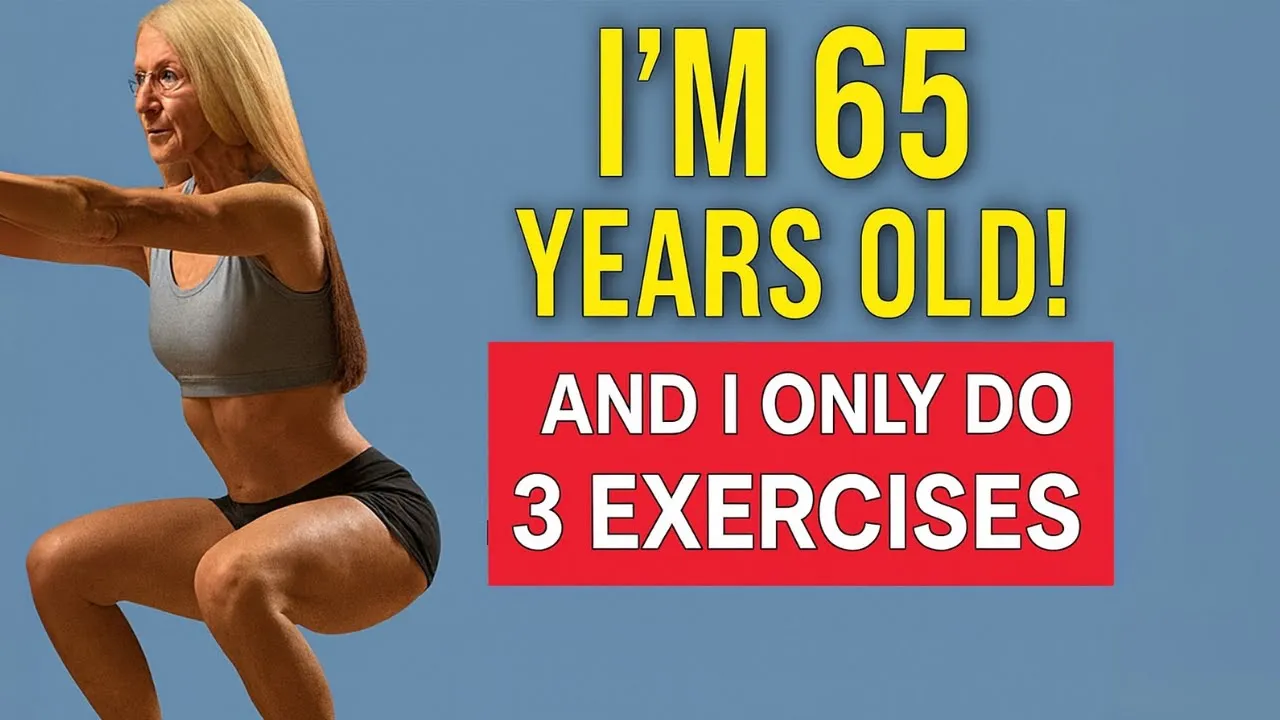
Three exercises that will improve your strength, balance, and circulation in a simple yet powerful way. Number five, the squat. The first exercise is the squat.
It's considered the king of movements because it strengthens almost all of your leg muscles at once. Quadriceps, glutes, hamstrings, and even your lower back. After age 60, muscle loss called sarcopenia accelerates rapidly and leg muscles are the first to be affected.
That's why many seniors take short steps, walk slowly, and need to use support to stand up from a chair. The squat directly combats this problem, bringing back strength, stability, and firmness. If you've never exercised before, you might feel afraid or think your knees won't handle it.
But don't worry, squats can and should be adapted to your level. In the beginning, hold on to a sturdy chair, a heavy table, or even a strong door handle. Push your hips back as if sitting down.
Slightly bend your knees and then return to the starting position. Inhale as you lower. Exhale as you rise.
Keep the movements short and gentle. Over time, increase your range of motion until your knees are bending close to 90°. If that still feels uncomfortable, there's an excellent alternative, the invisible chair.
Lean your back against a wall and slide down until it feels like you're sitting in an imaginary chair. Hold the position for 15 seconds. As the weeks go by, increase to 20, 30, and even 60 seconds.
This is an isometric exercise, meaning it strengthens muscles without impact, making it safe even for people with knee pain. Another great variation is the sit and stand movement. Sit on a sturdy chair.
Cross your arms in front of your chest and slowly stand up. Then sit back down in a controlled motion. It may seem simple, but it's extremely effective.
The ideal starting point is 10 repetitions every other day, increasing to 20 reps. You don't need more than that. Within a few weeks, you'll notice it becomes easier to get out of bed, climb stairs, and even walk.
The squat is the exercise that maintains your independence because strong legs mean freedom. Number four, balance exercises. The second exercise is focused on balance.
You may have never stopped to think about it, but balance is one of the most important factors for your independence. It's what allows you to walk without fear, climb stairs without holding on to everything, cross the street without worrying about tripping, or simply move around your home with confidence. When balance begins to fail, insecurity takes over.
A person starts avoiding walking alone, declines invitations to go out, stops going on walks, and little by little, their life becomes more and more limited. And all of that could be prevented with a simple balance training routine. As the years go by, the body loses not only muscle strength, but also response agility.
This means that if you trip on a rug or slip on a wet floor, your reflexes to recover are slower and a fall occurs. That's where balance training comes in. It teaches your brain and nervous system to react faster, strengthens stabilizing muscles, and brings back a sense of safety.
Many experts say that training your balance is like updating your body's software. The hardware, your muscles, and bones need to be strong, but if the system that controls them doesn't respond well, the whole system fails. The basic exercise is simple.
Stand on one leg. It sounds easy, but give it a try and you'll see the challenge. Stand near a wall in a corner of the room or hold lightly onto a sturdy chair.
Lift one leg, keep the other firmly on the ground, and extend your arms to help with stability. The initial goal is to hold this position for 30 seconds. Then switch legs and repeat.
You'll probably notice that one leg is easier than the other. That's totally normal as the body always has a stronger side. With practice, both sides will balance out.
As you progress, aim for one minute on each leg. Once you're feeling confident, try closing your eyes. And here's the trick.
When we close our eyes, the body loses one of its main balance references, vision. In that moment, your muscles, joints, and nervous system have to work together much more intensely. That's why this version is so challenging.
But never do it without safety. Always stay close to a wall or sturdy furniture. Another excellent variation is the three-point exercise.
Stand on one leg and with the other leg, lightly touch the ground in front of you, then to the side and then behind you. Repeat this cycle several times, always maintaining your balance. This exercise is powerful because it not only challenges your stability, but also strengthens your hips and glutes, muscles that are essential for steady walking.
The ideal frequency is to practice at least twice a week. It doesn't need to be every day because balance also develops with recovery intervals. The important thing is to stay consistent.
Picture yourself in a few weeks standing for 1 minute on each leg without support with upright posture and calm breathing. That means more confidence to cross streets, climb stairs, and move around without fear. And here's a detail many people forget.
Training balance doesn't just strengthen the body, it strengthens the brain, too. Research from Stanford University has shown that older adults who practice balance exercises regularly have better memory, greater mental clarity, and a lower risk of dementia. That's because these exercises stimulate communication between the brain, muscles, and joints, activating brain areas related to coordination and cognition.
In other words, when you practice this simple movement, you're protecting not just your body, but also your mind. Number three, strong calves. The third exercise is for your calves, and it might be the most underrated of them all.
Few people talk about it, but the calf muscle has a special nickname among doctors and physical therapists. It's called the second heart of the body. That's because every time you contract your calf, it acts like a pump that pushes blood back up from your legs to your heart.
Without this movement, blood tends to pull in the lower limbs, causing swelling, pain, varicose veins, and in more serious cases, even thrombosis. Now, think about this. After age 60, how often during the day do you actually activate your calf muscles?
Many people spend hours sitting, watching TV, or scrolling on their phone. And when they get up, they already feel like their legs are heavy, as if they were carrying sandbags. That heaviness isn't just fatigue.
It's a sign that blood isn't circulating properly. And if circulation isn't working well, the risk of blood clots increases, which can turn into thrombosis or even pulmonary embolism, extremely dangerous conditions. But the good news is that there's a very simple movement capable of activating this natural pump and bringing life back to your legs.
The calf raise. It's easy, quick, and can be done every day. Just stand up, support yourself on a chair or sturdy table, and lift your heels to stand on your toes.
Then lower down slowly. Repeat the movement several times. At first, 10 to 15 reps are enough, but the goal is to reach 20, 30, or even 50 reps per day.
This is the kind of exercise that can and should be practiced daily. The heart doesn't stop. And since the calf is your second heart, it shouldn't rest too much either.
If you want to increase the difficulty, try the single leg version. Hold on to something for balance and lift your heels using only one leg at a time. This variation requires more strength but also delivers faster results.
Another option is to perform the movement on a step. Place only the balls of your feet on the edge, letting your heels hang off. Lower your heels until you feel a stretch.
Then raise up as high as possible. This version increases the range of motion and strengthens the muscles even more. And don't think the benefit is just cosmetic.
Sure, firmer calves give your legs a younger, healthier look, but the biggest benefit is in your health. By strengthening this area, you improve circulation, reduce swelling, prevent varicose veins, and greatly lower the risk of vascular complications. In addition, strong calves boost your stamina for walking longer distances.
If you feel like you get tired quickly, this exercise can help change that. Medical research shows that seniors who regularly do calf exercises are able to walk more with less pain and less fatigue. That means more daily freedom.
Being able to go for a walk, visit friends, do your own shopping, or even travel without relying on others. That's what we're aiming for. Maintaining independence and the confidence to live life to the fullest.
Another important point is that strong calves help protect your ankles. When the calves are strong, they provide more stability, reducing the chances of sprains and imbalance. Remember, many falls don't happen because someone slipped, but because their ankle couldn't support the body at the right moment.
By strengthening your calves, you're also strengthening your foundation of support. Now, I want to propose a simple challenge. Every time you get up from a chair, do 10 calf raises before walking away.
It may seem like a small effort, but throughout the day that can add up to 50, 100, or even more repetitions. This habit is powerful because it turns an ordinary movement into a health boosting exercise. And if you spend a lot of time sitting, here's a valuable tip.
Even while seated, you can work your calves. Just keep your feet flat on the floor and lift your heels repeatedly, like tapping your toes to the rhythm of music. This movement keeps blood circulating and helps reduce the risk of swelling.
It's simple but very effective, especially on cold days or when you can't leave the house. But let me emphasize something. This exercise needs to be done every day.
Unlike squats, which can be done every other day, or balance training, which only needs to be practiced twice a week, calf exercises require daily stimulation. That's because circulation can't stop. Your heart beats every day without rest.
and your calves as your second heart also need to be activated daily to fulfill their function. Think of your veins as tubes that need to stay clean and active. Every time you rise onto your toes, you're helping blood circulate, preventing it from becoming stagnant.
And when blood doesn't stagnate, you drastically reduce the risk of clots and serious complications. It's a simple exercise, but one that can literally save your life. So, don't wait.
Start today. Stand up. Support yourself on a sturdy chair and do 10 calf raises.
Tomorrow, do 15. After a week, do 20. In a short time, you'll notice your legs feeling lighter, your steps more stable, and your body more energized.
That's the power of strong calves. Number two, hip raises. Now that you're familiar with the three pillars, squats, balance exercises, and calf strengthening, it's time to think about how to organize these movements into a practical routine you can follow without difficulty.
The great advantage is that you don't need to do them all on the same day. You can alternate, change the order, and adjust according to your energy levels. The most important thing is to stay consistent because your body responds to what you do repeatedly.
Squats are more physically demanding, so I recommend doing them every other day. This gives your muscles time to recover and grow stronger. Balance exercises don't need to be daily.
Two or three times a week is enough for your body to adapt and become more stable. On the other hand, calf strengthening should be done every day since its primary function is to keep circulation active, working as a second heart. If you organize your routine this way, you already have a powerful structure.
But I want to go further. I want to add a fourth exercise that perfectly complements the trio, the hip raise, also known as the glute bridge. This exercise is essential because it strengthens the glutes and the lower back.
Areas that are often neglected but are crucial for keeping your posture upright and protecting your spine. After 60, it's common to see people walking hunched over with lower back pain and even having trouble getting out of bed. Much of that happens because the glutes lose strength.
The hip raise is simple, safe, and extremely effective in reversing this problem. To do it, lie on the floor or on a firm surface. Bend your knees and keep your feet flat on the ground.
From this position, lift your hips until your body forms a straight line from shoulders to knees. Hold the position at the top for a few seconds, squeezing your glutes tightly. Then lower down slowly.
Repeat 10 to 15 times. This movement activates the entire posterior chain, strengthening not just your glutes, but also your lower back and even your core muscles. Over time, you can increase the difficulty by holding the top position longer or lifting only one leg at a time.
And why is this exercise so important? Because strong legs mean nothing if you don't have a stable hip to support them. The hips are like the base of a bridge.
If they're weak, the whole body loses stability. By strengthening this area, you improve your posture, reduce back pain, and gain more power for walking and climbing stairs. It's like adding an extra shield of protection to your body.
Research shows that older adults who maintain strong glutes experience less lower back pain, fewer falls, and even better performance in simple tasks like sitting and standing. In other words, hip raises are the perfect complement to squats, balance work, and calf exercises. Together, these four movements form a complete longevity program that can transform your body and your life.
Now, I want you to picture this routine applied in your daily life. Monday, squats and calf raises. Tuesday, balance exercises, calf raises and hip raises.
Wednesday, rest from squats, but calf raises every day. Thursday, squats and hip raises. Friday, balance and calf raises.
Saturday, squats. Sunday, calves and hips. See how simple it is?
In just a few minutes a day, you can effectively work your entire body. And don't think these exercises only benefit your physical body. They also impact your mind and emotions.
Each time you balance for a few more seconds, do more squats, or stand on your toes with more control, your self-confidence grows. This reflects in how you move, how you speak, and even how you face life's challenges. It's like every workout is a personal victory, a reminder that you still can, that your body still responds, and that your age is not a sentence, it's just a number.
Remember, there's no need to rush. The secret isn't training to exhaustion. It's training consistently.
Think of these exercises as bricks you lay each day in building your health. One brick a day might not seem like much, but over months you build a strong, solid, lasting wall. That's how longevity is built with simple habits repeated with discipline.
And if you still feel unsure about starting, here's one last tip. Track your journey. Write down how many repetitions you did today, how many seconds you balanced, and how you felt after the workout.
Next week, compare your results. That kind of progress tracking is one of the greatest motivators because it gives you clear evidence that you're improving. Now that you know these four exercises, squats, balance, calf raises, and hip raises, you have in your hands a complete strengthening and longevity routine.
Number one, side leg raises. We've reached the point where you already have four powerful exercises that strengthen your legs, hips, balance, and circulation. But I want to take it one step further and include a fifth exercise that I consider essential.
Side leg raises. This movement strengthens the muscles of the hips, especially the glutius medius, which is responsible for maintaining stability when we walk. Many falls happen because the hips can't support the body during a step.
That's why training this area is so important. The exercise is simple. Hold onto a sturdy chair or the wall.
Keep one leg firmly on the ground and slowly lift the other leg out to the side without rotating your torso. Hold for a few seconds, then return. Repeat 10 to 15 times on each leg.
At first, it might be hard to lift very high, but don't worry. Range of motion isn't what matters most. What matters is consistency.
Over time, you'll notice you can lift your leg higher and with more control. That extra strength in your hip protects your lower back, improves balance, and makes your walk safer. Now, if we look at the whole picture, squats, balance exercises, calf raises, hip lifts, and side leg raises.
We have a complete longevity program. They work virtually all the critical areas that aging tends to affect. Strength, posture, circulation, and coordination.
It's a real shield against the limitations that tend to appear with time. But here's an essential reminder. It's no use knowing the exercises if you don't do them.
The difference between someone who ages with vitality and someone who loses their independence lies in habit. Don't wait for magical motivation. It comes after action.
Start small, even with just a few reps. The key is building the habit. The human body responds quickly, and in just a few weeks, you'll feel stronger.
have less pain and more energy. And don't think these exercises are only for the body. They're also a way to care for the mind.
Every repetition is a message that you can still improve, still achieve new victories. That sense of progress is powerful. It combats discouragement, anxiety, and even depression, which often show up when people feel they're slowing down in life.
When you realize you can improve through your own efforts, your self-esteem comes alive again. I want you to imagine how things could be a few months from now if you start today. Walking with more stable steps, climbing stairs with more confidence, standing up from a chair with ease, and most of all, living without fear of falling.
That confidence is priceless. It brings back the freedom to leave the house, to go out with friends, to play with your grandchildren, to travel. It's the difference between merely surviving and truly living.
And don't forget, aging is inevitable. But how you age depends on your choices. Choosing to do these exercises means choosing more health, more energy, and more quality of life.
Think of it as a gift you give yourself every day. Just a few minutes, but the benefits last forever. Now, I want to challenge you for the next 30 days.
Practice these exercises consistently. Track your progress. Celebrate every improvement, no matter how small.
At the end of that period, compare how you were before and how you are after. Your body can still respond, your mind can still grow stronger, and your life can still be full of energy. All it takes is one step.
So, get up now. Choose one of these exercises and begin. The future of your health depends on the choices you make today.