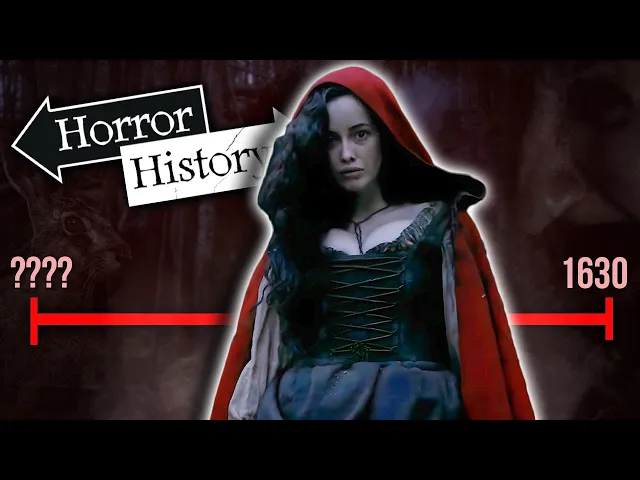
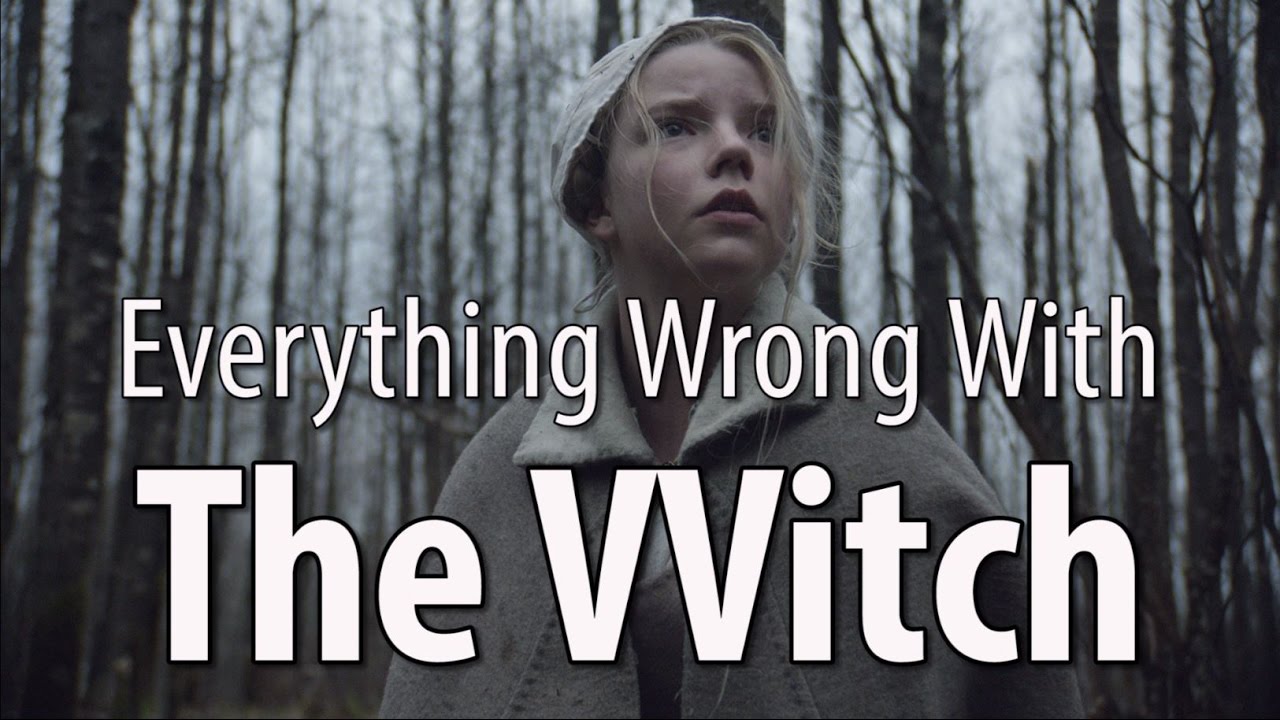
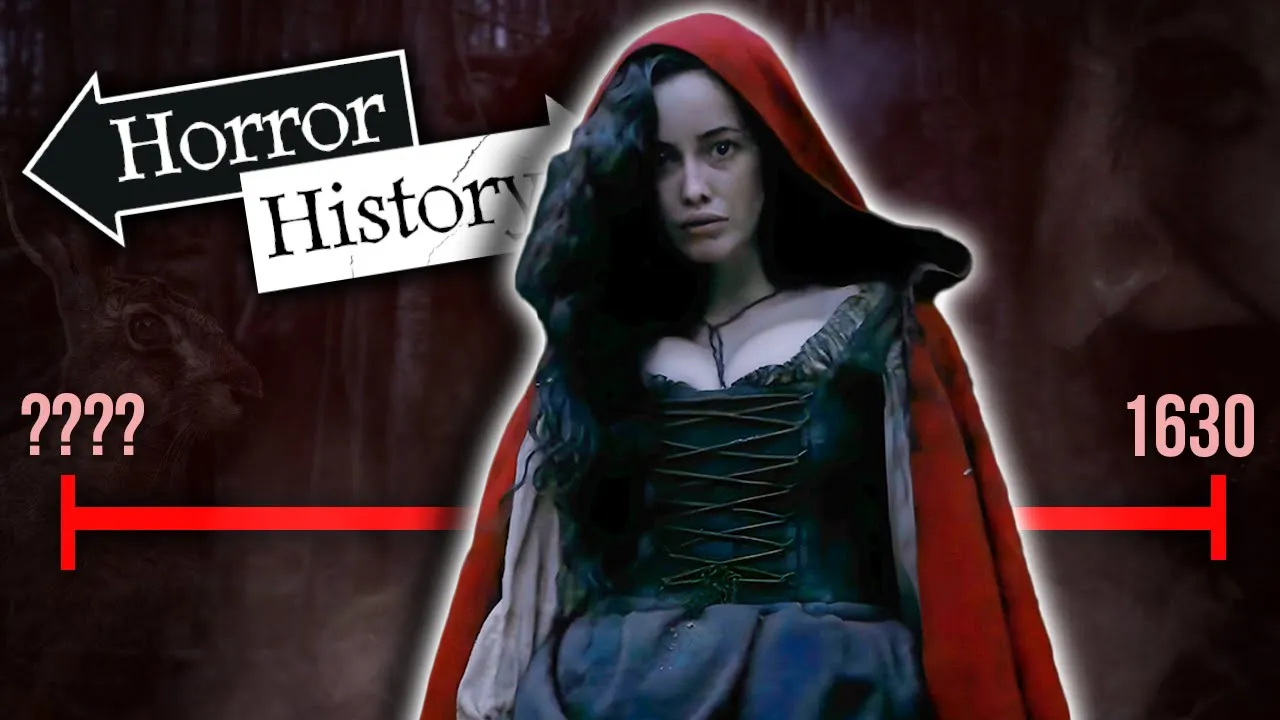
The first time we see The Witch in Robert Eggers The VVitch. She's running through the New England forest in the 1630s, wearing a red cloak and carrying a stolen baby in her arms. She pants and wheezes as she runs and eventually makes it back to her hovel.
There, a now unclothed witch grinds the unbaptized baby into a thick grease that she smears all over her body in her broom. She straddles the broom and lies on her side, and slowly but surely, she begins to levitate and fly towards the moon. An old, nasty woman who steals babies and flies around in a broom.
That's some pretty classic witch stuff. But there's a lot more to this particular witch. She takes on many forms and torments the Puritan family at the center of this New England folktale in a lot of different ways, with the objective of forcing one of them to resign themselves to Satan and join her ever growing coven.
Robert Eggers is a director known for his painstaking attention to detail. and as the final title card suggests, this film was inspired by many folktales, fairy tales, and written accounts of historical witchcraft, including journals, diaries, and court records. There are layers to this wedge, so if you want to learn about everything the witch does, how it connects to European and New England folklore, and how firsthand accounts of witches and witchcraft from the 1600s tied directly into the activity seen in The VVitch, then stick around to the end of this video.
♪ Metal Music ♪ Welcome to Horror History. Today we are discussing The Witch from Robert Eggers movie, the VVitch An New England folktale. Eggers has said in interviews that the aim of the movie was to create a Puritan's nightmare.
He also noted that in researching the film, there was little difference between The Witches described in fairy tales and the writings, diaries, and court records that described witches in witchcraft in the 15 and 16 hundreds. All of this is to say that the Puritans that migrated to New England believed this stuff. Puritans feared witches and witchcraft, and they believed that the new frontier that they faced in the New England wilderness was ripe with this kind of evil.
They believed this, not just because there weren't Christians in this new land before them, but also because they viewed themselves as especially pure Christians that the devil would want to test. The Puritan hysteria around witches is well known. The Salem Witch Trials were the most famous and one of the more bloody examples of this historical hysteria.
Eggers has said publicly that he read a lot of the writings of Cotton Mather, a Puritan clergyman who studied witches and served as an advisor of sorts to the judges that oversaw the Salem Witch Trials. Eggers also studied Elizabethan and Jacobian witch pamphlets from the 1500s. These witch pamphlets were basically the tabloids of the time.
They were sensational accounts of witches and witchcraft that were cheaply printed from wood carvings and spread far and wide throughout Europe. The fact that the movie title uses two V's to form the W in The Witch is a reference to these early wood carvings. But at this point, I've been calling it The VVitch for eight years, and I think I have to stick with it at this point.
The Witch in VVitch is an amalgamation of folklore and everything the Puritans feared about demonic possession and witchcraft from the 1600s. The Puritan family at the center of the story are the perfect marks for The Witch's evil intentions, and she attacks the family without mercy, and with mercy, using every trick in her cauldron to tear the family apart. Let's get into it.
(Impact) -[Thomasin] Boo! There you are. Boo.
Sam? We don't see a lot of the actual witch after the incident with the baby in the broom. In fact, we only get one other glimpse at her near the end.
So no, no, I said we're not doing that meme. There's a lot more to talk about here. We don't see The Witch much in her human form, but her presence, and more specifically, her curse, is felt throughout the entire movie.
The wood and wilderness surrounding it is The Witch's domain. Soon after the disappearance of the baby, Samuel, the father, William, or should I say VVilliam, must turn his attention to the family's survival. Life on the farm is not going well for them.
They don't have food to eat or anything of value to trade. Their corn is rotten, and even the eggs that the hens are laying are cursed. William's oldest daughter, Thomasin, collects an egg from the chicken coop, breaks it open, and inside is a bloody chicken fetus.
It's open to interpretation whether or not The Witch cursed this land or if it was just a difficult winter on the farm. Eggers said in an interview with Slate that the corn was rotten from ergot. Ergot poisoning could cause crawling sensations in the skin, hallucinations and convulsions.
It's suspected that some of the women accused of bewitchment in the Salem Witch Trials were simply experiencing these symptoms of ergot poisoning. Eggers mentions this as a possible reason for some of the family's madness at the end of the movie. For the purposes of this analysis, I'm going to assume that The Witch really does use magic to torment the family, and I think it's pretty clear by the end that this is the case.
But there are moments early on where the film is intentionally vague to potentially mislead the viewer. William realizes that their harvest won't last them through the winter, so he sets off with his son Caleb to the wood to hunt and trap animals. The cursed land drives the family directly into The Witch's domain.
William takes this battle with the land and unbeknownst to him, The Witch personally. -[William] We will conquer this wilderness. -[William] It will not consume us.
Spoiler alert. It does consume them. Later in the woods.
I'm sorry. The Wood. William and Caleb checks their traps, which of course, are empty.
William confesses that he acquired these traps by trading in his wife's precious silver cup. This desperate trade is yet another consequence of living on their cursed land, and it comes back to make the family angry and suspicious of one another later on. Finally, William and Caleb encounter The Witch head on, although they don't know it because The Witch appears to them in the form of a rabbit, or more specifically, a hare.
In European folklore, the connection between witches and hares has to do with the spring equinox. The spring equinox happens around March 21, where the sun rises exactly in the east and sets exactly in the west. Pagan fertility festivals happened around this time because it was believed that when day and night were of equal length, male and female energies were also in balance.
The fertility goddess at the center of this festival was called Eostre, and she was often depicted alongside hares and eggs. The Germans of the 16th century had a little fun with this idea by telling their children that if they were good, a bunny known as the Eostre House would bring them gifts of chocolate and eggs. This, of course, is the origin of the Easter Bunny, which is technically the Easter Hare.
Be sure to bring this up next Easter to annoy everyone in your general vicinity. It is this strong connection between hares and Pagan traditions that led to the association between witches and rabbits. Specifically, the hare's tendency to stand on a hind's legs and cry out like a human arrived suspicion that witches could turn into hares.
People believed that in this form, witches could steal food and destroy crops. William puts the hare in the sights of his rifle, but when he tries to shoot it, the rifle literally backfires and blinds him. Back at the farm, things continue to fall apart.
The twins, Mercy and Jonas sing a very elaborate and creepy song about their favorite goat, Black Phillip. The mother, Katherine, is too busy mourning and working to pay this much mind. I have to say, if you have a set of creepy twins in your family and they start singing about the pet goat ruling the sand and the sea, yeah, maybe get to the bottom of that.
The Witch has the ability to manipulate animals and at some point uses Black Phillip to speak to the young twins and plant seeds of suspicion towards Thomasin being responsible for the chaos that would follow. Down by the brook, we get the first hint that there may be more than one witch in this story. Caleb collects water and sneaks a glance at Thomasin's cleavage.
Shortly thereafter, Mercy is the first to address The Witch situation head on. She claims that she saw a witch in the woods and that it was her who took Samuel. Sensing an opportunity to scare the rowdy Mercy into obedience, Thomasin claims that she was The Witch that took Samuel and that she'll vanish Mercy, too, if she displeases her.
She gets oddly specific. -[Thomasin] I am that very witch. -[Thomasin] When I sleep, my spirit slips away from my body and dances naked with the devil.
Later on, after a fight at the dinner table over the missing silver cup. Thomasin goes to put the farm animals to bed and she sees the same bunny sorry, hare in the barn with the goats. Knowing what we know now about the link between witches and hares this suggests that The Witch is in their presence for everything that would follow.
Later that night, the children overhear their parents planning to send Thomasin to work for another family so they can survive. Caleb doesn't want Thomasin to leave, so he takes matters into his own hands by sneaking off to hunt for food in the woods. That night.
(Impact) ♪ Mysterious Music ♪ As Caleb prepares to go hunt in the night, Thomasin insists that she go along with him. That morning, they encounter The Witch again in the form of the hare. The dog goes bananas and chases the hare deeper into the woods.
Caleb runs after them and Thomasin gets thrown off her horse which also makes a break for it. The Witch lures Caleb deeper into the wood where he discovers his dog torn apart on the ground. The hare leads him into the thick forest and finally he comes across the witch's hovel.
He sees The Witch as a beautiful woman in a red cloak. Against his better judgment, he moves forward. She's probably too old for him.
But when you live on an isolated farm with your family you got to take the shots that you're given. The Witch touches his face, seducing Caleb to go in for a kiss. As soon as their lips touch, the decrepit hand of The Witch grabs the back of his head.
But as far as first kisses go, at least it wasn't as awkward as it could have been. The screen goes black for over 10 seconds. This happens almost every time we see The Witch strike which leaves a lot to the audience's imagination.
The Witch isn't on screen that much and when she is, she's often obscured or in some other form. We're not supposed to fully understand The Witch or what she's doing. And we're left in the dark and forced to use our imagination just like the puritans, which is how these folktales developed in the first place.
That uncertainty and paranoia is part of The Witch's spell, so to speak. It's a weapon that The Witch uses to create chaos and to manipulate those that she's after. Back at the farm, Thomasin has returned home and the family is in shambles.
They fight, they shout, and there's even a slap thrown. Thomasin once again volunteers to put the goats to bed and in doing so, she finds Caleb naked in the rain. Again, we don't see The Witch, but we feel her presence.
The family doesn't know what's wrong with Caleb, but for the first time an adult in the family, Katherine throws out the theory that Caleb has been bewitched. Meanwhile, Thomasin goes into the barn to milk the goats and catches the twins talking to Black Phillip again. Now convinced that Thomasin is a witch, mercy accuses her of bewitching Caleb, which Thomasin denies.
As she goes to milk another goat, she's horrified to find that the animal produces blood. This is another characteristic of a witch. According to Eggers, they steal milk from farm animals, dry it, curdle it, turn it into blood and drink it.
A little later on, Mercy is once again singing a very specific and frightening song about Black Phillip. -[Mercy] Sing bah bah, King Phillip the black. He'll knock thee on thy back!
-[Jonas] Enough! They hear a scream coming from inside and go attend to Caleb. -[Caleb] She's upon me.
-[Caleb] She kneels. -[Caleb] My bowels! My stomach!
She pinches. Scratches. Sin!
Sin! Sin! Before his accusations continue, The Witch seals his mouth shut with some kind of unseen magic.
William forcibly pries the boy's mouth open with a knife, and an apple pops out. The apple is a recognizable symbol of the original sin. It's the fruit that Adam and Eve famously couldn't resist in the Garden of Eden.
But Eggers also said that he found an Elizabethan witch pamphlet that told the story of a witch who gave the children poison apples. This is most likely the origin of the poison apple trope. As this pamphlet predates Snow White.
This apple, incident is the final straw. Katherine is convinced that Caleb has been bewitched, and the Dastardly twins start pointing fingers at Thomasin, having been fooled by the whispers from Black Phillip. They claim that Thomasin took Caleb to the woods and gave his soul to the Devil, making a pact with Satan by signing his book.
The idea of signing the Devil's book comes up multiple times in the story. The myth goes that in order to become a witch and gain the powers of the Devil, one had to sign a covenant with him. During the Salem Witch Trials, if one person testified against another that they had signed the Devil's book, or if somebody was accused of trying to get another to sign it, that was considered hard damning evidence of bewitchment.
William isn't so quick to believe that Thomasin is a witch, so he does the only logical thing. He forces her to say the Lord's Prayer at Caleb's side. This was also a common practice in the days of the Salem Witch Trials.
It was believed that anyone bewitched or possessed by the Devil would be simply unable to recite the Lord's Prayer. This was one of the more common ways that the clergy would test a witch's innocence. Although there was a famous instance of a man named George Burroughs.
Who was suspected to be a wizard and the ringleader of the group of witches in the late 1600s, he was sentenced to death by hanging, and the proceedings were supervised by Cotton Mather himself. George Burroughs shocked the crowd by reciting the Lord's Prayer perfectly with a noose tied around his neck. Some people in the crowd were convinced that Burroughs was innocent and that his life should be spared.
Cotton Mather called it an anomaly and hung him anyways. Back to Caleb. The family begins to recite the Lord's Prayer and to the surprise of everyone except for Thomasin, only the twins seem unable to recite the prayer.
They claim that they've forgotten it and that it's making them ill. This is pretty solid evidence that the twins are possessed but Katherine doesn't want to believe this, so all hell breaks loose. Caleb interrupts the chaos again, claiming that The Witch is back.
Roll it. No, not that clip. Come on.
This clip -[Caleb] A toad. A cat. A crow.
A raven. -[Caleb] A great black dog. A wolf.
-[Caleb] She desires my blood. She sends 'em upon me. This could be interpreted as the real Caleb trying to communicate with his family about The Witch's ability to manipulate animals and this knowledge could prevent them from being accusatory towards each other.
The family prays around Caleb and Caleb prays for himself. This culminates in a last resort prayer that he screams out and it almost resembles the peak of an adult act. If you look at the script, it also makes this comparison.
This is fitting because The Witch initially drew him in by taking advantage of the prepubescent boy's blossoming lust. During this prayer, he accepts the Lord's salvation and dies. Die!
Due to her existing suspicions. Katherine screams at Thomasin unable to see past the idea that she is a witch. This is probably a good time to add a little more context around Puritans and how their specific hysterical brand of faith blurred the lines between folklore and reality eventually leading to paranoia, hysteria and the death of innocent people.
The Puritans left Europe not because they were persecuted but because they thought that they were too pure to live in Europe. If anything, they felt persecuted because they were surrounded by people that weren't as holy as they were. When they came to New England, they brought that same attitude with them.
They felt that the new frontier in the wilderness surrounding them was untouched by people as faithful as them. It was a land where the devil and evil thrived and the proof of their theory was that it was very hard to live there. They weren't suited for it.
When it was too cold to go outside, grow crops or even go to church it was because the devil was testing them not because they'd made a stupid choice, By moving to a cold, unfamiliar wilderness. They felt that they were constantly being tried and tested which we see at the beginning of the movie in William and Caleb's dialogue, they repeatedly stepped on metaphorical rakes and blamed Satan when the handle hit their heads. The family at the center of this movie considered themselves to be too pure for the Puritan plantation that they had been living on in England.
The very first scene of the movie shows them excommunicating themselves from their original home. This is relevant to my analysis of The Witch because her actions in manipulation have shaken the faith of this family. Katherine is distraught and feels that she may never experience the love she knew before Samuel died.
William and Katherine suspect that Thomasin is a witch. Thomasin strongly suspects that the twins are possessed by the devil, not to mention two of the family's five children are dead, which would be enough to test the faith of even the most pure of puritans. Not knowing what else to do, William barricades the twins and Thomasin in the barn with Black Phillip and the other goats.
Katherine decides to sleep outside in the grave that they've dug for Caleb, which I guess is one way to deal with mourning. I think that this represents her emotional death. After losing her two kids, she no longer feels like she can love again.
William chops wood and confesses for his sins. This is how their last night as a family begins, and how their puritan nightmare finally ends, and The Witch that has been haunting them would bring the full force of her evil magic to tear them apart. (Impact) ♪ Mysterious Music ♪ Who knows what happened to Katherine as she slept out in the grave, but when we next see her, she's entering the house through a window.
She sees Caleb holding baby Samuel in his arms, both alive and well. She hugs him, and he whispers to her in a voice that some might find alarm. -[Caleb] Mother.
We have longed to see you so. Caleb has a book that he wants his mother to sign. Katherine is receptive to the idea, but first notices that Samuel seems hungry.
and when she goes to breastfeed him, she seems not to notice that she's actually holding a raven who pecks at her bloody breast. Another example of The Witch's manipulation of animals. When a witch takes the form of a raven dog, rabbit, or most famously, cats, these animals are known as The Witch's familiar.
The Witch would transform into these animals and provide them sustenance by feeding them with the blood that flowed from her nipples. This explains the previous scene. Witches were also thought to have an extra nipple.
This is where the phrase a witch's tit comes from, apparently. Back in the barn, the twins wake up to the sound of heavy breathing and footsteps to see The Witch in her true form sucking the blood from one of the goats. She turns and tackles at the children, who see her face for the first time, drawing screams from Thomasin.
During the night, The Witch possessed Black Phillip to tear apart the barn and kill the twins. Or at least we can assume that's why William wakes up and discovers his barn destroyed. The script includes a detail about Phillip bucking at the barn walls that morning, which further confirms that this is probably what took place.
He barely has a moment to register before old Black Phillip gores him in the stomach with his horns. You may be wondering, why has William been spared up until this point? Well, we can't answer that, definitely, but one reason why women were disproportionately accused of witchcraft was because they were believed to be weaker, both physically and in their faith than men, and that has been true throughout this story.
William has an unwavering faith in God. Thomasin has remained faithful too, despite her family's doubts. This could be why Black Phillip and The Witch went for the rest of the family first.
And this could also explain why William is killed through physical force rather than trying to get him to sign the book. Katherine comes outside and sees the aftermath of all of this, and yet again blames Thomasin, assuming that she must be The Witch because she's the only one left standing and her hands are stained with blood. This time, Katherine takes action and physically attacks Thomasin.
Although this is not spelled out in the movie, the fact that she fed the raven with her breast would imply that she is now bewitched as well. Either way, Thomasin reluctantly fights back. Only when it's clear that her mother is trying to strangle her does she strike back with a rusty bill hook, killing her.
Now, without any family remaining, Thomasin finds herself alone in the wilderness. After seeing what became of the twins, it's fair to say that her own faith is starting to waver, and she decides to try speaking to Black Phillip. After removing her bloody dress, she goes to the barn and asks Black Phillip to speak to her like he did to the twins.
After a long moment of silence, he responds -[Black Phillip] What DOST thou want? He offers her the chance at a decadent lifestyle and the opportunity to see the world. We had previously seen her reminiscing about her time in England, so it makes sense that she'd be enticed by this opportunity.
Of course, it comes at a cost. He's got a book for her to sign as well. -[Black Phillip]DOST thou see a book before thee?
Thomasin removes her clothes, presumably signs the book of the Devil, and follows Black Phillip into the woods, where she discovers a bunch of women chanting around a fire with Black Phillip. They all levitate into the air, and Thomasin, who has just abandoned her faith and modesty joins them, and a new witch is born. It's fitting that the history of The Witch is actually the history of two witches.
The whole purpose of a witch is to cause devastation and to get more people to turn away from God to Satan. This is what happens to Thomasin, and she only succumbs after The Witch takes everything from her. It's fitting that the chaos that followed her sister accusing her of being a witch is what actually drove her to become one in the end.
People told stories about witches, and the Puritans were so paranoid and forlorn in their new worlds that they turned their fears into actual death and destruction in the late 1600s. But The VVitch just scratches the surface of the horrifying occult rituals in A24 films. To get the full picture, you need to check out my analysis of King Paimon From Hereditary, which you can find on the left.
Your homework is to subscribe to CZsWorld for new horrors every week. Ring the Death Bell for all notifications and I'll see you in the next video. Assuming we both survive.